Number of building permits in Cyprus fell in January

IN A PRESS release issued earlier today, the Cyprus Statistical Service (CYSTAT) announced that the number of building permits authorized by the Municipal Authorities and the District Administration Offices during January 2010 was 619, comprising:

  • Residential buildings – 462 permits
  • Non-residential buildings – 86 permits
  • Civil engineering projects – 26 permits
  • Road construction – 3 permits
  • Division of plots of land – 42 permits

Compared to January 2009, the total number of permits issued in January 2010 fell by 10.8%, their value fell by 15.4% and their total area fell by 18%.

Focusing on the permits issued for residential buildings, these provide for the construction of 1,290 dwelling units – 507 single houses and 783 multiple housing units such as apartments. Compared to the January 2009 total of 1,585 dwelling units, this represents a fall of 18.6%.

According to CyStat, building permits constitute a leading indicator of future activity in the construction sector.

Developer swaps shares for property in Cyprus

MEDITERRANEAN resort developer Dolphin Capital Investors (DCI) is offering its shareholders 50% off the price of its luxury holiday homes in return for shares.

The company, which builds across southeast Europe and owns Cypriot developer Aristo, says the ‘shares for assets’ scheme will allow it to buy back shares at a significant discount because its properties are currently worth much less than the equivalent shares. The firm hopes this will help drive up demand for the shares and therefore their value.

The scheme was first trialled last May, when 39 Aristo properties with a total cost value of €4.2 million and with a total sales value of $8.8 million were exchanged for 9.3 million shares valued at €23.4 million.

The company was very pleased with the first ‘test-run’ of this programme because it proved that this pioneering scheme that was never used by any listed company before, works,” said Michael Tsirikos, chief operating officer for Dolphin Capital Partners (investment manager to DCI).

The company’s directors have decided on the principle that the SfA programme will be re-launched in the future and potentially on a larger scale, given the very positive effect of the pilot scheme for the company and the feedback that we got from our shareholders,” he told OPP.

DCI has also launched a programme to sell the company’s off-plan show villas to its shareholders at cost price, as long as they own shares of an equivalent market value. This will allow the firm to build show villas without the need for additional capital.

Falling value

The announcement was made as part of the firm’s full year results, which also showed the company’s net asset value (NAV) as €1.343 billion, representing a decrease of €67 million (4.7%) from 30 September 2009 due to operating losses and falling property values. The results said the firm had no bank debt at company level and no or very limited bank debt on 11 out of 13 major projects.

Dolphin’s portfolio is spread over 63 million square metres of coastal developable land and includes 13 large-scale residential resorts under development in Greece, Cyprus, Croatia, Turkey, Panama and the Dominican Republic. It also has more than 60 smaller holiday home projects through Aristo in Cyprus and Greece.

Cyprus property market tarnished by London protest

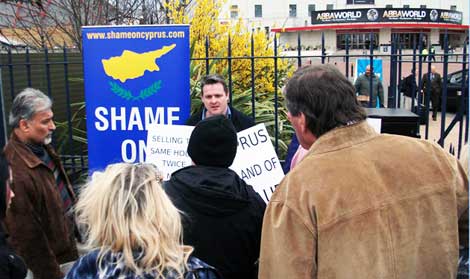
Conor O'Dwyer's protest
Conor O'Dwyer talking to potential Cyprus property buyers at Earls Court

TENS of thousands of prospective home-buyers were greeted with placards reading ‘Shame on Cyprus’ at the gates of a property exhibition in London over the weekend.

The signs were part of a high-profile campaign organised by Conor O’Dwyer who is embroiled in a lengthy legal battle with local developers.

His colourful protest, camped at the main entrance to Earls Court, was staged during the two-day A Place in the Sun show, an event designed to help people get onto the overseas property ladder.

The show was organised in conjunction with the popular Channel Four television programme, which draws millions of viewers every week.

Over 200 exhibitors, representing more than 40 countries worldwide witnessed the highly visible stand set up by O’Dwyer.

Despite objections from local property developers – many of whom were left fuming, O’Dwyer said he was allowed to stage the protest with the blessing of the Metropolitan police.

Greek Cypriot property developers came out of Earls Court on masse, they were furious with me. Some took photos; it was worrying because I had my children there. Some even said they would take me to court.

At first they wanted the stand to be taken down, but after I explained my situation, some of them expressed sympathy and one developer even offered to help, but many were not happy,” he said.

Thousands of property dealers and customers from Spain, France, Bulgaria, Turkey, Greece, Portugal, Italy and the USA were greeted by the protest, with many stopping to discover what was happening.

It needs sorting out,” insists property analyst Nigel Howarth, “This has been going on for far too long. His case is high profile and who can even begin to calculate the damage by the negative press?

O’Dwyer claims he purchased a house in the eastern village of Frenaros in 2005 that was then was resold without his knowledge by the developers.

The developers have dismissed the accusations and accused O’Dwyer of attempting to extort a more expensive house from them.

This is not the first time O’Dwyer has taken his campaign to the streets, two years-ago he held a protest outside the Cyprus High Commission in London.

O’Dwyer slept in a tent and spent his day updating his website and talking to passers-by, including, he said, potential British property buyers for Cyprus.

Ministers to examine property tax in Cyprus

AT 16:00 today the Finance Minister, Charilaos Stavrakis, and the Interior Minister, Neoclis Silikiotis, plan to meet to examine how state revenues may be increased by adjusting property taxes.

When the Cyprus Government announced its plans in January, the Association of Cyprus Tourist Enterprises, STEK, and the Cyprus Hotel Association, PASYXE, opposed the proposals as they would cause their industries financial problems: “this move will hit the hotel industry as hotel units will be required to pay much higher taxes; 10-15 times more than under he current system”.

Cyprus’ immovable property tax is calculated on the market value of the property as at 1st January 1980 and is paid annually the Inland Revenue Department.

Cyprus Immovable Property Tax tableAccording to a report in the Greek language “Politis” newspaper, the meeting will deal with the results of the survey undertaken by the Land Registry and will examine alternative scenarios on how to increase state revenues without affecting small-medium land and property owners.

Cyprus legal system has reached crisis point

IT HAS been suggested that property buyers in Cyprus who have problems with their developer can seek recourse through the island’s judicial system.

One high-profile case involving an alleged assault is still being heard by a court more than a year after proceedings started. It has required one of the prosecution witnesses to travel from the UK to Cyprus several times to give evidence. A few weeks ago, the judge pronounced that the defendants had a case to answer. Their trial continues.

An article in this weeks issue of the Cyprus Weekly examines the Island’s judicial system.

Outdated judicial system blamed for blowout in court cases

DELAYS in the island’s justice system are said to have reached a crisis point, with criminal and civil trials often taking up to five years to reach the courts.

Sotiris Argyrou, a Nicosia based lawyer and former police officer, said the Cyprus justice system had become prone to lengthy delays partly due to an overload of cases reaching the courts.

This is something that the government must acknowledge. We urgently need more positions for judges to be created in order to cope with the constant flow of cases that are coming in,” said Argyrou.

The lawyer explained that the mounting backlog was also directly related to the type of cases the courts accept and a lack in preparation of legal applications.

Speaking as a criminal lawyer, I can say that the police do not always take the legal responsibility they should and will often refer cases for prosecution before they are fully ready.

He added that the delays had several negative consequences that could result in some cases not going to trial or not being sufficiently prepared before they go to court.

On some occasions witness testimony is not properly evaluated be forehand and often these cases will be thrown out.

“It’s sometimes said that judges are not putting in the required hours to deal with all the court cases, but I don’t believe this is true. Judges will often spend their free time working on cases.

Delays in the hearing of cases not only create concern within the legal circuit, but are also a headache for many citizens who become involved in the court system.

Another Nicosia based lawyer, who asked to remain anonymous, strongly attacked the island’s legal system for its sluggish dealing of civil cases.

We have a situation now where the cases that are currently being processed in court date back to 2002 and 2003. This is a chronic problem that will not go away unless significant changes are made.

According to the law professional, the delays are due to a number of factors including rising crime, a shortage of courtrooms but, most importantly, slack administration in the island’s legal system.

He explained that due to poor management some cases were destined to be unnecessarily lengthy, creating a general blow-out in waiting times.

There are currently some very complex cases on trial which should not have gone to court in the first place.

“When hundreds of witnesses are called on to give testimony, the court is obliged to hear all of them and in some instances it’s later decided that there wasn’t a case to start with.

Using the UK as an example, the lawyer noted that delays had been greatly alleviated by giving judges a more active role in deciding which cases go to court. This combined with designated teams that study how cases can be processed more quickly have eased the delays, he said.

This is something we are desperately lacking in Cyprus especially as new pressures have been created with an increase in crime and the fact that our justice system, which has changed very little since the 1950s, cannot cope with this.

He added that with the European-wide evolution of the justice system, a number of factors were inherently causing mountains of red tape.

These include defendants being more aware of their rights and their entitlement to state legal representation.

When appeals are made and then granted they take time to be processed and can clog the court system with paperwork that in some cases is unnecessary,” the lawyer said.

With the huge backlog of cases currently overburdening the justice system, there is also great pressure on everyone involved to process their work as quickly as possible.

Hasty work, however, can lead to mistakes and when dealing with criminal cases in particular these errors can have serious consequences,” the lawyer warned.

“Excessive delays in the administration of justice are a significant danger for the rule of law”

Disy deputy and Chairman of the Council of Europe (COE) Human Rights Committee Christos Pourgourides agreed that the island’s civil procedure legislation was unsuitable for today’s needs.

There are many factors that lead to undue delays in the justice system but largely our outdated justice system is to blame. The courts, for example, grant postponements far too easily and this understandably causes great delays.

According to Pourgourides, bailiffs in Cyprus must still hand- deliver court summons to citizens when in most other European countries summons are simply mailed to their home addresses.

Issues such as these accumulate causing red tape and endless delays, but also our judicial system is largely failed by lack of proper training, management and insight.

“In Britain there are a small number of lawyers in proportion to the population so out of necessity they gain great experience through handling a high turnout of cases.”

In Cyprus, however, we have the reverse situation, a very small population and a vast number of lawyers.

“Often, a lawyer with seven years work experience in Cyprus may not have handled any cases in court which is where the real experience lies.

Despite wide recognition that court cases must be concluded within reasonable time limits, the island’s justice system is struggling to cope as is evident by the vast number of complaints that are brought before the European Court of Human Rights.

As European convention states, all citizens have the right to be brought promptly before a judicial authority and are entitled to a trial within a reasonable time.

justice delayed is justice denied

Pourgourides referred to the well known legal cliché ‘justice delayed is justice denied’

This is exactly why we have all these cases being scrutinised by the ECHR,” said Pourgourides. “Excessive delays in the administration of justice are a significant danger for the rule of law.

The human rights watchdog said that a reform of the judicial system was the only sure way to alleviate the delays.

We have so many petty cases which end up going to court when they should not.

The obvious solution is to evaluate the cost of these cases and prioritise them accordingly by allocating time for more deserving cases.

Delays will inevitably be caused when cases are not dealt with quickly and efficiently and when this happens we risk losing public confidence in our justice system.

However, because of demographic factors, updating Cyprus’ justice system is arguably easier than changing systems in other larger countries, Pourgourides said.

Because of our small population and general high level of public education, with the correct reform across the court systems we can easily fix or at least shorten the huge delays we face.

By Paul Malaos

The Loch Ness monster in Cyprus

EARLIER this month we reported that the Interior Ministry had submitted a new draft law to Parliament which is designed to open the doors to European estate agents wishing to practice in Cyprus.

This draft law resulted from a European Union inquiry into the Cyprus laws governing real estate agents and was designed to bring it into line with the Acquis Communautaire.

In an article in the current issue of the Cyprus Weekly, Antonis Loizou FRICS refers to the new legislation as being a Monster in the Making:

The Loch Ness monster in Cyprus

The estate agents law is again under attack from the European Union and a new proposal prepared by the government has been submitted for approval to the House.

We have written in the Greek press as well as to the government and MPs that this new legislation is a Monster in the Making. It is a Monster because it differentiates between local and foreign estate agents by using different criteria. Our basic objections are as follows:

  • In order for a person to become an estate agent in Cyprus and in addition to having a university degree on a related subject, the applicant must work for 12 months in Cyprus under a registered estate agent and then sit exams on Cyprus legislation. In contrast, foreign estate agents can operate in Cyprus with only a high school requirement and experience in the business for a total of two years of 10 years work experience in their own country.
    We wonder why those with a degree must sit exams and why such a requirement does not exist in any other profession in Cyprus. We also question the reason behind this and more importantly the difference between the local and foreign estate agent (in this sense any foreigner who is a permanent resident in Cyprus is considered as being a local one).
  • The new proposal suggests that each office must be manned by a registered estate agent. As such a firm which has four offices, must have one registered estate agent in each office. This means that the larger offices will close down and all agents to become one man one firm. We say this proposal will return the agents to the pre law conditions, called “agents on a bicycle”.
  • A foreign estate agent can work in Cyprus if he has the appropriate professional qualifications from their own country without any other requirement. If, however, a local has exactly the same qualifications of the same foreign country, this is not enough, he still has to work for 12 months, sit exams, etc.
  • All agents are responsible to disclose any impediments, permits etc that affect a property. But how are they to know since only the registered owner has access to the authority’s records?
  • No estate agent can sell his property or that of his relatives (up to third degree) and no estate agent can sell property of a company etc for which he has an interest (e.g. shares in a company). What a load of rubbish, since this means that an agent cannot sell his own relatives’ property and even if the agent owns 1% of a company’s shares, e.g. the Bank of Cyprus, he is excluded from any work from the bank etc, etc.
  • The council’s inspector can enter an estate agent’s office, without a court warrant and collect any documents, computers, records etc, for examination! A police state without requirement of a court order and with no other profession having such a proviso.
  • Property developers may not advertise or sell their own properties!

For our part it is all out war, not so much against the proposal per se, but war against the stupidity if nothing else.

Are we then wrong in saying that a Cyprus Monsters in the Making? (Nessie would be jealous).

By Antonis Loizou FRICS
Antonis Loizou & Associates Ltd
Property Valuers & Property Consultants

www.aloizou.com.cy
[email protected]