Recovery plan for struggling Britons in Cyprus

recovery scheme offers hope for struggling Britons in Cyprus
Many Britons buying property in Cyprus are struggling to repay their mortgages

THE DREAM of owning a place in the sun has turned into a nightmare for Brits struggling to meet mortgage payments on a property that has sunk in value. But a new UK-based scheme claims it has a solution which could allow owners to bail out without incurring the penalties of repossession and negative equity.

It’s the brainchild of financial services group Marcus James which has just launched the Recovery scheme in Cyprus. For a fee of £495 an owner places a property with the company which then finds a new investor to “adopt” the property and take over the mortgage payments for an upfront fee of £5,000. The property is, in effect, sold – or rather transferred – for the price of the outstanding mortgage.

Owners lose their original deposits plus any money they’ve spent on their homes. But Tony Barker from Marcus James says many are prepared to do so to escape the financial burden. “I’ve met so many people who just want to wash their hands of the whole thing. They want to cut their losses and walk away from a property which has become such a burden.

How does it work? The company claims to have unofficial agreements with local banks in Cyprus, allowing a third party – the new investor – to take over mortgage payments on a property. The Title Deeds are transferred, but held by the company’s local lawyer and in the event of any default, the contract is withdrawn.

Banks and developers in Cyprus are keen to support the Recovery scheme,” says Mr Barker, “the banks to avoid significant default, and developers to keep the market as buoyant as possible.

But there are serious questions to ask about the scheme, says Nick Hopkinson, a director of Property Portfolio Rescue. “Isn’t the scheme just getting new investors into the same problems as the original buyers but on a different timescale? Even if deposits are supposedly ‘gifted’, where is the proof that the property assets were ever worth what was claimed?

Mr Hopkinson says that anyone thinking of buying property overseas needs to be aware of the risks. People could end up with a rapidly decreasing asset but still need to meet the mortgage payments which could soar if interest rates rise.

Overseas property purchases have other risks as well, he adds. “Every country has inherent legal ownership, political, currency, tax, property management and economic risks. I doubt whether the original buyers were properly informed of these risks and question whether any buyers being sold a ‘distressed bargain’ will be informed either.

For example, the lack of a Title Deed could prevent the sale of a property. Some 130,000 properties in Cyprus are without Title Deeds. “It can take about 12 years to get the Land Registry to issue a Title Deed,” says Nigel Howarth of Cyprus Property News, “and until that time you often have no autonomy to sell.” One of the reasons Title Deeds are so elusive is that the land itself may be mortgaged by the developer. In Cyprus “corruption is endemic“, claims Mr Howarth. “A number of property lawyers are in the pockets of the developers and won’t have told you that the land is already mortgaged, so denying you Title.

Chris Eracleous, an independent financial adviser from Daveriye Mortgage Solutions in Cyprus says there is an issue regarding the sales of property on land which itself is mortgaged. “But it’s always been general practice for banks to retain a portion of off-plan sales to pay off the initial mortgage on the land. Problems arose when values started soaring and the smaller developers were able to remortgage on the strength of that. Regulations have become stricter.

Mr Howarth is wary of schemes that specialise in taking advantage of “distressed sellers”. “They may have made the decision to purchase in haste. They need to avoid making an equally poor decision when selling their properties.” He stresses the need for buyers to talk to their banks. “They may be able to take a payment holiday or restructure the loan. They should also be looking for long-term rentals.

Marcus James Group hopes to roll its scheme out in other parts of Europe, notably Spain. With strict legislation governing such financial transactions this may be a tall order. Says Mr Barker: “I’m aware that it’s a breach of a mortgage agreement, but such difficult times need drastic measures.

What’s in it for the buyer? The principal appeal of Recovery is that no deposit is needed, aside from the £5,000 fee, with a mortgage already in place.

But the apparent ease of taking over a mortgage shouldn’t be the reason to buy a property abroad, says Nick Hopkinson of Property Portfolio Rescue. “Without local, expert advice and deep reserves of cash it is foolhardy for an investor to just take a punt because someone is pitching it,” he warns.

Copyright 2009 Independent News and Media Limited

Steps to speed Cyprus Title Deeds issue flop

ACCORDING to a confidential letter from the Cyprus Interior Minister Charilaos Stavrakis to President Christofias, the forecast that this year’s deficit will reach 7 percent of GDP is optimistic.

In his letter, details of which were published by Stockwatch, the Finance Minister analysed the “alarming” condition of Cyprus’ public finances and sounded alarm bells for the future of the island’s economy if no measures are taken.

If no steps are taken to improve economic situation, the Finance Minister predicts that the deficit will reach 7% in 2010 and will rise to 10% by 2013 – and the public debt will rocket to 80%.

In his letter to the President, the Minister analysed a series of failed initiatives taken in 2009 to address the situation that resulted in pushing the deficit higher – and admitted that the target for collecting €50 million by accelerating the issue of Title Deeds had not added a single Euro to the state’s coffers.

New EU anti-fraud and corruption system launched

CORRUPTION AND FRAUD can now be reported via the Internet, even anonymously: A new electronic system – “Fraud Notification System” (FNS) – will make it easier and more secure for vigilant citizens and European Union civil servants to report suspicious cases to the European Anti-Fraud Office (OLAF).

The new system went online at the beginning of the month and may be accessed via the OLAF website at http://ec.europa.eu/anti_fraud/contact_us/index_en.html

Acting OLAF Director-General, Nicholas Ilett, said that “Citizens and business people frequently ask us how they should go about reporting suspected fraud involving EU funds to us,” adding that “from time to time we also hear from EU civil servants who, despite all the legal guarantees, are cautious about approaching us directly about cases where they suspect corruption is going on”.

Our new Fraud Notification System should help everybody. First it offers informants a simple user-friendly interface. Second it gives people the opportunity to submit information to OLAF anonymously but nevertheless to enter into a dialogue with our investigators”, explained Mr Ilett.

OLAF has been receiving tip-offs from across Europe via freephone numbers and e-mail for several years.

The new Fraud Notification System extends this service and employs the latest technical safeguards to guarantee informants absolute anonymity while enabling them to enter into dialogue with OLAF investigators if they so wish. No one, either inside or outside OLAF, can discover the identity of anyone who has opted to remain anonymous. The system operates like a ‘blind’ letterbox where both parties can drop off messages.

During a pilot phase the Fraud Notification System is available in English, French, German and Dutch. However, reports can be entered on the online form in any EU language. All the information received by OLAF is carefully examined and professionally scrutinised before it is decided whether or not to initiate an investigation.

Even during a test phase, several tip-offs were communicated via the new system and some of them led to further investigation.

The Fraud Notification System is accessible via OLAF’s website at http://ec.europa.eu/anti_fraud/contact_us/index_en.html

Cyprus property market speculators lose out

NEWS about the property scams in Cyprus has been reported in GlobalPost, a Boston-based international news service. During the following video report Nicole Itano speaks to Hazel May.

Hazel and her husband Bob came to Cyprus on holiday and fell in love. Eight years ago they sold their house in the UK and bought one in Pyla. But their dream of retiring in the sun rapidly turned into a nightmare.

They soon discovered that their house had been built illegally; without the proper permits. Worse, the man who built it and sold it to them took out hundreds of thousands of Euros mortgages on the land with the Hellenic bank. He was jailed for fraud but has now been freed and is continuing to build illegally and defraud other unsuspecting buyers in the Pyla area.

Because Hazel & Bob’s house was built without the proper permits, an order has been issued for its demolition. The bank has got a court order enabling them to sell Hazel and Bob’s home to recover the developer’s debt.

The Mays are trapped; she has cancer they want to sell the house and downsize. But with all the problems and the developer’s outstanding debts, they cannot get a Title Deed.

Lakis Tofarides, president of the Cyprus Land & Building Developers Association, blames buyers who have not done their homework. “If the property contract has been properly drawn and deposited with the Government, they (property buyers) would have nothing to worry about”.

Perhaps Mr Tofarides could explain why things went so badly wrong in Hazel and Bob’s case? The May’s instructed a lawyer, Maria Souroullas, to act on their behalf. She drew up a contract that was signed by all parties and subsequently deposited it at the Land Registry. According to Mr Tofarides the Mays “would have nothing to worry about”. Clearly Mr Tofarides is badly mistaken!

[youtube=http://www.youtube.com/watch?v=CJuwM8921Ns&w=470]

Fast facts

Investia Property Consultants – introduced the Mays to the property

Ms Maria Souroullas – the lawyer who acted on behalf of the Mays during their purchase.

Antonis Theophanous – the developer who built the Mays house and subsequently imprisoned for fraud, but who is allowed to continue building illegally and defrauding other unsuspecting buyers.

Can Cyprus benefit from the Irish experience?

THE RECENT Eurobarometer 2009 survey covering the member states confirms what many have always suspected, namely that corruption may be endemic in Cyprus.

Part of the EU summary states: ‘However, in eight Member States, including Greece, Bulgaria, and Cyprus, there is almost universal agreement that corruption is a national problem’.

Recent media reports suggest that Greece has been lying to the EU over its national finances for years, behaviour which now threatens the very stability of the Euro; and Bulgaria has reportedly previously lost €520m in EU funding due to corruption and fraud in that country. Now Cyprus is ranked alongside these countries by its own citizens.

Paradoxically, the EU anti-corruption organisation, Group States Against Corruption (GRECO), during its ongoing evaluation of corruption in Cyprus ‘was repeatedly told that corruption is not a big problem in Cyprus as there are very few cases’.

In the Eurobarometer survey, 94 per cent of Cypriots agreed that corruption is a major problem in their country, with 82 per cent agreeing that corruption is unavoidable in Cyprus and has always existed, and with the police, politicians, public officials and the judicial service taking a beating, amongst others.

Transparency International defines corruption as ‘the abuse of power for private gain’, and the Bribe Payers Index 2008 states that ‘construction, real estate, oil and gas sectors are most prone to corruption’. Given that oil and gas do not yet figure in Cyprus, one can see where this leaves us and may very well account for the current scam-ridden mess in the property sector which the government refuses so far to address.

The boom years for property in Cyprus occurred after its accession to the EU, driven mainly by foreign buyers expecting the perceived protection which EU membership should have provided – how wrong they were!

Even though the government has now been fully briefed, rather than attempting to properly regulate the industry for the benefit of all, it seems content to try to mislead the EU with this ill-conceived and widely condemned amnesty legislation, only needed because of the State’s failure or refusal to enforce the laws designed to protect property buyers in the first place. Whilst the main area of complaint to the EU i.e. developers’ mortgages on buyers’ properties, is being swept under the carpet, because there is no apparent solution.

Reportedly, developers’ mortgage outstandings grew 107 per cent between March 2008 and March 2009 to €5.9bn. Since then, it has been further reported that the banks have been caught by the Central Bank trying to hide developers’ failure to service these debts by dishing out even more money and extending the loan periods. However, these banks are content in the knowledge that the buyers are unwittingly the ultimate guarantors of much of this orgy of unethical lending.

In the Republic, with the highest interest rates in Europe and little or no income due to the collapsed market, developers are now starting to go bust and the banks pushing them into receivership, in order to recover their loans. The banks have also recently raised their provisions for bad debts, with for example Bank of Cyprus seeing an increase of 536 per cent over last year. Additionally, as part of the unfolding crisis in Greece, the Financial Mirror reports that Alpha Bank and Piraeus Bank have already had their credit ratings downgraded.

In Cyprus, developers have previously sold properties which now years later still have mortgages on them. In order to service these mortgages, they will have to sell even more properties, and many of these new properties will also have mortgages on them. Currently, there must be tens of thousands of unsold and unfinished buildings with mortgages on them, most built specifically for the overseas buyer market.

With the current economic slump in countries such as the UK and Russia this will be extremely difficult, especially so as more and more potential buyers are warned of the deception of Cypriot developers in this respect.

Accordingly, we are heading to a situation where this developer debt could be toxic debt very soon, debt unable to be serviced and the collateral properties unable to be sold off by the banks.

There is a solution – not a pleasant solution but a solution nevertheless – and something the Cyprus Property Action Group raised with the Minister of the Interior some months ago. Namely, that Cyprus should adopt the same approach as the Irish government, which was faced with the spectre of massive toxic debt in the banking system, due to the Irish banks’ reckless lending to their developers to the tune of around €80bn; on properties which have since seen their asset values’ plummet and remain largely unsold.

The newly established National Asset Management Agency (NAMA), an Irish Treasury agency, has started to buy developer debt at only 70 per cent of the book value – so this is not a bailout for the banks. The developers will not be forgiven any debts, as NAMA has more power than the banks to seize and sell-off properties in the event of developer default – so this is not a bailout for the developers.

And this is not a burden on the taxpayer, as NAMA plans to make a profit on its activities which are expected to take 10 years to complete. The EU has also sanctioned the programme.

Remember also that in Cyprus the state could bring in huge amounts of Title Deed transfer tax to mitigate against any potential losses. However, it also has to be said that in Cyprus the existing mortgages on previously sold properties have to be factored in. Currently, in this land of secrecy no one will declare how many of these properties are encumbered and to what value.

Clearly, funding will have to be raised on the international markets for such a venture, but the longer the government dithers the greater the amount to be raised due to developers’ ongoing failure to service debts. At the same time, the lower Cyprus’s credit rating sinks the greater the premium will be on any funding.

Lack of any tangible action in the coming months could see the Cyprus property market severely damaged for the foreseeable future, something which is not in any of our interests.

Whether the government of Cyprus could be allowed to take such decisive action by the vested interests which got us into this mess remains to be seen.

Cyprus Property Action Group

Price cuts fail to attract foreigners to Cyprus

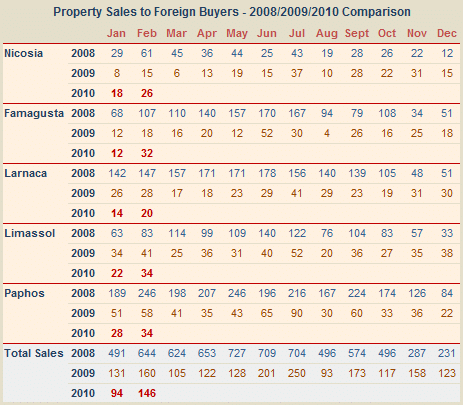
THE LATEST figures from the Department of Lands and Surveys show that 146 property contracts for foreign buyers were deposited last month compared with 160 a year ago. Foreign sales in February were down 9% on the same period in 2009.

Although property sales in Nicosia rose by 73%, it is unlikely that this was due to overseas investors as it is not an area favoured by expatriate second home buyers.

In all but one of the investment hotspots the decline is continuing, but at a slower rate than reported last month. Sales in Larnaca were down 29%, in Limassol they fell by 17%, and in Paphos (where some developers have been offering 30% discounts and other incentives) they were down by 41%.

Sales in Famagusta rose 78% compared with a year ago, but this may be due to British expats who can no longer afford their mortgage repayments selling to ‘vulture funds’ and individual investors who are picking up distressed property at rock bottom prices.

Sales of Cyprus property to foreigners February 2010
Property Sales to Foreign Buyers (Source: Department of Lands and Surveys)

Keeping up with their mortgage repayments is a particular problem for those who took Swiss Franc mortgages with Cypriot banks. Attracted by the low CHF interest rates, they been hit very badly by the Sterling/CHF exchange rate. At the start of 2007 a Pound Sterling would buy 2.39 Swiss Francs; today it will buy you around 1.61 Swiss Francs.

And there is another problem for buyers who took out mortgages with banks in Cyprus. When they signed their agreements, the interest was typically set at a Base Rate of 2% plus the monthly LIBOR Rate. But although the LIBOR Rate has dropped in recent months, helping to offset the negative impact of the fall in Sterling, many Cyprus banks have increased their Base Rate due to the increase cost of borrowing money. As a consequence some buyers find themselves having to pay almost twice as much than they budgeted for when they bought their property.

Negative publicity about the problems associated with buying property in Cyprus and government inaction continue to headline in the UK press.

The Interior Minister promised that new legislation to deal with the Title Deed problem would be ready by the end of 2008. But this statement, like similar vacuous statements made by his predecessors, proved to be nothing more than hot air.

However, in July 2009 the Interior Minister proposed legislation designed to deal with the Title Deed problem and invited comments from interested parties. But the proposals were criticised by many, including the Cyprus Bar Association who rejected them saying that they would “lead us into a labyrinth without solving the problem”. The government is continuing to work on legislation to resolve the problem, allegedly.

A recent High Court ruling in London that the Orams must demolish their villa in the occupied area of Cyprus and give back the land to the original owner has confused many potential buyers and put them off buying property on the Island.