Home Blog Page 632

Cyprus home buyers turn to Lords for Title Deed aid

THE BRITISH House of Lords is seeking answers as to why UK home buyers in Cyprus are still waiting for their title deeds and wants to know whether the British government intends to pressure Nicosia on the issue.

Answers to the two questions tabled by Lord Jones of Cheltenham are expected in the coming week.

The development is a victory for British home buyers in bringing attention to the plight of those who have not yet received the title deeds to their properties.

The average wait for title deeds in Cyprus is 10-15 years, and there are around 100,000 home owners still waiting, 30,000 of whom are foreigners.

British buyers in Cyprus recently began a campaign, writing directly to Prime Minister Gordon Brown and to their MPs expressing their worries.

And, the global crisis has added extra urgency to the issue. Home buyers are now worried sick over what might happen if property developers are unable to withstand the crisis.

Cypriot buyers are also worried, they say and plan to take their long-standing but less vociferous campaign up a notch in view of what is happening globally.

The current climate increases the possibility that some developers may go under,” he said. “I can’t imagine the repercussions,” said George Strovolides, president of the Cyprus Land and Property Owners’ Association, known as KSIA.

According to Denis O’Hare who leads the Cyprus Property Action Group (CPAG) developers in Cyprus currently have record mortgages of over €4 billion using their clients’ homes as collateral.

O’Hare said people had a right to know what would happen to them in a worst-case scenario.

Stating that it has not happened in the past has no bearing whatsoever on these real risks,” he said. “If the vendor has a mortgage on the property, the lending institution has rights which supersede the buyer’s.

Cypriot property developers said last week that going public about the possibility of companies collapsing was alarmist.

But Lakis Tofarides, the chairman of the Land and Building Developers Association did admit that over the past 10 months, there had been a “discernible and worsening” fall in demand for real estate.

That real estate was holding its own despite the credit crunch was down to a set of circumstances particular to Cyprus, “which nevertheless should not be taken for granted” he said.

Copyright © Cyprus Mail 2008

Sales of coastal property in Cyprus slump 40 per cent

ACCORDING to a report in today’s Cyprus Mail, there has been a significant slump in sales of property in the coastal areas of the island. The worst hit areas are Paphos, Paralimni and Protaras although Limassol and Larnaca are also feeling the effect.


Property sales in coastal areas have dropped up to 40 per cent as a result of flagging demand from foreign buyers, though prices are generally stable, estate agents said yesterday.

There is a big decrease in demand, especially from outside and especially from the British market, who are our traditional customers,” said Solon Kourouklides, chairman of real estate agents.

Speaking on state radio CyBC, Kourouklides said the coastal areas of Paralimni and Protaras were experiencing a 40 per cent drop in demand, as was Paphos, while Limassol and Larnaca have seen a 25 to 27 per cent fall.

The Capital Nicosia only has a five per cent share in property demand from foreigners so any drop there was due to declining domestic demand, Kourouklides said.

Regarding prices, generally speaking they are stable with one exception – coastal areas where there are organised projects specially targeting foreigners,” he said.

To attract customers, developers there do not charge VAT, or give away for free furniture, domestic appliances, or air-conditioning and central heating systems.

Kourouklides said many developers were having cash flow problems and could not secure bank loans to finish their projects because banks were asking them to cover a high percentage of the total cost.

In many cases, they ask for 50 per cent.

Banks are also demanding a 40 per cent deposit from foreign buyers now, whereas it used to be between 20 and 30 per cent.

Many deals have been cancelled due to the lack of cash flow, Kourouklides said.

He warned that there would be great pressure on property prices if the cash flow problem persisted in the New Year and banks asked for high percentages.

Copyright © Cyprus Mail 2008

Free top tips guide on buying property in Cyprus

My property buying guide Buying a Home in Cyprus: A Practical Guide to Successful Real Estate Purchase now has a brand new supplement, which is available completely free of charge.

Its 40 pages are filled with my ‘Top Tips’ for home seekers and investors thinking about buying property in Cyprus. Its aim is to set you on the right path to a trouble-free purchase by helping you to identify the potential risks and avoid making costly mistakes.

My Top Tips guide includes sections on:

  • General advice for all home buyers and property investors.
  • Buying off-plan property.
  • Buying resale property.
  • Finding property for sale.
  • Buying property as an investment.
  • Financing your purchase.
  • Planning to make your permanent home in Cyprus.
  • Title Deeds.
  • Places to find further information, resources and advice.

To register to receive your copy of my Top Tips Guide completely free of charge, click here.

“My personal experiences of buying property in Cyprus have been very positive – and I know many people who have also had positive experiences. I hope my Top Tips guide helps to set you on the same road to a trouble-free purchase.”

Nigel Howarth
Editor: Cyprus Property Magazine

Property problems: Questions raised in the House of Lords

NEWS of the many problems being experienced by British citizens who have bought property in Cyprus has reached the ears of the UK Government.

Yesterday, Lord Jones of Cheltenham tabled two questions in the House of Lords. Replies to both questions are due by 27th November:

  • To ask Her Majesty’s Government what advice they are offering to United Kingdom citizens who have bought property in Cyprus but have not received their title deeds.
  • To ask Her Majesty’s Government whether they will make representations to the government of Cyprus over the practice of allowing developers to use title deeds of completed houses as collateral for future loans, with reference to Article 23 of the Constitution of the Republic of Cyprus.

These questions, which require a written answer, will be passed to the responsible Government department.

For those who wish to follow the progress of these questions, their references are HL6385 and HL6386 respectively and can be found on the House of Lords website.


Biographical note

A Gloucestershire County Councillor from 1989, Nigel Jones was Member of Parliament for Cheltenham from 1992 until he stepped down at the 2005 general election.

On January 28, 2000, deranged constituent Robert Ashman attacked Jones and his assistant, local councillor Andrew Pennington, with a samurai sword. Pennington was killed, and Jones was severely injured.

On 13 May 2005 it was announced that Nigel Jones would be created a life peer, and the peerage was created on 20 June 2005 as Baron Jones of Cheltenham, of Cheltenham in the County of Gloucestershire.

Property market slowdown

ACCORDING to figures just released by the Cyprus Land Registry Department, the number of property sale notes during the period January – October 2008 reduced by 24.2% compared to the same period last year. While the number of notes in October fell by a massive 50.2% compared with October 2007.

Property sale notes show the activity recorded in the property market as these notes refer primarily to new property without an ownership title (Title Deed). This is a further indication that the Cyprus property market showing signs of fatigue and that a further slowdown is underway as local economic growth slows.

Chairman of the Land and Building Developers Association, Lakis Tofarides, was upbeat about the market’s future.

Cyprus property has not been affected, at least not to a significant degree, with the possible exception of second home sales in the coastal areas,” he said – but he went on to admit that over the past 10 months, there had been a “discernible and worsening” fall in demand for real estate.

According to Tofarides at the moment “there is no reason to panic” and fears that Cyprus might suffer a similar fate to America’s shattered property market were entirely unfounded, he added.

And although a small drop in real estate prices was inevitable, “nothing dramatic” was on the cards.

Tofarides said the major problem facing the property sector is the imposition of 15% VAT on property from 2004, which led to a dramatic increase in prices and generated millions in added revenue for the state in the form of taxation, which is now set to turn around.

For example, for a house costing €120,000 in 1999, the transfer fee was €4,270. Today, the same property would cost €400,000, with the transfer fee going up to €25,300.

Come next year, when the VAT will go up further, the state will end up harvesting up to 30% on the sale of a house… that’s ridiculous,” said Tofarides. Another source of grievance hindering the growth of the property sector is red tape and the threat of new VAT on land deals.

Tofarides acknowledged that banks’ current lack of liquidity was a problem, which is why the developers want the government to issue bonds to pump liquidity into the banks to be given as loans for property purchase.

Our sector employs some 45,000 people, and has a turnover of €2 billion contributing 20% of GDP. Every year, the state rakes in some €500 million from the property sector. Now imagine what would happen if real estate entered a slump and our revenues were cut in half,” said Tofarides.

Cyprus property: long term investment rating

MANY overseas investors buy property in Cyprus believing that they will make substantial profits if they buy “off plan” and then sell on once the development is finished. (Off plan is where a property being bought is at the planning stage and has yet to be built).

In one marketing brochure, investors were told that they “only have to invest 30% of the selling price, then the property is put back on the market before the next 60% is due and the property is sold at retail price.” This scheme (or should I say scam) predicted that investors would realise a 78% return on their investment in 9-12 months.

Needless to say the investors, who bought more than 1,500 of these properties, soon found out that they’d been duped. The days of “buying and flipping” in Cyprus are long gone!

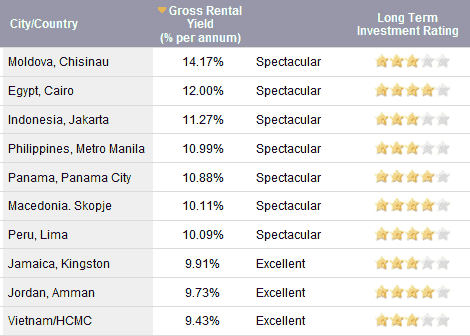
The long-term investment rating and prospects for Cyprus are also looking very shaky. On the 11th November, the influential Global Property Guide published its Country Investment Ratings for 69 locations around the world.

At the top of the list is Chisinau in Moldova with a “Spectacular” gross rental yield of 14.17% and a long term investment rating of 3 stars.

Long term investment rating top 10 countries

Languishing near the bottom of the list at position 65 out of 69 is Limassol in Cyprus with a “Very Poor” gross rental yield of 3.45% and a long term investment rating of 1 star.

Long term investment ratings bottom 10 countries

The Global Property Guide long term investment rating is based on many factors:

  • Gross rental yield
  • Income tax
  • Capital gains tax
  • Round-trip transaction costs
  • Potential landlord and tenant problems
  • Long-term GDP growth
  • Potential over-supply
  • Affordability
  • A view of long-term appeal to investors