

As revealed earlier today by the Greek language Phileleftheros, the new bill to address the many problems of jointly-owned buildings does very little to address the single biggest headache for management committees – owners who simply refuse to pay their communal fees.
Under the new bill, nothing prevents an owner from ignoring their communal fee obligations for years, continuing to live in the property, even passing it on in their will – with no consequences until the property is sold.
In situations where the owner rents the property, their tenant can pay the communal fees to the management committee and take that amount off their rent they pay to the owner.
In cases where the owner doesn’t rent the property, the only option left to Management Committees remains the courts, a route so costly and slow that it offers no solution to the immediate need for the communal fees required to insure, maintain and manage the building.
What’s in the new jointly-owned buildings bill?
The proposed law, which has already undergone revisions, introduces a framework for the proper management, inspection, and maintenance of jointly-owned buildings. Interior Minister Konstantinos Ioannou has sent a formal letter to the committee, which will resume discussions on on the subject this Thursday.
One of the key provisions enables management committees to commission structural, mechanical, and electrical inspections by qualified professionals registered with the Cyprus Scientific and Technical Chamber (ETEK).
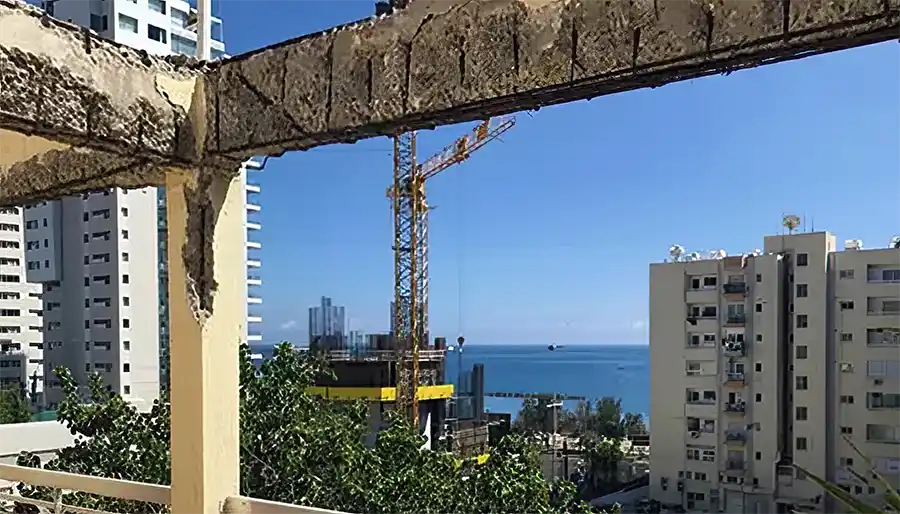
The absence of such inspections in the past has left many buildings – particularly older apartment blocks – vulnerable to neglect, with balconies collapsing and walls deteriorating (as shown in the photo above.) If approved, owners and residents will, for the first time, gain a clear picture of the structural soundness of their homes.
Jointly-owned buildings inspection & maintenance opportunity missed
A controversial amendment removed the requirement for regular mandatory inspections, which would have guaranteed consistent upkeep. Instead, inspections will now be at the discretion of each management committee and dependent on available funds. The minister, however, indicated that the provision might be reinstated in a future amendment of the existing Streets and Buildings Law.
Meanwhile, the bill requires management committees to set up a reserve (sinking) fund for unplanned repairs and maintenance work.
Financial obligations for owners
Under the new law, owners will contribute to:
- Heating costs: covering fuel, maintenance, and repairs of central heating systems (where applicable).
- Communal fees: including cleaning staff salaries, cleaning supplies, lift maintenance, electricity and water for shared areas, decoration, sewage emptying, and other related expenses.
- Other expenses: insurance, general repairs, plumbing, electrical installations, insulation works, and environmental upgrades.
Tackling non-payment of communal fees
The most significant source of disputes in jointly-owned buildings is the non-payment of communal fees. The bill introduces a measure that prevents the sale of a property if the owner has not settled outstanding charges. Management committees will be authorised to issue certificates confirming payment, removing obstacles to property transfers – provided no other debts remain.
Legal review and technical improvements
The revised draft has passed legal review by the Attorney General, confirming no constitutional or legal barriers. Several technical enhancements have also been incorporated, including:
- Clear definitions for GDPR compliance, management companies, and the register of owners.
- Appointment of district self-governing authorities as responsible bodies.
- Introduction of mediation procedures for disputes between owners and committees.
- New provisions on fire safety systems and personal data protection.
Why this matters
As the Attorney General highlighted, the bill is crucial to address long-standing shortcomings in the management of jointly-owned buildings. Many properties have suffered from poor or non-existent maintenance, with serious safety risks for residents and the public.
But while the new bill appears to be a step in the right direction, it fails to address some of the problems with jointly-owned buildings; mandatory safety inspections & maintenance have been ruled out – and the most critical issue, non-payment of communal fees, has yet to be fully resolved.

I agree with David Simpson. The failure by the new law to addresses the issue of non-payment of maintenance fees is, indeed, ludicrous. We formed a management committee shortly after taking possession of our properties and try our best to do things properly.
Many of the features in the new legislation do not worry us as we put in place a maintenance fund from the outset, we also have insurance in place and do not fear the prospect of registering our committee or the possibly being subject to inspection visits.
We do however operate on a tight budget so cash flow is all important. The arrangements currently in the new law are of little use to us. The fact that a bank has repossessed a number of properties and are not currently contributing towards our maintenance fund is exacerbating the situation.
Lyn Hill
Lynn – in some newer complexes the situation has been exacerbated by the fact that a large number of the units were purchased by foreign investors simply to obtain a European passport.
These owners don’t pay the communal charges (or local municipal charges etc) which means the complex cannot keep up with maintenance or improvements – the new legislation requiring a “sinking fund” (which we brought into our complex about 10 years ago) is simply not going to happen.
Just cannot understand why existing owners committees were not given the opportunity to discuss the issues with the government or at least offer some suggestions…!
There’s a Association of Cyprus Condominium Managers (SYDIKOIK), which consists of 40 building management companies. They’ve had meetings with TPTB, but is seems their suggestions have been ignored.
Ludicrous not to address the enormous issue of non payment – everything we do as an Owners Committee depends on money so what is the point of legislation saying we have to maintain the property if the owners can get away without paying. Yet another “fudging” of the most important point.
The committee needs some teeth to force owners into contributing – it’s getting worse with absent owners who bought simply for passports etc and increasingly we see owners buying simply to screw as much as they can out of the property with AirBnB etc.
From the summary above, there appears to be very little significant change to the existing law on jointly owned property. (Is there an English translation available of the new bill?)
I doubt we’ll get an English translation of the revised bill until it’s passed by Parliament.
But I did translate the initial draft of the bill as proposed in 2023 – Click here to view and download.
But I’m sure much will change.