

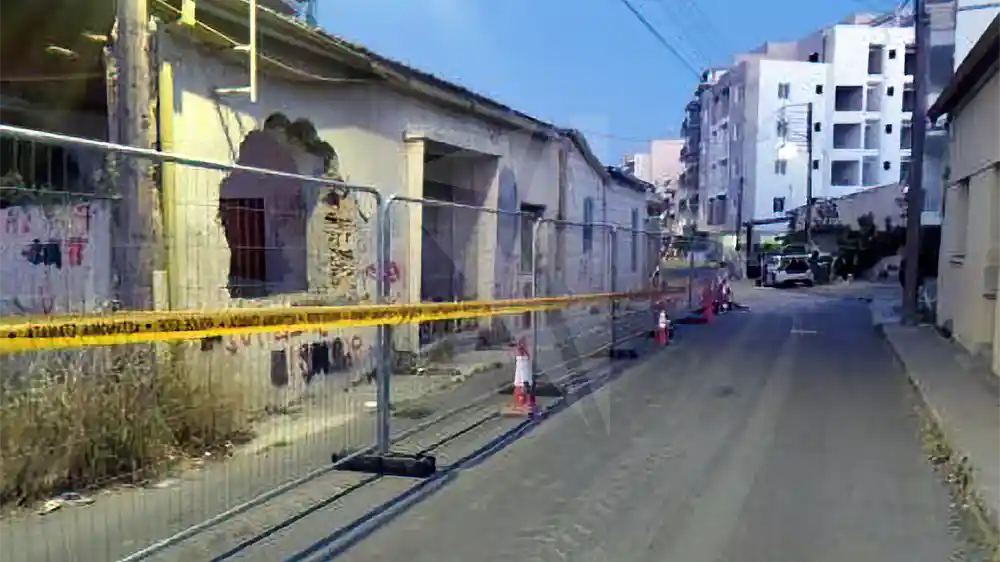
The Larnaca District Local Government Organisation (DGLO) is stepping up its efforts to make dangerous buildings safe, with hundreds of properties across the district now assessed.
So far, 335 buildings have been classed as dangerous. Of these, 189 are considered the highest risk and are being dealt with first, the DGLO said.
One recent example was an abandoned building on Stavrodromiou Street in Larnaca. After repeated interventions by the DGLO, the owner paid to have it demolished, removing a hazard that had concerned local residents for some time.
The DGLO says similar action has been taken in Larnaca and Tersefanou. Some demolitions followed partial collapses; others came after residents raised concerns or inspectors visited the properties.
In each case, the owners covered the cost following repeated notices and intervention by the DGLO. The demolitions show that the work is moving beyond identifying and assessing risky buildings to dealing with them on the ground, helping protect residents and neighbouring properties.
More than 1,100 possibly dangerous buildings in Larnaca
The DGLO took responsibility for dangerous buildings on 1 April 2025, inheriting records of 563 properties thought to pose a risk. Since then, it has updated its records, carried out site visits and received reports from residents, municipalities and local communities. Its register now includes 1,101 buildings that may be dangerous.
To speed up assessments, the it brought in specialist private-sector civil engineers. They have been commissioned to carry out 378 visual inspections and have submitted 372 technical reports. So far, 335 buildings have been classed as dangerous, including 189 in the highest-risk category.
It has also taken steps to reduce risks. These include putting up barriers and other safety measures, work carried out by owners, and demolitions. Seventeen buildings have been formally declared dangerous, while action on a further 22 is well advanced.
Owners responsible for building safety
The DGLO has reminded property owners that they are responsible for maintaining their buildings and dealing with any safety risks.
When owners act, the it says that it will work with them to make their properties safe as quickly as possible. If they do not comply and the danger remains, the DGLO says it will use the powers available under the law, including procedures that could lead to demolition. It will continue to prioritise the buildings considered most dangerous.
Its aim is to ensure that no building formally deemed dangerous is left without the necessary safety measures indefinitely. Public safety, it says, cannot be put on hold.
(Adapted from an article published by StockWatch)
