

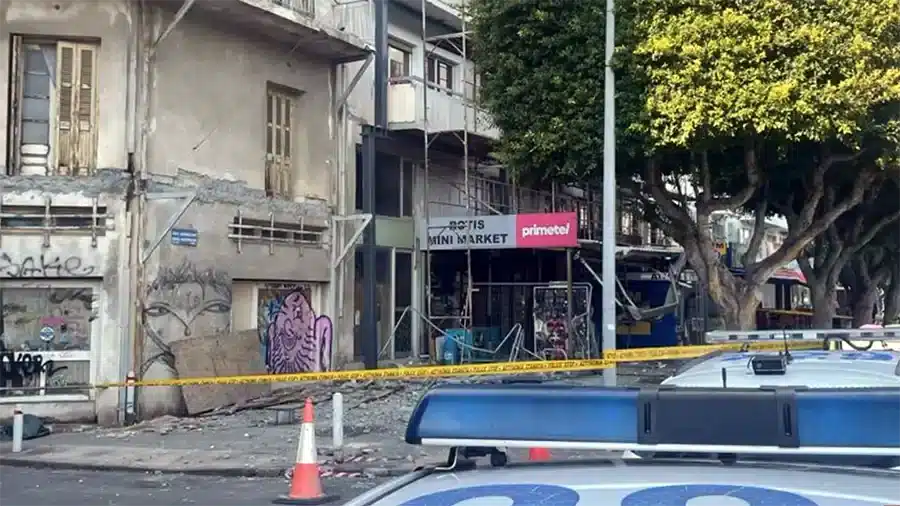
Cyprus’ ageing buildings are becoming a major property and infrastructure challenge, according to Platonas Stylianou, First Vice President of ETEK and President of the European Council of Civil Engineers (ECCE).
Speaking to the Cyprus News Agency, Stylianou said recent deadly earthquakes in Venezuela highlight the importance of earthquake safety in countries at risk of seismic activity. He noted that high death tolls are often caused not only by the strength of an earthquake but also by weak or poorly maintained buildings.
Newer buildings are safer
Buildings constructed in Cyprus after 2012 offer strong earthquake protection because they were designed under mandatory European standards known as Eurocodes.
Buildings built between 1994 and 2011 also perform much better during earthquakes than those built before 1994, when modern earthquake-resistant standards were not fully in place.
Although Cyprus experiences major earthquakes only occasionally, it remains in a seismically active region. The last significant earthquake occurred in 1996, but stronger events remain possible.
Stylianou stressed the need to follow seismic regulations, carry out regular inspections and maintain buildings properly.
He added that no building can be guaranteed to remain undamaged in a major earthquake. The main goal of engineering standards is to protect lives and prevent building collapse.
Older buildings need attention
Many buildings in Cyprus were built before 1994 and do not meet modern seismic standards.
Stylianou said these properties need special attention because ageing can weaken structures over time. Factors such as corrosion, weather exposure, poor maintenance and unauthorised alterations can reduce a building’s strength.
The problem is especially serious in coastal areas, where salt and harsh environmental conditions can speed up deterioration.
“The ageing of the building stock is one of the greatest challenges Cyprus faces today,” he said.
Call for regular inspections
ETEK is calling for a national policy requiring regular building inspections, assessments and maintenance.
Priority should be given to public buildings, schools, hospitals, apartment blocks and other structures used by large numbers of people.
Stylianou said ETEK has repeatedly submitted proposals to Parliament and government ministers and has organised seminars and published guidance on the issue.
The organisation hopes new legislation will be approved soon. It argues that identifying structural problems early and carrying out timely repairs is the most effective way to protect both buildings and lives.
Drawing on international experience, Stylianou said that earthquake-related deaths are often caused by building failures rather than the earthquake itself.
He concluded that prevention, expert assessments, regular inspections and ongoing maintenance are the best ways for Cyprus to prepare for future earthquakes and protect its ageing buildings.
