Serious decline in construction sector continues

THE NUMBER of building permits issued in September stood at 422 compared with the 604 issued in September 2012; a fall of 30%, according to figures released earlier this week by the Cyprus Statistical Service.

Compared with September 2012, the total area of these permits fell 46% to 63,022 square metres from 116,257, while their value fell 48% to €70,430 million from €135,145 million.

During September, building permits were issued for:

  • Residential buildings – 291 permits
  • Non-residential buildings – 77 permits
  • Civil engineering projects – 18 permits
  • Division of plots of land – 31 permits
  • Road construction – 5 permits

During the first eight months of 2013 a total of 3,993 building permits were authorised; a drop of 26% compared with the 5,365 permits issued during the same period last year. Their total value has fallen by 27% and their total area by 31%.

New home construction

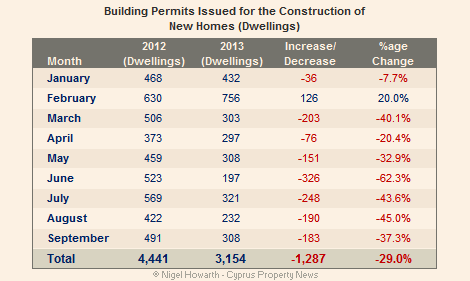
The 291 residential building permits approved in September provided for the construction of 308 new homes comprising 132 single houses and 176 multiple housing units (such as apartments and other residential complexes).

This is a fall of 37% compared with September 2012 when building permits were issued for the construction of 491 new homes.

During the first nine months of 2013, the number of new homes for which permits were authorised has fallen by 29% compared with the same period last year.

Cyprus new home construction

According to the Cyprus Statistical Service, building permits constitute a leading indicator of future activity in the construction sector.

Property sales slump slows

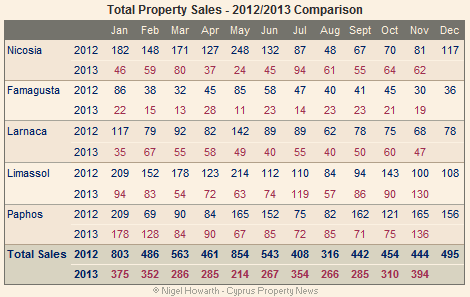
LATEST figures from the Department of Lands and Surveys reveal that a total of 394 contracts for the sale of property were deposited at Land Registry offices across the island during November compared with the 444 deposited in November 2012; a fall of 11%.

This monthly fall is considerably lower than those experienced in previous months and could be a sign that the slump in sales is slowing down.

Of those 444 contracts 76% (298) were deposited on behalf of domestic buyers, while 24% (96) were deposited in favour of overseas buyers.

Sales fell in all districts. Famagusta was the hardest hit with sales dropping by 37%. Sales in Larnaca fell by 31% and those in Limassol by 30%, while sales in Nicosia and Paphos fell by 24% and 18% respectively.

Cyprus property sales (total) November 2013During the first eleven months of 2013, total sales are down 41% compared to the same period last year having fallen to 3,388 from 5,774.

Domestic sales

Domestic sales during November were up 10% compared with November last year, having increased to 298 from 292, resulting from increased sales in Limassol and Paphos of 39% and 9% respectively.

However sales in Larnaca fell by 26% and those in Nicosia by 15%.

Domestic property sales November 2013During the first eleven months of 2013, domestic sales have decreased by 44% compared to the same period last year falling to 2,484 from 4,470.

(Note the anomalies with the Department of Lands and Surveys November 2012 figures for Famagusta.)

Overseas sales

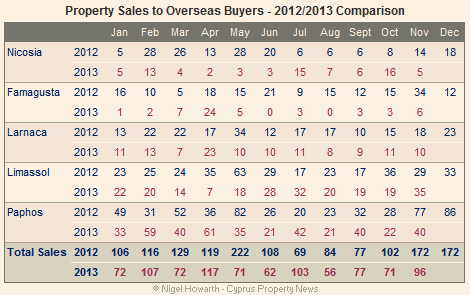
Sales to the overseas market fell sharply in November compared with November last year, having fallen to 96 from 172 (-44%). Although sales in Limassol increased 35 from the 29 recorded in November 2012 (+21%), sales fell in all other districts.

Famagusta was hardest hit with sales falling 82% compared with November last year, while sales in Nicosia fell 64%. Sales were also down in Paphos and Larnaca, falling by 48% and 44% respectively.

Overseas property sales November 2013During the first eleven months of 2013, property sales to the overseas market have slumped 31% compared to the same period last year falling to 904 from 1,304.

Stricter procedures for granting loans

rejected loan applicationSTOCKWATCH today published a draft directive from the Central Bank of Cyprus that will introduce much stricter procedures for the granting of loans.

Although the Directive is still being discussed, it is clear that the Central Bank intends to correct the ‘idiosyncrasies’ in the lending practices of the banks by ensuring that they become professional and diligent when granting loans.

The basic philosophy of the draft Directive is that lending has to be based on a borrower’s ability to repay a loan rather on collateral as highlighted in the Pimco report.

Banks will now have to consider the income of borrowers and loan repayments should not 35% of the monthly income of private borrowers or their estimated monthly savings.

For a loan to purchase a first home, the loan should not exceed 80% of the property’s value and for other properties the loan should not exceed 70%.

Private borrowers will have to provide a wealth of information, including confirmation of their employment, originals of the last quarter’s wages/salary payment slips, bank statements, income tax certificates, certificates of tax payments for the last two years and other documents.

For loans in a currency that is different to the borrower’s income, credit institutions will be required to provide borrowers with adequate information regarding the risks involved in foreign currency lending to enable them to take well-informed and prudent decisions.

When lending to developers, credit institutions should ensure that its staff have the appropriate experience, qualifications and expertise to deal with applications. Furthermore the institution will have to ensure that the loan is used for its intended purpose and that it monitors the progress of work.

Further reading

Draft Directive Issued to Credit Institutions on Loan Origination Processes.

Concerns raised over home repossessions

THE HOUSE human rights committee on Monday discussed legislation surrounding seizing and selling people’s primary residences that authorities are expected to update with a view to reducing banks’ non-performing loans.

Lawmakers were told there were about 6,000 cases pending with land registry relating to non-performing loans and properties held as collateral and subject to repossessions but were not given a breakdown of how many involved primary residences.

The existing legislations on debtors and forced sales of the immovable property date back to the early 1960s. Cyprus has agreed with their lenders on a series of legislative changes to be submitted to Parliament by mid-2014 and implemented by the end of 2014.

Many buyers are now in trouble as the debt crisis continues and property developers fold. The developers’ land and buildings are counted as assets that need to be offset against their debt to banks, which gives lenders a claim on people’s properties that had been mortgaged by the property developers even if the purchasers paid for their properties in full.

The banks readily lent to property developers, especially between 2004 and 2008, fuelling an unsustainable frenzy of activity which roughly tripled prices. The outdated legal framework enabled property developers to sell on property that was already mortgaged.

Thousands of people still do not have title deeds to their properties, although authorities are expected to eliminate the backlog to less than 2,000 cases by the end of 2014.

The Memorandum of Understanding (MoU) agreed with Cyprus’ lenders as part of a €10 billion bailout for Cyprus states that property pledged as collateral should be able to be seized within a maximum time-span of 1.5 years from the start of legal or administrative proceedings. “In the case of primary residences, this time-span could be extended to 2.5 years,” the MoU says.

Representing the Central Bank, Mary Kyriakidou, told lawmakers that legal action to recover assets by creditors would be launched only after creditors and debtors exhausted all other options.

Kyriakidou said the Central Bank has instructed banks to renegotiate loan agreements, with borrowers having an option to appeal to their lender’s independent commission and ask for a mediation service to find a viable way of meeting their loan obligations.

On behalf of the banks’ associations Demetra Valianti Plati said the banks were not looking to repossess properties per se and added the land registry itself had final say on forced sales. She said that one way to avoid repossessions would be for the bank to take up ownership of a property and then lease it to the debtor with a view of returning the property back to the owner after the loan is paid back.

However, the borrowers’ association Costas Melas called for caution however on any bank scheme that gives banks the final say on what to do with their property.

The finance ministry and the Financial Ombudsman did not attend the meeting, to the annoyance of the committee’s members.

The head of the committee, DIKO’s Sophocles Fyttis, said they wanted to secure people’s rights to their homes while deputy with main opposition AKEL Skevi Koukouma accused the government of pushing to expedite procedures that could lead to people losing their homes.

EDEK MP Roulla Mavronicola said her party was looking to protect by law primary residences up to a certain value.

The House committee will continue the discussion next week.

Concerns raised over home repossessions

Bank of Cyprus loan restructuring appeals

BASED on the Central Bank of Cyprus “Directive on Arrears Management of 2013” the Bank of Cyprus has adopted an Appeal Process mechanism and established an Appeals Committee for the impartial handling appeals received from borrowers regarding the restructuring of their credit facilities.

Borrowers wishing to submit an appeal must do so in writing by filling out a Submission of Appeal on Restructuring Form (001-01-1888).

The form, which should be completed in full and signed by the borrower, should be sent with all supporting documents either:

  • By post in a sealed envelope to the following address: PO BOX 21472 – Group Compliance Unit, or

(The form is also available in all branches of the bank.)

The Bank will provide borrowers with an official acknowledgement of their appeal, which may not be later than fifteen (15) business days from the date of receipt of the complaint, and an official decision of the Appeals Committee, which may not be more than three (3) months from the date of receipt of the appeal.

If, in the period between the submission of the appeal and the receipt of the decision of the Committee, borrowers wish to be informed on the progress of their appeal, they may contact the 1Bank Call Centre/Telebank, which shall respond within twenty four (24) hours.

Central Bank Directive

The Central Bank Directive on Arrears Management of 2013 regulates the arrears management framework and establishes a code of conduct between Authorised Credit Institutions (ACIs) and borrowers. The main purpose of the Directive is to bring achievable, successful and sustainable long-term credit restructuring solutions.

The Directive is in two parts:

The Personal Financial statement has to be completed and signed by the borrower and returned to the bank together with the restructuring form 001-01-1888.

Will Cyprus adopt a debt relief package like Iceland?

ON SATURDAY the Icelandic government unveiled a mortgage debt relief programme worth about 150 billion krona (€913.5 million), financed by a tax hike on financial institutions and a haircut on debts owed to overseas investors in Iceland’s failed banks.

“The plan will assist over 100,000 households,” Prime Minister Sigmundur Gunnlaugsson said. “This will be the beginning of an economic renaissance.”

According to Reuters, the debt relief will apply to some ISK1.36 trillion (€8.3 billion) in mortgages linked to inflation, with a maximum limit of ISK4 million (€24,360) per household and totalling around ISK80 billion (€487 million) over the four-year period of the programme.

Mortgage holders will also be given tax breaks to encourage them to use pension savings to pay down their borrowing, a measure worth about ISK70 billion (€426 million).

The government said it would finance the measure through tax hikes on financial institutions and a haircut on around $4 billion (€2.9 billion) in debts owed to overseas investors in Iceland’s failed banks, which collapsed in late 2008.

Those debts are now mainly held by hedge funds, which bought them at a deep discount.

“The net impact on the Treasury is expected to be insignificant each year during the period 2014-2017,” the government said.

The Central Bank of Cyprus has given notice that there could be a haircut on non-performing loans. Perhaps a household debt relief programme similar to that announced by Iceland will follow?