Non-EU buyers accounted for 30% of January’s property sales

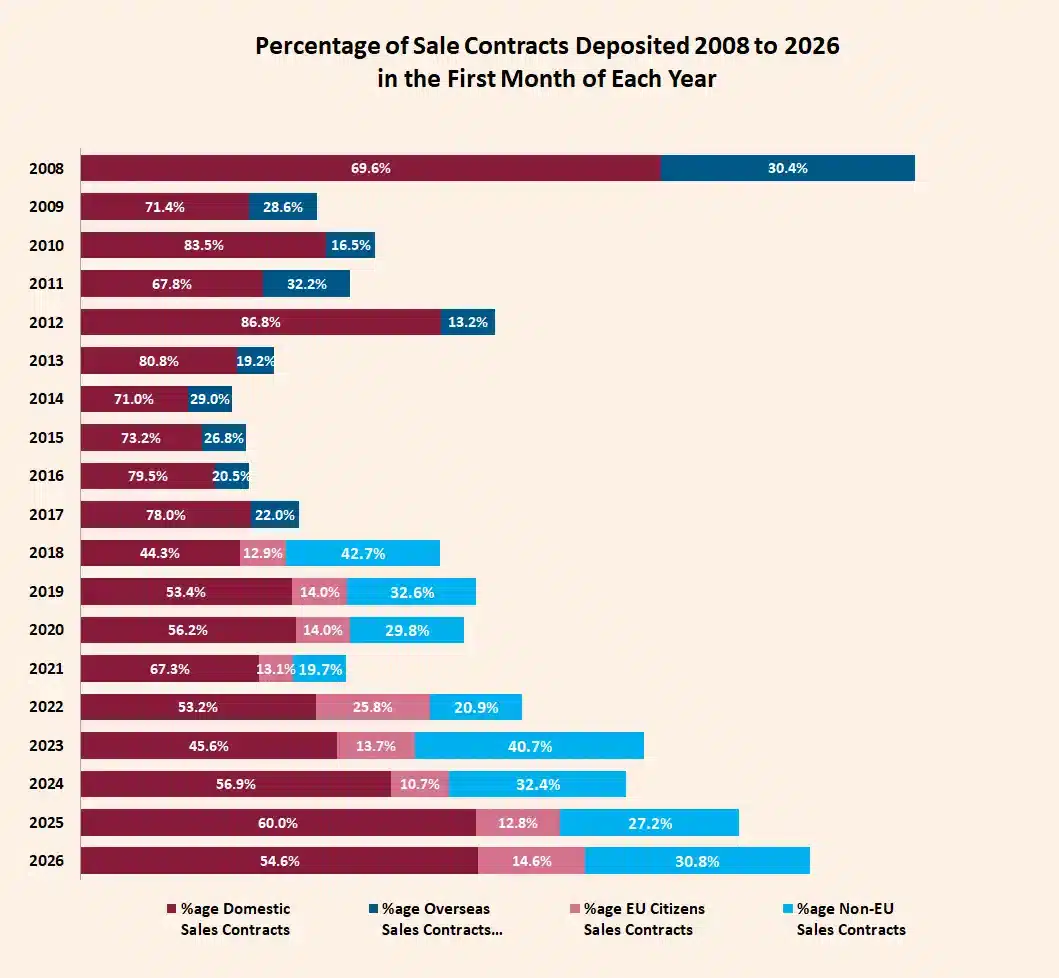
Based on the number of property sale contracts deposited at Land Registry offices across Cyprus, non-EU buyers made up 30.8% of all property sales in Cyprus during January.

Following last week’s report, the Department of Lands & Surveys has now released updated data breaking down property sales to EU and non-EU buyers. Amid growing ‘concern’ in foreign property purchases, the latest figures highlight both the number and percentage of sales across domestic, EU, and non-EU market segments.

However, the data has some limitations. The Department only began separating EU and non-EU buyers’ statistics in 2018. Before then, all foreign purchases were recorded together as “Overseas Sales Contracts,” combining both groups.

Additionally, UK citizens were reclassified as non-EU citizens from 31 January 2020 due to Brexit. As a result, sales to EU citizens appear lower – and sales to non-EU buyers higher – from that point onward.

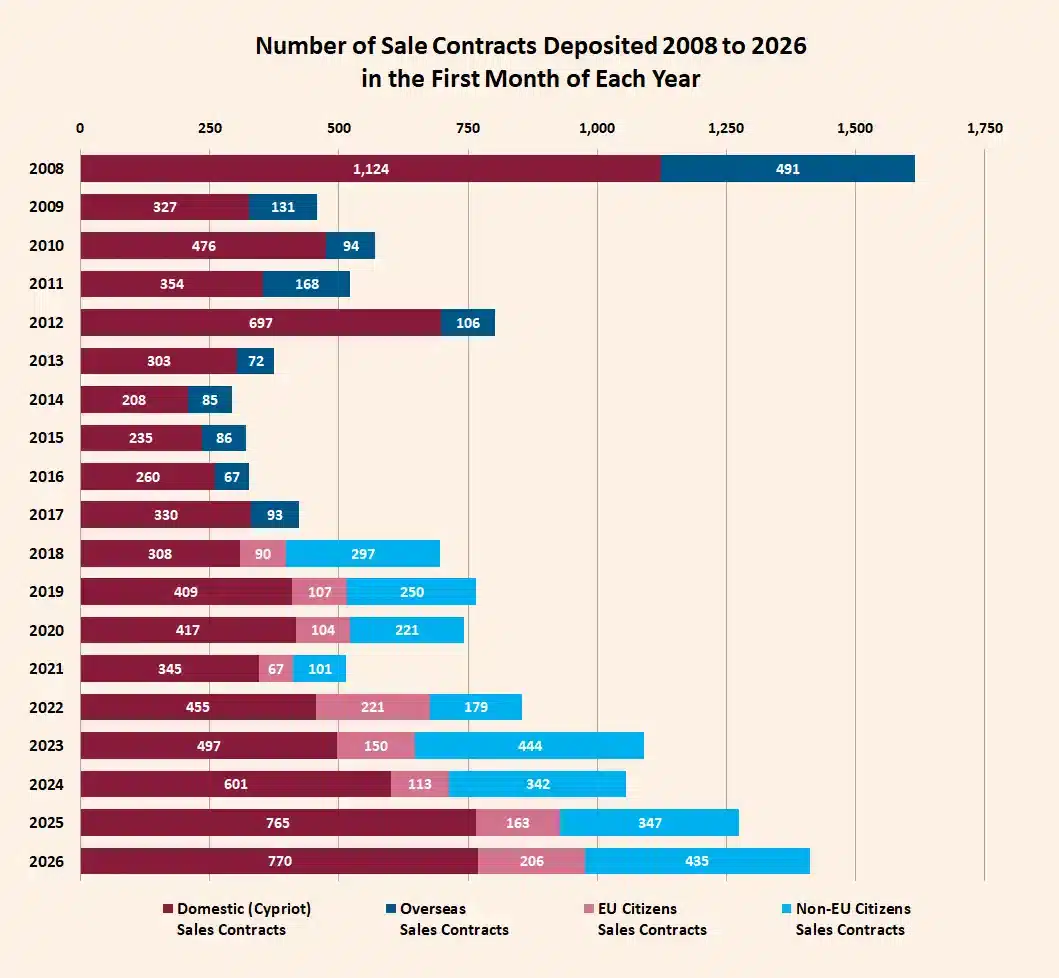
Cyprus property sale contract numbers January 2026

Cyprus property sale contract percentages January 2026Property sales – market segment analysis

Marginal growth in domestic sales

Domestic buyers accounted for 54.6% of total property sales in January, with 770 contracts, compared with 765 in the same month last year — a 1% increase.

Sales fell in:

  • Paphos: -13% (62 vs 71)
  • Larnaca: -12% (130 vs 148)

Sales rose in:

  • Famagusta: +78% (41 vs 23)
  • Nicosia: +4% (249 vs 240)
  • Limassol: +2% (288 vs 283)
Domestic contracts of sale deposited – 2025/2026 Comparison (Jan)

Strong growth in property sales to EU citizens

EU buyers made up 14.6% of total sales, with 206 contracts, up 26% from 163 last January.

Sales changed as follows:

  • Famagusta: -26% (14 vs 19)
  • Limassol: -24% (34 vs 45)
  • Nicosia: unchanged (17)
  • Larnaca: +135% (40 vs 17)
  • Paphos: +55% (101 vs 65)

The strong rises in Larnaca and Paphos outweighed the falls elsewhere.

Contracts deposited by EU Nationals – 2025/2026 Comparison (Jan)

Strong growth in property sales to non-EU buyers

Non-EU buyers accounted for 30.8% of total sales, with 435 contracts, an increase of 25% from 347 in January last year.

Sales by district:

  • Famagusta: unchanged (14)
  • Nicosia: +32% (25 vs 19)
  • Paphos: +30% (155 vs 119)
  • Larnaca: +26% (118 vs 95)
  • Limassol: +22% (123 vs 101)
Contracts deposited by non-EU Nationals – 2025/2026 Comparison (Jan)

Market drivers

In Paphos, both EU and non-EU buyers bought more properties than Cypriot buyers, confirming it as a leading destination for overseas investors and holiday-home buyers. Larnaca has also seen strong demand from non-EU buyers.

Market Segment Summary Analysis 2026 Year to Date

Cyprus set to tighten building inspection and supervision

Cyprus is set to introduce stricter building control rules, making supervision compulsory for all construction and renovation works.

The Parliamentary Committee on Interior has examined new regulations that require all building works, including new builds and repairs, to be supervised by qualified professionals such as architects, civil engineers, electrical engineers and mechanical engineers.

What the new building regulations cover

The proposed amendments to the Roads and Buildings Regulations Law focus mainly on electrical and mechanical installations. The aim is to strengthen the building inspection system and improve the energy performance of properties.

The changes also partly align Cyprus with the European Union Directive 2024/1275 on the Energy Performance of Buildings, adopted in April 2024.

Under the new rules:

  • An electrical or mechanical study must be submitted when applying for a building permit for new properties.
  • The same requirement applies to additions or alterations to existing buildings if a new unit is created or if the authority considers it necessary.
  • Supervision of electrical and mechanical installations will now be mandatory.
  • The engineer who prepared the study must personally supervise the relevant works.

Once the works are completed, the responsible engineer must provide written confirmation that everything has been carried out according to the approved building permit. These certificates must be submitted to the authorities together with the Project Completion Certificate.

Historic day for construction sector

The President of ETEK (Cyprus Scientific and Technical Chamber), Constantinos Constanti, described the move as a “historic day” for the construction sector.

He explained that compulsory supervision of electrical and mechanical works strengthens public safety and ensures proper monitoring of construction projects. Supervision will now be required from all key professionals involved, architects, civil engineers, electrical engineers and mechanical engineers.

While some may worry about increased costs, ETEK argues that proper planning, correct system sizing and effective supervision will reduce long-term expenses. According to the Chamber, the cost of studies and supervision is affordable and small compared to the overall benefit for homeowners.

Importantly, engineers who fail to properly supervise works could face disciplinary action, including temporary suspension of their professional licence. Fees for supervision will be determined by market conditions.

Political support to improve building safety

Aristos Damianou, Chair of the Parliamentary Committee on Interior, said the new regulations will significantly improve building safety. He also noted that the reform strengthens Cyprus’ alignment with European legislation.

The rules will apply to both new buildings and certain existing properties, addressing safety concerns and ensuring the efficient operation of electrical and mechanical systems.

The proposal is expected to move quickly to the House of Representatives for final approval.

The EU directive on the energy performance of buildings

The reform partly aligns Cyprus with EU Directive 2024/1275 on the Energy Performance of Buildings. This directive is a key part of the European Green Deal and supports the EU’s goal of achieving climate neutrality by 2050.

Its main objectives include:

  • Reducing energy consumption across the EU building stock
  • Achieving an energy savings target of 11.7% by 2030
  • Promoting renewable energy systems in buildings
  • Tackling energy poverty
  • Lowering household energy bills
  • Strengthening the competitiveness of the European construction and clean technology sectors
  • Supporting access to sustainable and affordable housing

Overall, the new regulations mark a significant shift for Cyprus’ property sector, placing stronger emphasis on professional accountability, construction safety and long-term energy efficiency.

Paphos overtakes Limassol in luxury property prices

Cyprus’ property market has started to show a shift in power, with Paphos now recording higher average prices than Limassol for new homes.

While Limassol remains the clear leader in total sales value and activity, high-end villa sales in Paphos have pushed the district’s average property price above €646,000 in prime areas. This signals a growing demand from wealthy international buyers.

Nearly €2 billion in new-build sales

The new-build property market closed the first ten months of 2025 on a strong footing. According to Landbank Analytics, total sales of newly built houses and flats reached almost €2 billion between January and October.

Andreas Christoforides, CEO of Landbank Group, said the figures show three clear trends: rising apartment demand, Limassol’s dominance in transaction value, and Paphos emerging as a hotspot for luxury homes.

Apartments continue to lead the market

Flats remain the most popular choice across Cyprus.

During the first ten months of the year, 5,059 new flats were sold compared to 1,138 houses. Apartment sales reached €1.41 billion nationwide, with an average price of €280,000.

Houses sold in smaller numbers but achieved much higher prices, with the national average reaching €518,000.

Limassol: Cyprus’ property champion

Limassol once again confirmed its position as Cyprus’ most expensive and active property district.

The city recorded 1,800 new property sales worth more than €812 million — almost 40% of the total value of new-build sales across the island.

The most expensive sale in Cyprus this year was also in Limassol: a flat sold for €15.2 million.

The district’s average sale price reached €451,000, more than double the averages seen in Nicosia and Larnaca.

Paphos: The new luxury leader

Although Paphos ranked fourth in total number of sales, with 799 transactions, it recorded the highest average sale price in Cyprus at €470,000 — even higher than Limassol.

This growth is mainly driven by the housing market. The average price of a house in Paphos rose sharply to €697,000. By comparison, houses averaged €582,000 in Limassol and €552,000 in Famagusta.

The figures suggest Paphos is becoming a preferred destination for high-net-worth buyers searching for luxury villas.

Nicosia and Larnaca offer affordability

At the more affordable end of the market, Nicosia and Larnaca continue to attract steady demand.

Nicosia recorded 1,730 new home and flat sales, closely following Limassol in activity. The average flat price in the capital stood at €191,000, making it attractive mainly to local buyers.

Larnaca showed strong growth with 1,596 sales. Flats averaged €196,000, while houses averaged €394,000, offering better value compared to Limassol and Paphos.

The hottest property areas in Cyprus

Germasogeia leads in value

Limassol district dominates the list of top-performing areas.

Germasogeia led the market with €351.5 million in sales and an average price of €583,905. Limassol municipality followed with €274 million in sales, while the Kourion area added €111.7 million.

Together, these three areas generated around 1,600 transactions, underlining strong and consistent demand.

Akamas becomes Cyprus’ most expensive area

The Akamas region in Paphos district, which includes Peyia, ranked seventh in total value at €88.5 million. However, it recorded the highest average sale price in Cyprus at more than €646,000 — even above Germasogeia.

Paphos municipality recorded €124.6 million in sales, while Geroskipou added nearly €78 million. All three areas posted average prices above €420,000, highlighting their luxury appeal.

Larnaca’s mass-market growth

Larnaca municipality recorded 927 sales worth €207.2 million — the highest number of transactions for any single area.

Together with Aradippou, which recorded 394 sales worth €77.9 million, the district continues to attract buyers looking for affordable options, with average prices between €200,000 and €220,000.

Nicosia’s stable performance

Nicosia remains a pillar of steady domestic demand.

Nicosia municipality recorded 624 transactions worth €130 million, ranking fourth overall. Lakatamia offered the most competitive pricing in the top ten areas, with an average sale price of €195,000.

The capital continues to show stability, driven largely by local housing needs and mid-range properties.

A market of two speeds

The latest figures show a property market moving at two different speeds.

Limassol and Akamas continue to attract high-income investors, keeping prices at record levels. Meanwhile, Larnaca and Nicosia maintain strong sales volumes by serving steady demand for more affordable housing.

In premium areas such as Akamas and Germasogeia, where average prices exceed half a million euros, the focus is clearly on luxury investment. In contrast, areas like Lakatamia and Aradippou, with prices around €200,000, show that local demand remains the backbone of Cyprus’ property market.


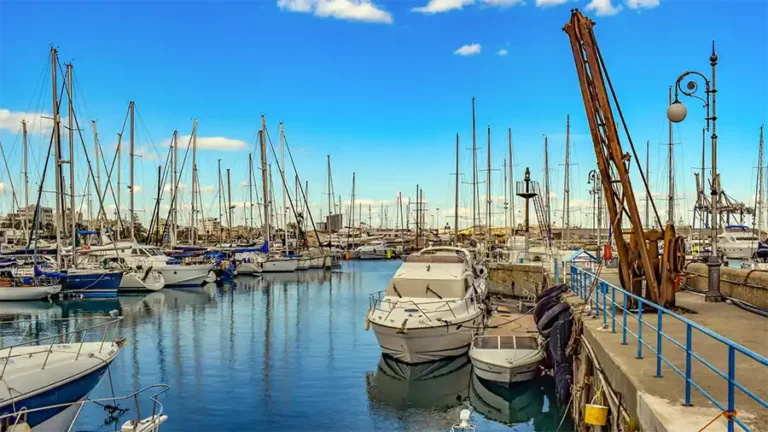
Larnaca port & marina set for separate development

The development of Larnaca’s port and marina should proceed as two distinct but parallel projects, according to advisers to Greece’s National Investment Fund (the “Superfund”), who were commissioned to conduct a study into their future development and management.

Sources indicate that the advisers recommend independent growth strategies for both the commercial port and the marina, while leaving all potential uses of the port open for consideration. This approach could pave the way for lifting the current cap on the port’s commercial activity, regardless of Cyprus’ obligations under the Limassol port concession agreement.

Three options under review for each project

The proposed framework is built around three alternative scenarios for each project, assessed separately. These options are currently being evaluated by officials at the Ministry of Transport before formal consultation begins with the local community.

Timelines for each scenario are also being prepared, following a request by the Municipality of Larnaca.

According to the same sources, the advisers’ report is based on two key criteria. First, any selected development must address projected needs over a 50-year horizon. Second, it must align with long-term growth prospects, a matter expected to be subject to negotiation with the local authority.

All options open for Larnaca port

In relation to the port, no specific use has been ruled out. Commercial, tourism-related, or hybrid models remain under consideration.

The advisers acted on government instructions to evaluate all possible uses, irrespective of Cyprus’ commitments under the Limassol port agreement. Given that any new investment would shape the site for the next half century, the strategic role of Larnaca port as a potential gateway to Cyprus cannot be constrained by an earlier contract.

It is worth noting that the Limassol concession agreement currently sets a ceiling of 900,000 tonnes on Larnaca’s commercial port activity.

Larnaca marina upgrade reflects local aspirations

The report also acknowledges the need to upgrade Larnaca marina, based on specific development options.

Option 1 would see the marina continue as currently configured, alongside works already underway, including dredging, construction of the Yacht Club, external landscaping, road improvements and related infrastructure. However, this scenario is not expected to meet long-term demand.

Option 2 involves a more ambitious investment-led and tourism-focused redevelopment of the marina. The scale and scope of such investment would be determined through discussions between local authorities and Transport Minister Alexis Vafeades.

Larnaca Mayor Andreas Vyras recently stated, following a meeting with the minister, that there is shared agreement on attracting “productive investments” for the city. These could include a theme park, hotels, a university campus and potentially a private hospital, provided they remain consistent with the city’s character and urban identity.

(Translated and summarised from an article in StockWatch)

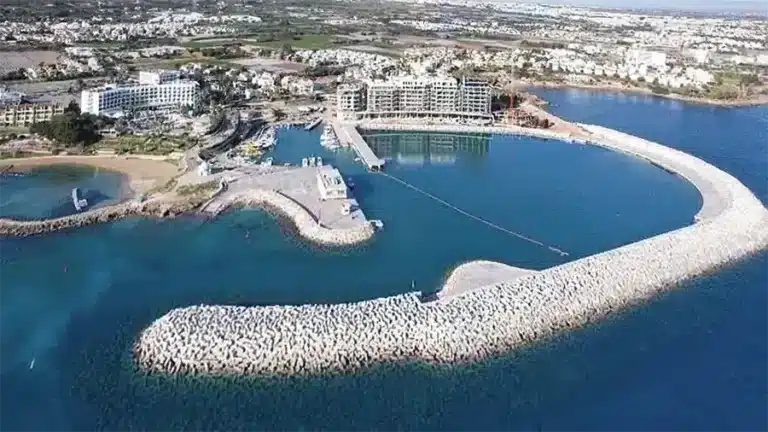
Paralimni marina enters final development phase

Paralimni Marina, described as the largest and most emblematic infrastructure project undertaken by the Municipality of Paralimni-Deryneia, has entered its final phase of development, signalling a new era of growth for the entire Famagusta district.

According to an official municipal announcement, the port and harbour works have now been fully completed. Construction activity is currently concentrated on the commercial and residential components of the scheme, with works progressing at an intensive pace and in line with the agreed timetable.

In parallel, the building that will accommodate Police and Customs Services is expected to become operational within the coming month. The marina’s fuel station is also scheduled to commence operations during the same period, marking another key milestone in the project’s delivery.

Paralimni Marina is regarded as a large-scale, complex and strategically significant investment for the region. Once fully operational, the marina is expected to play a pivotal role in upgrading the quality of the local tourism offering, while strengthening the wider economic performance of both the municipality and the surrounding area.

The development is anticipated to enhance the region’s profile as a modern, international destination for nautical tourism, attracting yacht owners, visitors and property investors alike. As the project moves steadily towards completion, local authorities view the marina as a cornerstone initiative that will support sustainable growth and reinforce Famagusta’s position within Cyprus’ competitive coastal real estate and tourism markets.

With major infrastructure already delivered and final works advancing, Paralimni Marina is poised to become a defining landmark for the district’s future development.

Property sale probe: €8.5m price drop under fire

The Auditor General, Andreas Papaconstantinou, has raised serious concerns about how a property sale between 2015 and 2017 was handled. His comments appear in the introduction to a Special Report by the Audit Office titled “Audit of the Tax Department in Relation to the Sale of Immovable Property“.

The Auditor General’s comments translated from the Special Report:

This Special Report was prepared following an anonymous complaint concerning the sale of property belonging to a well-known businessman during the period 2015–2017.

An examination of the relevant tax files indicates that, although there were multiple warning signs at various stages suggesting potential non-compliance with legislation, the Tax Department does not appear to have identified and/or properly examined the transactions in question so as to take appropriate corrective action.

(a) Significant Reduction in Sale Price

The original sale agreement (2015) valued the property at approximately €19.35 million. Six months later, in 2016, the agreements were cancelled and replaced with new ones, reducing the sale price by €8.5 million (around 44%). As a result, it appears that this amount was effectively “forgone” by the sellers without logical or adequate explanation.

Following this amendment, a loss of €7.7 million was ultimately recorded, whereas a profit would otherwise have arisen. The €7.7 million loss was subsequently utilised for accounting purposes to offset taxable profits for 2016.

(b) Inconsistencies in Cost Reporting

While the Tax File recorded land and construction costs of approximately €9.3 million for 2013, the financial statements recognised corresponding costs of €15.8 million. At the time of sale in 2016, the total cost of the property was recorded at €18.6 million, resulting in a loss on disposal.

The €18.6 million cost attributed to the sale of the incomplete property included significantly increased capitalised interest, as well as interest capitalised during a period of inactivity.

Furthermore, the total project cost upon completion in 2018 was calculated at approximately €47.7 million. By contrast, another comparable project in the same area, involving the same businessman, of similar quality and nearly double the size, completed four years later (2022), was reported to have cost approximately €42.9 million — nearly €5 million less.

These facts reasonably raise questions as to the realism of the recognised costs and the correctness of their tax treatment.

(c) Transactions with Related Parties

The majority of transactions relating to the sale, construction and exploitation of the property were conducted between related parties. Such transactions should, by their very nature, have been regarded by the Tax Department as high risk and subject to thorough tax scrutiny.

(d) Preference Shares at Elevated Valuations

Under the Cyprus Investment Programme, approximately €62 million was raised through the issuance of preference shares. The valuation implied by these investment transactions appears inconsistent with the loss-making sale of the property, giving rise to reasonable questions regarding the authenticity of the transactions and the overall valuation of the asset.

(e) Reacquisition by Related Parties

The property ultimately reverted, through complex corporate structures and financing from related entities, to individuals within the immediate family circle of the original owner. This development further strengthens concerns regarding the authenticity, commercial substance, independence and arm’s-length basis of the transactions.

Final Considerations

In our view, there were multiple indications of heightened risk surrounding the totality of transactions relating to this property.

The Tax Department is called upon to reflect on how such an extensive pattern of warning signs, involving transactions amounting to millions of euros, was neither identified nor adequately examined, potentially resulting in significant implications.