The latest preliminary figures released by the Cyprus Statistical Service (CyStat) suggest that the residential property market remained broadly stable in the third quarter of 2025, with only marginal movements recorded across the House Price Index (HPI).
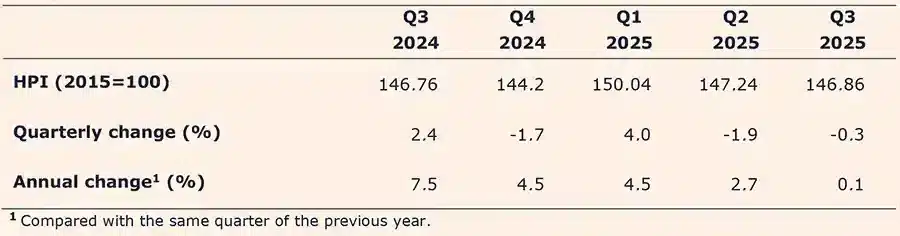
According to CyStat, the HPI reached 146.86 units in Q3 2025, reflecting a quarter-on-quarter decline of 0.3% when compared with the second quarter of the year. Despite this slight dip, annual performance remained positive, with prices 0.1% higher than in the third quarter of 2024. This indicates a market that is cooling gently rather than experiencing any significant correction.
Data covering the period from Q3 2024 to Q3 2025 highlights modest fluctuations in both quarterly and annual price changes, reinforcing the view that house prices are currently moving within a narrow range.
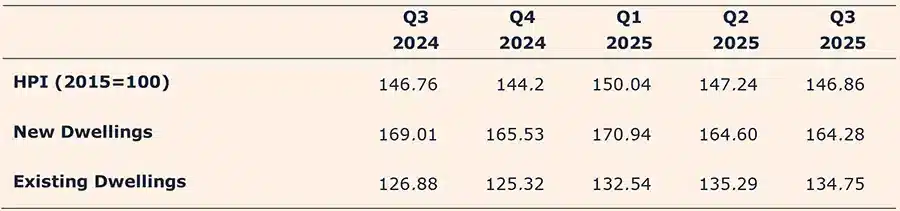
A closer look at property categories reveals diverging trends between new-build and existing homes. The House Price Index for new dwellings stood at 164.28 units in Q3 2025, edging down slightly from 164.60 units in the previous quarter. This minor decline suggests a softening in demand or pricing pressure within the new-build segment.
Meanwhile, the index for existing dwellings was estimated at 134.75 units, compared with 135.29 units in Q2 2025. Although the decrease is modest, it mirrors the broader market trend of subdued short-term price movement.
Quarterly sub-indices for both new and existing homes, covering the period from the third quarter of 2024 to the third quarter of 2025, provide further insight into these gradual shifts.
Overall, the figures point to a housing market characterised by stability, with limited volatility and restrained price growth as buyers and sellers adjust to prevailing economic conditions.
Cyprus has overhauled its tax system, with a broad package of tax reforms that came into effect on 1 January 2026. Several of these changes directly impact property owners, investors, and buyers, reshaping the island’s real estate tax landscape.
After reviewing updates published across accountancy and legal advisory platforms, it’s clear that the tax reforms place a strong emphasis on reducing transaction costs, modernising capital gains tax rules, and strengthening tax compliance.
Key property tax reforms from 1st January 2026
National immovable property tax
The national annual Immovable Property Tax (IPT) – calculated on outdated 1980 property values – was abolished in 2017 and will continue to remain so.
Property owners will still be responsible for local municipal charges, which typically cover refuse collection, sewerage, and community services, and generally range between €90 and €300 per year.
Separately, a proposed “Mansion Tax“ on properties valued above €3 million, introduced in a bill by AKEL MP Stefanos Stefanou, is expected to be debated when Parliament reconvenes after the Christmas break. This proposal is not yet law.
Stamp duty
Stamp duty on contracts, share transfers and most other instruments will be fully abolished from 1 January 2026.
This move removes a longstanding transactional cost and is expected to improve affordability and liquidity across the property market, particularly for buyers and investors.
Capital gains tax reforms
Several important changes to Capital Gains Tax will come into force:
Exemption for property swaps (antiparochi)
Property exchange arrangements (“antiparochi”), whereby a landowner transfers land in return for completed unit(s) from a developer, will be fully exempt from the 20% CGT, provided that construction is completed within five years.
I have seen one article advising that ‘trapped buyers‘ who cannot sell or mortgage their property due to planning infringements may take advantage of antiparochi, by exchanging the property (presumably at a much reduced value) for a completed unit. However, I have yet to confirm this is possible.
Increased lifetime CGT exemptions
Lifetime CGT allowances have been significantly enhanced:
Primary residence: Exemption increased to €150,000 (from €85,430), subject to a five-year occupancy requirement.
General exemption: Increased to €30,000 (from €17,086).
Agricultural land: Increased to €50,000 (from €25,629).
Revised definition of immovable property
To combat tax avoidance, the scope of CGT has been widened. The disposal of shares in companies where 20% or more of their value derives from Cyprus immovable property (previously 50%) will now be subject to CGT.
Expanded powers for the tax commissioner
The reforms also strengthen enforcement. The Tax Commissioner will gain enhanced authority to:
Request declarations of assets and liabilities
Override bank confidentiality in tax investigations
Withhold approval for property transfers if any party is non-compliant with tax obligations
Mandatory traceable rent payments
From 1 July 2026, rent payments exceeding €500 must be made via bank transfer or other traceable electronic methods, improving transparency and enforcement in the rental market.
What this means for the Cyprus property market
Taken together, these reforms aim to reduce upfront costs, modernise tax rules, and increase compliance, while maintaining Cyprus’ appeal as a property investment destination. Buyers benefit from the removal of stamp duty, owners gain from higher CGT exemptions when they sell, and authorities gain stronger tools to combat avoidance.
The ten most expensive property transactions recorded across Cyprus in October 2025 reached a combined value of €87.6 million, with Limassol firmly maintaining its position as the island’s leading luxury property market, according to data processed and published by Ask Wire.
The highest-value sale of the month was a €15.2 million, three-floor apartment in Potamos Germasogeia, underlining Limassol’s long-established strength in high-end property transactions.
Limassol accounted for eight of the ten most expensive sales, while the remaining two were recorded in the free Famagusta district, specifically in Ayia Napa.
Commenting on the findings, Ask Wire CEO Pavlos Loizou said that “Limassol continues to play a decisive role in the high-end property market.”
He added that it is “the district where transactions in the seven- and eight-figure range occur more frequently,” noting that sales of this magnitude, “especially involving apartments” are rarely seen in other districts.
Turning to Germasogeia specifically, Loizou said that “in that area in particular, we consistently observe high-value sales over time.”
No
Property Type
Sale Price
District / Municipality – Community
1
Three-floor apartment
€15.2 million
Limassol / Potamos Germasogeia
2
Touristic building
€15 million
Limassol / Potamos Germasogeia
3
Office building
€14.8 million
Limassol / Neapolis
4
Mixed-use building
€9 million
Limassol / Katholiki
5
Apartment
€7.6 million
Limassol / Ayios Nektarios
6
Field
€6 million
Famagusta / Ayia Napa
7
Field
€5.6 million
Limassol / Pareklisia
8
Field
€5.3 million
Limassol / Ayios Tychonas
9
House
€4.9 million
Famagusta / Ayia Napa
10
Apartment
€4.2 million
Limassol / Potamos Germasogeia
Source: Department of Lands and Surveys, Analysis: Ask Wire
The eight Limassol sales featured in October’s top ten totalled almost €77 million, while the two transactions in Ayia Napa were valued at approximately €11 million.
Of the ten most expensive deals, four involved residential properties—three apartments in Potamos Germasogeia and one house in Ayia Napa—amounting to €31.9 million in total. A further three transactions concerned fields, with a combined value of €16.9 million.
Ask Wire emphasised that the data is based on completed sales transactions and highlights the ongoing strength of Cyprus’ luxury property market, with Limassol continuing to act as its focal point.
As reported last week, property sales in December 2025 rose by 24 per cent compared with December 2024, helping Cyprus achieve its strongest year for property sales since the peak of 2007 and its third most successful year since records began in 2000.
The Department of Lands and Surveys has published figures summarising sales to the domestic (Cypriot) market, EU citizens and non-EU citizens.
Property sales: market segment analysis
Domestic (Cypriot) buyers accounted for 1,007 sales in December, representing 50.7 per cent of total transactions.
Foreign buyers from the EU filed 222 sales documents during the month, accounting for 13.4 per cent of total sales, while buyers from outside the EU filed 430 sales documents, representing 25.9 per cent of total sales.
Over the twelve months of 2025, domestic buyers accounted for 10,859 sales, or 59.9 per cent of the total.
EU buyers filed 2,446 sales documents during the year, representing 13.5 per cent of total sales, while non-EU buyers accounted for 4,809 sales, or 26.5 per cent of the total.
Overall, foreign buyers (both EU and non-EU) accounted for 40.1 per cent of all property sales in 2025. To put this figure into perspective, since 2008 foreign buyers have accounted for an average of 36.2 per cent of total sales and have exceeded 40 per cent in six of the past 18 years. However, the 7,255 sales recorded in 2025 represent the third highest number on record, only exceeded in 2006 (8,355) and 2007 (11,281.)
Statistics from the Department of Lands and Surveys indicate a property market increasingly shaped by international demand.
In Paphos, non-EU buyers once again outnumbered domestic purchasers, reinforcing the district’s position as a preferred destination for overseas investors and holiday-home buyers.
Market Segment Summary Analysis 2025
Property sales to the domestic market
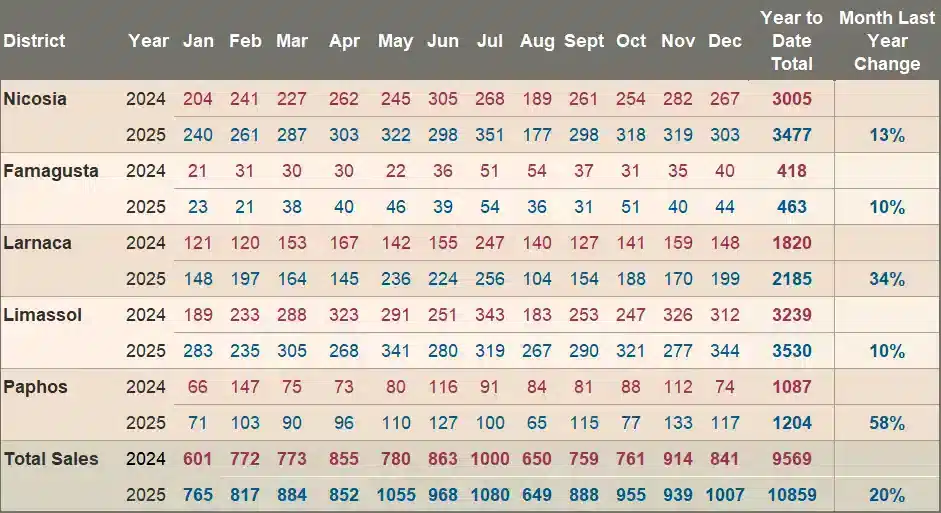
The total number of sales to the domestic (Cypriot) market December 2025 rose 20% compared to December 2024 and accounted for 60.7% of the total number of sales in the month.
All districts reported a growth in sales – Paphos (58%), Larnaca (34%), Nicosia (13%), Limassol and Famagusta (10%). Limassol had the highest number of sales.
Total Domestic Property Sale Contracts – 2024/2025 Comparison
Over the 12 months of 2025 sales to the domestic market rose by 13% compared to 2024 with all districts recording gains.
Domestic contracts of sale deposited – 2024/2025 Comparison
Property sales to the overseas market
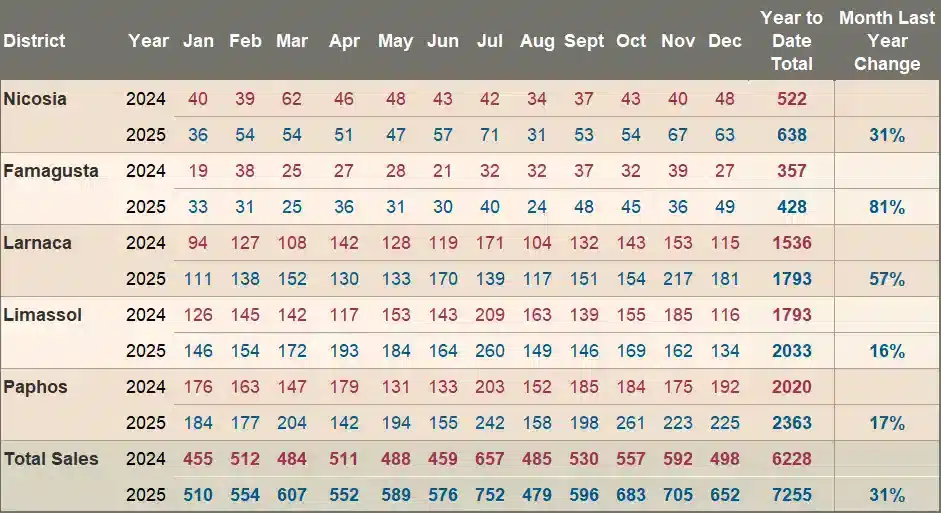
The total number of property sales to the overseas market (both EU and non-EU citizens) in December 2025 rose 31% compared to December 2024.
All districts reported a growth in sales – Famagusta (81%), Larnaca (57%), Nicosia (31%), Paphos (17%), and Limassol (16%). Paphos had the highest number of sales.
Total Overseas (EU & Non-EU) Property Sale Contracts – 2024/2025 Comparison
Over the 12 months of 2025 sales to the overseas market rose 16% compared to 2024, with all districts gaining ground.
Overseas contracts of sale deposited – 2024/2025 Comparison
Property sales to EU nationals (excluding Cypriots)
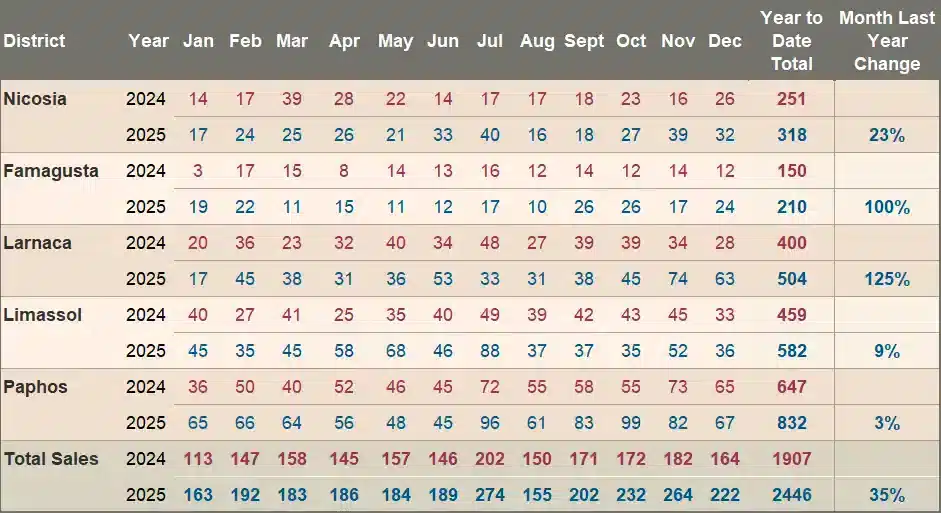
Sales to EU nationals rose 35% compared to December 2024 and accounted for 13.4% of the total number of sales (1,659) achieved during the month.
All districts reported a growth in sales – Larnaca (125%), Famagusta (100%), Nicosia (23%), Limassol (9%), and Paphos (3%). Paphos had the highest number of sales.
Total Property Sale Contracts for EU Citizens – 2024/2025 Comparison
Over the 12 months of 2025 sales to EU nationals rose 28% compared to 2024, with all districts recording gains.
Contracts deposited by EU Nationals – 2024/2025 Comparison
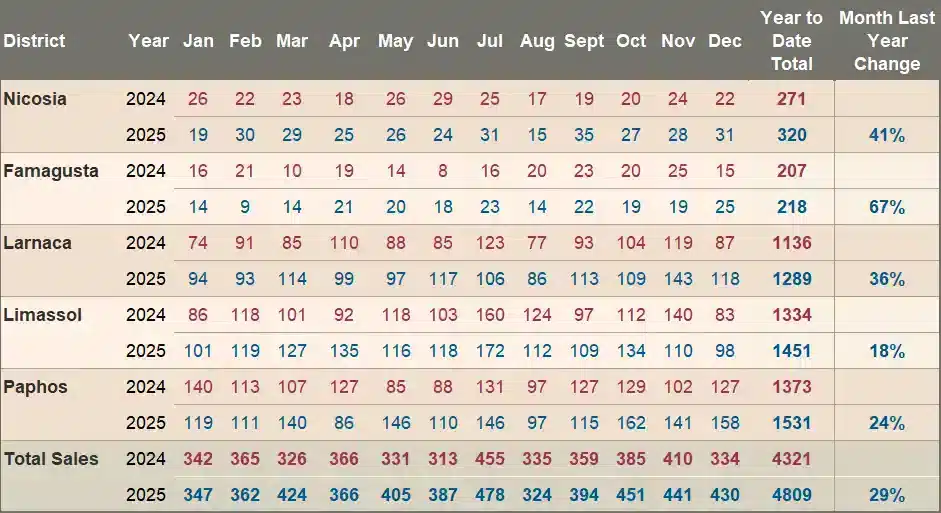
Property sales to non-EU citizens
Sales to non-EU citizens in December 2025 rose 29% compared to December 2024 accounting for 25.9% of the total number of sales (1,659) achieved during the month.
All districts reported a growth in sales – Famagusta (67%), Nicosia (41%), Larnaca (36%), Paphos (24%), and Limassol (18%). Paphos recorded the highest number of sales.
Total Property Sale Contracts for Non-EU Citizens – 2024/2025 Comparison
Over the 12 months of 2025 sales to Non-EU nationals rose 11% compared to 2024, with all districts gaining ground.
Contracts deposited by non-EU Nationals – 2024/2025 Comparison
The Cypriot Parliament is facing significant changes in legislation concerning jointly-owned buildings and property transfers, with the aim of addressing serious problems related to non-payment of common expenses and the inability to enforce existing provisions.
The new bill, which is over 80 pages long, is being discussed by the Parliamentary Committee on Internal Affairs and is expected to be voted on during the current session. Its purpose is to modernize the management framework for jointly owned buildings, strengthen the legal status of management committees, and ensure the effective operation of apartment buildings and complexes, where almost half of the country’s population lives.
One of the most significant changes is the obligation to present a certificate of payment of common expenses in order to complete the transfer of a property. The Land Registry Department will not be able to proceed with the transfer of title unless a relevant certificate is provided by the Management Committee or the building manager.
Until now, in certain cases, buyers could benefit from exemptions or reductions in transfer fees, even if there were outstanding utility bills. Under the new regulations, this is no longer the case. The existence of outstanding common expenses cancels the right to exemption, regardless of whether the transaction is subject to VAT or meets other conditions.
The bill provides for the creation of a Registration and Supervision Service for Management Committees, as well as the implementation of standard internal regulations to regulate the rights and obligations of owners. The committees will be able to impose financial penalties, register encumbrances (memos), and take legal action to collect debts.
These changes are expected to improve the management of common areas, enhance transparency in real estate transactions, and protect buyers from unforeseen financial obligations. At the same time, they create a stricter and fairer framework as far as owners who neglect their obligations are concerned.
The content of this article is valid as at the date of its first publication. It is intended to provide a general guide to the subject matter and does not constitute legal advice. We recommend that you seek professional advice on your specific matter before acting on any information provided. For further information or advice, please contact Savvas Savvides, Senior Partner, Paphos Office of Michael Kyprianou law firm at Tel +357 26930800.
A strong 24 per cent increase in Cyprus property sales in December, together with steady growth throughout the year, has made it the country’s best year for property sales since the record-breaking year of 2007.
In 2007, property sales peaked at 21,245. However, the global financial crisis, the most severe worldwide economic downturn since the Great Depression of the 1930s, triggered the collapse of property bubbles across the world.
In Cyprus, property sales continued to fall until the island faced its own financial crisis in 2012–13. In March 2013, Cyprus agreed to a €10 billion bailout package with a troika of international lenders: the European Commission, the International Monetary Fund, and the European Central Bank. As part of the agreement, the troubled Laiki Bank was closed, uninsured bank deposits exceeding €100,000 were subject to a “haircut,” and the remaining assets of Laiki Bank were transferred to the Bank of Cyprus.
As a result of the severe economic conditions, property sales plunged to just 3,767 transactions in 2013.
Since then, the property market has gradually recovered, although it has faced several challenges along the way. These have included the impact of the COVID-19 pandemic in 2020, the fallout from the notorious “Golden Passport” scheme, and long-standing structural issues such as title deed delays, property repossessions, and non-performing loans.
District sales December 2025 vs December 2024
According to official statistics published by the Department of Lands & Surveys, total of 1,659 property sale contracts were deposited at Land Registry offices during December, up from 1,339 in December last year.
All districts recorded increases in property sales:
Nicosia: 366 vs 315 (+16%)
Limassol: 478 vs 428 (+12%)
Larnaca: 380 vs 263 (+44%)
Famagusta: 93 vs 67 (+39%)
Paphos: 342 vs 266 (+29%)
Total contracts of sale deposited – 2024/2025 Comparison (Dec)
Annual property sales 2025 vs 2024
During the twelve months of 2025, total sales rose 15 per cent to 18,114, compared with 15,797 in 2024, with all districts achieving double-digit gains.
Nicosia: 4,115 vs 3,527 (+17%)
Limassol: 5,563 vs 5,032 (+11%)
Larnaca: 3,978 vs 3,356 (+19%)
Famagusta: 891 vs 775 (+15%)
Paphos: 3,567 vs 3,107 (+15%)
Total contracts of sale deposited – 2024/2025 Comparison
Three-year comparison: Nicosia Leads Growth
Land Registry data from 2023 to 2025 show clear differences in how Cyprus’ property market performed across districts:
Nicosia recorded the strongest growth over the three-year period. Property sales rose from 3,105 in 2023 to 4,115 in 2025, an overall increase of 32.5%, the highest among all districts.
Larnaca also showed strong growth, with sales increasing from 3,185 in 2023 to 3,978 in 2025. This represents a total rise of 24.9%, the second-highest increase.
In Limassol, sales were 5,092 in 2023, fell slightly to 5,032 in 2024, and then increased to 5,563 in 2025. Overall, this equals a net rise of 9.2%.
Famagusta saw sales grow from 812 in 2023 to 891 in 2025, an increase of 9.7%. Paphos recorded the smallest change, with sales rising from 3,373 to 3,567, up by 5.8%.
Overall, the figures show that the Cyprus property market grew between 2023 and 2025, but at different speeds in each district. Nicosia and Larnaca recorded the strongest growth.