Cyprus set to curb third-country nationals buying property

The Cyprus parliament is set for an intense start to the new year, as MPs return to debate a series of legislative proposals aimed at putting the brakes on the uncontrolled purchase of property by third-country nationals.

The issue has gained growing political and public attention, with the housing crisis increasingly emerging as one of Cyprus’ most pressing socio-economic challenges.

According to findings from the Audit Office, more than 27% of total property and land sales in 2024 were made to buyers from third countries. Paphos recorded the highest volume of such transactions, followed by Larnaca. These figures have raised alarm among policymakers, particularly in relation to housing affordability and national interest concerns.

(During the first 11 months of 2025 more than 26% of total immovable property sales were made by third country nationals.)

The three proposed bills will be examined by the Parliamentary Committee on Interior on Thursday, 15 January, during its first session following the Christmas recess. Two of the proposals were submitted by AKEL General Secretary Stefanos Stefanou, while the third was jointly tabled by MPs from DIKO, DISY and DIPA who serve on the Parliamentary Audit Committee.

AKEL proposals: Tighter controls on third-country nationals

The two AKEL-backed bills aim to place firm restrictions on the acquisition of immovable property by third-country nationals and foreign-controlled companies. Their stated objectives include safeguarding the right to housing for low- and middle-income households, preventing the unchecked sale of land, and protecting the country’s economy and national security.

The first proposal seeks to amend the Immovable Property (Transfer and Mortgage) Law, preventing the Director of the Department of Lands and Surveys from approving transfers or registering sales, exchanges or assignments where restrictions under the Immovable Property Acquisition (Aliens) Law apply. AKEL argues that this measure is essential to strengthen legal oversight and prevent indirect property acquisitions through corporate structures or assignment contracts.

Closing loopholes for foreign-controlled companies

The second AKEL proposal focuses on modernising the Immovable Property Acquisition (Aliens) Law. It abolishes provisions that currently allow indirect acquisitions without Cabinet approval and introduces stricter enforcement mechanisms.

Notably, it expands the definition of a “foreign-controlled company” to include any entity whose beneficial owner, under anti-money laundering legislation, is a third-country national. The proposal also clarifies that Cypriot or EU-registered companies controlled by foreign interests should not be exempt from restrictions, closing legislative loopholes that have enabled third-country nationals to acquire property indirectly.

Under this proposal, the Council of Ministers would determine, via regulations, the conditions and criteria under which third-country nationals may acquire immovable property. Each application would be assessed individually, with decisions formally communicated to applicants.

The following limited exemptions are envisaged for third-country nationals buying property:

  • One apartment or house of up to 200 sq m
  • One shop of up to 200 sq m
  • One office of up to 300 sq m

The proposal also introduces a blanket ban on property acquisitions, direct or indirect, by foreign nationals near the ceasefire line or in areas of critical infrastructure, including ports, airports, beaches and military facilities.

Third proposal: One home only for third-country nationals

The third bill, submitted by MPs of the Parliamentary Audit Committee, also amends the Immovable Property Acquisition (Aliens) Law. It proposes that third-country nationals be permitted to acquire only one house or apartment, whether under construction or completed, on a single plot of land.

It further introduces ownership thresholds for legal entities, requiring at least 51% of share capital, voting rights or control to be held by Cypriot, EU or EEA nationals, or by companies established and headquartered within the European Economic Area, including Cyprus.

In addition, the proposal bans foreign nationals from acquiring forest or agricultural land altogether.

Housing a priority for Cyprus and the EU

Audit Office data presented to the Parliamentary Audit Committee indicates that foreign purchases accounted for 27% of all property sales in 2024—a figure believed to underestimate the true scale, as it excludes transactions involving Cypriot companies with foreign shareholders. Similar information was also provided to Parliament by the Minister of Interior in response to MPs’ questions.

Housing policy will be a key priority during Cyprus’ EU Presidency, beginning on 1 January 2026, reflecting wider concerns across EU member states over affordability, supply constraints and speculative foreign investment.


High rents fuelling demand for home ownership schemes

The days when renting was clearly cheaper than buying a home are quickly coming to an end. These days, monthly rent often matches or even exceeds what people would pay on a mortgage. And that shift is changing how households think about home ownership.

That’s the picture painted by Interior Minister Konstantinos Ioannou, who oversees the government’s housing programmes. Responding to a question in Parliament from DIKO MP Christos Senekis, the Minister said fewer displaced persons are now applying for rent subsidies, while more are turning to schemes that help them buy or build a home.

The numbers back this up. Applications for rent subsidies dropped from 4,509 in 2022 to 3,155 in 2024. At the same time, interest in home ownership has grown — something the Minister directly links to rising rental prices.

As Mr Ioannou explained, over the past three years there’s been a gradual decline in rent subsidy applications and a parallel rise in applications for home purchase or construction schemes. With rents climbing so sharply, many households are deciding it makes more sense to buy, since mortgage payments are often similar to what they’d pay in rent anyway.

In total, rent subsidy beneficiaries numbered 4,509 in 2022, 3,712 in 2023 and 3,155 in 2024. To ease some of the pressure, subsidy amounts were increased by about 15% as of 1 January 2024.

All of this highlights just how fast rental prices have risen — and why there’s growing pressure to strengthen state housing support aimed at home ownership.

The government is continuing to roll out the KtizO housing scheme for displaced persons, which is expected to cost around €130 million over its ten-year lifespan. Other housing programmes are also still in place. Since 2013, the number of people eligible for housing assistance has increased, after children of refugee mothers were officially recognised as refugees — expanding eligibility beyond paternal descent and bringing more households into the system.

Mr Senekis also raised another long-standing issue, asking whether the Ministry plans to revise the income criteria for the Rent Subsidy Scheme. As he pointed out, those thresholds have not been updated in more than 15 years.

In response, the Minister confirmed that the Welfare Service has already submitted a draft bill to the Legal Service for review. The proposed changes aim to modernise the rent subsidy framework and expand eligibility. Among other things, the bill would repeal certain provisions of the Rent Control Law related to subsidies for displaced persons and victims, create a dedicated Rent Subsidy Officer, introduce an appeals process, and update evaluation criteria.

Once the bill is approved, new income assessment methods and thresholds will be put before the Council of Ministers. The goal, Mr Ioannou said, is to make the scheme fairer and allow more people to qualify.

On the budget side, the Minister noted that rent subsidy funds were used at an average rate of over 90% between 2022 and 2024 — specifically 93.54% in 2022, 93.76% in 2023 and 85.39% in 2024.

Any unused funds don’t go to waste, he added. Instead, they’re redirected to other housing schemes for displaced persons, such as programmes for buying, building or repairing homes and flats. These schemes tend to be oversubscribed, meaning the state can approve more applications than originally planned.

Green light anticipated for Paphos marina early 2026

Paphos is awaiting the long-anticipated green light for its Marina project, with local stakeholders hoping for clarity by early 2026.

The district is currently awaiting the results of the tender announced by the Deputy Ministry of Tourism on 17 September, calling for expressions of interest and bids for the construction of the Paphos Marina at the Potima site in Kissonerga.

Across the district, there is both optimism and expectation that the tender process will be completed in the early months of the new year, allowing this flagship development to move smoothly towards implementation.

Local authorities and business groups are keen to see the project progress without once again becoming entangled in prolonged legal procedures, as has happened repeatedly over past decades.

The Paphos Marina is considered a project of strategic importance for the district’s long-term tourism, economic and commercial growth. There is widespread hope that the repeated re-launching of the tender process over the years will, this time, lead to a definitive outcome.

Paphos marina tender

According to the tender specifications, the project includes a large-scale marine development featuring a marina with capacity for up to 1,000 leisure vessels. This capacity will be distributed between sea and land zones, with 70–80% of berths allocated to wet mooring and the remainder to dry docking facilities.

In addition to the marina itself, the tender allows for residential and commercial development, potentially including hotel infrastructure as well as facilities capable of accommodating cruise ships. This mixed-use approach is expected to enhance the area’s attractiveness to both investors and international visitors.

For the purposes of the project, the Government opted for a two-phase open tender process. The current phase concerns expressions of interest, to be followed by a second phase inviting shortlisted parties to submit binding offers.

Landmark development

The Paphos Marina was also highlighted by President Nikos Christodoulides during a recent presentation of major government-backed projects planned for the district. He described the marina tender as a landmark development that is expected to elevate Paphos into a leading maritime and tourism destination in the Eastern Mediterranean.

Covering a total area of approximately 165,000 square metres and accommodating up to 1,000 leisure vessels, the development is expected to provide a significant boost to the local economy, create new employment opportunities and substantially upgrade the overall tourism offering of the Paphos district.

The troubled history of the long-awaited Paphos Marina

Since an initial study was carried out more than 30 years ago, the Paphos Marina project has been stalled by legal battles and mired in bureaucracy.

1990s–2006 — concept & early planning
The idea of a marina for Paphos appears in long-term coastal development planning and feasibility studies through the late 1990s and 2000s as Paphos developed as a tourism hub.

2007–2008 — first high-profile tender and award
A major government tender was run. In 2007–2008 the Cybarco-Pandora consortium (including Leptos Group in reporting) was initially announced the winner of the concession/tender for the Paphos marina. Litigation followed almost immediately as the other bidders objected and appealed the award.

2008–2015 — litigation, counter-awards and re-examinations
The 2008 award triggered multiple legal challenges and reviews. Different bidders (notably Poseidon Grand Marina and Pafilia) lodged appeals and objections; the administration re-examined financing evidence and committee procedures. These years saw annulments and re-assessments rather than construction.

December 2015 — Supreme Court milestone
In late 2015 the Supreme Court issued a pivotal decision favouring the Poseidon consortium in aspects of the dispute (reporting indicates the court found procedural problems with the administration/committee handling of earlier stages), which reshuffled the legal status of the tender. (The ruling did not immediately produce a stable concession because subsequent steps required proof of funds and committee re-assessments.)

2016–2018 — committee rulings, new award and withdrawals
Following court rulings, the management/steering committee attempted to move ahead. At different moments Pafilia was invited/approved as the next concessionaire, and a new committee signed an agreement in 2018 — but Pafilia then withdrew from the process (citing the uncertain legal and commercial environment). Meanwhile Poseidon and others continued legal actions asserting procedural irregularities.

2019–2021 — continuing delays and fresh objections
Even after new committee actions, interested parties kept raising formal objections to tender steps (complaints brought to tender review authorities and interim orders). That kept the project on hold and prevented contract signature/works starting. Reporting in 2021 flagged another objection that again froze progress.

2022–2023 — renewed government work and feasibility / tender preparations
The government and the Deputy Ministry of Tourism repeatedly restarted preparatory work: updated feasibility studies, revised tender documents, and public statements that the ministry would re-launch an improved, legally robust procurement process designed to avoid the errors of the past. Coverage in this period described a “new hope” and active preparation for a fresh investor call.

January 2025 — publication of basic characteristics / call for proposals (Phase 1 input)
In January 2025 the Deputy Ministry published the basic characteristics of the project and invited interested parties to submit proposals/expressions of interest under those characteristics (reports cited a submission window that closed in late January 2025). This marked a concrete administrative step toward a two-phase procurement (expression of interest and invitation to tender).

August 2025 — ministry preparing investor call / tender documents
By August 2025 reporting noted the Deputy Ministry was finalising the investor-interest call and legal checks, with stakeholders saying the formal call for investors / opening of tender documents was expected in late August / early September 2025. Officials signalled an intention to run a more rigorous tender process and to address financing, environmental and archaeological constraints up front.

September 2025 – ministry launches tender process
The Deputy Ministry of Tourism has launched the tender process for the development of the Paphos Marina project.

Top 10 stories in 2025 – Cyprus Property News

As 2025 draws to a close, it’s time to look back at some of our most popular news stories published this year in Cyprus Property News.

A total of 259 news stories and articles were published this year. The list below features our top 10 most viewed stories published since the start of this year.

Thank you, to every one of you who spent time with our local property news coverage this year.

It is hardly surprising that the top three stories, which focus on the long-awaited overhaul of Cyprus’ outdated swimming pool laws and regulations, attracted more views than the other seven top-ten stories combined:

  1. Cyprus new swimming pool laws explained (2025 update) Published twelve days after it emerged that Cyprus had at last taken a more sensible approach to swimming pool management after over twenty years of campaigning, meetings with officials, EU questions, complaints, hollow Interior Ministry announcements, pool closures, passport confiscations, patchy enforcement, a petition, and countless other efforts.
  2. New rules for communal swimming pools In a stunning revelation, the government finally admitted that the old swimming pool regulations were basically impossible to follow and economically disastrous particularly for small or large developments with shared pools. According to the ministry, booming residential growth left no choice but to “modernise” the legal framework.
  3. Communal swimming pools: essentials for owners & management committees A comprehensive guide to the new swimming pool laws and regulations, explaining what they mean for individuals and Management Committees. It summarises key responsibilities, legal obligations, and practical steps for compliance, helping everyone understand their role in managing and maintaining swimming pools safely and legally.
  4. New law offers hope to Trapped Buyers in Cyprus A revised Trapped Buyers Law that provides a legal path for 9,500 frozen title deeds, allows court-backed encumbrance removal, sets a 45-day application window, and may address related tax memos. Although the law may bring relief and justice to thousands, the battle isn’t over. Lawmakers must now deliver a fully constitutional, unchallengeable solution for all Trapped Buyers to secure their title deeds.
  5. Limassol inferno: Cyprus’ most catastrophic wildfire in decades A ferocious wildfire swept through Limassol, scorching over 120?km², killing two elderly residents, and destroying and damaging hundreds of homes. Driven by extreme heat, winds, and drought, the blaze forced evacuations from multiple villages, injured several people, and left over 100 residents in temporary accommodation, some losing everything.
  6. Pissouri landslide: Hidden catastrophe destroying a Cypriot village After 13 years, authorities confirm a geological disaster in Pissouri where a landslide has destroyed homes and upended lives, with damage deemed irreversible. Two key areas are now classified as “White Zones,” permanently prohibiting building or habitation, as experts finally concede the situation cannot be salvaged.
  7. Communal fees: The crisis in Cyprus’ jointly-owned buildings It’s been more than two years since a bill was drafted to resolve longstanding issues and challenges in the management of jointly-owned buildings, and published for public consultation. Despite calls for amendments from SYDIKOIK, ACB, and the Real Estate Registration Council, the bills still fail to resolve the key issue: ensuring timely communal fee payments.
  8. Cyprus to plug loopholes in property law for non-EU citizens Cypriot law allows non-EU citizens to buy residential or commercial property and up to 4,000?m² of land for private homes. However, widespread misuse of Cypriot companies circumvents these rules, enabling massive property transfers while leaving authorities largely unaware of the true ownership and scale of these transactions.
  9. Essential due diligence for buying property in Cyprus The island attracts overseas buyers with holiday homes, rental investments, and permanent residences. While opportunities abound, risks are significant. Thorough due diligence before signing any sale agreement is essential to protect investments, avoid legal issues, and ensure peace of mind. This guide highlights key risks and the steps every buyer should follow.
  10. Cyprus trapped buyer case exposes deep property & legal failures A man faces losing his home over debts owed by his developer, not him, a plight shared by thousands of innocent buyers in Cyprus. Trapped by hidden mortgages and severe planning infringements, poor advice, and incomplete developments, he urgently needs competent legal help. His story highlights the ongoing human cost of the trapped buyer crisis, which has yet to be fully resolved.

Music video of the year

In July this year an American mathematician died at the ripe old age of 97. I expect that his passing wouldn’t have been reported, but as well as being a mathematician, Tom Lehrer also wrote and recorded 37 satirical, humorous, and often political songs in the 1950s and 1960s.

Recorded in 1959 his most famous song was “The Elements”, in which he sang the names of all the chemical elements known at the time. Here’s another of his songs, which is still relevant in today’s world.

May I take this opportunity to wish you all a Merry Christmas
and a Happy and Healthy 2026

Retirement dream unravels in Cyprus property maze

Why is it so hard in Cyprus to bequeath property where the owner sees fit?

It’s all fun and games until you need the official documents. This is what a couple from the UK, visiting the island every year since 1981, found out when they bought property in Cyprus.

Carefree holidays on an island they came to love were suddenly replaced by the dismay, disappointment, frustration and stress of endlessly running around in circles.

Edmond and Claire (not their real names) decided they loved the island so much that they would retire here, so in 2005 they bought a plot of land in Ayios Tychonas from a developer.

What they did not know was that the plot itself was actually part of a larger piece of land, of which they became the co-owners and had no idea where their boundaries were. So, they were unable to build. Three years in and out of court did eventually lead to getting their names on the land, but for an unspecified plot, making it impossible to do anything with it.

Meanwhile, the developer failed to deliver on a promise in writing that utilities – a road, electricity and water – would be made available within a year of purchase.

The couple were helped by a Cypriot friend, Lakis (not his real name), who knew the ins and outs of the system and spoke Greek and English fluently.

Under his guidance, they took the developer to court and managed to get their ownership in writing, but the lawyer cautioned them against suing for the unfulfilled promise of a road, water and electricity as the developer was a well-known hothead.

“I am so lucky to have good Cypriot friends who are also trying to help me navigate the system,” Claire told the Sunday Mail.

Seeing their dream retirement going down the drain, they decided to purchase another plot with Lakis in another area of Limassol. Wary about the land, they asked the lawyer to make sure everything was in order. They were soon assured it was.

After buying the land, they sent off their blueprints to obtain a building permit, only to be told that an old road and water tank were inside their boundaries and to their surprise they were unable to build.

“In the UK, you go to a lawyer and they advise and tell you the correct route to take. They do everything for you and you trust the lawyer. In Cyprus, it’s completely different,” Claire complained.

In 2018, Edmond died. Claire believes that the stress of their situation contributed to this. Edmond’s will left the land to Claire.

However, she was in for another surprise. When she tried to sell the land, not only was it impossible due to the vague ownership status, but Cyprus’ forced heirship laws meant their estranged son was entitled to a share.

“Once again I’m hitting a brick wall with the Cyprus legal system, and nobody seems to care,” Claire said.

Not knowing that as a foreign national he could include a clause in the will, Edmond did not specify he wished for the will to be executed according to UK law, although clauses would most likely make this impossible anyway.

According to Cyprus law, succession is governed by two main pieces of national legislation, namely the Wills and Succession Law and the Administration of Deceased’s Estate Law. In addition, as a member of the European Union, Cyprus applies European law on succession matters, such as the EU Succession Regulation.

By law, a person can write a will, however, their wishes are only applicable for the disposable portion of it. The remaining property is referred to as statutory portion. The calculation of both the disposable and statutory portion depends on who the surviving relatives at the time of death are.

Cyprus law aims to protect family bonds, imposing restrictions on the freedom of the writer of a will to dispose of the estate as they see fit.

Protected people include close relatives, namely the spouse, children or grandchildren or parents, for whom a substantial part of the estate of the deceased is guaranteed under the regime of forced heirship.

However, EU law allows EU citizens to choose the law of the country of their nationality as the governing law of their will.

Edmond, who died before 2020’s Brexit, could have opted for UK law for the administration of the estate in the event of his death, and avoiding the forced heirship regime altogether. But here again there are regulations.

The decision to apply an EU country’s law should be mentioned clearly in the will, as failing to do so will make the Cyprus law of succession applicable by default.

However, there are certain exemptions linked to whether a deceased has left movable or immovable property in Cyprus.

For immovable property, the succession is governed by the law of the country where the specific immovable property is situated so Cyprus law applies regardless of the testator’s domicile country at the time of death.

For movable property, if the deceased has mentioned clearly in his/her will the decision to opt for the law of their domicile country, the law of that country will prevail over the distribution of movable property.

There are four classes of kindred who are entitled to inherit in a will. First are the legitimate children of the deceased and their descendants who died during his/her lifetime; second are any parent or sibling of the deceased; third are the closest in degree of kindred living ancestors of the deceased, such as a grandparent; and fourth are the nearest relatives of the deceased alive at the time of his/her death up to the sixth degree of kindred, namely cousins and siblings of grandparents.

The disposable portion of the estate is calculated in three ways. First, where a person passes away, leaving spouse and a child, or spouse and descendant of a child, or no spouse but a child or descendant of a child, the disposable portion must not exceed one-fourth of the net value of the estate; Second, when a person passes away, leaving spouse or father or mother but no child or descendant of a child, the disposable portion shall not exceed one-half of the net value of the estate; and Third when a person passes away, leaving neither a spouse, nor a child, nor a descendant of a child, nor a father, nor a mother, he/she is free to dispose as he/she wishes all of the estate.

If the will disposes more than the disposable portion, it will not be void, but the disposition will be reduced and limited to the disposable portion.

The remaining statutory portion will be disposed of according to the rules covering wills.

The portion of the spouse is calculated first and then the rest of the estate will be distributed to the relatives of the deceased depending on the degree of kindred.

On a positive note, there is no inheritance tax for people who passed away after January 1, 2000, when inheritance tax was abolished.

CM

Cyprus revises house price index to improve market accuracy

The Cyprus real estate market is set to gain greater clarity following a major revision to the country’s quarterly House Price Index (HPI), announced by the Cyprus Statistical Service (Cystat).

The revised index, which covers the period from 2016 to the second quarter of 2025, aims to improve accuracy and provide a more reliable reflection of long-term housing market trends.

According to Cystat, the update was driven by enhancements to the quality adjustment process used in compiling the index. This included updating the methodology with additional variables and incorporating richer, more comprehensive microdata sourced from key administrative records. The revised approach strengthens the stability, coherence and overall reliability of the index, allowing it to better track changes across Cyprus’ residential property market.
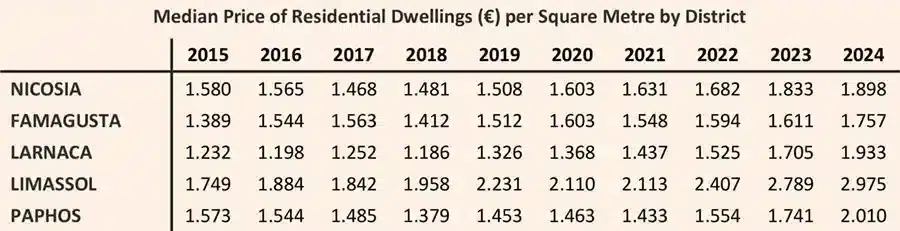
Price of Residential Dwellings (€) The statistical service noted that the revised house price index now shows stronger alignment with other official indices it produces, offering a clearer picture of how property values have evolved over the past decade. Further details on the methodology are available in Cystat’s published methodological information.

Following the revision, the House Price Index for the second quarter of 2025 was estimated at 147.24 points. On a quarterly basis, the index recorded a decrease of 1.9 per cent compared with the first quarter of 2025. However, on an annual basis, prices continued to rise, with the index showing a year-on-year increase of 2.7 per cent compared with the second quarter of 2024.

To coincide with the revision, Cystat also released a comprehensive analytical report titled “House Price Index 2015–2024“. The publication provides in-depth analysis of the revised index and its sub-indices, covering both new and existing dwellings.

The House Price Index measures quarterly changes in average residential property prices, including apartments and houses, with land values incorporated. Data and weighting for the index are sourced from the Department of Lands and Surveys, ensuring broad market coverage.