Cyprus property tax receipts plummet

THE DRAMATIC fall in state revenues must be causing major problems for the Cyprus Finance Ministry. According to Stockwatch, the fiscal situation is so dramatic that if revenues continue to decline, the only way to keep deficit below supervision level is to suspend development expenditure for 2009 and delay payments and transfers.

During August, the state received €78 million; 27% less than August last year, which corresponds to 0.5% of the island’s Gross Domestic Product.

The largest fall in revenue has resulted from the collapse of the property market. Tax collections resulting from the sale and acquisition of real estate plunged €200 million in the first eight months of the year.

Cyprus Inland Revenue Department collections January - August 2009/2008

In total, the Inland Revenue Department collected €189 million less from direct taxes in the first eight months of the year. Together with the €169 million that it lost from indirect taxes, the total decrease stood at €356 million, which corresponds to 2.1% of GDP.

According to official figures, the budget deficit in the first half reached 2.4% of GDP. Since then, Cyprus has lost €160 million more in revenues from direct and indirect taxes.

According to Stockwatch, if those trends continue the state might lose more revenues of €300 million or 2% of GDP in the last four months of the year. To keep deficit below 3%, the government must cut its expenditure by millions of Euros in the next few months or even delay the payments and transfers. This would entail suspending the development budget. It is not accidental that in the first seven months of the year the government executed only a small part of its development budget of €1.3 billion, despite its commitment to accelerate development projects.

(Last week the Finance Minister, Charilaos Stavrakis, spent a night in the Nicosia General Hospital’s cardiology unit with chest pains. Although his doctor said the minister was in good health and there was nothing to worry about, minister blamed the scare on “too much stress”.)

Cyprus government Title Deed proposals

cyprus-govt-proposalsTHE government has submitted four draft bills to help solve the Title Deed issue problem. In addition, there is a private member’s bill submitted to the House by lonas Nicolaou MP. In brief, this is what they say:

  • A building amnesty is proposed for those buildings/individual units that have not been built according to their building permit. It refers to those cases where the approved building density has been exceeded by up to 30 per cent, increased in height, increase in floor numbers, not keeping the maximum distances etc. Amnesty will be given to those cases that the Special Committee (to be appointed) will approve, with the main criteria being that the “illegality” does not affect the interest of nearby properties. This is not a straightforward procedure, but in all cases (save changes of use etc) there is a certain route laid out how one can secure a Title and transfer on one’s name.
  • Depending on the extent of the building violation, there will be three types of Titles:
  1. ‘Final Title’ (with no violations);
  2. ‘Incomplete Title’ (on which the violations are minor and will be so recorded on the Title);
  3. ‘Incomplete Title’ (which will include serious violations and they will also be recorded on the Deed).

This third type of Title will not be allowed to be sold/transferred, mortgaged etc, until and unless such violations are removed. In this way, practically all will get a Title of one type or another. The local authority would have the right to ask for a Title to be downgraded or upgraded, if any illegalities appear (or are removed) after the Title issue.

Titles with non serious violations will have to pay compensation for the violation as set by the Lands Office and approved by the Committee.

Building density that exceeds limits by 10 per cent, the erection of an added floor, the intrusion of one’s building to a neighbour’s plot etc are considered serious violations and as such these Titles will attract the ‘incomplete Title’ (in addition the rights of third parties, local authorities etc to take action).

  • Some red tape is passed to private enterprise and some procedures are shortened.
  • The Specific Performance law is proposed to be changed, increasing the deposit time from two to four months, special provisions are introduced so that contracts can be deposited later and more protection is given to the buyer in case of mortgages etc.
  • The Certificate of Final Approval is now unrelated to the occupation of a building (subject to certain conditions) and this must relieve many buyers.
  • The Supervising Engineer must inform the local authority if the project is being developed not in accord with the permit (during construction).
  • A Division Permit will be issued at the same time as the building permit, saving thus around six to eight months for the Title time issue.
  • The Certificate of Approval can be sought by any interested party, including buyers, mortgagors etc, if the developer does not submit such an application.

These proposals are now the subject of discussion by interested groups and parties, and it is expected that once the deliberations finish, a final proposal will be submitted to the House by the end of the year. Although these measures will help ease the situation, they do not go far enough. Of course, the greater the change, the more difficult is to get the proposals approved.

As time passes, we feel more and more that the British or Greek system on Titles is better. In these countries, the securing of the permit is one thing and the Title issue is another (as opposed to our system which implies that 100 per cent of the building permit conditions must be adhered to before the Title issue).

Antonis Loizou & Associates Ltd


Editor’s comment

The proposals will be welcomed by those who are currently unable to obtain Title Deeds to properties they have purchased due to planning irregularities, which may have been caused by ‘indiscretions’ by the property developer during its construction or by illegal changes made subsequently by its ‘owners’. Speeding up the prerequisite processes involved in issuing Title Deeds will also be welcomed.

However, the proposals will be of little comfort to those who have been duped into buying mortgaged property and who face the very real threat of losing their homes if their developer goes bust (see the article Title Deed legislation too late for Paphos home ‘owners’).

The mortgaged property problem is an extremely serious issue that the Government needs to address without further delay.

Ownership & illegal construction

Regard to the comments made by Mr Loizou concerning the British or Greek system on Titles, there needs to be a clear distinction between the systems of ownership (i.e. Title Deed legislation) and building/planning/construction irregularities (i.e. Planning legislation).

For example, a Vehicle Registration document bears the name of the vehicle’s legal registered owner. That owner may sell or dispose of that vehicle in what ever way he wishes regardless of whether that vehicle is roadworthy or has an MOT certificate.

The two systems – that of vehicle ownership and its roadworthiness are completely separate; you can sell a vehicle without an MOT certificate.

The same principle needs to be applied to property.

Incomplete Titles – serious violations

The proposal is that properties with this type of Title cannot be sold/transferred, mortgaged etc, until those violations are removed.

I envisage situations (e.g. where a property developer has built an illegal three floor apartment block rather than a legal two floor block) where the demolition or partial demolition of the structure may be necessary. In this eventuality who will compensate the buyers of the third floor apartments, who may have bought the property in good faith, for their loss?

Similarly, if serious violations have reduced the market value of properties built in the vicinity of the illegal construction, will the owners of those properties be compensated by the offenders?

Certificate of Final Approval

I have to disagree with Mr Louizou’s assumption that buyers will be relieved that the Certificate of Final Approval will be unrelated to the occupation of a building.

Unlike other EU countries, where properties are independently inspected while under construction, Cyprus employs a self-regulatory system. Therefore the independent inspection of completed properties, and subsequent issue of a Certificate of Final Approval, is a vital safeguard to ensure that properties are built in accordance with the planning and building permits issued for their construction, and that they are safe and suitable for human habitation.

Summary

The Government’s proposals will undoubtedly help a number of people obtain Title Deeds to properties they have bought. But regrettably, they fail to address the most serious issue; those who have been duped into buying property built on mortgaged land and who face losing their homes if their developer goes bust.

The proposals are now under discussion and it is anticipated that the final proposals will be submitted to Parliament by end of the year.

Although they will help ease the situation, they fall short of giving consumers adequate legal protection from the crooks and conmen that plague the Cyprus property industry. Hopefully the government will take note of the concerns expressed and amend their proposals accordingly.

Full details of the Cyprus government proposals may be found on the website of the Interior Ministry – English-language translations have yet to be published.

Larnaca marina project will boost construction sector

larnaca-marinaTHE LARNACA marina and port project will inject up to one billion Euros into the construction industry and provide a much-needed boost to the economy, said Communications Minister Nicos Nicolaides on Tuesday.

The minister said negotiations will begin next Tuesday with the winning bidder, A. Vouros Consortium, after one of the losing bidders withdrew their appeal at the Tender Review Board on Monday, opening the path for the project to move ahead.

Nicolaides described it as “one of the largest infrastructure projects ever undertaken in Cyprus” adding “it is an inspired project for Larnaca and for all of Cyprus”.

The total project is expected to generate one billion euros in cost, without any burden on the state, as a private company will take on the study, finance, construction and management of the project for 35 years after which it will be returned to the public sector. The project’s construction and subsequent operation is expected to add a huge boost to the economy, said Nicolaides.

Development involves construction of a port, 1,000-berth marina, hotels and houses. The minister said he expected the port to become the first port for tourism in Cyprus, as well as a transit centre for commerce in the EU.

Although the finer details of the joint venture between the state and private consortium have yet to be negotiated, the public official estimated that the state would earn seven per cent of the total revenue of the consortium annually. He calculated that for a 35-year-period, “we are talking about a sum that goes beyond €100m at today’s value”.

Copyright © Cyprus Mail 2009

Cyprus divides industry on Title Deed proposals

property-poolInterior Minister Neoclis Sylikiotis recently announced a series of measures to help speed up the issuing of Title Deeds to property buyers. This includes legislation to allow properties not built according to their original planning permits to have their Title Deeds issued, and to remove obstacles for single properties located in larger developments.
An estimated 130,000 properties are without Title Deeds, including around 30,000 purchased by foreign buyers. The government’s official target is to have 20,000 deeds issued by mid 2010.

Positive step?

Savvas Georgiades, of developer Aristo, welcomed the proposals. “We believe that the simplification of the whole process will help enormously,” he said, adding that “90% of the deeds are not expected to be problematic, with the other 10% having problems regarding unauthorised changes to their plans and these could be corrected by the amnesty measures proposed by the minister”.

However, David Pollard, commercial director of agent Universal Vacations Realty, questioned the effectiveness of the proposals against the practices of taking out mortgages on the sold property. “Simply bringing out new laws will not increase the speed at which some developers apply for Title Deeds,” he said, “It will only make them more inventive because they have too much to lose.

There is also a view that buyers have contributed to the Title Deed situation.

Although there are many who claim they do not get their Title Deeds on time there is still a large percentage that does not want to pay the hefty transfer fees (up to 8% on the purchase price),” said Panayiotis Makedonas, Sales & Marketing Director of Country Rose. “In addition to that there is n interest or penalty inflicted on the buyer if he does not transfer. In spite of this, it seems that the developer is always the bad guy!

© Overseas Property Professional

Cyprus construction sector shows signs of recovery

THE STATISTICAL Service has announced that the number of building permits authorized by the Municipal Authorities and the District Administration Offices during June 2009 was 818.

The total value of these permits, which were for the construction of both residential and non-residential properties, reached €383.4 million and their total area 359.7 thousand square metres.

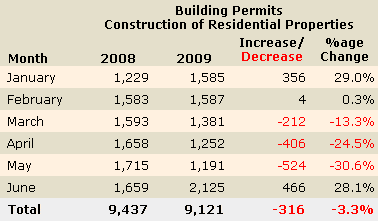
Building permits for the construction of residential properties increased by 28.1% compared to June last year, following a 30.6% reduction in May.

During the period January – June 2009, 4,515 building permits were issued; an increase of 5.0% compared to the corresponding period last year. Although the total value of these permits increased by 9.2%, their total area decreased by 5.1%.

The overall reduction in the total area of building permits issued and the rise in their value may result from property developers focusing their efforts on the luxury property market, which has suffered less from the global economic downturn.

building-permits
Number of residential properties for which building permits have been issued

Compared to last year, the total number of residential properties for which building permits have been issued has fallen by 3.3% as shown in the table above.

Title Deed legislation too late for Paphos home ‘owners’

bank-of-cyprusACCORDING to Minister of the Interior, Neoclis Sylikiotis, the Cyprus property sector is in good form.

In statements made recently by the minister, Sylikiotis said that “property investment is much safer in Cyprus than anywhere else”. He also accused the media of misrepresenting the island as “an unreliable place for investment in the property market due to a problem of issuing title deeds”.

The story is well-known by now. With the economic crisis badly hitting Britain, Cyprus’ chief property market, sales have slumped and some developers are struggling, fuelling fears that, if they go under, the banks will repossess homes remortgaged for developer loans.

The government says that it is tabling legislation which will specifically facilitate the release of 20,000 deeds by the end of 2010.

But the Cyprus Property Action Group (CPAG) which has been canvassing for the release of deeds since 2007, is not confident that it will be passed owing to what it describes as ‘vested interests’ of particular MPs.

In reference to the court route, Sylikiotis said that the current system in Cyprus actually protects disenfranchised buyers waiting for their deeds.

CPAG says that such a course could be extremely costly, lengthy and without any guaranteed positive outcome for the claimant. One such case has been adjourned 17 times over seven years.

Sylikiotis’ insistence that all is quiet on the property sector front is unlikely to give much comfort to two Paphos property ‘owners’ whose homes in Paphos village do not even have the completion certificates necessary for deeds and whose developer has gone into liquidation.

In 2007 it transpired that the developer, Yiannis Liasides, had mortgages on the land of an entire development and was in serious financial straits. Homeowners took measures to find out details of the extent of the debts connected to their properties and discovered that they were far in excess of what they had initially been told by their lawyers.

Liasides recently declared himself bankrupt. Two couples who have been told point blank by their banks, that their homes could be taken away in order to cover the debts, spoke to the Cyprus Weekly about their worries.

In 2002, Roy and Diane Lloyd-Roberts bought a single from the developer. The stress that has plagued the couple over the matter in the past few years has cost them their marriage.

The mortgage was taken out on our property just before we bought and we would definitely have refused to go ahead with the purchase if we had been informed of this at the time by our lawyer, whom we gave power of attorney.

Recently we visited the lender bank who informed us that our developer had not paid anything back from loans he took out on our property in 2002! We also found out that our particular loan balance has gone from the original €59,800 to a figure of over €85,500 with the added interest.

The bank could repossess our home at any time

The bank suggested that we may want to take a loan ourselves to pay off the developer’s mortgage as the bank could repossess our home at any time to recover any outstanding loans.

We are not in a position to take out a loan and why should we have to? We have already paid for the land and villa! The receivers could sell our property at a reduced price to settle the mortgage and just give us what is left over. This is why the banks don’t care if developers don’t pay anything back for seven years!

The stress has cost Roy & Diane their marriage

I had a major operation just five months ago and am not fully recovered yet. The whole thing has left me feeling, scared, helpless, and trapped. It has caused untold misery between my husband and myself to the point that we have now separated and are in the process of getting a divorce.

Pete and Judy Adams arrived in Cyprus in 2002. They tried several developers but were most impressed with Yiannis Liasides because his company was young and they liked his ideas.

Our lawyer went into a rage and screamed at us for challenging her

One of our main complaints is with our lawyer. She didn’t look after our interests at all. She was the same lawyer as one of our neighbours and put a clause in the contract that paid off the mortgage with a stage payment. She didn’t do that for us. When we went and enquired about what we hadn’t been advised about, she went into a rage at us. She screamed at us asking how we dared come in and challenge her.

more stressful than anything we faced in our working lives

Both I and my wife had stressful jobs in the UK. I in particular had what I would describe as a few mucky ones. But we can honestly say that this experience has been more stressful than anything we faced in our working lives

If Cyprus was serious about getting this mess sorted, it could take some of Spain’s market. Spain has had some very bad press which has turned buyers away from there. Those buyers could have considered Cyprus as an alternative for retiring or moving to but are unlikely to do so while this debacle continues.

We are actually still on good terms with Yiannis. We think he trusted the wrong people and one thing led to another. We don’t think he set out to defraud anybody.

What we want is for the bank to say to us that, because we didn’t take the mortgage out, they don’t hold us responsible for paying it back. Why should we?

We don’t understand the way banks lend money. Why give a loan, and in one case we know of, not get one penny back in seven years? We don’t think this matter will ever be resolved while lawyers and developers are in positions of power.

The whole experience has soured Cyprus for us all. All we want to do now is get out of here and move somewhere peaceful. Like Beirut.

©2009 Lucie Robson