Proposals to untie the Gordian knot

YESTERDAY, Cyprus Interior Minister Neoclis Sylikiotis announced a series of measures, including a town planning amnesty, to untie the “Gordian knot” keeping 130,000 properties on the island without Title Deeds.

Neoclis Sylikiotis said that the Ministry had taken action to counter “malevolent” foreign press reports about the Title Deeds saga. He attributed the reports to ‘ulterior motives’ that either sought to strengthen Cyprus’ competitors in the foreign investment market or compare the Republic’s treatment of buyers with the abuse of Greek Cypriot properties in the north.

The Minister announced a number of legal proposals that seek to tackle the complex problem of “trapped buyers” who are tied to a building that they cannot sell because they don’t have the Title Deed.

The new proposals include the introduction of a completely new system for issuing Title Deeds which will be divided into three categories, as well as penalties and a “name and shame” policy for developers that delay Title Deed applications.

This was the first time that a government had acquired a “comprehensive view” of the wider problem, said Sylikiotis, adding that bold steps had to be taken and not piecemeal changes.

The water is running now and very soon people will start getting Title Deeds,” he said.

There are currently around 130,000 units (houses, flats, hotels) without Title Deeds, while only 20,000 applications for Title Deeds have reached the Land Registry. This translates to a lot of uncollected revenue for the state in terms of taxes on transfers and other costs.

Finance Minister Charilaos Stavrakis has previously noted that €700m was collected in total tax revenues from property sales in 2008, while forecasts for 2009 were less than half that amount.

Sylikiotis told reporters that he hoped the 20,000 pending Title Deeds would be issued by June 2010. He further noted that in the free areas of Famagusta alone, around 25,000 titles had not been issued.

Head of the Land Registry, Andreas Christodoulou said that for every 10,000 titles and transfers completed, the state would receive between €100m and €120m.

The five legal proposals target amendments to existing laws on Town Planning, the Regulation of Roads and Buildings, Immoveable Property, the Sale of Land, and Contract Law.

Interested parties may read the proposals on the Ministry website and submit their comments by the end of next month. The Minister hopes to table the amendments before parliament by September and have them voted into law by the end of the year so the town planning amnesty can begin in 2010.

One of the proposals is to create a three-tier system of issuing Title Deeds, though Ministry officials acknowledge they are not certain whether the system will pass legal scrutiny yet.

The first type of Title Deed will be a “complete” Title Deed which is the same as what is issued today. The next type is called the “incomplete” Title Deed. This will be issued with an appendix noting any unauthorised but minor extensions or modifications that go beyond the issued permit, or in cases where it is not possible to identify the property boundaries for which a single unit of the whole project has exclusive rights. The third type is called the “limited” Title Deed, which will also have an appendix recording unauthorised yet substantial changes or extensions. This latter title won’t have legal status, meaning the owner can’t sell their property nor can they mortgage it.

Sylikiotis explained that the Title Deeds hierarchy would be effective since a deed could be upgraded or downgraded, depending on developments.

The Ministry also proposed imposing fines in cases where owners are reluctant to meet their obligations, thereby preventing the issuing of Title Deeds in the name of buyers who have met all their obligations. Another proposal is to make public the names of companies who are considered “repeat offenders” of this practice. This way, every future buyer knows the credibility and capabilities of the various developers, said the Minister.

The Ministry also hopes to make it compulsory to submit the contract of sale to the Land Registry, with specific sections of a building delineated as set out in the contract. Another innovation will be to give competent authorities the power to take the initiative and issue permits on the request of the buyer.

For example, where the developer fails to submit the necessary applications for approval of certain irregularities or uses the irregularities of buyers not to proceed with issuing certificate of approval or Title Deed, the competent authority may, after representations from the purchasers, automatically proceed with the examination of the building and issue various permits and approvals, with or without special notifications,” said Sylikiotis.

The amnesty will be handled by three-member committees in each district that will deal with expansions or modifications that represent up to 30 per cent of the original permit. However, this only applies to buildings constructed before the law is passed.

Copyright © Cyprus Mail 2009

Cyprus Interior Minister’s Statement on Title Deeds

FOR SOME time now, there has been an attempt, driven mainly from foreign media, to present the Republic of Cyprus as an unreliable place for investment in the property market due to a problem of issuing title deeds.

The Ministry of the Interior and I have repeatedly, and in multiple ways, stated that those allegations are entirely unsustainable, and, in any case, they ignore our serious efforts for the reformation of the whole system of issuing property titles in Cyprus.

Our policy aims to boost the property market in Cyprus, introducing effective and comprehensive practices for solving this problem. Within this context, the Ministry of the Interior has already completed the drafting for the amendment of four legislations concerning property registration and building permission procedures.

The amendment of the four legislations primarily aims to address the current full dependency of the procedure for issuing title deeds of separate housing units in comprehensive housing projects from the will and initiative of the owner-seller.

Also, provisions will be introduced which will allow the competent Authorities to encourage developers to apply for the issuing of title deeds. In addition, the measures entail new regulations, which will enable the issue of permits for certain irregularities to buildings that are not covered by permit, by imposing appropriate conditions and obligations in respect to the compensation of such irregularities.

In fact, the amendments will be a significant reform of the planning system, and will largely improve the system of issuing property titles, providing for solutions to several problems identified in the current system. Overall, the proposed amendments will contribute to the speeding up of the issuing of title deeds, whilst our goal is the issuing of some 20.000 title deeds by mid 2010.

In essence, since proposed legislative amendments accelerate the process and remove obstacles for the issuing of separate title deeds for each individual unit in larger developments, any aggrieved buyer will have readily available the option of applying for a court order, which in effect will order the seller to transfer the title deed on the name of the buyer.

If the seller still refuses, the court orders another party to compulsorily transfer the title deed. Furthermore, amendments will allow authorities to enforce a penalty fine to any unwilling seller, in order to encourage timely responses and the cooperation of sellers, while the Minister will have the power to publicize the names of sellers who are not cooperating with authorities on these procedures.

These significant improvements will surely benefit, not only new buyers, but also people who have already signed such a contract for buying a housing unit that is part of a development project, and find difficulties in having their title deed.

Despite our determination to cut this Gordian knot with the introduction of new legislation for the improvement and reformation of the planning system, as well as the system of issuing property titles, it must be clarified here that even the current system and the existing legislation protects buyers and their ownership status.

In this regard, any aggrieved buyer can appeal to courts against the seller who refuses to abide to his obligations and transfer the title deed to the buyer-owner. It must also become clear that the ownership status of a buyer-owner of immovable property in Cyprus is definitely secured and cannot be challenged, as long as the buyer-owner has submitted the buying-contract to the Department of Lands and Surveys.

In conclusion, I should stress that in the Government controlled part of Cyprus, the case of a property-seller bankruptcy is quite rare; in fact, our record on this is much better than most other European countries.

In that sense, the property market in Cyprus is stable and secure, and property buyers must be absolutely certain that their investments are safe here; indeed, property investment is much safer in Cyprus than anywhere else. Indicatively, I could mention that despite the global financial crisis and the collapse of the property market all around the world, and in much of Europe, the estate market in Cyprus is quite healthy and still in positive growth rate.

Furthermore, there is something that one must not forget. Nobody and no Authority anywhere can ever challenge the property rights or the ownership status of buyers of immovable property within the territory which is under the control of the Republic of Cyprus.

Neoclis Sylikiotis
The Cyprus Minister of the Interior
22nd July, 2009

Cyprus market at risk from unsold houses

THE SHARP drop in the demand for property in Cyprus has pushed the number of unsold apartments and houses up considerably, with some developers now offering discounts of up to 30% fearing that the situation will worsen in the coming months.

In the first half of the year, developers tried to attract buyers with gifts such as free air-conditioning etc. In the second half, they couldn’t bear the pressure of the economic crisis and decided to cut property prices“, Chairman of Real Estate Agents’ Association, Solomon Kourouklides told StockWatch.

Some believe that big discounts are being offered in the expectation that the situation will worsen after September, when the problems in the tourist sector will be reflected in the Cyprus property market. According to Antonis Loizou “The property market will sink to the bottom after September. Areas such as free Famagusta, Avgorou, Dasaki Achnas, Xylofagou, Tersefanou and the seaside areas of Paphos might be under strong pressures“.

According to Loizou, the drop in prices is mainly attributable to the low demand and developers’ attempts to pay the cancellation debts of many buyers – mostly British – who cannot pay their debts and return their purchases.

Cybarco sales representative, Alexandros Sinka, explained that the large number of unsold apartments and houses are a financial burden for developers due to their cost of maintenance. “As time goes by and there is a large number of unsold apartments and houses, the chances of them being sold are minimized due to their wear and tear“.

Sinka also linked the discounts to the strategy that developers adopt to increase the Company’s capital adequacy during the tough economic crisis.

Property valuator, Haris Timotheou from Danos Consultants and Valuators, stressed that this period is a knife that cuts both ways for the developers.

On the one hand, the land developers try to minimize the loss from the market freezing and push prices down, while on the other they have a significant number of indisposed properties that if they remain unsold, they will be loss-making for themselves“, he said.

Mr. Timotheou agreed that the problem affects the coastal areas such as Protaras, Pissouri and Paphos. However, he believes that city and town areas will also be at risk if the property market fails to recover soon.

Chairman of Land Developers’ Association, Lakis Tofarides wondered how developers can offer 30% discounts without giving the impression that prices formerly were unjustifiably high.

The base cost of the developers’ materials does not allow such discounts. Only in specialized cases such as tourist areas like Paphos, Protaras and Tersefanou, where houses of 100 sq. meters were built for non-Cypriots exclusively, justify such discounts.”

There is a general acknowledgement that these discounts indicate a significant decline in prices being offered, which may signal further discounts. Chairman of the Valuators’ Association, Charalambos Petrides agreed that prices of non-competitive properties have declined by up to 30%. He clarified by saying that even though prices remain stable in Nicosia and Limassol, prices of properties of secondary importance have fallen by 5%.

Mr. Kourouklides anticipates that property prices will continue to be under pressure in the second half of the year, while this decline might expand to cities.

Details of Title Deed proposals to be announced

Presidential Palace in Nicosia

THE CYPRUS Interior Minister is considering measures and new legislation aimed at speeding up the issue of Title Deeds to the 100,000+ properties without them. However as any proposed legislation needs the approval of the House, MPs with vested interests could scupper his plans.

It is understood that these proposals will be targeted at clearing the logjam caused by various misdemeanours by property developers, buyers, and bankers as well as bureaucratic delays in the Land Registries.

In summary, the measures are as follows:

  • Liberal building amnesty to enable properties that have not been built in accordance with the permissions and permits issued for their construction to be ‘legalised’ on payment of a fine by the transgressor. The level of the fine will depend on type, severity and degree of the infringement. The amnesty will not cover intrusions into neighbouring land or change of use, but it could be applicable in cases where building density and floor height limits have been exceeded.
  • Division permits are to be issued at the same time as the cover building permit (currently these are applied for after cover building permits have been issued).
  • Properties forming part of a development complex will be issued with Title Deeds; those with planning infringements being issued with a “temporary” Title Deed. Although the ownership of properties with “temporary” Title Deeds may be transferred to buyers, they may not be resold or mortgaged unless they are covered by the proposed building amnesty.
  • If, when a property is sold, it is mortgaged (or the land on which it is built is mortgaged) the vendor will be required to provide the buyer with a mortgage release from the mortgagor.

The Interior Ministry has received a number of suggestions to further alleviate the problem, but has yet to take them on board:

  • Privatisation of the surveying work carried out by the Land Registry, which is currently overwhelmed. Although it has been argued that the government will receive millions of Euros in Property Transfer Fees, it will incur a considerable additional cost by outsourcing this work.
  • The appointment of an individual from the private sector to act as a ‘super coordinator’ responsible for the supervision and implementation of the above measures.
  • Separation of the issue of a certificate of final approval from the legal occupation of a building. (Article 10 of the Streets and Buildings Regulations Law, Cap. 96, provides that no person shall occupy, use or permit any other person to occupy or use any building, unless and until a certificate of approval has been issued in respect thereof by the appropriate authority).
  • The value of a property at 1.1.80 (on which the Immovable Property Tax liability is calculated) to be assessed by approved valuers at the time of sale and stated in the sales contract. This value will be reviewed by the Land Registry when it issues the Title Deed and adjusted accordingly. The buyer will be liable to pay Immovable Property Tax on production of the Inland Revenue receipts by the registered owner.

The report claims that the main cause of the Title Deed problem results from the recent property boom. But it fails to state that the problem has been around for many years and that although successive governments have made many vacuous promises, nothing’s been done to resolve the issues.

However, it does admit that problems are also caused by developers jumping onto the money-making bandwagon, the attitude of civil servants and staff shortages, the inefficiency of local authorities, and the greed of financial institutions who lend money to just about anyone who asks.

Meanwhile, pressure on the government continues to mount as news of Cyprus’ Title Deed problems reached the U.S.A. when the New York Times printed a story ‘Homeowners on Cyprus Turn to British Courts‘.

Building permits for residential properties down

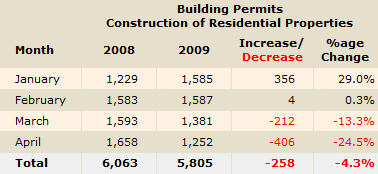
THE Statistical Service announces that the number of building permits authorized by the municipal authorities and the district administration offices during April 2009 stood at 687.

The total value of these permits reached €197.5 million and the total area 234.4 thousand square metres. These building permits provide for the construction of 1,252 dwelling units.

During the period January – April 2009, 2,867 building permits were issued, registering an increase of 2.8% compared to the corresponding period of last year. The total value of these permits decreased by 0.3% and the total area decreased by 8.6%. ?he number of dwelling units recorded a decrease of 4.3%.

However, a closer inspection of the figures reveals that the number of residential properties for which building permits have been issued fell back by 24.5% compared to April last year. This followed a 13.3% reduction in March.

Number of residential properties for which permits have been issued

It is difficult to draw any conclusions from the CYSTAT figures as developers in Cyprus often start construction work before the authorities have issued the building permits. However, with a number of part-completed developments in the tourist areas having been mothballed, it is reasonable to assume that the number of residential properties being built is reducing.

Sea caves destroyed by developer

Sea caves at Peyia near Paphos

DEVELOPERS using heavy machinery to cut into the coastal rock formations are destroying the area of the sea caves at Peyia in Paphos.

On Friday, residents of the area complained to local councillor Linda Leblanc, that a developer was bulldozing the seafront near the sea caves.

As well as causing irreparable damage to the rock formations, they have also laid large pipes to discharge waste into the sea

Andreas Evlavis, the Paphos district secretary of the Green Party suspects the developers might have known they were in the wrong. “The developers have caused a huge amount of damage. When they realised they had been spotted, the driver of the vehicle ran away.

Evlavis said the destruction was the work of a single developer and that the area was protected.

“Immediate action must be taken. The Interior Minister needs to look at the case,” he said.

The Paphos District Office representative for beaches, Andreas Charalambous, was equally upset. “I have been to see this problem for myself and it’s terrible. These people have made a path and small harbour for themselves. The sea is for everyone and this action is illegal. I can assure you that this whole area will be brought back to how it was before parts were destroyed.” He added: “I’m sure that these people will be taken to court.

Peyia mayor Neophytos Akourshiotis gave his own assurances. “The coastal area and the sea caves will be protected.

At the same time he expressed his wish to continue with efforts to establish a coastal walkway from Coral Bay to Saint Georges.

According to Leblanc, similar occurrences have taken place before in the same area and there is an existing case in courts.

Leblanc, who visited the area on Friday and again yesterday morning told the Cyprus Mail, “The work is an intrusion into the coastline. There is a house under construction, which is quite far back from the sea, but where the plot ends and the protected zone starts is difficult to fathom. This construction work is on the cliff’s edge next to the sea. I realise this happened a lot in years gone by but now officials must be more careful to distinguish areas and verify them.

According to Leblanc, the area has been bulldozed solely to provide access to the sea.

The house next door to the construction plot also seems to be in violation of regulations, as they have built a pathway to the sea, complete with their own sea wall.

Leblanc pointed out that the mayor of Peyia was aware of the situation and that she had discussed the matter him recently. “There is very little law enforcement regarding such matters in Cyprus and it appears as if developers and owners seem to think they can do whatever they want,” she said.

The practice of bulldozing the coastline is illegal and prohibited everywhere in Europe.

The law here seems to be weak,” she said,”this is a national protected zone, I think the district office will have a case for court with this“.

According to the councillor, the damage is irreparable and appears to cross over the area of the proposed public pathway.

This is part of a bigger scheme, with the aim of creating a long pedestrian path from Paphos airport to Saint Georges in Peyia.

Leblanc said the neighbours of the building plot are very upset and added that developers and private owners’ awareness needs to be raised. “We must be stricter with the developers and check wording of documents. We can no longer take for granted that they won’t intrude beyond their land.

Leblanc was sceptical about the potential for action. “Are fines really a solution – and will it be a deterrent to others considering doing the same thing? The problem is there is a weakness of enforcement of legislation in Cyprus.

Copyright © Cyprus Mail 2009