Property developer collapses

A&G PROPERTY Wise Development Ltd (A&G), the company operating the Froiber brand in Cyprus, will be liquidated on 17 July for repeated failure to make employer’s social security contributions.

The Social Security Fund (SSF) lodged a request with Nicosia District Court on 4 May 2007 for the company to be liquidated. The liquidation order was finally issued on 18 November 2008, with effect on 18 May 2009. At A&G’s request, the court agreed to postpone execution of the order for two months, to 17 July 2009.

As required by law, the announcement of the request for liquidation appeared in the Government Gazette of 24 April 2008, and will have appeared in at least one newspaper. However, owners of property built by A&G who are still without Title Deeds might still be unaware of the company’s impending liquidation.

In any case, as unsecured creditors, their claims will have to wait in line behind the SSF, the banks and then any other holders of security or guarantees from A&G. Ultimately, they will probably have to argue their case in court.

When contacted by the Sunday Mail to discuss his company’s liquidation, Director and company owner of A&G Georgios Andreou denied “any link whatsoever” with various Froiber companies. The simple fact is that the listed telephone number for Froiber Estates Agents is the same office number given for A&G in its own documents.

A&G’s official accounts for 2003 – the last accounts lodged with the Companies Registry – also demonstrate a direct link with companies such as Froiber Land Developments Ltd, Froiber Estates Ltd, Froiber Marisa Developers Ltd and Froiber Hellas – a 100 per cent-owned Greek subsidiary which made total losses of €1.77 million in 2003, rising to €2.31 million in 2004. The accounts also refer to an 80 per cent share valued at C£749,638 in a UK affiliated company, Southbury Lets Ltd., which entered into voluntary liquidation in September 2005, and was dissolved in August 2008. There is also an unconfirmed link with Froiber (UK) Ltd, whose Chairman listed as a George Andreou, signed a resolution in July 2007 to voluntarily wind up the company. This company was dissolved in April 2009.

So how could a company worth millions on paper fail repeatedly to pay a relatively modest amount – just 15 per cent of payroll, e.g. C£27,000 in 2003 – to cover its social insurance obligations to employees. The SSF routinely goes to court over a debt of €2,000-3,000. It has been suggested by a legal source that A&G owes as much as €500,000. Even with compound interest, it would take years to rack up that amount. If the suggested figure is even remotely accurate, this would imply that at best someone in the SSF has displayed gross negligence.

One clue to the company’s demise lies in the way that treats its customers. Some of them, like Colin Smith, former war correspondent for The Observer newspaper and author of history books such as Singapore Burning, got his Title Deed a mere five years after taking possession of his Froiber flat in June 2003.

Others have not been so lucky. Maria (not her real name) signed an agreement with A&G in April 2000 to buy a property in a Froiber block of nine flats. She took possession in August 2000, and has an official statement of account proving that all outstanding amounts had been paid.

Having finally lost patience after years’ worth of empty promises from Andreou regarding their Title Deeds, Maria and the eight other flat-owners – who had also paid in full – consulted a lawyer in December 2008.

The lawyer established that Title Deeds for all nine flats had been issued in December 2008 in Andreou’s name and he was promptly informed that if he did not proceed immediately to transferring the Title Deeds, he would be taken to court.

In mid-December 2008, Andreou sent a letter to each flat-owner, claiming insurance, sewerage, Immovable Property Tax – which was not payable on Maria’s flat, as its value was below €100,000 – and Transfer Tax for the period 2000-08. Despite the fact that the amount claimed was excessive, the lawyer advised Maria and the others to pay anyway, if it meant getting their Title Deeds.

They did so on February 2 2009. The Sunday Mail has a copy of Andreou’s written commitment on February 4 that, since “all of the flat-owners have paid the amount due on each flat“, he would transfer the Title Deeds to all of the flat-owners “within three weeks of today’s date“.

The lawyer obtained an execution order from Nicosia Court on the basis of Andreou’s written commitment, to be carried out on April 3. A&G failed to attend the Land Registry on the date set by the court. Instead, Maria and the others each received another copy of the bill for outstanding taxes, this time with a note saying: “The above amounts have been paid off. There remains a balance of €5,000 to cover the company’s administration costs, which must be paid on the day the transfer is effected.

Maria has now sued Andreou for non-performance of his various commitments. The writ was registered with Nicosia Court last month, but will only be heard on 17 September, in other words, two months after the court order to liquidate A&G is executed.

Maria said she had learned through a legal acquaintance of Andreou’s own lawyer that the developer had not paid any of the state taxes he had collected from her building’s residents. Andreou’s lawyer is reported to have said: “Tell them to light a candle, make a votive offering and pray that he pays the taxes so that they can get their deeds.

So what went wrong with A&G?

Its official accounts for 2003 show sales of C£2,200,200 plus C£1,838,935 in unsold stock (compared to C£534,069 the previous year), against a total cost of construction (including the cost of land) of C£3,566,970. A&G declared a gross operating profit of C£401,968, and a net profit of C£228,821 (around €393,000).

One can dispute the accuracy of a property developer’s accounts which include stated values of land, unsold stock and “work in progress“, and assets and balances of affiliated property companies. What stands out in A&G’s 2003 accounts is the C£1.84 million received as downpayments from clients plus C£1.91 million in unspecified “commercial debtors” on the credit side, and the C£2.02 million interest-bearing liabilities plus C£5.47 million in bank overdrafts on the debit side.

The bottom line is that in 2003 A&G declared current liabilities totalling C£8.74 million, which it would not be able to repay on demand in order to remain solvent.

A note in the accounts says that its long-term loans and bank overdrafts were secured by C£10.07 million in mortgages on land and buildings and C£2.04 million in assigned sales contracts (some €8 million with Universal Bank alone), and a further C£2.02 million in current charges and guarantees.

There is a question regarding what A&G has been doing since the liquidation order was requested in May 2007. The Official Receiver’s office said that Cyprus law allows a business to continue to operate normally, because at that point its financial status has not changed legally. Between May 2007 and November 2008, when the order was granted and a liquidator appointed, A&G will have been free to sell any stock it may have had, with no obligation to disclose to the buyer that it might not be in a position to have the Title Deeds issued.

Today, the Froiber website (www.froiber.com) is the internet equivalent of a deserted office containing a pile of unopened mail. Clicking on the links “Homes for Sale“, “Apartment Find“, “Real Estate Leads” and “Apartment Lease“, one gets the message: “We were unable to find results for your search term“.

But the liquidation of A&G will not necessarily mean the end of Andreou’s business career. In the UK, the law ensures that directors of bankrupt companies are disqualified on the basis that their conduct calls into question their fitness to be involved in the management of other companies.

Not in Cyprus. According to the Official Receiver’s office, someone who is personally bankrupt is disqualified, but a director of a bankrupt limited company is legally entitled to act for another company.

It is important to remember that the request to liquidate A&G was made in May 2007, more than a year before the global economic crisis began in the United States and spread outwards.

The fundamental reason A&G has gone bust is not the crisis, but the fact that the existing legal and regulatory framework in Cyprus allows a builder with five years’ experience to set up as a developer and apply his own standards of commercial behaviour. Factor in a bank or two willing to extend loans on a questionable basis – from a financial if not a legal point of view – and the prospects are grim for many who decide to purchase a new home from a developer.

It is hard to avoid the conclusion that when it comes to property rights, the legal and regulatory framework – and by extension the political system – in Cyprus is treating citizens like Maria with a degree of cynicism that borders on contempt.

Copyright © Cyprus Mail 2009
Prices in Cyprus down & worse to come

In its annual Property Market Index presented by The Cyprus Weekly, property valuers and property consultants Antonis Loizou & Associates Ltd present the real picture of the property market today, based on their own information and data and make a forecast for the future of the sector.

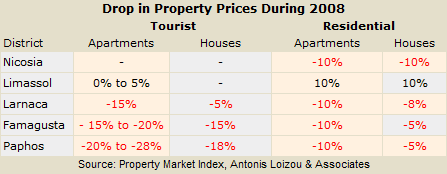
The firm calculates that prices are down between 5% and 28% in some areas (mainly Paphos, the free Famagusta areas and Larnaca) whereas in other areas, such as Limassol, they are unaffected or have actually risen.

Demand is down by 50% from foreign buyers, and 20% down among locals.

The firm does rule out further falls in prices since, “as time passes and the situation does not improve (as regards the economy), then the drop in prices will increase so as to balance to a certain extent the drop in demand.

The worst period for the property market is expected to come just after this summer because, the firm argues, that is when the extent of lower revenue from tourism will become evident.

Nevertheless, there is still room for optimism because of a series of characteristics of the island and the local population. These include the antiquated system of forced sale of property and the mentality here not to sell property below cost.

It is also worth noting the fact that the property sector, the second largest in Cyprus after tourism, has more than 40,000 employees and generates some €1.2 billion a year in foreign currency.

Comparison to other countries in Europe

The chapter projections for 2009 as of December 31 compares Cyprus to various countries in Europe. It refers to Spain which has similar economic characteristics with Cyprus (emphasis on tourism and property sales to foreigners).

The market there has sustained a 25% drop in prices, with one million housing units on the market. The report notes “the drop in prices so far seen in Cyprus is at similar levels.

There are some 200,000 unsold units in Greece and prices are down by around 18%.

On the other hand, Cyprus is in a much better state than countries such as Romania where demand from abroad has sunk to nearly nothing while local banks are not issuing loans, thus affecting local demand. At the same time, Bulgaria has disappointed foreign investors, with thousands of flats on sale. Developed countries such as Ireland have also experienced a similar drop in prices, while commercial property in the UK expects to see a drop of more than 30%.

Life-saving delays

What ‘saves’ prices in Cyprus according to the firm of Antonis Loizou is the outdated system of selling mortgaged property. Based on the existing system, this could take between five and eight years, and if involving a permanent home could range between 10 and 12 years.

In contrast, in the US for example, delays in repaying a loan allows the mortgage holder to proceed with a foreclosure in about two to three months. In the UK it takes three to five months and in Greece about six.

The firm estimates that there are between 1,500 and 2,000 delayed mortgage repayments.

You can appreciate what the impact would be if these units could be sold in 2009,” it says.

The firm estimates that if forced sales could be carried out immediately in Cyprus, then prices for property that has nothing in particular to offer would fall by 30%.

On the other hand, Loizou notes that the antiquated system of forced sales which in good times is a problem for banks can now be positive for financial organisations. “The forced sale property with high loans and at low prices is not in their interest and if it took place would lead to large losses on their balance sheet.

Problems for businessmen

But the study anticipates that the problem will intensify in 2009 among property developers.

According to the Sunday Times, every single person with financial problems has a knock on effect on another three.

With this in mind, Loizou notes that “if one company does not have economic problems but is owed money it will be affected. Already, cheques without collateral are on the rise and there are delays in payments.

One example given is that of a land developer in the process of constructing a 48-unit project in Larnaca. He had sold 16 and was forced to start building. But in the process, six of the buyers cancelled their projects, construction stopped and the contractors were fired. Some buyers are selling below cost, something which triggers similar action by others.

An encouraging note on the other fact is that interest rates will fall within this year. Already in the US, the cut in interest rates by 20% has led to a 40% increase in housing. The fact that both the local and world economy is expected at the end of 2009 early 2010 is extremely positive. “This short time period is an encouragement to hang on to property, therefore curbing cuts in prices.

The problems with VAT

The imposition of VAT on new property may lead to two prices on the markets.

That is because the tax will be imposed by the sellers who are registered on the VAT register and, therefore, the buyer will pay VAT or not depending from whom he is buying. In additional, VAT hampers the market since it raised prices by 7-8%, compared to the pre-VAT era.

Interest and cheaper loans

The report notes that banks are unable, despite the government’s injection of €700 million to lend to third parties long term.

That is why the firm is proposing three measures it believes will help lending:

  • Abolition of charges to transfer a mortgage from one bank to another. At the moment, borrowers who have mortgaged their property cannot shift their loan to another bank because they will have to pay the charges once more. If these charges are abolished, as the Central Bank also proposes, there would be room for competition to secure loans with low interest.
  • Leasing legislation: this is a method used by companies all over the world to create liquidity from their assets, thus reducing the need for financing. The relevant bill has been drafted but it is not clear when it will be passed into law.
  • Improve working conditions at the Registrar of Companies – the better this office works to respond to the need of lawyers, auditors and other, the more deposits will be made.

Construction costs

The sharp increase in construction costs observed the past few years led to more expensive properties and has held back construction activity.

When the cost of construction rises at a faster rate than home prices, this erodes the profit margins of property developers and dampens their incentive to operate.

Construction costs are expected to be down by 15% in 2009.

Indicative of this is that from 2000 to 2007, the labour cost index in construction rose by 27.5% while the construction materials index soared by 131.4%. During 2000 and 2006, the production index in housing rose by 50% which reflects the cost of acquiring land as a result of faster increase in price compared to the increase in the price of homes. The report sees this construction cost as continuing to rise, having a negative effect on the building sector. Nevertheless, building costs are expected to fall in 2009 because of pressure on contractors and suppliers, but also because of lower costs in the production of steel, aluminium and other raw materials.

2008 – An unpredictable year

The report described 2008 as the most unpredictable year in the history of the island’s property market.

And this was because the first three months saw a continuation of the sharp increase in prices and demand of 2007. Playing a part in this was the anticipation that VAT would be imposed on the sale of building land sometime in 2008 as well as the relaxation in the down payment to banks for a first home from 30% to 20% and for a holiday home from 40% to 30%. But demand began to fall after April 2008 because of the increase in prices and in interest rates. September 2008 was a landmark. The crisis struck Cyprus suddenly in September 2008 as if a rope had snapped.

It was particularly felt in the British market and in demand for holiday homes.

The drop in the value of the pound sterling vis-à-vis the euro was an important contributory factor. It not only affected demand for Cypriot property but increased living costs for some 40,000 Britons who have bought houses here. Things became even more serious when, as demand from foreigners and Cypriots plummeted, existing foreign property owners started selling their property at 20% to 30% lower prices than in 2007. The table below shows the drop in prices per district according to the estimates of Antonis Loizou and Associates and ranged between 5% and 28%. The drop in demand in the last period of 2008 was down by 50%, whereas local demand was down by some 20%. The firm believes that “as time passes and the situation does not improve then the drop in prices will increase so as to balance out to some extent with the drop in demand.

price-falls-2008The worst period will be immediately after the summer, when the extent of the impact of tourism will become evident.
© 2009 Cyprus Weekly

Cyprus minister denies ignoring deed issue

THE CYPRUS government has responded to recent reports that new title deed legislation will not help existing property owners.

A statement issued to Overseas Property Professional (OPP) reads: “The Interior Minister [Neoclis Sylikiotis] has not stated that the measures that are being studied will not concern those who have already bought houses or other buildings.

“Measures will be introduced which will allow the competent authorities to intervene independently in cases where the original owner-seller is indifferent or refuses to implement his obligations regarding the issuing of separate title deeds.

However, the government also admits that “the content of immovable properties sale contracts that have already been signed between sellers and buyers cannot be altered“.

The statement follows information given to the UK House of Lords last week when foreign office minister Lord Malloch-Brown revealed that Sylikiotis had said legislation would “only apply to future cases“.

Lord Jones of Cheltenham has since asked the UK government whether it would support the closure of Cypriot property companies’ UK offices and ban them from trade exhibitions.

© Overseas Property Professional

Proposals to accelerate Cyprus title deeds

EVROKO, the European Party, has made a proposal to Finance Minister Charilaos Stavrakis to “speed up the processes for issuing title deeds for property“, but will “have to think about” how to encourage developers to pay off their mortgages, the party said yesterday.

Party leader Demetris Syllouris told the Cyprus Mail that the main aim of the proposal is to speed up the process of issuing title deeds by cutting down bureaucracy, and thereby “reverse the bad image that Cyprus has developed abroad due to problems with the transfer of property rights“.

This would be achieved through three main measures: applying the existing regulations “more favourably“, i.e. less strictly; allowing self-regulation by civil engineers for smaller projects involving, for example, no more than five property units; and a “town-planning amnesty“.

When he was reminded that the government was in the process of preparing amendments to property legislation amounting to an “amnesty” for developers who have broken town-planning laws and regulations in relation to existing property, Syllouris said that “EVROKO has already proposed two bills in the past, and has discussed them with both the current Interior Minister [Neoclis Sylikiotis] and his predecessor, but nothing was done.

Commenting on the fact that, according to information given to the Cyprus Mail by the Interior Ministry, the proposed legislation will only be presented to the House of Representatives after the summer recess in September, Syllouris said: “If we have to wait till then, so be it. As far as we’re concerned, we will do everything we can to get things approved as quickly as possible.

Syllouris said that the Finance Minister has agreed to meet EVROKO representatives “in the next few days” to discuss a total of 27 proposals, including those relating to the title deeds issue. “A quick resolution would mean a significant boost to state revenues“, he said.

EVROKO MP and parliamentary spokesman Rikkos Erotokritou told the Cyprus Mail yesterday that, beyond the legislative steps to address the title deeds situation, “we don’t have a solution for the financial aspects – that’s for the banks.

When asked what steps might be taken to encourage developers to pay off their mortgages and allow title deeds to be issued to the owners of property built on mortgaged land, Erotokritou said: “We don’t have an answer. Let us think about that one.

Copyright © Cyprus Mail 2009

Non-Cypriot demand for property collapses

THE COLLAPSE of property sales to non-Cypriots must be very worrying for the Cyprus Government. No doubt affected by the financial crisis and reports about the various scams practised by property developers, the flow of foreign currency into the economy is diminishing rapidly.

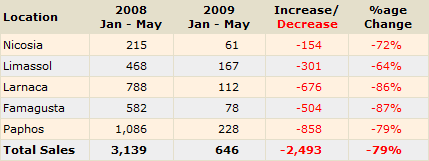
The decline in external demand for property is reflected in the latest Land Registry figures. Contracts of sale deposited by non-Cypriots during the first five months of the year show that all municipalities are having similar problems, with an ever increasing number of unsold apartments and houses.

Sales of Property to non-Cypriots (Source: Land Registry)

Real estate agents and developers in Paphos say that some sales are the result of Britons selling up and moving elsewhere. Taking advantage of the Sterling/Euro exchange rate, those with Title Deeds are asking much less for their properties in order to sell.

The Real Estate Agents Honorary Chairman, Elias Danos believes that pre-crisis prices will not return.

Mr Danos said that the property market in 2007 and 2008 was a “bubble as a result of the capital of €3 billion injected in the Cypriot market after the approval of the amnesty by the Parliament. This led to an abnormal increase in property prices, which instead of increasing around 10% per annum, they increased by 50% each year“.

According to Mr. Danos’ estimates, “prices will start recovering in the second quarter of 2010, if the climate in the international market improves. Before 2010, market will not recover fully“.

Cyprus tax receipts continue to fall

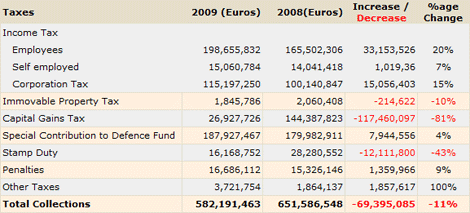
THE COLLAPSE of property sales is having a dramatic impact on Cyprus government revenues. Compared to the first five months of last year, Capital Gains Tax receipts have fallen by €117 million, Stamp Duty receipts by €12 million and Immovable Property Tax receipts by €214,000.

Overall, Inland Revenue collections have fallen by more than €69 million Euros – a drop of 11% compared to last year.

Cyprus Inland Revenue Department collections January - May 2009

Finance Ministry plans to increase the flow of revenue into state coffers include a planning amnesty. This will allow property developers (and others who have contravened town planning regulations) to pay to have those contraventions ‘regularised’ – and will enable the process of issuing Title Deeds for the properties concerned to continue.

Exactly how much revenue the state will be able to collect as a result of this amnesty is unclear. (The amnesty will not help those who are unable to get their Title Deeds due to property developers having mortgaged the land on which their homes are built).