Home Blog Page 608

Cyprus could suffer as EU monitors deeds fiasco

DESPITE an assurance by the government that an end to the title deeds shambles is in sight, many desperate home buyers are putting their faith in the EU in an effort to safeguard their properties.

The move comes after the EU Parliament recently froze hundreds of millions of euros in EU payments to Spain as a result of illegal practices perpetrated against property buyers – the EU ruling was largely as a result of buyers petitioning Brussels.

MEPs were acting on complaints from Britons and other homeowners who feared their homes might be bulldozed.

In a move that sent shock waves to Nicosia, the European Parliament flexed its muscles and voted overwhelmingly to freeze hundreds of millions of euros in Spain’s EU funding.

It is now understood that the EU are planning to turn their attention to Cyprus, with Edward Macmillan-Scott the Vice President of the EU Parliament saying publicly that he is “appalled” and “enraged” by what is happening on the island.

The Sunday Mail can reveal that the European Commission has addressed a request to the government asking for detailed information on the legal provisions and practices regulating and operating in this sector.

The Commission has also warned it will take the “necessary measures” if it can establish the existence of infringement of EU law.

The fallout from the deeds scandal is widespread, with a recent study by ‘Property Abroad’ online showing that Cyprus has been knocked out of the top five destinations for property buyers after a wave of negative press.

In an attempt to cool tempers, Interior Minister Neoclis Sylikiotis went on record last week to say that legislation was in process that would bring an end to the problem affecting the 100,000 properties bought by Cypriots and around 30,000 foreigners, most of whom are British.

His statement directly contradicted that given a month earlier when one of his colleagues disclosed that the only legislation under review was another amnesty for developers who had broken the planning laws and were unable to obtain a Final Certificate of Completion and minor legislation to protect future buyers was being developed.

Last night Cyprus Property Action Group (CPAG) spokesman Denis O’Hare called on Sylikiotis to clarify the situation.

There is a very easy way to put people’s minds at ease – show us the legislation, tell us about it,” he said.

We will happily come and see the minister. Knowing how many people can’t sleep at night, I’m sure any responsible minister does not want the suffering to continue. I await his call,” he added.

In a recent letter to its thousands of supporters, CPAG urged them to complete individual online petitions on the EU Parliament website just as the Spanish buyers had done.

Property analysts say Cyprus could suffer the consequences to the tune of millions of euros in frozen funds if it fails to act on the title deeds issue soon.

The ongoing fiasco which is putting thousands of families at risk of losing their homes in Cyprus has been getting uglier lately, as fed-up residents have said they will resort to direct action.

Until recently, Cyprus had seemed like the ideal place for pensioners to spend the rest of their lives, but for most their hopes were quickly marred by property scam nightmares and the title deed shambles.

A recent CPAG poll showed nearly 100 per cent of foreign buyers would not have bought in Cyprus if they had been informed of the practice of withheld title deeds and developer mortgages.

The Cyprus petitions are based on Article 17 (Property Rights) and Article 38 (Consumer Protection) of the EU Charter of Fundamental Rights.

CPAG claims property buyers in Cyprus are currently being denied these rights by the practices of developers withholding title deeds to properties in order to take out mortgages on the land on which these are constructed.

Shockingly, there is no legal obligation for the developer to inform potential buyers of the presence of a mortgage when they are buying, nor is there any legal obligation for the buyer’s own lawyer to search for any mortgages.

Around 100,000 properties in Cyprus are without title deeds, mainly because developers have mortgaged land on which these properties are built to the tune of €4 billion which prevents transfer of title.

Land Registry officials have confirmed that 30,000 of these properties have been bought by foreigners, which means that at least 60,000 foreigners must be in this precarious position, the vast majority being British.

O’Hare added: “It is clear that in a worsening economic climate with the Cypriot developers receiving little or no income from sales the situation can only get more dire.

With non-payment of their mortgages and these unethical banks just adding the overdue payments to the principle loan a huge problem could be building up in the banking system.

We therefore urge all buyers to find out whether their developer has a mortgage on their property or development and to check with the lender bank as to whether the developer is making repayments because the sooner any problems are discovered the better the options may be for the buyers.

Details of how to petition the EU Parliament and how to find out about developer mortgages can be found on CPAG’s website (www.cyprus-property-action-group.net)

Copyright © Cyprus Mail 2009

Cyprus property exchange schemes target UK homeowners

SCHEMES where property developers offer part-exchange deals are commonplace in the UK. They enable those wishing to move house to sell their present home to a developer in return for a discount on the price of the new home they wish to buy.

These schemes offer those wishing to move a number of benefits:

  • A guaranteed buyer for their existing home
  • No estate agent or advertising fees to pay
  • No chains or last minute hitches

There are also benefits for the property developer as it enables them to sell new property much quicker than would otherwise be the case.

But there can be downsides to these schemes. The main issue will probably be financial because the person wishing to move will be unhappy with what the developer offers for their present home.

UK to Cyprus property exchange schemes

The Cyprus Property Magazine has learnt that a number of developers in Cyprus are offering overseas property exchange deals.

They are focussing their marketing efforts onto UK homeowners and those in other countries who wish to move to Cyprus but who cannot sell their present home because of the depressed market conditions.

Wealth Warning

We urge anyone considering these schemes to proceed with extreme caution:

  • You may end up part-exchanging the equity tied up in your UK home for a mountain of debt tied up in the one you’re getting in Cyprus.
  • You may find that the property you’re receiving in part-exchange has been built illegally; without the required planning and building permission permits.
  • You may also find that the property you are getting is overpriced compared to similar properties in the same area.

Advice

It is absolutely essential that you take independent legal advice; i.e. from a lawyer in Cyprus who is totally independent and not connected in any way to the developer, their agents, or anyone else connected with the company selling the property.

The British High Commission in Nicosia maintains a list of English-speaking lawyers who may be able to assist. You can view and download that list by clicking here.

Under absolutely no circumstances should you sign any papers or hand over any money until you’ve taken independent legal advice. This is very, very important; particularly if any contract you are asked to sign contains a clause; “The present Agreement will be governed by the legislation of the Republic of Cyprus“. The property laws in Cyprus are NOT pro-buyer.

The property laws in Cyprus are totally different to those in the UK. For example:

  • In Cyprus, there is no requirement for the person selling a property to pay off any mortgage they have on it before you pay for it. So there’s a very real possibility that you could end up buying a property being blissfully unaware that it’s mortgaged; you’ll only discover this later, when you come to sell the property or when the bank comes knocking on the door to repossess it because the developer has not repaid the loan.
  • There is also no requirement on a lawyer acting on behalf of a buyer to carry out various searches as there are in the UK. So it is essential that you instruct the lawyer acting on your behalf properly – and get a written estimate of their fees.

Make sure you do your homework properly. Do not rely on the word of the developer or any of their employees or agents. Do your own independent research – visit the island to see precisely what’s on offer and the price of comparable properties in the same area.

Do your sums! In addition to the costs associated with moving from the UK to Cyprus and refurnishing your new home, you’ll need to budget for legal fees, stamp duty, application to the Council of Ministers (non-EU citizens only), mortgage fees, value added tax, agency fees, property transfer fees, local property taxes.

Don’t forget to factor in exchange rate fluctuations. We have received many letters from victims of the current financial crisis who have been hit by the fall in the Sterling/Euro exchange rate.

Visit the Cyprus section of the UK Foreign & Commonwealth Office website and take particular note of the ‘Purchasing property’ advice in the General section.

Finally, remember that acting on impulse can seriously damage your wealth!

Cement sales confirm property problems

FURTHER confirmation that the Cyprus property and construction sectors are facing serious problems came today with the release of domestic sales figures for cement by the Cyprus Statistical Service (CYSTAT).

With many new developments either mothballed or frozen, domestic sales of cement in April 2009 fell by 28.6% compared to a year ago. (In March, cement sales fell by 29.6%).

For the first time after several months, the industry decided to export cement with 5,300 tons being exported in April.

Tourism

There was also disappointing news on the number of tourists arriving from the UK. In April, a mere 84,526 visited the island compared to 93,862 a year ago; a decrease of 9.9%.

HELP – I can’t pay the mortgage!

INCREASING numbers of people are struggling to make their mortgage payments on property they have bought in Cyprus. Having fallen victims to the current financial crisis, some have been hit by the Sterling/Euro exchange rate while others, unfortunately, have lost their jobs.

Clearly, this is a very stressful situation for the individuals concerned and their families. So what can you do about it?

The worst thing you can do is bury your head in the sand in the hope that the problem will somehow go away; it will not.

The first thing to do is discuss the problem with the bank that loaned the money – they may be willing to help. If you just do nothing, the bank may get possession of your property in Cyprus and a money judgment against you. They could then register that judgement with the Courts in England, Wales and Scotland and seek possession of your UK assets to recover the debt. However, that would take the bank a very long time – and it is unlikely that they would want to pursue you though the UK Courts. However, this is an option open to them.

Dealing with the bank

  • Be honest with the person you deal with at the bank and explain your problems to them.  At first, they may try to make you feel guilty about your situation and say it’s up to you to sort things out – or they may try and scare you by making you believe that if they foreclose they will chase you for the debt in the UK. Although the banks in Cyprus do have the power to do this, it is unlikely they will do so unless there is a substantial negative equity on the property.
  • Always answer the telephone when they call you, even if the only thing you can do is let them know that you cannot pay. Ignoring their calls sends out the wrong message – and who knows, they could be calling with some good news. And if they leave a message asking you to call back, make sure you return their call. Local banks are accountable to their headquarters for such cases may show more understanding and willingness to help if they can contact you for updates.
  • See if you can make interest only payments for a time until your back on your feet. If successful, this will reduce your monthly payments – but you will need to catch up on the lost ground at a later date.
  • See if you can take a ‘payment holiday’ until you are back on your feet. Some of the property development companies in Cyprus have agreed ‘payment holidays’ with their banks. This involves adding the unpaid interest of the loan to the principal and increasing the repayments to cover the extra amount once the holiday period is over.
  • If the bank appears unwilling to help, ask them when would be a good time to see them to formally pull out of the deal. Taking such action will not absolve you from paying the debt, but it could have the effect of making the bank think again.
  • If the bank is totally intransigent and leaves you with no option but to hand back the property, you should try to come to an agreement with them that they will not a money judgment against you. You will probably need a lawyer to put your case, which will be money well spent.

One thing to remember in all of this is that banks are not estate agents. As they already have more than €4 billion worth mortgages, foreclosing and repossessing your property should be a last resort option for them.

One other thing you should try is renting the property to help cover your mortgage repayments. Forget short-term holiday lets, the market’s dead. Look for long-term rentals (one year or more) and even if you have to rent below the market rate, you should be able to get a few hundred Euros a month to help with the repayments.

The following article was written by Diarmaid Condon, an independent property consultant in Ireland. It was published recently on www.OverseasCafe.com.

I have a distressed property overseas – what should I do?

This is a predicament which is, unfortunately, currently very common one for Irish overseas property purchasers, particularly those who have purchased holiday property in resort locations for investment.

The first advice to give anybody in this situation is – don’t panic. If you make panic decisions they will, invariably, be very poor decisions, made under duress, and the one thing you can guarantee is that they will not benefit your pocket.

You may have read that there are ‘vulture funds’ out there looking to pick up distressed property at bargain basement prices. These funds specialise in taking advantage of ‘distressed sellers’ who are making decisions under duress. The first thing to ensure is that you are not giving a valuable asset away for a price far below what it is worth. You may have made the decision to purchase in haste and feel that, with mature recollection, it wasn’t such a great decision. Don’t add to this by making an equally poor decision when disposing of your asset.

The one comment most made in such situations is that this ‘asset’ is not actually an asset, but an expense. This may well be the case in the current climate, but it is advisable to do everything you can to maintain its ‘asset’ status before deciding to jettison it. There is no point in losing money when you buy and again when you sell. If you have already made the purchase there is nothing you can do about the former, but you still have the ability to do something about the sale of the asset.

It is difficult to be specific as to what you should do in every case as there are very many different ways in which property investors can be distressed. The most common form is those who purchased with the intention of letting the property when it has completed. On completion, quite a few of these discover that the ability to achieve rental income was either overstated or, in many cases, never existed at all.

Another common problem at the moment is an inability to complete. Most overseas resort property was purchased off-plan over the past five years. The investment climate at that time was vastly different to what we are facing at the moment. Consequently, there are a significant number of investors who cannot afford to complete on the property now that the final payments are due. This can be due to a change in their employment status or a change in the lending practices of a bank on which they were relying for funding.

Others have put deposits on properties which they intended to ‘flip’ for a profit before or at completion. Now that the properties are completing they are finding that the market is not there to flip them. Even if they could do so, they are now finding that what they would receive is far less than they actually paid for the properties because markets have retreated so much in the interim.

There is no doubt that there are severe problems out there for many buyers, but the problems can often be overstated by an overly negative press and a constant barrage of gloomy economic predictions.

In the middle of an economic maelstrom is the very worst time to try to sell a property so, if you’ve already purchased the property, the first piece of advice to be give would have to be ‘hold on to it if at all possible’. Admittedly this isn’t possible for every property owner, but, if you can postpone the potential sale until market conditions improve to some extent, you are giving yourself a far better chance of achieving a reasonable return on your investment – or at least reducing your loss. Certainly you should receive a far better return if you can hold on for a year or two than anything you will receive now. At the moment we are more than likely residing at, or close to, the bottom of a market cycle … it is the worst possible time to try to sell a property.

But what if you’ve purchased on the basis that you were going to get a local mortgage, but cannot now do so because of credit has dried up? The first thing to do here is to look carefully at your contract. Have it translated if you haven’t already done so (you’d be amazed how many people don’t bother) and check to see if your contract contains a clause entitling you to a return of your deposit in the case that finance cannot be obtained. In all honesty this is unlikely to exist unless you, or your independent legal representative, specifically asked for it. If it is the case that you have been recommended a legal representative by the agent or developer selling you the property you can be nearly guaranteed that this clause does not exist – hence the value of independent legal representation.

If the clause does not exist then you need to have your legal representative talk to the developer, explaining your predicament, to see if alternative financing can be obtained. It is not in the developer’s interest to lose you as a client – they are an extremely scarce resource at the moment – so use this leverage to ensure that your are accommodated to the greatest extent possible.

If you have thought it through fully, know your figures and are still absolutely convinced that this is a very poor investment decision then you may simply have to withdraw from the purchase and lose your deposit. It is, however, worth fighting to have the deposit returned. Depending on the country in which you purchased, you may be entitled to have it given back to you – or at least have some of it returned.

There are those currently considering taking the ‘jingle mail’ option (sending the bank the keys in the post and ceasing all loan repayments). Just be aware that this is not necessarily the end of the issue. The bank is entitled to sell the property for whatever it can get (probably not a lot at the moment) and then revert to you for the balance due. It is not, therefore, as clearcut an option as some may have you think.

If you do have a property that you wish to sell there are a number of avenues open to you – although it is, admittedly, far from the ideal time to consider this option. The cheapest of these is to list it on a free property listing website such as www.OverseasCafe.com. Other sites may charge a small fee for listing the property or you can list it with an agent that uses multi-listing sites to promote its listings. It is also worth checking out websites which offer local property for sale in the area in which your property is located. You could also look at auctioning the property through companies such as www.allsop.co.uk.

If you can’t sell the property then you may be able to let it until the market reaches equilibrium. There are a plethora of sites such as www.holidayhomesdirect.ie which offer such a service, although you will need to differentiate whether your property is for holiday or general letting use. There are generally local sites, such as www.kyero.com in Spain, which will be more appropriate if you are looking to let your property for a longer period.

It is difficult to give advice that will suit all clients in a short piece such as this but it should at least outline that there are options out there, if you are prepared to step back from the situation somewhat and take a more objective view.

Diarmaid Condon

http://www.overseascafe.com

How to avoid buying into a bubble

THE COLLAPSE of the US housing market bubble emphasizes how important it is to figure out what property is really worth, from a fundamental perspective. Make sure you’re not over-paying!

Here are some yardsticks to avoid buying in bubble markets:

  1. Price to Rent Ratio (or Yield)
  2. Relative Prices
  3. Affordability
  4. Price to Replacement Cost

What ought a house to be worth?

To be supremely unemotional, a house can be considered, from a certain perspective, to be a money-making asset (especially if you don’t live in it but own it to rent).

Now the most comprehensive set ideas of how to value such assets has been developed in connection with the stock market. The value of a share is its Net Present Value, i.e., the value of all expected future earnings from the share, discounted for risk, for financing costs, and for time-preference.

Since no-one knows what the risks, etc, are, stock analysts fall back on rules of thumb:

Valuation tool 1: The price to rent ratio

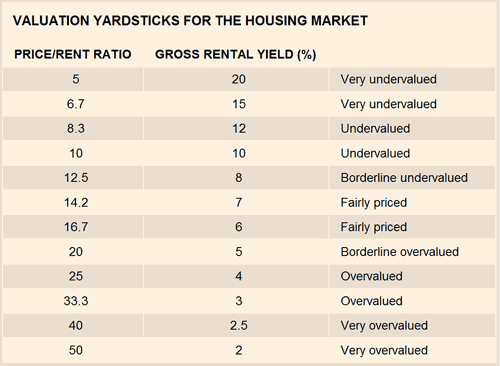
In the stock market a very popular rule of thumb involves the price-earnings ratio, which measures how high the company’s net earnings are, in relation to the price of the stock. For an ordinary company, a price earnings ratio of between 9 and 18 would be considered within the normal range. Anything above that is considered high. Alternatively yields from the company’s shares of between 5.5% and 10% are considered normal (the price rent ratio is the reciprocal of yields).

Because the stream of future income can be expected to be higher for a company which is rapidly growing, it might be considered normal for a ‘growth stock’ to be priced at up to 20 or 30 times earnings.

It’s the same in the housing market. What’s generally viewed as reasonable is similar to what’s considered reasonable in the stock market, although houses tend to be expected to yield slightly less, perhaps because a house’s value depreciates less over time than the assets of a typical company. The price/rent ratio (or gross rental yield) is the housing parallel to the price/earnings ratio.

Here is a set of rules of thumb for the housing market:

Valuation yardsticks for the housing market
Valuation yardsticks for the housing market (Source: Global Property Guide)

When strong future growth in value is expected, e.g., land on an undiscovered but beautiful beach, or dwellings in an area whose communications infrastructure is being upgraded, or land in a high-growth area, then relatively weak present earnings can be acceptable.

The common sense man raises an objection!

The ordinary house buyer may well feel these reflections don’t answer his main concern.

He wants to live in a house. Why should he value housing for its rental earnings?

As he looks around, the average person sees that while housing is expensive, it also seems generally to increase in value. He needs a house, and if he waits he’ll probably have to pay more for it. And if he buys in a city where housing tends generally increases in value, he’s not going to lose money if he buys now, never mind what signals are sent by all those ratios.

Perhaps 90% of all house-owners have no intention of renting their house out. So what’s the relevance of the price/rent ratio?

There’s a lot of practical sense to this objection. Buyers do tend to treat houses-for-owning-and-living-in as sui generis, and not precisely equivalent (e.g) to rented houses. But there are several good reasons why people should pay attention to the ‘valuation parameters’.

Low price/rent ratios push the housing market higher

If rental yield levels are high, this will tend to mean that the interest cost of buying a house is low, compared to the cost of renting a house:

Potential buyers will pay less to borrow from the bank (in order to buy) than they pay when renting a house too. Many will move from being renters to buyers.

Entrepreneurs will find it makes sense to buy houses to make money, i.e., buy in order to rent them out.

Both these factors put upward pressure on house prices.

High price/rent ratios put downward pressure house prices

If rental yield levels are low, this will tend to mean that the interest cost of buying a house is high, compared to the cost of renting a house:

  • Potential buyers will find that to buy a house involves paying much more to the bank, than it costs to rent a house. Buyers, especially first-time buyers, may have difficulty financing housing. Banks will be worried about over-lending at loan-to-income ratios which mean that a slight increase in interest rates will mean financial crisis for the borrower.
  • Entrepreneurs will find that buying-to-let won’t pay.

High price/rent ratios tend to put downward pressure on house prices.

House prices tend to revolve around a price/rent ratio range. The house price cycle can be viewed as a kind of circle, with houses prices moving from yields of (say) 4% to 11%

  • Yields shifting down to 4% would represent danger.
  • Yields rising to 11% would signal opportunity.

In broad international perspective the ‘range’ is likely to be fairly similar in different countries (because real interest rates are broadly similar) but not entirely similar.

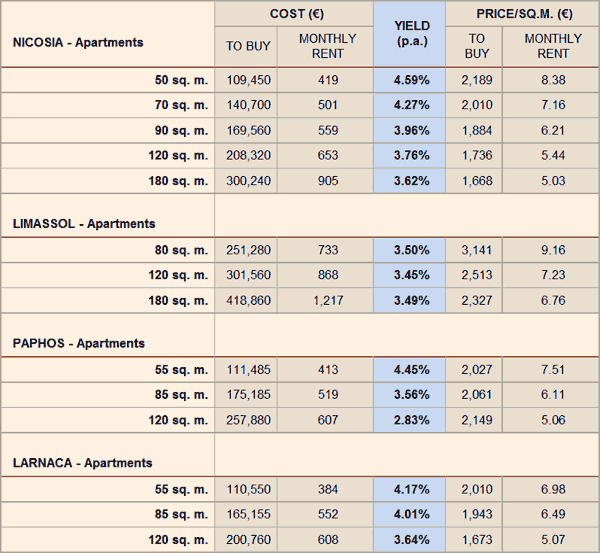
Cyprus property rental yields
Property rental yields in Cyprus (Source: Global Property Guide)

Countries with higher nominal interest rates, and countries with weak mortgage markets, will have relatively low price/rent ratios. As their housing markets develop institutionally, house prices will also adjust upwards – as is now occurring now in Eastern Europe.

Every market will have a range. To imagine that a market can escape totally from its range of price/rent ratios is bubble thinking.

Valuation tool 2: Relative prices

People tend to actively look for cheaper and better alternatives. Where houses are very highly priced, people will seek more affordable alternatives.

So if you’re buying property that’s amazingly expensive on a square metre or square foot basis – beware.

To some extent, that logic applies internationally, as well. Consider – is the average Muscovite’s income-earning potential really enormously higher than that of the Parisian, Roman, Dubliner, or Viennese? Clearly not. So Moscow’s apartment prices, at €10,000 per sq. m., seem overvalued.

Similarly Brussels (Belgium) is apparently undervalued – located in a high-income country; its housing is valued at prices similar to Eastern Europe.

These anomalies can last a long time. But eventually, relatively high house prices tend to come down to earth.

An economic crisis, a currency crisis, and bang – house prices fall, and are no longer out of line with reality.

Valuation tool 3: Affordability

If house prices are so high that very few people can actually afford to buy them, then their value will likely fall in future. Simple, right?

Right. But how to measure when prices are ‘high’?

Well, a reasonable measure of value is a country’s GDP/capita, as a multiple of house prices per sq. m.. In a country where the ratio of house prices to GDP/capita is high, it’s a fair bet that houses are overvalued.

Relative to GDP/Capita levels:

  • House prices in Luxembourg, Belgium, Norway, Denmark and Austria seem cheap.
  • House prices in the UK, Italy, France and the Netherlands seem comparatively expensive. However, note that our GDP-Cap/Sq. m. yardstick is best used to compare countries at the same GDP levels. Why? Because:
  • Housing in poor countries tend to be relatively expensive relative to the local standard of living (they’re poor, right?).
  • Global Property Guide house prices are for high-end, city-centre prices – not average house-prices (particularly in poorer countries).

Valuation tool 4: Price-to-replacement cost

If house prices are much higher than the cost of building (construction costs), developers are motivated to put up buildings.

As new supply comes into the housing market, that tends to put pressure on prices. So when house prices are far greater than new-build costs, it’s a danger sign – prices are likely to come down.

There is one exception. Where regulations restrict the construction of new buildings, new-build prices are less likely to act as a ceiling on the market.

Europe is replete with building codes, permits, quantitative restrictions, etc. These limit the amount of new housing supply. Such regulations mean that house prices tend to be above new-build costs. That’s not an anomaly. It’s part of the system.

Elsewhere, keep an eye on new build costs. Where (in the absence of strong regulation) house prices move above new-build costs, it’s a warning sign.

Now use our valuation tools!

Horrendous screams! Despair! Anguish! – We’ve just fallen off the top of the strongest housing market boom for a century.

Well, we warned you before the crisis, didn’t we?

Well, we’re still warning you. Use our yardsticks! Use our four indicators of value:

  1. Price to Rent Ratio (or Yield)
  2. Relative Prices
  3. Affordability
  4. Price to Replacement Cost

Use them to make judgments about housing prices. Above all, remain sceptical. Be hard-headed about valuations.

There will be some great deals emerging in the coming years. Use these yardsticks to identify them.

Copyright © 2009 Global Property Guide

Tax rebate for British second homeowners

MANY Britons who let out their European holiday homes could be entitled to a tax rebate under measures announced in April’s budget. From next year, however, all tax breaks on second homes in the UK and abroad will be abolished, removing any tax barriers that might encourage Brits to invest in property at home rather than overseas.

The scheme gives those with second homes in the EU the same rights as those with holiday properties in the UK until April 2010. People who let out their property but still make a loss, or who have sold the house at a profit, may be able to claim tax repayments for as far back as 2003.

In the short term this will provide a more favourable treatment for some of those who let out their foreign properties,” Michael Axelrod, commercial director of international mortgage broker Conti, told OPP. “This won’t affect all foreign property owners but a lot of people will fall into this category and the amount of tax they can reclaim could be quite high for some of them.

Mark Tuckwell, head of the Midlands office for Target Chartered Accountants, said: “Anyone thinking of selling their foreign holiday property might want to do so before 6 April 2010 to take advantage of the extra capital gains tax relief on eligible properties. Clearly, tax will always be secondary to how much money they can make from the sale of the property.

Levelling the playing field

EUROPEAN law requires countries to have standard tax rules for those who own property at home or in any other EU state. Granting the same relief to UK and foreign properties would cost the government £15m so, instead, all tax breaks will be abolished next year.

With the tax incentive removed, people might think about investing in holiday let property abroad instead of just in the UK because there will be a more level playing field,” Tuckwell told OPP. “From 6th April 2010, holiday let property will be treated equally wherever it is in the world. All in all, these changes may make it easier and more attractive for UK nationals to invest in overseas property.

However, Bill Blevins, managing director of international tax specialists Blevins Franks, remained sceptical about how much this would affect buyers’ decisions. “You’ve always got to look at the big picture – savvy investors will be looking for returns and growth,” he told OPP.

There might be no tax in somewhere like Dubai but British buyers still have to pay UK tax on investments there. Buyers should go for what they want and make it as tax efficient as possible.

© www.opp.org.uk