Home Blog Page 622

Government resolved to speed up golf course construction

EAGER to boost a weakened construction sector, the Cyprus government is trying to speed up the process of issuing licences for golf courses and the housing projects that accompany them.

The details of this ‘speed-up plan’ are currently before the Minister of Commerce Antonis Pashalides, ahead of a decision by the Council of Ministers. For conservationists, however, this plan is highly irresponsible both because of the current water crisis and the negative impact on the environment.

The original requirement was that golf courses would use water from desalination plants that get their electricity from renewable sources of energy,” said George Perdikis, Green Party MP. “Now they are relaxing this requirement, asking only that they purchase water from desalination units using EAC electricity, but pay a higher price – the price it would cost if the energy came from renewable sources. In essence, they will just pay for the water at higher rates.

The Greens’ alarm was heightened by the discovery that the state had allowed an existing golf course in Paphos to start constructing its own desalination plant on the banks of Ha Potami, in a beach protection zone, and destroying part of a eucalyptus forest in the process.

Although the authorities have tracked down the illegal activities of the forest’s destruction, they are not intervening, so as not to affect the ‘holy cow’ of golf courses and villas,” the Greens said in a statement.

The desalination plant at Ha Potami was allowed a licence without first presenting the usual environmental impact assessment. The state allowed this exception under a legal exception for small desalination plants, originally only intended for beachfront hotels. The ‘hotel desalination’ option was later abandoned, but the decision has apparently been applied to golf courses instead.

The desalination unit at Ha Potami will give water to a nearby existing golf course that previously got its water supply from the Asprokremmos Dam. “Now the dam has dried up, they are building this desalination unit to supply the golf course,” Perdikes said.

We are warning that whatever is being destroyed today in the name of facing the economic crisis will be forever lost and future generations will not have it.

From the outset, the state was offering an attractive incentive package to businessmen interested in developing golf courses, based on the belief that golf courses are not financially viable on their own, and must be complemented by luxury residential areas. Developers can freely build these complexes as the state incentive package provides considerable town planning relaxations. These incentives are even more attractive now the construction sector is struggling.

However, environmental groups fear that companies will take advantage of these incentives to build the luxury villas first and then abandon the golf courses. Naturally, for the environmentalists the lack of the golf course is not the problem. Their concern is that these licences allow residential development in areas where they would otherwise not have been allowed.

We believe the incentives offered to businessmen for the creation of golf courses are many and there is a danger that after taking advantage of these incentives, businessmen will abandon them,” said a statement from the environmental group, Terra Cypria. “Our worry is intensified by the fact that the fine of £1 million that would have been imposed in abandoning [the golf course] was finally not adopted. We believe that the incentives plan offered by the state should be re-examined and adjusted based on public interest considerations and not serving private interests.

Some of the environmental problems associated with golf courses include: their intensive consumption of water, pollution to the soil, as well as to the surface and ground water reserves, loss of biodiversity, habitat destruction, destruction of the natural landscape, desertification, restriction of environmentally sustainable small scale agriculture and the danger of spreading genetically modified organisms by using GMO grass.

The state plans that a total of 14 golf courses will be built by 2010, including the three that already operate. Four courses will be built in the district of Limassol at Ayios Ambrosios, Paramali and Fassouri, two in Polis Chrysochous, two in Paphos and three in Ammohostos-Larnaca.

Copyright © Cyprus Mail 2009

Cyprus property and construction statistics for 2007

THE CYPRUS Statistical Service (CYSTAT) has published the annual report “Construction and Housing Statistics, 2007” containing detailed information relating to the property sector including the number of new properties completed, construction costs, building permits authorised, etc.

During 2007, the main developments in the construction sector were:

Growth – The sector continued to record a positive rate of growth, registering an upwards trend in its value added in real terms of 7.4% compared to 7.3% in 2006 and 4.4% in 2005. This is attributed mainly to the significant increase in the construction of new buildings.

Output – Gross output at current market prices rose by 16.2% and reached €2,740 million compared to €2,358 million in 2006. New residential buildings accounted for 50.7% of the gross output, new non-residential buildings (hotels, shops, offices, factories, etc.) for 26.4%, civil engineering projects (roads, water supply and sewerage networks, telecommunications and electricity lines etc.) for 14.6% and repairs and maintenance for the remaining 8.3%.

Employment – Employment in the sector increased from 34,058 persons in 2006 to 35,590 persons in 2007 and accounted for 9.6% of the gainfully employed population.

Costs – Labour cost in construction increased by 4.6% compared to 5.3% in 2006. The price index of construction materials recorded a rise of 5.3% compared to an increase of 5.0% in 2006.

Numbers – The number of new dwellings completed decreased by 0.9% to 16,501 dwelling units compared to 16,647 in the previous year. By district, the number of new dwellings is distributed as follows: Lefkosia (Nicosia) 4,622, Ammochostos (Famagusta) 2,024, Larnaka 2,962, Lemesos (Limassol) 3,112 and Pafos 3,781.

Sizes – The average area per dwelling completed in 2007 was 191 square metres for houses and 117 square metres for apartments, compared to 193 and 111 respectively in 2006.

Construction costs – The cost of construction per square metre (excluding the value of land) rose from €764 in 2006 to €803 in 2007 for houses and from €694 to €726 for apartments.

The full report may be downloaded free of charge from the publications section of the Cyprus Statistical Services website.

British pensioners in Cyprus feel the squeeze

THE GLOBAL economic downturn and the collapse of the British pound are having an enormous impact on the retired population of Brits in Paphos.

David Cornthwaite, the Chairman of the UKCA in Paphos told the Sunday Mail that the biggest topic of conversation among expats at the moment is the financial crisis.

The government of Cyprus is saying that we’re OK, but this simply isn’t so. They’re living in fantasyland.” He continued, “The full force of the impact has yet to be felt, but it’s begun already.

Two of our members, the Crawfords, are shortly returning to the UK. They’ve done all their sums and worked out that they’re far better off there. They’ve been comparing prices between UK supermarkets and those in Paphos, and they will get substantially more groceries in their weekly shopping trolley in England.

Due to a combination of the poor exchange rate from sterling to the euro and local inflation, they’ve worked out that they’re 42 per cent worse off here.

Brian and Barbara Crawford decided to retire to Cyprus just over two years ago.

It was a dream to move here, like paradise. We loved the sun, the sea, the atmosphere and the people. The standard of living, before the introduction of the euro, was good. We were well in pocket, in fact I could say we had a surplus on our sterling pensions,” said Brian Crawford.

The pair has decided they’re no longer able to live in Paphos due to the inflated costs of living and are returning to the UK.

We’ve made the decision to move back to the UK. Our flights are booked for March 11 and we’re in the process of sorting out a container,” said Crawford.

Crawford’s price comparisons have been accrued over a few weeks. He said the differences he’d found were mostly on food.

My brother in the UK, and I have been exchanging our weekly budget and comparing costs on necessities. The prices in the UK are ridiculously low .For example a box of 160 teabag cost €8 here in Paphos. The same teabags in the UK cost £3.27.

He continued, “We’ve been delighted with the local vegetables and the quality is superb. In fact, the Cyprus potatoes are a firm favourite, but the prices have now rocketed sky high.

The couple plans to rent a property close to Witham St. Annes in the UK, whilst keeping an eye on house prices, which are plummeting.

The pair, who rent in Paphos, said they would wait until the British housing market ‘bottoms out’ and then buy a property.

Crawford said, “I was a professional sales and marketing administrator before retiring, and I like to know all of the facts and information. You can’t make an informed decision without facts; information is power.” He added, “I did the same thing when we were moving here. This is why we rented, because I had heard of all the problems buyers were encountering with developers and title deeds.

Brian Crawford is chairman of the UKCA computer club and the camera club.

I’ve made good friends here that I will really miss. But this is something we have to do. A lot of my friends are in the same boat, but many of them have to stay here as they own property, which isn’t selling.

He said his friends will have to start budgeting and favour Cyprus brands over imported ones, which are still a little cheaper at present.

Crawford believes the Cypriot government is living in a bubble.

People are being laid off left right and centre. It’s going to hit them so hard, and I don’t want to be here when that happens,” he said.

It’s a real tragedy, but the modern Cypriots are greedy. There are fewer customers, and yet they seem to raise their prices. It doesn’t make sense.

He believes locals will learn the hard way, and added that young people are unable to buy properties as the developers’ prices are high.

They target the British and make it attractive to us, selling Paphos as paradise. In turn and the young people blame us for the rising housing costs. But it’s not our fault, it’s the developers.

Crawford concluded, “It took us some time to mull over the information and come to our decision, but we decided over the Christmas period that we had to move back.

I would love to be able to move back to Cyprus in the future, but I can’t believe the government will see sense, and as I will be 74 in August, maybe time will run out.

Currently, there is a 30 per cent differential exchange rate, so put simply, pensioners with one £100 before the crisis, now have £70.

Cornthwaite is lucky enough that, at present his pension is sufficient.

I came out of a corporate life and am lucky that my pension is still OK. But many people are frightened and don’t know what to do. The UKCA will always do what we can to help, and also can put people in touch with the relevant professionals.”

To help struggling pensioners, the UKCA is freezing their club prices for at least the next 12 months.

Our costs are rising, but we are trying not to pass this onto the members in the current climate,” said Cornthwaite.

The UKCA Chairman said that he has spoken to many concerned individuals who are unable to sell their houses, and feels the property market in Cyprus is stagnating.

I know that for the last quarter in Limassol, no properties were registered for capital gains tax. This must surely mean that no re-sale properties were sold,” he said.

More people are eating at home and reducing the number of times they go out a month and cutting back on luxuries. Gardeners, pool maintenance and cleaners services are all being terminated in favour of households doing these tasks themselves.

Cornthwaite added, “Whether people are economically shielded or not, it’s the uncertainty surrounding the crisis which is scaring them. No one knows how deep it is, or how long it will last.

Expat pensioners are facing real problems if most of their income is in sterling. Whereas working Brits don’t seem to be feeling the pinch as much yet.

The government need to realise the extent of the problem in Cyprus, and understand the future is bleak in order for anything to change,” concluded Cornthwaite.

Copyright © Cyprus Mail 2009

Cyprus lawyer at centre of protest replies

FOTOS PITTADJIS, the lawyer at the centre of yesterday’s peaceful protest in Paphos, has given his side of the story concerning allegations made against him to the Cyprus Mail. In an article by Bejay Browne in today’s paper, he said:

I have heard about this demo, and I must say I find it offensive and annoying. It all seems to be organised by Chris Wood and Conor O’Dwyer.

My father represented O’Dwyer in court, and the case was lost.

Pittadjis continued, “I’ve represented thousands of British nationals, and offered a high degree of legal service, it’s highly unlikely that the people outside were my clients.

He added, “As regards Chris Wood, he was only my client for one week. He then decided not to buy the property in question.

In Wood’s case, the developer had mortgaged the land. In turn, Chris got a mortgage from the bank, and I explained to him, the mortgage would be taken off the developer’s name and put into his.

He then told me he wasn’t happy with this and he wanted his money back. He pulled out because of the recession and he’s picking on me.

Pittadjis continued, “I explained this would be difficult as we had signed a sales contract, but I called the developer to try and negotiate. I was assured by the developer he would refund all the money, I’m sure Chris has had it back.

Pittadjis believes all of his clients to be happy and assured that his company are careful to provide a high level of legal advice.

Often in Cyprus, properties are built on land mortgaged by the developer in order to fund another project.

I never accept to release the final payment instalment unless the bank issues a waiver to free the property of the mortgage,” said Pittadjis.

I’ve spent thousands ensuring that I have highly trained staff, so that this sort of situation can be avoided. I want to protect my reputation. People never get to hear my side of the story, and it’s unfair,” he added.

Pittadjis said he checks the mortgage imposed on a property and that the relevant building permit is in place.

If anyone is a cash buyer, I check I’ve received a waiver form the bank before we release the third and final stage payment,” he stressed.

He added, “Chris even contacted me to negotiate his legal fees. I decided not to charge him anything, so as not to experience any further problems.

“I’ve provided a good service to thousands of people. As if I would risk everything for a couple of thousand euros,” he said.

Pittadjis himself is one of many purchasers who have brought a property without title deeds.

Cyprus was never prepared for this building fever,” he pointed out. “I hope that in two or three years, the new legislation will allow owners to apply for title deeds, and all the problems can be resolved.

Pittadjis concluded, “I have to be honest. Some of these people are right: there are lawyers who might release payment without checking the situation but we never do that.

We always make sure we have a bank waiver. That’s why the developers have never wanted to work with me – and this is why I’m so hurt by these accusations now.”

Cyprus protesters take to the streets

Protesters outside the Paphos offices of Photos Pittadjis
Protesters outside the Paphos offices of the law firm Fotos Pittadjis

EARLIER today a group of around 100 Cypriots and expatriates mounted a peaceful protest outside the new Paphos offices of the law firm Fotos Pittadjis.

The protest was organised by those who believe they have suffered at the hands of Pittadjis – and they were supported by other property buyers who also consider they are having problems as a result of their lawyer’s dereliction.

The firm, which also has offices in Larnaca and Paralimni, was cited in a recent court case involving a British couple who bought a property at Ayia Thekla and who came very close to losing their home after their developer, Lane Homes, sold it to someone else behind their backs.

Pittadjis is also at the centre of an on-going legal battle between Conor O’Dwyer and the Paralimni-based property developer Christoforos Karayiannas & Son Ltd. In this case too, the developer sold a property for a second time to another buyer.

Many of the protestors spoke of how they had been hoodwinked into buying mortgaged property because their lawyers had failed to advise them properly. Some complained that they had tried to sue their lawyers but had been unable to find another lawyer prepared to take on their case.

Typical of those protesting was Chris Wood from Wrexham North Wales who bought an apartment in Mazatos. “Pittadjis did the conveyancing but did not tell me that the land on which the development is being built is mortgaged. I believe that without unscrupulous lawyers in Cyprus, property developers wouldn’t be able to prey on unsuspecting buyers. They are the root of all problems and cause unnecessary suffering to innocent families,” he said.

‘Kate’ and her husband are in Cyprus to see what progress is being made on their apartment. She told me “MRI introduced us to a lawyer in Paphos who they said was very good. But the latest plans we have seen for our apartment are completely different to what we agreed to buy and it’s much smaller. I spoke with her (the lawyer) and said that we wanted our money back. She just shrugged her shoulders and said ‘this is Cyprus and that is not possible’. I’ve now been told by someone here this morning that she’s the developer’s girlfriend. How can she be acting on our behalf?

One supporter, who preferred not to have his name published, commented “We all work hard for what we have and to see someone just play with land, property and developments is unjust. We are the lucky ones; we have our Title Deeds and a lovely home. But I just think how on earth I would behave in the situation that some of these people are in through no fault of their own.

Revised property investment ratings for Cyprus

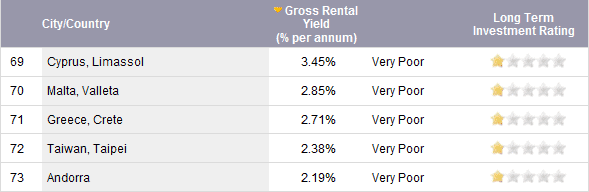
EARLIER today the influential Global Property Guide published reassessed Country investment ratings for 73 locations around the world. Their investment tables show gross rental yields and long term investment ratings.

At the top of the list is Chisinau in Moldova with a “Spectacular” gross rental yield of 14.17% and a long term investment rating of 3 stars.

Languishing near the bottom of the list at position 69 out of 73 is Limassol in Cyprus with a “Very Poor” gross rental yield of 3.45% and a long term investment rating of 1 star.

Top five countries to invest in property - January 2009

Bottom five countries in which to invest on property - January 2009

The Global Property Guide’s Gross Rental Yield figures are based on the average yields for 120 square metre properties, while their Long Term Investment rating is based on many factors:

  • Gross rental yield
  • Income tax
  • Capital gains tax
  • Round-trip transaction costs
  • Potential landlord and tenant problems
  • Long-term GDP growth
  • Potential over-supply
  • Affordability
  • A view of long-term appeal to investors