

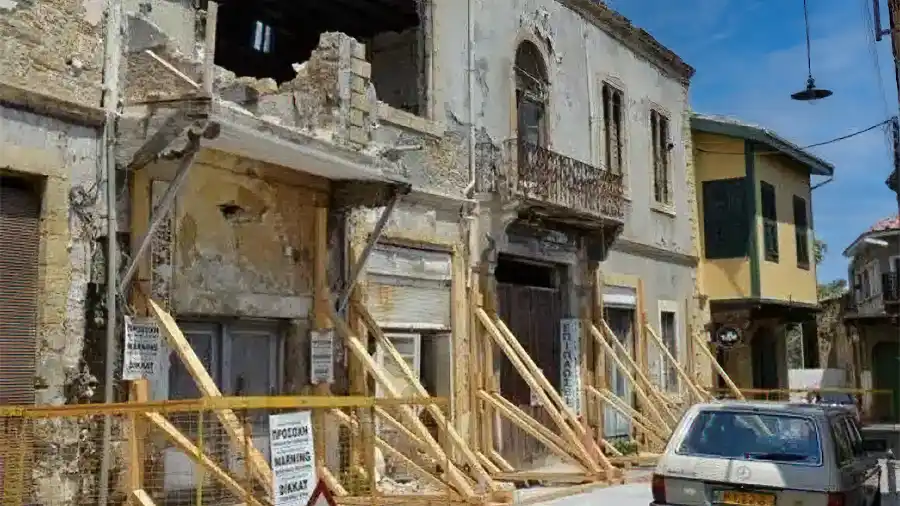
Authorities are taking action to address 1,292 buildings considered to be dangerous and at risk of collapse, posing a threat to public safety.
New legislation and increased state funding have been announced to tackle the issue. The affected buildings are spread across Nicosia (618), Limassol (308), Larnaca (170), Famagusta (26), and Paphos (170).
MP Marinos Mousiouttas is introducing a draft law, with Interior Minister Constantinos Ioannou’s support, to improve safety and address weaknesses in existing legislation. Current laws inadequately protect the public, affected properties, and neighbouring structures.
To assist District Local Government Organisations (DLGOs), which now oversee these hazardous buildings, state funding will increase. Nicosia will receive €500,000, with similar but insufficient funds allocated to other districts.
Following discussions with Mousiouttas, Ioannou announced that a revised legal proposal had been formulated by the House Interior Committee. The primary goal is to strengthen public safety and enhance the management of dangerous buildings.
Ioannou highlighted that flaws in the current legal framework, identified in collaboration with the Unions of Municipalities, Communities, and the DLGOs, have hindered enforcement. Some local authorities have acted, but others have struggled due to legal ambiguities.
With the transfer of responsibility for dangerous buildings to the DLGOs now in effect, legislative amendments are being introduced to enhance monitoring and enforcement. Property owners will be held accountable for ensuring their buildings are safe, with enforcement measures compelling them to take action.
Key changes include streamlined procedures for notifying owners, enabling courts to issue immediate intervention orders, and prohibiting the use or rental of unsafe buildings until repairs are made. The law also allows for partial or full demolition and utility disconnections.
Additional provisions include registering a memo on affected properties to cover intervention costs, introducing out-of-court settlements, and imposing stricter penalties for non-compliance.
Previously, financial constraints limited authorities’ ability to manage dangerous buildings. To address this, the Interior Ministry has secured extra financial support.
Funds will be distributed to the DLGOs based on registered dangerous buildings within each municipality, following a structured restoration plan developed in collaboration with local authorities.
Dangerous buildings: draft law
Roads and Buildings Regulation (Amendment) (No. 2) Law of 2025 (Greek)
Roads and Buildings Regulation (Amendment) (No. 2) Law of 2025 (English)
