

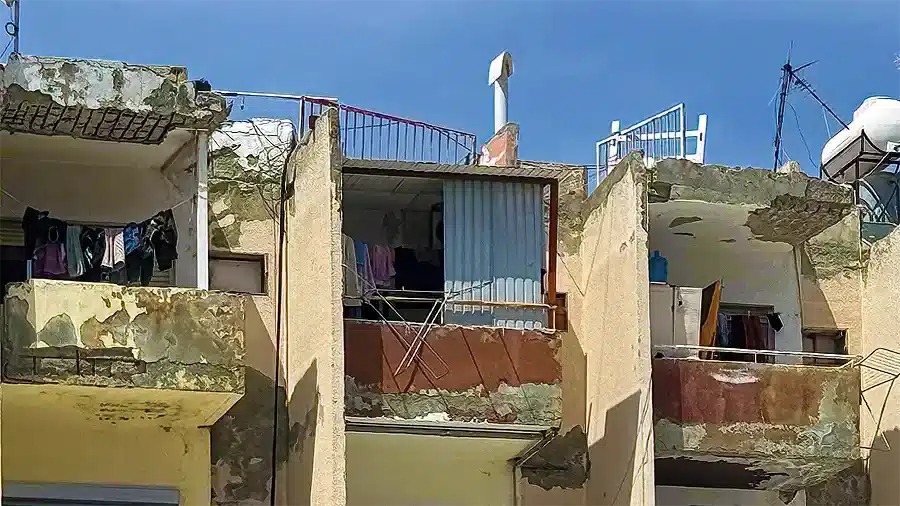
The fatal collapse of a building in Germasogeia has brought Cyprus’ growing building safety crisis into sharp focus, exposing long-standing concerns over ageing buildings, weak enforcement, and the absence of mandatory structural inspections.
Experts warn that without urgent reforms, including stricter oversight and faster intervention, unsafe buildings across the island will continue to pose a serious risk to public safety.
Across the island, structurally compromised buildings continue to stand with some visibly decaying and others silently deteriorating, while authorities struggle, or fail, to act with urgency.
This is not a problem born overnight. It is the cumulative result of years of regulatory gaps, fragmented oversight, and a culture of delayed enforcement that has allowed risk to compound unchecked.
Only now, after a building collapse in Germasogeia claimed two lives, has there been any real sense of urgency. It should not take loss of life to trigger action.
Visible risks unmistakable
Walk through older parts of Limassol, Nicosia, Larnaca or Paphos and the signs are unmistakable: cracked facades, exposed rebar, sagging balconies. These are not merely aesthetic issues – they are the warning signs of structural fatigue and potential collapse.
For years, engineers and property specialists have raised the alarm about Cyprus’ ageing concrete buildings. Combined with heat, humidity, and seismic exposure, deterioration is not just likely – it’s accelerating. Yet even when the danger is obvious, intervention is rare and often comes too late.
Bureaucratic paralysis
If the risks are widely known, why does action lag so far behind?
Responsibility for identifying and addressing dangerous buildings is scattered across multiple authorities, with little coordination between central and local government. The result is paralysis: cases stall, decisions are delayed, and dangerous buildings remain untouched for years.
Ownership issues deepen the problem. Many buildings have several owners – some absent, others unwilling or financially unable to contribute to repairs. Legal mechanisms to force action are slow and ineffective, leaving hazardous buildings in a state of indefinite limbo.
Meanwhile, people continue to live and work in conditions that would be deemed unacceptable in any properly regulated system.
Warnings ignored, enforcement absent
Even when buildings are officially declared dangerous, enforcement is inconsistent at best. Repair or demolition orders are issued, then quietly ignored. Deadlines pass without consequence. Risk is documented, but not reduced.
Political hesitation only compounds the problem. Demolitions and evacuations carry social and economic costs, and authorities appear reluctant to act decisively where public backlash is likely. But this caution comes at a far higher price: human lives.
System failure, not isolated incidents
This is not a maintenance problem – it is a systemic failure.
Efforts such as ETEK’s proposed digital register of unsafe buildings are a step in the right direction, but data alone will not fix the problem.
Unless ETEK’s efforts are backed up by proactive inspection regimes, and strictly enforceable timelines for action, their efforts will have been in vain, and the problems will only worsen.
Experts have called for:
- Clearer legal frameworks to streamline enforcement
- Financial assistance schemes for necessary repairs
- Stronger penalties for non-compliance
- A unified authority to oversee building safety
Until such reforms are implemented, the cycle of neglect and delay will continue.
The cost of doing nothing
Behind every deteriorating building is a human story with families living with uncertainty, businesses operating under risk, communities shaped by neglect.
Reform should not be reactive. It should not follow tragedy – it should prevent it. Yet meaningful action is (allegedly) only coming after lives have been lost.
Cyprus is at a tipping point. The risks are visible. The warnings have been issued. The only question left is whether those in power will act before the next collapse makes the consequences impossible to ignore.
