Increased mortgage rates have dashed dreams of owning a home, leaving many in a catch-22 situation as rents are rising, exceeding what families pay in monthly instalments for a housing loan.
Interest rates on mortgages could reach 5%, from 2.5% by the end of next year, affecting the buyer’s cost.
Meanwhile, the housing market has entered a new cycle of price increases, especially in the capital Nicosia.
For a €200,000 mortgage, to be paid over 20 years at an average market interest rate of 4.5%, the monthly instalment is around €1,270.
This is just under the average salary in Cyprus; according to the statistics, the median wage in Cyprus is €1,573.
Meanwhile, interested parties should have a deposit set aside to finance at least 30% of the property’s value.
Essentially, with €200,000, borrowers can buy an apartment of less than 100 sqm, most probably not new.
If the property’s value is higher, this means a higher loan amount.
Cyprus banks provide plans, which in the first years have a fixed interest rate, so the loan instalment does not change depending on the policies followed by the ECB.
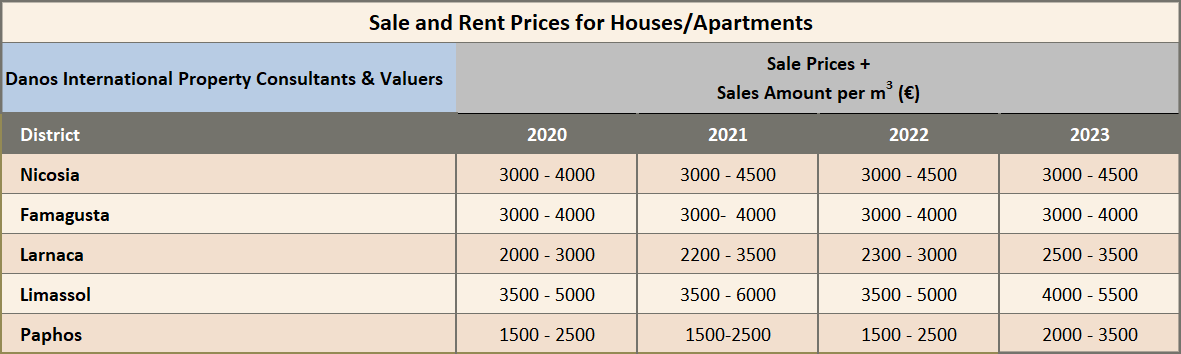
According to data from Danos RICS, rents in 2023 could double in some areas.
Danos notes rents in Larnaca could double from €4.5 – €5 per square metre to €6 to €10 monthly.
Similarly, Paphos rents are expected to increase from between €4.5 to €5.5 to €5 to €10.
This means renting a 100 square metre flat in Larnaca or Paphos could cost a family €1,000 a month.
Famagusta rent rates are also to go up from €4 to €5, to €5 to €8 per square metre.
In Limassol, prices are to increase from €7 to €14 per square metre, to €10 to €15, with an almost 50% increase for lower-end properties.
The cost of buying a home in the capital and Famagusta is expected to remain the same in 2023, pushing up by up to 15% and 20% in Larnaca and Limassol.
Obtaining property in Paphos will cost buyers up to 40% more.
With house prices increasing and borrowing costs increasing, Cypriots on the lookout for their new home have a lot to consider.
Borrowers also need access to between 20% and 30% of the money needed for a deposit to buy the property and meet the basic banking criteria, such as a steady income.
The interest rate on home loans rose to 2.95% in November, compared to 2.93% the previous month.
According to the Central Bank, the effective annual rate borrowers must pay is 3.63% in November 2022, from 2.86% in 2021 to 2.78% in 2020.
The European Commission has given Cyprus until mid-February to enact new legislation governing the levying of reduced VAT on properties, otherwise it will move infringement proceedings forward.
Brussels is breathing down Cyprus’ neck, letting Nicosia know that unless it amends current legislation by February 15, it will advance infringement proceedings it initiated last summer. Complicating matters further is that parliament is currently in recess due to the upcoming presidential elections.
In a letter to the legislature dated December 16, 2022, the finance ministry’s permanent secretary Giorgos Panteli warned MPs that the clock is ticking. The missive was also copied to the attorney-general and the Tax Commissioner.
Brussels contends that Cyprus does not properly apply VAT rules for homes purchased or built here.
The VAT directive allows member states to apply a lower rate for first homes as part of social policy. But the broad interpretation of the Cyprus provision apparently exceeds the social policy aim stated in the directive, for such an exemption.
The policy was also flagged when it emerged that recipients of the ‘golden passports‘ scheme – who invested in property in exchange for citizenship – likewise benefited from the lower VAT rate.
Meantime the government has come up with a ‘sweet spot’ – a bill amending the levying of the reduced 5 per cent (as opposed to the full 19 per cent) VAT rate for homes. According to media reports, Brussels has given the nod to the proposal – but the February 15 deadline still looms.
Under the government proposal, the reduced VAT rate would apply to the first 170 square metres of a home of a total surface area of 220 square metres and with a property value up to €350,000. For apartments, the lower rate would apply to the first 90 square metres of a total surface area of 110 square metres and with a property value up to €200,000. In addition, a special clause stipulates that the total surface area criterion does not apply to persons with a disability.
However, the idea has met with stiff resistance from several organisations – the Employers and Industrialists Federation, the Chamber of Commerce, the Cyprus Land & Property Owners Organisation and the Property Valuers Association.
They have instead suggested raising the value of eligible properties – both homes and apartments – to €500,000. And they point out that with the current inflation and increasing cost of building materials, no one would find a home or apartment with the square metres and value cited in the bill – making the legislation a damp squib.
Also against are opposition parties, including most prominently AKEL and EDEK. The latter have made it clear they will vote against the bill if it goes before the plenum as is.
Daily Politis contacted the finance ministry’s Panteli to ask whether the government would be open to a new round of discussions with stakeholders. Panteli said no.
“The finance ministry will not enter into deliberations with the interested parties on this bill. The MPs themselves must assume their responsibilities, by either voting for or against.”
Meantime Christiana Erotokritou, DIKOMP and chair of the House finance committee, said lawmakers would be willing to convene in an extraordinary session to discuss the matter, despite the parliamentary recess.
In February last year the government came up with a bill intending to find a balance. But opposition inside parliament forced it to go back to the drawing board and come up with an amended bill, first shown to MPs in late June.
Currently the law provides for the application of a lower VAT rate of 5 per cent for the first 200 square metres of primary residences, without any qualifications. This lower rate is applied irrespective of the income, property or economic conditions of the person or his family residing in the house. Moreover, the total surface area of the home bears no relevance.
Brussels hinted at approving the mortgage-to-rent scheme for distressed borrowers, urging Cypriot authorities to create a company dedicated to managing it.
The European Commission’s Directorate-General of Competition has instructed the Ministry of Finance to speed up procedures for establishing a company that manages the mortgage-to-rent scheme.
According to reports, it has instructed the Finance Ministry to have KEDIPES, the state-owned Asset Management Company, the former Coop Bank turned bad bank, establish a subsidiary.
The EU would like to see the state managing the scheme to boost transparency and access for supervisory authorities in Brussels.
Finance Ministry sources told news site Stockwatch it agrees with the Commission.
The mortgage-to-rent scheme is the government’s latest lifeline for some 4,000 distressed borrowers.
The cost of the scheme was estimated at €400 million.
The plan is for KEDIPES to acquire the properties tied to the mortgage at 50% to 60% of their current value.
This way, the debtors would maintain occupancy of the property but not its ownership.
In exchange, the outstanding debt would be written off.
Borrowers will then be given the option to stay in the property, paying rent equal to 2% or 3% of its market value.
Rent will be adjusted annually based on a formula to be decided, while borrowers will have the option of state aid in case of any increases they cannot meet.
It entails a 15-year payment duration, while borrowers could submit a proposal to acquire the property after five years.
The value of the home must not exceed €250,000.
Nicosia is trying to convince authorities to allow flexibility so borrowers with a mortgage backed by their home worth up to €350,000 approved for other schemes, to switch to the mortgage-to-rent plan.
The Finance Ministry intends to set the scheme in motion before the government’s term ends in February.
The mortgage-to-rent scheme will cover a portfolio of €3 billion worth of loans, of which approximately €1.5 billion are already under KEDIPES’ management.
In September 2020, the government launched the ESTIA scheme subsidising borrowers with toxic mortgages to reduce Cyprus’ bad debt mountain.
Estia subsidises one-third of toxic borrowers’ monthly instalments after a loan restructuring has been agreed with the bank.
A female lawyer has been struck off the roll by the Cyprus Bar Association’s Disciplinary Board following a hearing that found her guilty of professional misconduct.
The Disciplinary Board found the lawyer (who has not been named) guilty on eight charges involving the administration of a deceased’s estate; the lawyer failed to appear the hearing.
The charges against her included:
Failing to inform the heirs of the deceased’s estate of the actions, handling and progress of their case.
Failing to exercise the due diligence reasonably expected by the heirs to carry out the inventory of the property, its management and distribution as well as the registration of final accounts as required by law.
Failing to pass the proceeds resulting from the sale of two apartments amounting to €50,000 and €75,000 to the heirs.
Failing to pass the rents received from the two apartments of €1,922.78 and €1,432.88 to the heirs.
Failing to attribute a further amount of €20,000 to the heirs.
Failing to express her views on the charges against her to the Attorney General.
This was not the first time that this lawyer had been brought before the Disciplinary Board. In earlier appearances she was fined on a number of occasions.
The lawyer is appealing the decision of the Disciplinary Board to strike her off. (The Supreme Court may review the whole case and either confirm the decision of the Disciplinary Board, or set it aside, or make such other order as it may think fit.)
A veil of secrecy protecting lawyers
The Cyprus Bar Association‘s Disciplinary Board operates behind a veil of secrecy by failing to publish details of charges brought against its members, their names and its decisions.
In this respect, the Bar Association could be accused of protecting its members rather than protecting the public from the nefarious activities of some of its advocate members.
In this particular case, by failing to publish the name of the ‘female lawyer’ the Cyprus Bar Association throws the public’s suspicion on all female lawyers in Cyprus, which could potentially damage their reputation and their business.
The end of 2021 saw Europe’s and Cyprus’ economies gradually recovering from the two-year rollercoaster ride of lockdowns, the stock market at record highs, and inflation increasing.
One year later, the disruptions in the supply chain are less severe (e.g. the global container freight index is down 74% from $9,304 to $2,404), the stock market is down (e.g. the S&P 500 is down 19.5% from 4,750 to 3,800), and inflation appears to have peaked at circa 8-9%.
The war in Ukraine and the related geopolitical changes, the EU’s quick transition away from Russia as its primary energy supplier, and the rise in interest rates have all resulted in (and are still resulting in) a significant repricing of risk across asset classes, particularly those that are highly leveraged (such as real estate).
This repricing will continue in 2023, especially as other investment opportunities increasingly appear to be more appealing.
Our analysis will be split into two parts: establishing an evaluation framework and then using it to analyse Cyprus.
Higher disposable income, population expansion, more lenient lending requirements, and lower interest rates all serve to increase home values.
Similar to residential real estate, the price of commercial property tends to rise with GDP expansion and fall when interest rates and returns on other investments are greater.
International investors have an effect on the dynamics of property prices in both the residential and commercial real estate sectors.
With the above in mind, let’s look ahead at each of these drivers for 2023.
Disposable income is likely to be lower due to inflation and rising interest rates.
Credit conditions are tightening across the board and interest rates for mortgages, development, and investments are rising.
On the other hand, population has increased significantly due to arrivals from Ukraine, Russian, Belarus, and other countries causing a spike in residential rents and prices in certain areas.
The influx of overseas investors, particularly from Lebanon and Israel, is also causing prices to rise for certain property types (mainly small residential units and touristic establishments in Larnaca).
Regarding commercial property, GDP continues to rise but with higher interest rates and returns on alternative investments higher, investing in real estate for income return/ capital appreciation has become less appealing (for example, the yield on the 10-year bond of the Cyprus government is currently at 4.2% and banks across Greece and Cyprus are issuing preferred and Tier 2 bonds offering 7.0-10.0% coupons).
The above indicate that the main drivers of growth in the local real estate market are likely to be population growth, inbound investment from overseas, and sticky supply (it takes 2-4 years to add meaningful levels of stock).
Headwinds
The headwinds are lower disposable income and rising interest rates.
Due to these “tensions”, it would be logical to assume that a two-tiered market will develop, as it already has in Limassol and Paphos, where certain properties are only built/ targeted to foreign nationals.
The main question here is whether these foreigners will continue to call Cyprus their “home” for these prices to be sustainable over the medium term.
The likely answer is yes, as the local business environment and political stability (given what is happening in the region) and the “work from anywhere” way of doing business are playing to Cyprus’ favour.
It’s important to emphasise how “sticky supply” is causing prices to increase, something that is likely to change over the medium term as more projects are announced (especially in West Limassol and part of Larnaca).
The construction of new homes has not fully recovered since the 2008 housing crisis and the 2013 banking crisis, and housing supply remains near historic lows.
This tight inventory has made homes unaffordable for many, particularly first-time homebuyers. In addition, those who purchased homes in recent years at extremely low mortgage rates are staying put, further limiting the overall housing supply.
The demand side has been significantly affected by the increase in population over the past decade (+85,000 from 2011-2021), the influx of arrivals during 2022 due to the war in Ukraine (circa 20,000), and additional inflows from Lebanon and Israel (these are not permanent residents – and are thus not recorded – but have acquired or are renting real estate).
To these, one should add the influx of investors in residential real estate especially for short term rentals (both for tourist arrivals, but also for businesses travellers).
We do not expect that the housing market in Cyprus will see a significant correction, as the economy remains strong and demand for housing is still relatively high.
In fact, low supply and strong demand mean that it is unlikely that home prices will drop significantly in the near future.
However, the potential for a slower pace of home price growth and declining sales in the coming year could make it easier for would-be buyers to access affordable housing.
We are less positive on commercial real estate, where the range of alternative investment opportunities has increased significantly over the past year.
That, combined with rising interest rates, is likely to cause repricing over the short to medium term particularly on smaller units and dated properties.
The analysis on property prices ends here.
For those willing to consider where Cyprus is heading, it’s interesting to consider the parallels between the “Cyprus dream” and the “California dream” as described in the Eagles’ song “Hotel California.”
Both places have attracted people seeking sunshine, lower taxes, and opportunity, but over time, the realities of these places have not always lived up to initial expectations.
Cyprus seems like a beautiful oasis in a turbulent part of the world. Thousands of people have migrated to Cyprus in search of sunshine, lower taxes, and money, yet many find this dream to be a mirage.
As the nightman of the Hotel explains, “we are programmed to receive.” In many ways, Cyprus has been “programmed to receive” from its inception.
In 1990, when Cyprus started attracting Russians and others doing business in Eastern Europe, the “Cyprus dream” was born – a dream of instant wealth waiting to be claimed by anyone bold enough to take it.
Thousands of people poured into the country, hoping and expecting to find a more friendly place to do business.
However, as time has passed, most of them never found it.
The relaxed regulatory environment and friendly banks are gone, and it didn’t take long for big investment groups to take a stranglehold on specific industries, and for EU regulations to take over the majority of the country’s institutions.
Since 2013, most individual investors have been reduced from independent treasure-seekers to dependent service providers. In some sense, a kind of false hope was written into the fabric of Cyprus from its inception.
This is similar to what the Eagles found in California. Despite their connection to the state, no member of the Eagles was originally from there.
According to Don Henley, “we were all middle-class kids from the Midwest. ‘Hotel California’ was our take on the high life in Los Angeles.”
As Cyprus transforms from a small, closed community into a playground for international travellers and business, it’s easy to look back with rose-tinted glasses.
However, I’m certain that this swift transition will cause many to fall behind and thus destroy its social fabric.
The Mortgage-to-Rent scheme, the government’s latest lifeline for distressed borrowers, is in rough seas after the Finance Ministry claimed to be in the dark over the exact number of eligible applicants.
The Finance Ministry said the potential number of eligible applicants could not be determined accurately as borrowers will not reveal their true income.
Applications are submitted through banks, with the ministry arguing that borrowers withhold information over any state benefits received.
And borrowers need to cooperate with banking institutions or credit-acquiring companies fully.
Last year, the Finance Ministry’s permanent secretary George Panteli said that 3,000 to 4,000 distressed borrowers would be included in the new government scheme.
The cost of the scheme was estimated to €400 million.
A banking source told the Financial Mirror that stakeholders fear the lack of cooperation may see another lifeline thrown to defaulted borrowers wasted, as in the case of the ESTIA scheme subsidising borrowers with toxic mortgages.
According to ministry data, 30% of the 6,393 ESTIA applications were rejected as they were deemed incomplete.
Of the 4,374 completed applications, only 1,050 have been approved, and 62% of completed applications have been rejected.
The mortgage-to-rent plan is for KEDIPES, the state-owned Asset Management Company, the former Coop Bank turned bad bank, to acquire the properties tied to the mortgage at 50 to 60% of their current value.
This way, the debtors would maintain occupancy of the property but not its ownership.
In exchange, the outstanding debt would be written off.
Borrowers will then be given the option to stay on the property, paying rent equal to 2% or 3% of its market value.
Rent will be adjusted annually based on a formula to be decided, while borrowers will have the option of state aid in case of any increases they cannot meet.
It entails a 15-year payment duration, while borrowers could submit a proposal to acquire the property after five years.
The value of the home must not exceed €250,000.
The scheme is currently before the European Commission for evaluation, with the Finance Ministry noting in its update to the House that it expects a reply in January.
The ministry intends to set the scheme in motion before the government’s term ends in February.
Initially, Nicosia had been preparing a mortgage-to-rent scheme to cover non-performing loans collateralised by primary residences and SME premises, with a value of up to €350,000.
However, Brussels shot it down in June, demanding it only covers borrowers with homes worth under €250,000.