Lack of overseas sales slowing market recovery

Figures released by the Department of Lands and Surveys earlier today reveal that the lack of property sales to overseas buyers is slowing the recovery of the Cyprus property market.

The figures show that property sales to the domestic market during the first eight months of 2021 (4,089) are at their highest level for more than a decade. However, sales to the overseas market in the same period (2,000) have yet to recover to their pre-pandemic level in 2018 (2,884.)

We can speculate the reasons why overseas property sales have yet to recover:

  • The COVID-19 pandemic continues to make it more difficult for foreigners wishing to visit the island and return to their home countries.
  • The abrupt termination of the island’s disgraced Citizenship by Investment (a.k.a. Golden Passports) scheme, following the expose by undercover Al Jazeera reporters in August 2020, The Cyprus Papers, which also resulted in incalculable reputational damage to Cyprus.
  • The decision by the Cypriot authorities to impose restrictions and bureaucratic hurdles for Britons wishing to buy property post Brexit. At a stroke, this decision reduced Cyprus’ competitive advantage over countries such as Spain for Britons seeking holiday homes in the sun. (A few years ago, the majority of foreigners buying property in Cyprus hailed from the United Kingdom.)

Property sales figures for each of the market segments:

Domestic property sales

Sales to the domestic market in August maintained their strong growth, with sales up 32% compared to the same period last year, encouraged by the government’s interest subsidy scheme and low interest rates.

Cyprus: Domestic Property Sales Transactions – 2020/2021 Comparison
Domestic Property Sale Transactions – 2020/2021 Comparison

But as we’ve reported previously, these figures will include an unknown number of ‘non-sale’ agreements such as loan restructurings, recoveries and debt-to-asset swaps agreed between the banks and defaulting borrowers in efforts by the banks to reduce their non-performing loan portfolios. Unfortunately, the Department of Lands and Surveys does not publish these figures separately.

(However, we do know that the Bank of Cyprus Real Estate Management Unit (REMU) sold 387 properties with a contract value of €85 million during the first six months of 2021 – and during the same period, REMU acquired properties amounting to €21 million through debt for asset swaps and repossessions.)

Overseas property sales

Foreign sales also rose in August, up 24% compared to the same period last year. But for the reasons outlined above, it’s going to take sales a long time to recover to their pre-pandemic levels.

Cyprus Property Sale Transactions to Overseas investors – 2020/2021 Comparison
Foreign Property Sale Transactions – 2020/2021 Comparison

Overseas sales to EU citizens

Sales to EU citizens rose by 60% in August compared to the same period last year, with sales in all districts rising over the first eight months of 2021 compared to last year.
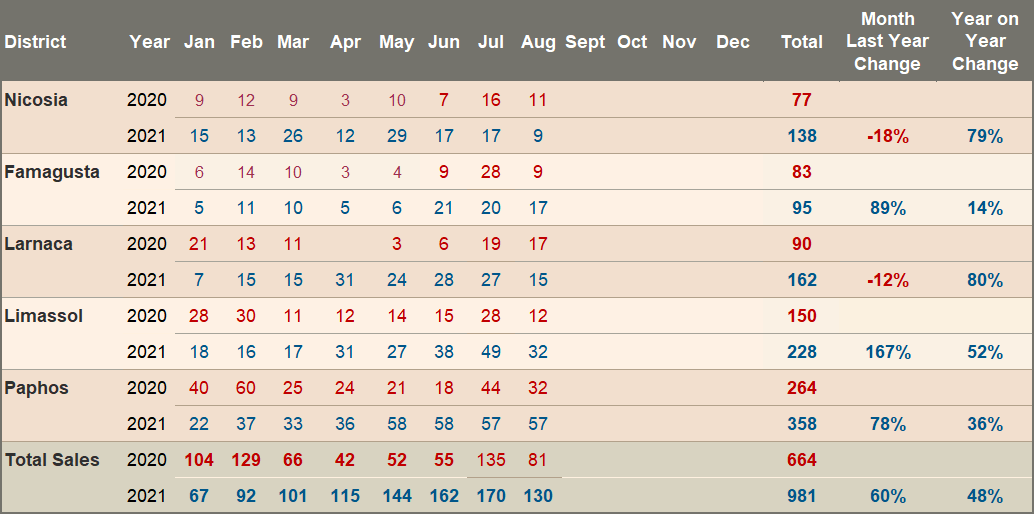
Cyprus Property Sale Transactions to EU citizens – 2020/2021 Comparison
Foreign (EU) Property Sale Transactions – 2020/2021 Comparison

Overseas ales to non-EU citizens

Sales to non-EU citizens (which include UK citizens) fell 1% in August compared to August 2020, with sales in Nicosia (the capital) and Larnaca bucking the trend. However, sales are still well below pre-pandemic levels.
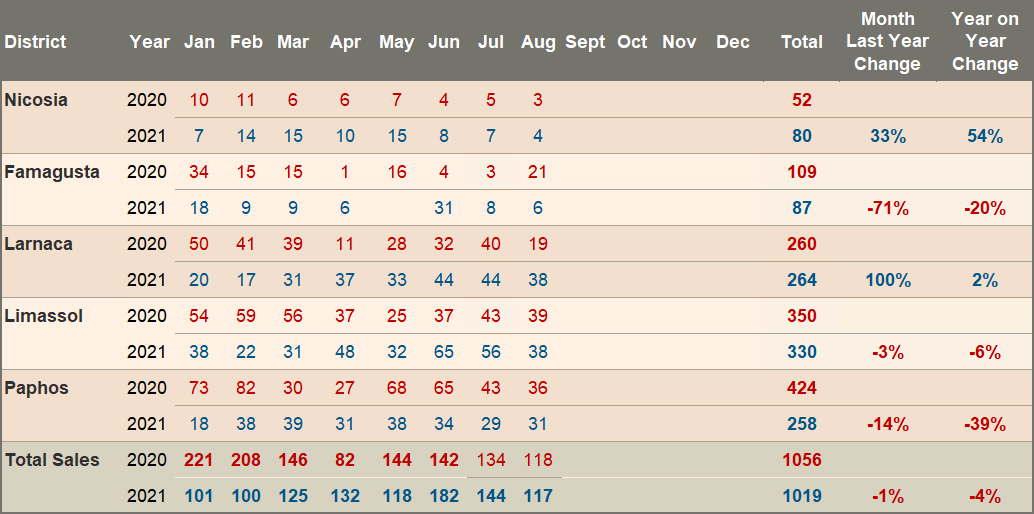
Cyprus Property Sale Transactions to non-EU citizens – 2020/2021 Comparison
Foreign (non-EU) Property Sale Transactions – 2020/2021 Comparison

Analysis of property sales since 2000

Cyprus Property Sale Contracts 2000 – 2021

Year Domestic Sales Overseas Sales Total Sales Percentage
Overseas Sales
2000 12,214 450 12,664 3.6%
2001 12,849 1,207 14,056 8.6%
2002 14,111 2,548 16,659 15.3%
2003 15,294 3,981 19,275 20.7%
2004 11,947 5,384 17,331 31.1%
2005 10,106 6,485 16,591 39.1%
2006 8,598 8,355 16,953 49.3%
2007 9,964 11,281 21,245 53.1%
2008 8,031 6,636 14,667 45.2%
2009 6,409 1,761 8,170 21.6%
2010 6,568 2,030 8,598 23.6%
2011 5,366 1,652 7,018 23.5%
2012 4,793 1,476 6,269 23.5%
2013 2,750 1,017 3,767 27.0%
2014 3,334 1,193 4,527 26.4%
2015 3,603 1,349 4,952 27.2%
2016
5,250 1,813 7,063 25.7%
2017 6,328 2,406 8,734 27.5%
20181 4,875 4,367 9,242 47.3%
2019 5,884 4,482 10,366 43.2%
2020 4,983 2,985 7,968 37.5%
2021 (Aug) 4,089 2,000 6,089 32.8%
Totals 167,346 74,858 242,204 30.9%

1 The Department of Lands & Surveys has advised that overseas sales in 2018 and subsequent year should not be compared to sales in previous years due to changes in the methodology used to classify ‘Aliens’ (foreigners).

Property sales continue to improve

The number of property sales in Cyprus continued to improve in August 2021 compared to the same period last year according to figures released by the Department of Lands and Surveys.

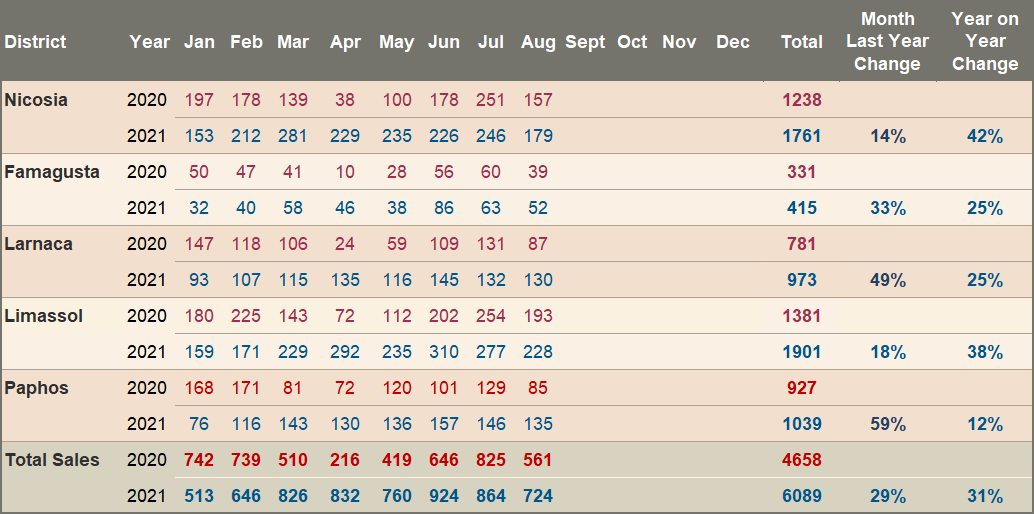
During August 2021, a total of 724 contracts for the sale of property were deposited at land registry office across the Republic, an increase of 29% compared with the 561 contracts deposited during August 2020.

Property sales figures
Total Cyprus Property Sale Transactions – 2020/2021 Comparison

But comparing the number of contracts deposited in August 2021 with those of August 2019 (588), property sales have yet to recover to pre-COVID-19 levels. This slow recovery is also reflected in the annual figures:

During the first eight months of 2021, a total of 6,089 contracts were deposited.

During the first eight months of 2019, a total of 7,044 contracts were deposited.

However, sales so far this year have surpassed the 2018 figure of 6,019.

Property sales chart 2020-2021The coronavirus resulted in the fall in property sales during 2020, which was also exacerbated by the abrupt cancellation of the Cyprus disgraced ‘Citizenship by Investment Scheme’ (a.k.a. Golden Passport) following the expose by Al Jazeera.

But the figures are muddied as the banks are selling properties they’ve repossessed. E.g., according to the Bank of Cyprus half-year results, its Real Estate Management Unit (REMU) sold 387 properties with a contract value of €85 million during the first six months of 2021. During the same period, REMU acquired properties amounting to €21 million through debt for asset swaps and repossessions.

The Department of Lands and Surveys has yet to release its analysis of the figures showing domestic and foreign sales. We’ll bring you the figures as soon as they become available.

As Cyprus changes so do properties

Large companies and high-net-worth individuals who purchase houses and apartments either to resell or rent them to third parties currently make up 20% of all property buyers in the US.

This trend has been progressing upward for the last two years, as people with the necessary financial resources buy properties intending to rent them back to their previous owners or put them back in the market in search of a tenant.

As financial crises become more frequent, an increasing number of people see the sale of their properties as an opportunity (a misnomer) to generate cash to finance the repayment of their loans.

At the same time, Generation Y (those born in the ’80s and the ’90s) has shown its preference towards renting properties rather than being homeowners and being in city centres with more amenities.

In the US, out of some 140 million housing units, approximately 80 million are family homes.

And, out of these family homes, some 15 million are being rented, with 300,000 homes in the hands of institutional investors.

The rest, in their majority, are owned by independent professionals.

While a relatively low number, it is enough to gauge in which direction the wind is blowing.

Properties in Cyprus

In Cyprus, the idea of owning a house still resonates with a lot of people.

However, we believe that the local market will progressively follow a similar trajectory to the US, as have most European countries.

A recent WiRE FS analysis of transactions in Nicosia over the past 18 months showed some 40% of the transaction value involved apartments, while two-thirds of these transactions took place in urban areas.

This indicates the increasing trend by mainly younger Cypriots to acquire apartments instead of houses (cheaper, smaller, closer to amenities) and many acquisitions being from investors looking to generate a rental income by tapping into the growing demand to rent.

Taking a step further and looking at data released by Eurostat, it becomes easier to see that owning a property is somewhat losing its appeal.

In 2009, property owners constituted 74.1% of the Cypriot market; in 2013, that number fell to 73% and in 2019 (latest available data), it dropped even further to 67.9%.

In fact, 2019 marked the first year where the percentage of property owners in Cyprus fell under the EU 27 average of 69.8%.

With the country’s demographics shifting (fewer births, smaller families) and changes in social norms (increase in employment – more women in the workforce, greater need for letting out steam/ entertainment), this inevitably affects peoples’ housing needs. Nowadays, most people don’t want to go for a big house with a front lawn and a swimming pool.

They want a smaller, functional unit, close to amenities and with low running costs, as they expect to spend a significant amount of their time going out for coffee/ dinner and travelling.

Besides, the number of people who can afford these properties has significantly decreased compared to thirty years ago.

We also observe this on the websites of asset management companies: big houses don’t sell for years, whilst apartments tend to be considerably more liquid.

In Cyprus, the population and households have significantly increased over the last thirty years (from 185,459 households in 1992 to 303,242 in 2011), which brought about many changes in the supply of residential property.

However, the main increase in supply has been to cater to overseas buyers rather than locals.

The native population has progressively aged and family size shrunk over the past two decades.

While we are waiting in anticipation to see what the 2021 census will show, the number of households (i.e., permanent residents) with one and two people in 1992 stood at 69,418 and 156,679, respectively, making up just 37% of all households.

In the 2011 census, that number jumped to 52%.

On the other hand, the number of households with four people or more fell from 45% in 1992 to 30% in 2011 (83,792 in 1992, 91,266 in 2011).

The layout of housing units being developed has also changed.

In the 2001 census, properties with up to 5 rooms (including kitchen and living room) made up 52% of the whole, while in 2011, that number went up to 61%.

During that same period, the largest percentage increase was found in houses with three and four rooms (18% and 23% respectively); this is in line with how households changed over time, with family size decreasing and young Cypriots having 1-2 kids.

The trends in the property market will keep following the accelerated demographic shifts. Therefore, the state, and the private sector, i.e., developers, banks, investors, need to make the necessary strategic steps to take account of these so that they are not placed in a position where they are forced to rush into decisions after the fact.

About the Author

Pavlos Loizou, Managing Director, WiRE FS


Property developers & banks face legal action

The Cyprus Consumer Protection Service (CCPS) has registered 56 applications at court against property developers and banks in connection with abusive clauses in consumer contracts.

According to the Greek language Phileleftheros applications have been registered against 7 banks and 49 property developers.

Although the property developers and banks have not been named, an English translation of the list of decisions taken by the CCPS can be found by clicking here.

In February this year, the European Commission has sent a reasoned opinion to Cyprus for failing to properly implement and enforce EU law on unfair contract terms (Council Directive 93/13/EEC) and unfair commercial practices (Directive 2005/29/EC).

The Commission opened this infringement case in 2013 based on a series of complaints from EU citizens who had bought real estate in Cyprus and had allegedly been misled by real estate developers, banks and lawyers.

The Commission found that the Cypriot authorities were not effectively enforcing either of the two relevant EU Directives.

In March this year, lawmakers welcomed the first court judgement against a bank for unfair contract terms of contract, but still harangued the banks for acting with “impunity” in terms of their service fees to clients.

In June 2020, the Nicosia District Court issued a decree against the Societe Generale Bank, ordering the immediate cessation and non-repetition of use of terms which are included in a mortgage agreement form, following a request from the Consumer Protection Service.

The decree against the Societe Generale Bank paved the way for more requests concerning abusive clauses and the CCPS can now submit requests for older cases to be considered.

Making your complaint to the CCPS

Although many people who have bought property in Cyprus have complained about abusive clauses in their contracts with property developers and banks, we expect that many have yet to do so and need guidance.

Anyone wishing to complain should read the following pages from the CCPS website – Unfair commercial practices,  Unfair contract terms and the CCPS’ contact details.

Fitch warns of threats to Cyprus banks’ balance sheets

Fitch rating agency reaffirmed Cypriot banks’ negative outlook noting the general environment poses threats to their balance sheets.

In a report on the Cyprus banks, the agency notes that while they are offloading their toxic non-performing exposure, banks are still sensitive to possible obstacles to the economic recovery and investor sentiment.

Fitch said the small Cypriot economy and the private sector have a lot of leverage (private debt was 210% of GDP end of 2020), making the economy more vulnerable to external shocks.

The weak financial position of banks limits business opportunities and new viable lending options in a small and highly leveraged economy.

However, as Fitch notes, the country’s economy “has shown flexibility for a speedy recovery in previous crises, as reflected in an average growth of 4.6% in the five years before the pandemic.

“We expect the recovery of the economy will support the further reduction of risk in Cyprus’ balance sheet and will offer stability in the operating environment over time.

“Nevertheless, the lack of structural solutions throughout the sector in Cyprus limits the speed with which banks can reduce risk in a weaker-than-expected economic recovery scenario.”

It said Cyprus’ ESTIA scheme, the homeowner rescue scheme backed by the Ministry of Finance to help loan repayments, had “disappointing” participation.

It noted the most promising solution for the issue of home-backed non-performing loans is the one under discussion for the conversion of the remainder of the Cooperative Bank into a bad loan buyer, a fact that could help accelerate the liquidation of quality assets.

Cypriot banks have successfully reduced the non-performing loan ratio from historically high levels over the last five years (63% at the Bank of Cyprus in 2014 and 60% in Hellenic Bank in September 2015), taking advantage of strong economic development dynamics.

Reducing the stock of NPLs was a difficult task during the pandemic.

However, banks continued to write off some loans and sell loans, a tactic carried out successfully, especially by the Bank of Cyprus.

Hellenic’s toxic assets ratio fell to 19% at the end of March 2021 from 27% at the end of 2019, while BOC reduced the ratio to 25% from 38% at the end of 2019.

Fitch said Cypriot banks have not benefited from structural solutions to clear their balance sheets in 2020-2021.

Banks relied heavily on write-offs and sales to process their stock of impaired loans during the pandemic.

BOC & HB’s direct exposure to the accommodation, food, and trade industries accounts for around 20% and 16% of gross loans by the end of 2020, respectively, making them vulnerable to resurgences of COVID-19 or international travel restrictions.

BOC and HB unveiled new targets regarding the reduction of NPLs in 2020 as part of their new strategic plans.

Bank of Cyprus targets its ratio to be less than 10% by the end of 2022 and about 5% in the medium term.

Similarly, HB plans to reduce its index to single digits in the medium term.

“In our view, these targets are ambitious but realistic and reflect the confidence of banks in their ability to absorb MES inflows from areas severely affected by the pandemic, such as tourism.”

Fitch noted that banks’ plans would depend on their ability to complete large loan transactions, which depend on the economic environment and investors’ appetite for Cypriot assets.

Fitch notes that the banks’ capitalisation capability is another key criterion.

“Reducing the stock of toxic assets and therefore reducing the capital burden is in our view the most likely scenario that will reverse the negative trend in the rating of the capitalisation of the two banks.”

NPLs remain at 18 per cent of total bank loans

Statistics published by the Cyprus Central Bank reveal that non-performing loans (NPLs) in May 2021 accounted for 18.07% of total bank loans; unchanged from April 2021.

According to the Central Bank, NPLs stood at €5.134 billion in May, a fall of approximately €7 million from April’s figure of €5.141 billion as follows:

  • General governments – €218,000.
  • Other financial corporations – €215.7 million.
  • Non-financial corporations – €2.158 billion (of which €1.782 billion by SMEs.)
  • Households – €2.761 billion.

But while the percentage of NPLs remained the same, the total accumulated impairment (provisions) increased to 47.6%.

At the end of 2020, non-performing loans were estimated at €5.111 billion, down from €8.972 billion in 2019.

Total restructured loans amounted to €3.833 billion, of which €2.311 billion continue to be classified as non-performing loans.

In addition, total accumulated impairment (provisions) at the end of May were estimated to be €2.618 billion, up from April’s figure of €2.598 billion.

NPLs the plan

It is anticipated that once the transformation of KEPIDES into a bad bank is completed and its purchase of non-performing loans from the financial institutions gets underway, NPLs will reduce sharply.