

More Israelis have been buying property, investing in businesses and moving to Cyprus in recent years. The trend is bringing new capital to the island, while raising questions about housing affordability, land ownership and the scale of foreign influence.
The prolonged insecurity in Israel after the October 7, 2023 attacks and the wars that followed has led some Israelis to consider Cyprus as a place to live. For some, the nearby island is no longer just a holiday destination or investment opportunity, but a permanent home or a contingency plan.
“I want to have a Plan B in case the situation in Israel gets more difficult,” one Israeli who recently bought a home in a large residential development in the Limassol district told Deutsche Welle, speaking anonymously.
Another buyer cited the island’s closeness and familiar climate: “It’s a 40-minute flight, the same landscape, the same climate. It’s like being in Israel without actually being there.”
A third interviewee said business considerations also played a role, as Israeli companies have moved some operations to Cyprus to make it easier to work with European Union countries.
Buyers, residents and second homes
The Republic of Cyprus has a population of fewer than one million. Estimates cited by Israeli media put the number of Israeli families living permanently on the island at 3,000 or more, with several hundred additional families arriving each year.
Israeli media have also reported that tens of thousands of Israelis own property in Cyprus. Israel Hayom, has estimated that around 20,000 Israelis own property in Cyprus without living on the island year-round.
Cyprus Land Registry figures presented to parliament recorded 3,851 property transfers and sale contracts involving Israeli buyers between 2021 and 2024 in the coastal districts of Larnaca, Paphos and Limassol.
Israeli investment also extends to tourism and large development projects. Hotel group Fattal has invested hundreds of millions of euros in Cyprus, with properties in Limassol, Paphos and Larnaca.
In Larnaca, investors with Israeli interests are involved in the redevelopment of the historic Palm Beach hotel, a project valued at more than €110 million, and the approximately €40 million Aqua Residences development. The latter plans two 15-storey towers along the seafront.
In the Limassol district, Uriel Kertesz, a Hungarian-Israeli businessman and investor has proposed restoring about 60 homes in the long-abandoned village of Trozena and adding tourism facilities, a campsite and a winery. The project lies within a Natura 2000 protected area. It has drawn opposition and prompted an investigation by the authorities after some work reportedly began without the necessary planning and building permits.
Services for a growing community
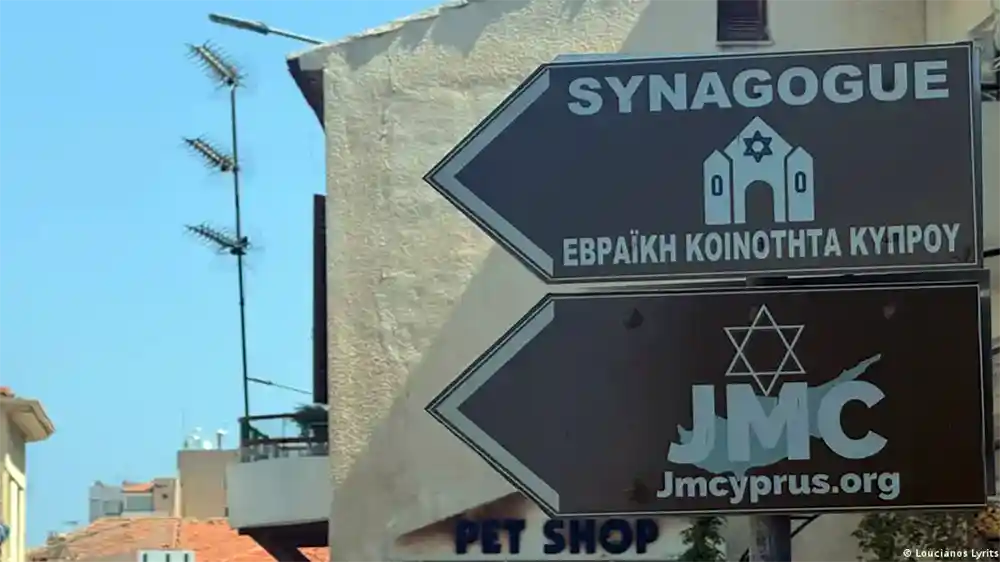
A more established Israeli presence is visible in the services and businesses opening across Larnaca, Limassol and Paphos. These include places of worship and restaurants offering kosher food. Hebrew-language advertisements, including political campaign material, have also appeared on roadsides. Last summer, billboards for Gadi Eisenkot’s Yashar party targeted Israeli voters in Cyprus.
A planned private Jewish school in Polemidia, near Limassol, could accommodate up to 1,500 students – another sign of the community’s growing permanence.
The developments have intensified a wider debate about foreign investment and property ownership. That discussion is also shaped by critics’ concerns about Cyprus’ diplomatic support for Israel and memories of the Russian capital inflows that followed the 2013 financial crisis, when the country expanded its citizenship-by-investment program.
Political criticism and response
Stefanos Stefanou, secretary general of the opposition Progressive Party of Working People (AKEL), has warned about what he described as uncontrolled sales of Cypriot land to foreigners. He specifically cited Israeli purchases and the development of gated residential communities with their own infrastructure.
Fidias Panayiotou, a member of the European Parliament and leader of the Direct Democracy party, has gone further, claiming that “Israel is buying Cyprus” and warning that the Cypriot economy could become too dependent on Israeli capital.
Israel’s ambassador to Cyprus, Oren Anolik, rejected claims that Israelis wield excessive influence. He said Israelis who live and do business on the island have become part of its social and economic fabric. Anolik also warned that singling out a nationality and invoking stereotypes about “foreign economic power” could fuel antisemitism.
The government has made attracting foreign investment a priority. President Nikos Christodoulides has repeatedly presented Cyprus as a destination for international investors. In 2025, then-Energy and Commerce Minister George Papanastasiou said the government was pleased that Israeli businesspeople were active in sectors including tourism, technology, energy, health and real estate.
Proposed restrictions on land purchases
The issue has reached parliament, where lawmakers are considering proposals to restrict land purchases by non-EU nationals. The proposals come from the country’s two largest parties: the left-wing AKEL and the centre-right Democratic Rally (DISY).
DISY MP Nikos Georgiou told Deutsche Welle that foreign land purchases had reached “unprecedented proportions” in recent years, affecting demographic patterns, land values and, in some cases, national security. He said his proposal was not aimed at any specific country or its citizens, and called for debate “without scaremongering” or rhetoric against people from third countries.
AKEL has put forward a similar proposal. MP Giorgos Koukoumas said mass property purchases by foreign nationals were among the factors pushing prices beyond what many Cypriots could afford to buy or rent in urban areas.
Koukoumas also pointed to concerns about Israeli acquisitions of major businesses and large areas of land. He cited Israeli media reports about the creation of a “second Israel in Cyprus,” as well as concerns about Israeli intelligence activity on the island and closer Cypriot-Israeli defence and security ties.
The debate now brings together competing priorities: Cyprus’ effort to attract international investment, the effect of property demand on local residents, and the question of how to discuss foreign ownership without directing hostility at a nationality or community.
By Loucianos Lyritsas, Limassol | Edited by Aingeal Flanagan
Adapted from an article published by Deutsche Welle
