Real estate outlook gloomy, Nicosia bucks trend

Real estate specialists are not optimistic over the sector’s outlook, as property sales are struggling compared to pre-COVID-19 levels.

Property sales in Cyprus dropped by 17% across the island in the first seven months of 2021, compared to the same period in 2019, before the coronavirus outbreak in March 2020.

Despite property sales improving 31% compared to the same period in 2020, experts argue this is not enough to overturn the gloomy outlook for an industry nowhere near its pre-pandemic performances.

In comments to the Financial Mirror, Angelos Constantinou of BNP Paribas/ Danos Real Estate’s research department said that a drop of 17% might not say much, taking into account that the industry took one blow after another in 2020, but when one takes a look at the breakdown, disappointment settles in.

“Essentially, the drop was buffered by a 46% increase in real estate transactions in Nicosia, mainly concerning housing purchases.

“The decline in sales in high-performing districts during the boom are now reporting drops of up to 45%,” said Constantinou.

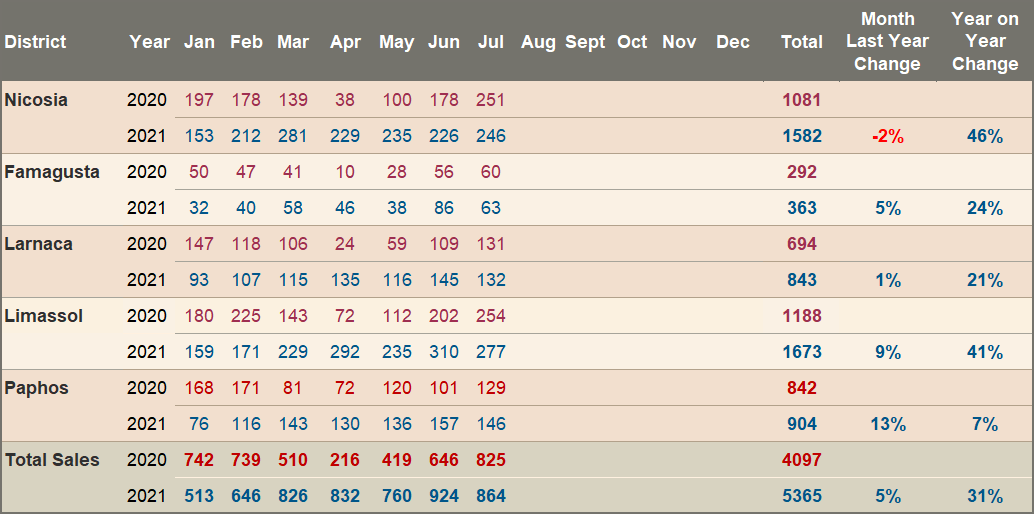
According to the data published by the Land Registry, sale documents reached a total of 5365 in the period January – July, up from 4097 in the same period last year but down from 6456 in the first seven months of 2019.

The biggest drop of 45% occurred in Paphos, where sales documents went from 1646 to 904 in the first seven months of 2021 compared to the same period in 2019.

A decrease of 26% was recorded in Limassol, where sales reached 1673 in the first seven months of 2021 compared to 2273 in 2019.

In Larnaca, 843 property sales took place compared to 929 in 2019, recording a decrease of 9%. In Famagusta, the reduction amounted to 14%.

In 2020, sales documents fell to the lowest point since 2016 at 7968 units from 10366 in 2019, recording an annual decrease of 23.1%.

Constantinou said the drop in sales is mainly attributable to the coronavirus and demise of the Citizenship for Investment scheme, which generated €8 billion in real estate.

In November, the government pulled the plug following a ‘gotcha’ Al Jazeera video alleging corruption in the ‘golden passports’ scheme.

The undercover video portrayed high ranking officials ready to assist an investor from China with a dubious past to obtain a Cypriot passport.

The video also revealed how civil servants would assist in speeding up the passport process while overlooking the applicant’s criminal record.

Al Jazeera’s video led to a public outcry and the resignations of the House Speaker and an AKEL MP.

“Obviously, the demise of the CIS was the biggest blow to the industry, but the coronavirus outbreak only made things worse in 2020,” argued Constantinou.

He said that minimal tourist arrivals meant that many properties bought by investors aiming to make a profit from renting them to tourists found their way back on the market, pushing prices and interest in new properties down.

“The same goes for housing units in Paphos where 30% of homes are owned by British expats who usually rent out their homes during the hot months of the summer which they’d rather spent back home.”

Constantinou said it was common for Britons to rent out their homes in the summer.

“We are now seeing a number of these homes being put up for sale as their owners either cannot travel to Cyprus so easily due to COVID or have difficulties in renting them out to make ends meet.

“No tourists, no demand for this kind of property rentals.”

“These properties on the market affect prices, but also construction as people looking to buy a house will be attracted by a home that is already built.”

The property expert said the picture is no better in Limassol, where construction projects have been put on hold, as developers fear that demand will wither.

He said developers are hoping to reap the last CIS fruit, as 784 passport applications submitted by foreign investors before the scheme was officially scrapped have yet to be examined.

“However, following the scandals with dubious investors acquiring Cypriot passports, going through their applications is expected to be a long process that may end in 2022.”

Developers have received down payments from these investors, which is almost as good as money in the bank, but their applications will need to be approved for the purchases to be completed and registered with the Land Registry.

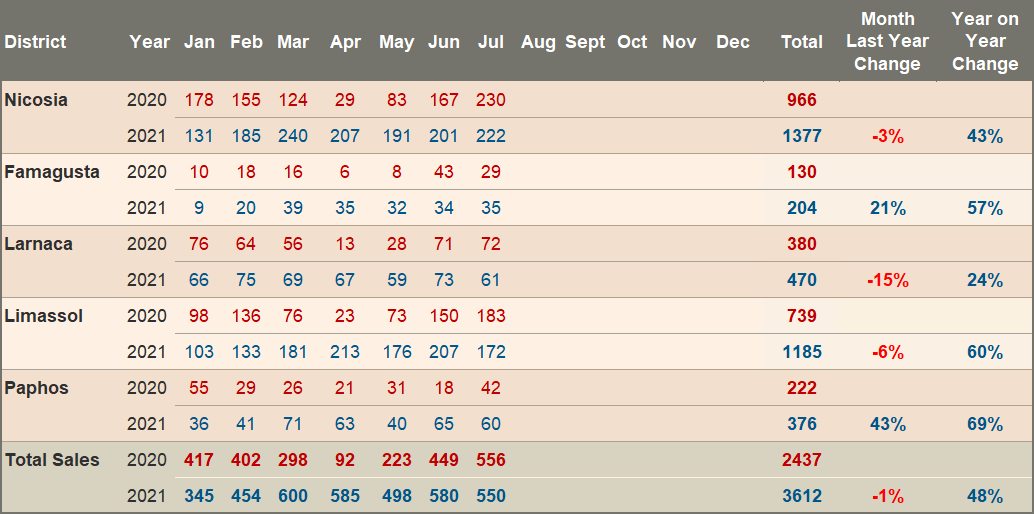
According to the data, sales to locals in 2021 amounted to 3612, accounting for 67.3%, while sales to foreign buyers amounted to 1753 or 32.7%.

In the first seven months of 2020, sales to locals were 1660 and in 2019, a higher 2902.

In July alone, real estate sales increased by 5% annually, compared to an annual increase of 43% in June and 81% in May.

Sales to foreign buyers increased by 16.7% year-on-year in July, rising to 314 from 269 in July 2020 and 429 in July 2019.

Recovery in property sales slows

Cyprus property sales continued to improve in July but slower than in previous months, with sales to the overseas market leading the way and a small drop in sales to the domestic market compared July 2020 according to figures released by the Department of Lands and Surveys.

Total sales

During July a total of 864 contracts for the purchase of real estate comprising residential, commercial, retail and land were deposited at Land Registry offices across the Republic; an increase of 5% on the June 2020 figure of 825. (This compares with a 44% rise in sales during June.)

While four of the island’s districts reported increases in the number of property sales, sales in Nicosia (the capital) fell by 2% compared to July 2020.).

Cyprus total property sales
Total Cyprus Property Sale Transactions – 2020/2021 Comparison

During the first seven months of 2021, total sales have risen by 31%.

Domestic property sales

Despite the number of new loans for house purchasing reaching a record high of €114 million in June, property sales to the domestic market fell by 1% in July compared with July 2020.

Although sales rose in Paphos and Famagusta, they fell in the three remaining districts.

Sales July 2021
Domestic Property Sale Transactions – 2020/2021 Comparison

During the first seven months of 2021 sales to the domestic market have risen by 48% compared to the same period last year.

(However, the figures will include an unknown number of ‘non-sale’ agreements such as loan restructurings, recoveries and debt-to-asset swaps agreed between the banks and defaulting borrowers in efforts by the banks to reduce their non-performing loan portfolios. Unfortunately, the Department of Lands and Surveys does not publish these figures separately.)

Foreign sales

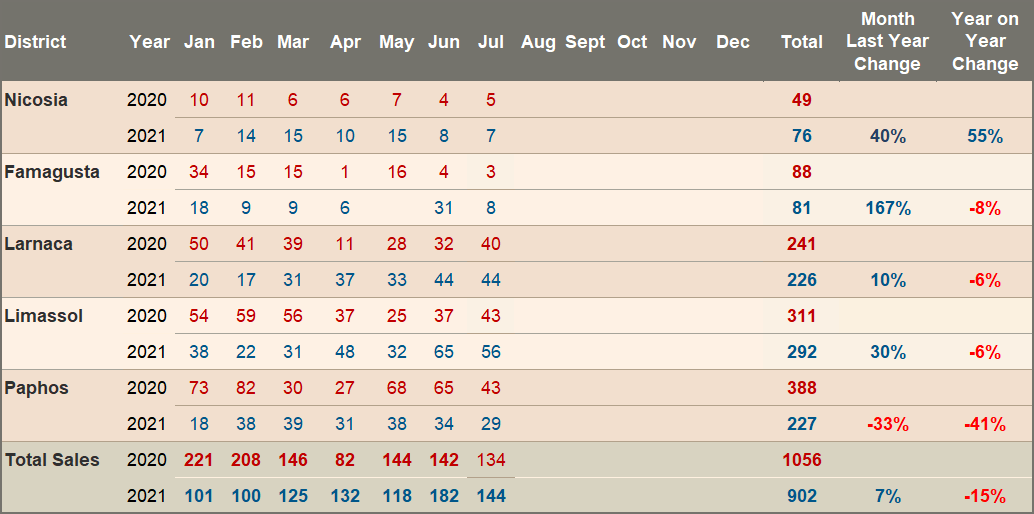
Foreign sales (EU and non-EU nationals) rose by 17% in June compared to June 2020 with sales rising in all districts with the exception of Paphos and Famagusta.

Foreign sales
Foreign Property Sale Transactions – 2020/2021 Comparison

During the first seven months of 2021 property sales to the foreign market have risen by 6% compared to the same period last year.

Foreign sales to EU citizens

Sales to EU nationals rose 26% in July compared to June 2020 and are up 46% year-on-year.

With the exception of Famagusta, where sales fell by 29%, sales rose in all districts.

EU Sales
Foreign (EU) Property Sale Transactions – 2020/2021 Comparison

Foreign sales to non-EU citizens

Sales to non-EU citizens rose 7% in July compared to July 2020 but are down 15% year-on-year.

With the exception of Paphos, where sales fell by 33%, sales rose in all districts.

non-EU sales
Foreign (Non-EU) Property Sale Transactions

Analysis of property sales since 2000

Cyprus Property Sale Contracts 2000 – 2021

Year Overseas Sales Domestic Sales Percentage
Overseas Sales
Total Sales
2000 450 12,214 3.6% 12,664
2001 1,207 12,849 8.6% 14,056
2002 2,548 14,111 15.3% 16,659
2003 3,981 15,294 20.7% 19,275
2004 5,384 11,947 31.1% 17,331
2005 6,485 10,106 39.1% 16,591
2006 8,355 8,598 49.3% 16,953
2007 11,281 9,964 53.1% 21,245
2008 6,636 8,031 45.2% 14,667
2009 1,761 6,409 21.6% 8,170
2010 2,030 6,568 23.6% 8,598
2011 1,652 5,366 23.5% 7,018
2012 1,476 4,793 23.5% 6,269
2013 1,017 2,750 27.0% 3,767
2014 1,193 3,334 26.4% 4,527
2015 1,349 3,603 27.2% 4,952
2016
1,813 5,250 25.7% 7,063
2017 2,406 6,328 27.5% 8,734
20181 4,367 4,875 47.3% 9,242
2019 4,482 5,884 43.2% 10,366
2020 2,985 4,983 37.5% 7,968
2021 (July) 1,753 3,612 32.7% 5,365
Totals 74,611 166,869 30.9% 241,480

1 The Department of Lands & Surveys has advised that overseas sales in 2018 and subsequent year should not be compared to sales in previous years due to changes in the methodology used to classify ‘Aliens’ (foreigners).

Battle lines drawn in foreclosures’ row

The ongoing tussle between the government camp and the opposition over freezing bank foreclosures has turned into a kabuki theatre of sorts, both sets of actors content with playing to their respective audiences while the underlying issue remains unresolved. And with the 2023 presidential elections not that far away, one should expect more of the same, analysts say.

“As regards foreclosures, frankly I see nothing changing anytime soon as far as parliament goes. Sooner or later, we’ll enter into the charged political orbit of the 2023 presidential elections,” said Antonis Ellinas, associate professor at the department of social and political sciences, University of Cyprus.

In his opinion, the legislature “is playing a dangerous game” with banks’ balance sheets, at a time when banks are trying to sell assets. As we saw in the not so distant past, taxpayers end up paying the price for banks’ troubles.

Continuous freezes on foreclosures put stress on banks – as debtors are let off the hook with debt payments – and there may come at a time when regulators, both here and especially in Frankfurt, draw a line in the sand.

“Seeing that bank assets/collateral are depreciating because it takes more time to deal with bad debts, bank regulators could instruct Cypriot lenders to increase their provisions for bad debts, and hence, raise more capital. If they cannot raise more capital, guess who will pay the price?”

A similar scenario had played out with the now-defunct cooperative bank, says Ellinas. A culture of pandering to delinquent debtors snowballed into an untenable situation, and in October 2018 the EU’s Single Supervisory Mechanism (SSM) forced the bank to wind down its operations.

This past week saw another episode in the long-running foreclosures saga. In a special plenary session the House voted to reject President Nicos Anastasiades’ refusal to sign off on a bill that would renew for three more months a freeze on property repossessions.

Anastasiades had declined to sign the bill passed on July 8 citing a number of reasons, including that it violated articles of the constitution and appeared to interfere with the right of borrowers to freely enter into a contract.

As per procedure, he had then sent – or referred – the bill back to parliament.

Parliament had the option of accepting the president’s referral or declining it, that is, insisting that the bill be enacted into law.

With the matter now deadlocked legislatively, the president is expected to refer the bill to the Supreme Court. Until the Supreme Court rules, the law at it stands applies, with the ban on foreclosures elapsing yesterday.

However, the opposition did seem to have a point in accusing the government camp of hypocrisy. For instance Diko MP Christiana Erotokritou observed that during the last extension to the freeze the government had not opposed it over constitutional reasons, as it was doing now.

She said the government had at the time looked the other way, because the parliamentary elections were coming up in May, and the ruling party wanted to avoid incurring the political cost of opposing an extension to the moratorium.

Other opposition MPs piled on, saying that the president invokes the constitution only whenever it’s politically expedient.

Making a cameo during this latest spat was a letter from the European Central Bank (ECB). On the day of the House plenary, a local media outlet published the letter which the ECB sent to the government on July 20.

Depending on whom you ask, the ECB appeared either not to be in favour of extending the freeze on foreclosures, or that the ECB did not mind either way.

Effectively, both sides have kicked the can down the road. Perhaps the theatrics will resume in autumn.

“Not only with foreclosures, but also with other matters, we see a trend from both the government and the opposition to defer disputes to the Supreme Court. And by the time it gets to the courts, political accountability about who did what is gone, as memories fade,” remarks Ellinas.

Deferring issues to the Supreme Court has gained traction in recent years, in part because the government has been a minority in parliament for seven out of its eight years in power, he added.

The bill – whose fate now lies with the Supreme Court – which MPs passed on 8 July provided for prohibiting repossessions on primary residences valued at up to €350,000, business premises with annual turnover of up to €750,000, and agricultural land plots valued at up to €100,000. Previously, the protection afforded was even broader in terms of the amounts.

Lawmakers had passed the bill despite warnings from the government and the banking industry not to. Both the government and the banks advised against extending the moratorium on repossessions because of the moral hazard – given that foreclosures serve as a tool and an incentive encouraging delinquent debtors to restructure their loans.

Marios Mavrides, an MP with the ruling Disy party, accuses the opposition of acting irresponsibly, not realising the potential damage this can cause to the banking sector.

“Had it gone through, it would have been the third extension on the [foreclosures] moratorium, which dates back to November last year. This risks becoming a permanent state of affairs, rather than a temporary measure.”

The opposition’s core argument is that the stay on foreclosures aims to give people relief amid the coronavirus situation. In turn it accuses the government of not caring for ‘the little guy’ and siding with the banks and ‘vulture funds’.

Speaking in his personal capacity, Mavrides describes calls this reasoning disingenuous, and one that falls apart under the slightest scrutiny.

“We have no problem helping out those who demonstrably suffered financially due to the covid situation specifically. But most of the loans impacted by these foreclosure freezes date back to 2019 and before.”

According to the lawmaker, and despite the alarm bells being sounded by the opposition, to date hardly anyone in Cyprus has seen their home repossessed and thrown out on the street.

“There may have been maybe a couple of cases where a primary residence was foreclosed on by a bank. And if I recall correctly, those were unoccupied houses where the borrowers were being absolutely uncooperative.”

Moreover, the net cast by the proposed ban on foreclosures is too wide.

“Look at the provision seeking to shield businesses with a turnover of €750,000. First of all, that’s a totally arbitrary number. Why not, say, a €1 million turnover? Also, a business may have a high turnover, but operate at a very low profit margin. Were their profit margins considerably affected by the covid situation? That’s the kind of detail we ought to be looking at.”

That said, Mavrides cannot entirely fend off the criticism that his party did go along with the first two proposals to freeze repossessions. If it’s a matter of political conviction and sound economic policy, where’s the consistency?

“We didn’t want to oppose the freeze in the midst of the pandemic,” he offers. “Now that the pandemic seems to be subsiding, things are different.”

New loans for homes reach record high

Net new loans for house purchasing rose to €114 million in June, reaching a new all-time monthly record since December 2014, when the Central Bank of Cyprus (CBC) began recording data.

The rise was driven by a government’s interest rate subsidy scheme, aiming to support economy that has been affected by the Covid-19 pandemic.

According to data released Monday by CBC total new loans continued to rise in June 2021, driven by both net new loans and restructurings. Total new loans recorded an increase to €674.5 million in June, compared with €415.3 million in the previous month. Of the €674.5 million, net new loans amounted to €291.7 million and restructured loans amounted to €383.9 million.

Most of the net new loans were for house purchasing that rose to €113.7 million, followed by loans to non-financial corporations over €1 million which rose to €100.3 million.

New loans of up to €1 million amounted to €50.5 million in June, while new consumer and other loans amounted to €13.4 million and €12.8 million respectively.

The vast majority of restructured loans where loans to non-financial corporations for amounts over €1 million and amounted to €273.4 million in June, followed by restructured housing loans with €58.2 million and restructured loans to non-financial corporations for amounts up to €1 million with €50.5 million.

The restructurings of consumer loans in June amounted to €6.4 million and the restructurings of other loans to €4.1 million.

According to CBC data, during the period January – June, a total of €1.39 billion in net new loans were granted, marking an increase of 4.2% compared to the corresponding period of 2020.

Why construction cost skyrocketed & what’s next?

The construction cost in Cyprus has increased abnormally. The recent hike in diesel price has worsened the situation, as the price has a domino effect on prices of every material used in the construction sector.

Crucial inputs such as steel, cement, sand, stone aggregates and wood-oriented materials have seen a price increase in the last one year, pushing up the overall construction cost.

Apart from the prevailing housing demand, below we categorize the main factors that contribute to rising construction costs.

Oil

Crude oil prices have shot up around 80% since October 2020. Oil is essential to the construction industry since the manufacturing of the building materials, their transportation and the construction site machinery operation are all depended to oil.

Increase of home improvement activity and slowdown in the supply

During the world-wide lockdowns and semi-lock downs, homeowners were stuck at home and they were unable to take vacations or make social expenses. Inevitably, with time and money on their hands there was a huge increase in the home remodelling activity (renovations of some rooms, extensions of current ones etc.).

At the same time, the lockdowns cause a slowdown in the production of the materials. This have caused an imbalance of supply and demand that remains up to today in some extent.

Finally, the combination of low mortgage rates and the trend of working remotely persuaded some apartments owners to buy a house and thus the increasing demand for bigger space have caused further activity.

Infrastructure spending plan & electric vehicles

There is a worldwide spike of investment on infrastructure projects by the governments (mostly USA and China). This shift is considered to be the safest and fastest way to generate a lot of employment while it offers the higher fiscal multiplier on a nation’s GDP.

As we look forward, the investment on infrastructure projects is sucking up a lot of materials and thus will cause further increase in all of the construction materials.

Moreover, the growing demand of car industry and especially the electric cars are causing a further increase in the usage of the materials of steel, aluminium and especially copper, which is an essential element in the construction industry in the form of pipes, plumbing, wiring, heating and cooling systems.

Transportation

Being an importing country, the recent transport issues due to capacity constraints, shortage of containers (container crisis), surge of electronic commerce and increase in the demand of transportation space and port labour shortage are causing higher importing costs and thus higher final product costs that are passed into the consumers.

Construction costs what’s next?

The rapid increase in construction cost worsening the affordability for buyers while for developers it creates business issues since their estimates may be completely off once the project starts or during the development process.

While there’s little room to adjust pricing for existing contracts, costs are being passed on for new projects. Following this, the increasing construction costs are causing slowdown in the sales of the off-plan new homes while it boosts demand and prices for the resale and key ready properties.

Unfortunately, the rising construction cost came at a bad time, since a strong supply of houses is the solution to the existing housing shortage.

With regards to the future of construction cost, although demand is expected to hold up well for some time, the key determinant is whether and how fast the production and transportation will actually return back to their full capacity.

In this respect, with reference to the existing expectations of the market, our view is that construction cost will remain high for another 1-2 years and then drop back to pre-pandemic levels within 2023. By that time, construction costs will moderate at a more normal increase pace of 3% – 5% per year.

About the author

Charalambos Pitros is a PhD holder in Real Estate Economics and Member of the Royal Institution of Chartered Surveyors (MRICS) and of the European Real Estate Society (ERES). He is a Property Valuer at Zyprus | Property Valuers & Estate Agents.

Less than 1 in 5 Estia applications approved

The Ministry of Finance has released the provisional results of its Estia housing loan subsidy scheme.

From the 4,374 completed applications received, the ministry has approved 802, roughly 18 per cent of the total number.

Under the initial Estia scheme conditions, eligible borrowers with loans using their primary residence as collateral and with a value of up to €350,000 will receive a state subsidy amounting to one third of their monthly instalment required by the restructured loan facility.

The scheme was approved by the European Commission’s Directorate for Competition and aimed to protect applicants’ primary residence from being foreclosed on as well as at decreasing the number of non-viable loans in the Cypriot banking system.

Estia statistics

The ministry said that 6,393 applications were submitted.

Of those, roughly 30 per cent were incomplete and remained as such despite repeated warnings and reminders issued by the ministry.

One per cent of applications were withdrawn by the applicants themselves.

This left a total of 4,374 completed applications that could be formally considered.

The ministry deems the above number as lower than expected and attributes the underwhelming adoption of the scheme to financial privacy concerns.

“As shown by the high percentage of incomplete applications, the lower than estimated participation in the Estia scheme is mainly attributed to the reluctance of a significant number of borrowers to the disclosing of their income and assets,” the ministry said in a statement.

“It was first revealed during the audit that a significant number of applications had incomplete data or documents (28 per cent of rejections) and therefore remained incomplete,” the ministry said, explaining that additional information was requested but not provided.

“Exceeding the income and property criteria is the main reason for rejection (32 per cent of cases), which shows that there is, at least in part, some financial possibility to service or settle the loans,” the ministry added.

Additional reasons for rejecting applications included the inability of the applicant to prove that they reside in the submitted location as some were using the property as a place of business, the value of the property exceeding the scheme’s upper limit of €350.000, as well as the submission of illegible loans to the scheme.

The ministry also said that only one reason for rejection was provided for each application, despite more than one reason existing in some cases.

2,697 applications, 62 per cent of the number of completed applications, have been rejected.

759 applications, 17 per cent of the aforementioned number, have been classified as non-viable loans.

Roughly 2 per cent of completed applications are still under consideration and the final decision is pending.

Based on estimates, 802 approved applications correspond to a total sum of 200 million in non-viable loans.

The ministry has also provided various reasons for the rejection of applications for the Estia scheme.

Finally, the above results are pending a review of those applicants who have objected the ministry’s decision.