Covid-19 impacting overseas property sales

Property sales in Cyprus to the overseas market continue to be hit by the COVID-19 pandemic and are unlikely to improve substantially until it becomes easier for foreigners to travel to Cyprus.

Positive news

Last month Cyprus signed agreements with Greece and Israel to ease travel restrictions allowing citizens with Covid-19 vaccination certificates to travel unimpeded between the three countries.

Just a few days ago Cyprus announced it will allow British tourists who have been fully vaccinated against Covid-19 into the country without restrictions from 1 May.

However, under the UK’s current COVID-19 restrictions, it is illegal to travel abroad for holidays or leisure purposes. But if the UK government is satisfied that its four tests are being met, the earliest date people from England will be able to travel overseas for a holiday, including Cyprus,  is 17 May, when the country moves in to step three of its lockdown exit plan.

As Pavlos Loizou noted in his recent article, as Cyprus was in lockdown during the first three weeks of January, the Land Registry was understaffed, several transfers and deposits were moved to February. As you will see below, domestic sales are holding their own in the face of the pandemic.

February sales figures

During February a total of 646 property sale contracts were deposited at Land Registry offices across Cyprus. Of those 646, 70% (454) were deposited by Cypriot buyers and 30% (192) by foreigners.

EU citizens accounted for 14% (92) sales, while non-EU citizens accounted for 15% (100) sales.
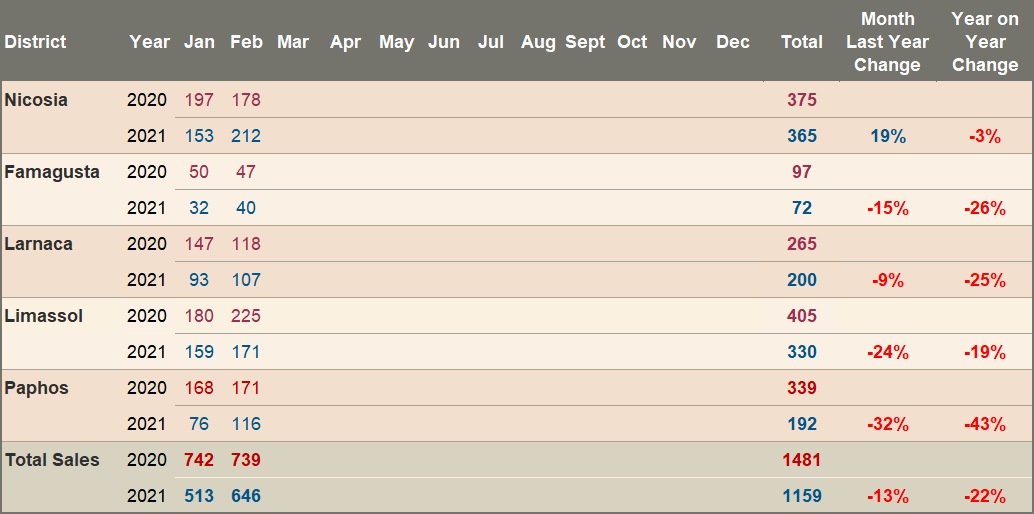
Total Cyprus Property Sale Transactions - February 2021
Total Property Sale Transactions – 2020/2021 Comparison

Domestic property sales

In February, property sales to the domestic market performed well despite the Covid-19 restrictions, rising by 13% compared to February 2020.

Domestic Cyprus Property Sale Transactions - February 2021
Domestic Property Sale Transactions – 2020/2021 Comparison

Sales to EU Citizens

Property sales in February declined by 29%, mainly due to the Covid-19 restrictions imposed by their home countries and Cyprus. If efforts to contain the pandemic go well, as these restrictions ease more visitors to the island should encourage more sales.
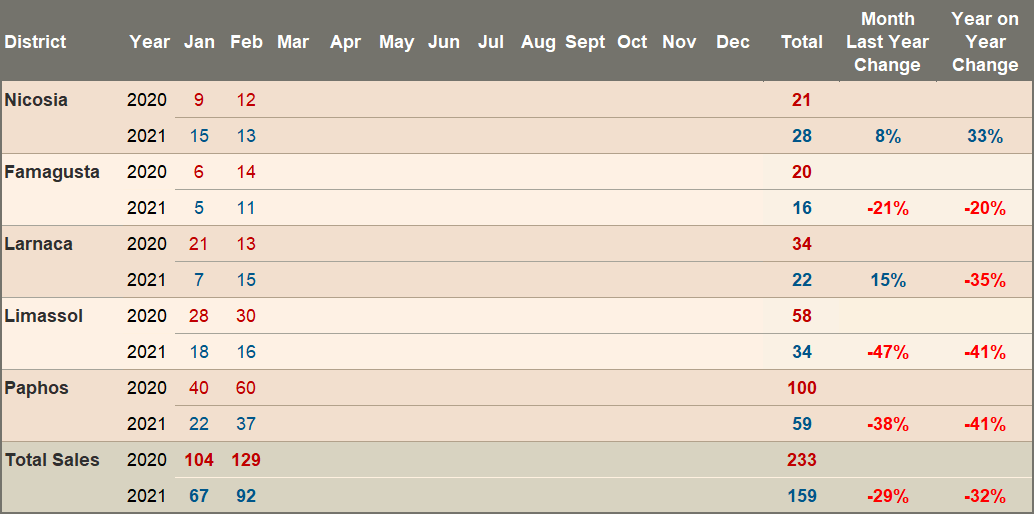
Cyprus Property Sale Transactions to EU Citizens - February 2021
Foreign (EU) Property Sale Transactions – 2020/2021 Comparison

Sales to non-EU citizens

Property sales to non-EU citizens declined 52% in February compared to February 2020. These have been hit by a double whammy; the Covid-19 restrictions and the cancellation of Cyprus’ citizenship-by-investment (aka Golden Passport) scheme last November.

A bill laying out revised criteria for citizenship has been submitted to the Cyprus parliament. According to the bill, applicants must be legally residing in the republic for the last 12 months, and for 10 years prior to their application with a total time spent on the island of not less than seven years during that period plus a number of other conditions.

Currently foreign nationals can apply for residency using the fast-track or the normal procedure.

The fast-track procedure grants permanent residence status to foreign nationals who purchase of a property sold for the first time, which is worth at least €300,000. They must also make a three-year fixed deposit of €30,000 in a Cyprus bank and must visit Cyprus to provide their biometric data and visit the country every two years.

The normal procedure grants permanent residence status to foreign nationals who have been continuously and legally resident in Cyprus for five years.
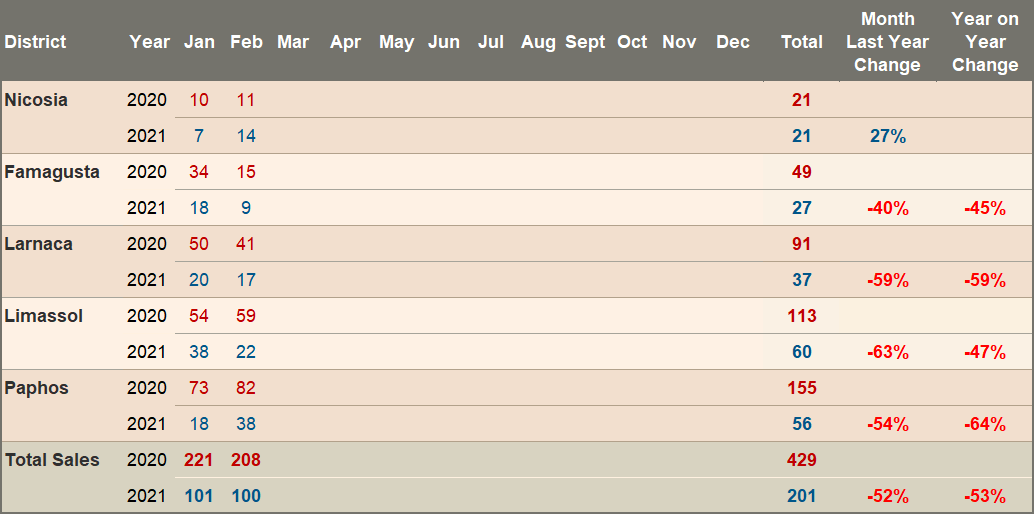
Cyprus Property Sale Transactions to Non-EU Citizens - February 2021
Foreign (Non-EU) Property Sale Transactions – 2020/2021 Comparison

Analysis of property sales since 2000

Cyprus Property Sale Contracts 2000 – 2021

Year Overseas Sales Domestic Sales Percentage
Overseas Sales
Total Sales
2000 450 12,214 3.6% 12,664
2001 1,207 12,849 8.6% 14,056
2002 2,548 14,111 15.3% 16,659
2003 3,981 15,294 20.7% 19,275
2004 5,384 11,947 31.1% 17,331
2005 6,485 10,106 39.1% 16,591
2006 8,355 8,598 49.3% 16,953
2007 11,281 9,964 53.1% 21,245
2008 6,636 8,031 45.2% 14,667
2009 1,761 6,409 21.6% 8,170
2010 2,030 6,568 23.6% 8,598
2011 1,652 5,366 23.5% 7,018
2012 1,476 4,793 23.5% 6,269
2013 1,017 2,750 27.0% 3,767
2014 1,193 3,334 26.4% 4,527
2015 1,349 3,603 27.2% 4,952
2016
1,813 5,250 25.7% 7,063
2017
2,406 6,328 27.5% 8,734
20181 4,367 4,875 47.3% 9,242
2019
4,482 5,884 43.2% 10,366
2020
2,985 4,983 37.5% 7,968
2021 (Feb)
360 799 31.1% 1,159
Totals
73,218 164,056 30.9% 237,274

1 The Department of Lands & Surveys has advised that overseas sales in 2018 and subsequent year should not be compared to sales in previous years due to changes in the methodology used to classify ‘Aliens’ (foreigners).

First court ruling against bank for unfair terms

Lawmakers on Thursday welcomed the first court judgement against a bank for unfair terms of contract, but still harangued the banks for acting with “impunity” in terms of their service fees to clients.

Last week a court found that a bank had used certain unfair terms in a contract with a client, ordering the lender in question to cease and desist from the practice. The bank has yet to appeal the decision.

State attorney Froso Soteriou told MPs that two more similar cases have been filed in court.

Moving on to the broader issue of bank fees, legislators at the House commerce committee slammed the banks for “arbitrariness and impunity” in their dealings with customers.

Financial ombudsman Pavlos Ioannou alluded to instances where banks refuse to hand customers an account statement or other documents.

“It all stems from the immense and completely monopolistic power that banks hold against each and every consumer,” he said.

A finance ministry official said the ministry has issued a decree setting a ceiling of €36 per year for charges on basic bank accounts.

The ceiling was set after consultation with the Central Bank. The ministry has also prepared a website listing the fees charged for the main services provided by banks.

Banks have an obligation to inform clients of coming changes to fees in a timely fashion, as well as provide a report of yearly fees charged.

Regarding loan restructurings and bank fees, the Central Bank has created a complaints mechanism where borrowers can report a bank for suspected violations of the relevant legislation.

Bank of Cyprus’ Corporate Affairs Director Michalis Persianis said their pricing policy is designed to encourage clients to go digital.

He denied allegations that the bank charges elderly people or vulnerable groups at the cash counter, or that it refused to provide documents to customers.

Apartment prices highest in Limassol

A recent survey that compared apartment prices across the island concluded that the most expensive were in Limassol, followed by Nicosia, Larnaca, Paphos and Famagusta.

The cost-of-living survey, which was conducted by the Insider Magazine, looked at various price comparison websites to determine the average prices of city restaurants, supermarkets, monthly bills, sports and leisure expenses, rent and property purchase, transportation and tuition in nurseries and private schools.

Limassol proved to be the most expensive, mainly due to the high rents and the cost of buying an apartment. (In 2018 ‘Limassol for All’ staged a protest outside the Limassol District Administration office on Anexartisias Street against the high rents in the city.)

The full results of the cost-of-living survey may be found results on the Philenews website. Here’s a summary of their findings for property prices and rents:

Apartment purchase prices/sqm.

City centre

  • Nicosia € 1,500
  • Limassol € 2,883
  • Larnaca € 1,575
  • Paphos € 1,700
  • Famagusta (No data provided)

Outside the city centre

  • Nicosia € 1,233
  • Limassol € 2,011
  • Larnaca € 1,066
  • Paphos € 1,466
  • Famagusta (No data provided)

Apartment rental prices/month

One bedroom city centre apartment

  • Nicosia € 525.19
  • Limassol € 808.33
  • Larnaca € 532.14
  • Paphos € 401.33
  • Famagusta (No data provided)

One bedroom apartment outside the city centre

  • Nicosia € 444.23
  • Limassol € 671.96
  • Larnaca € 425.00
  • Paphos € 323.46
  • Famagusta (No data provided)

Three bedroom city centre apartment

  • Nicosia € 891.30
  • Limassol € 1,375.86
  • Larnaca € 923.29
  • Paphos € 687.50
  • Famagusta (No data provided)

Three bedroom apartment outside city centre

  • Nicosia € 774.79
  • Limassol € 1,134
  • Larnaca € 756.85
  • Paphos € 586.54
  • Famagusta (No data provided)

Conclusions

The survey concluded that the monthly cost of living (excluding rent) for a family of four was €2,620.98 in Limassol, €2,617 in Nicosia, €2,410.61 in Larnaca and €2,087.46 in Paphos.

Property sales figures can lie

When the Department of Lands and Surveys released data on sales contracts for January, it struck me the numbers and percentages were presented without analysis, indicating the beginning of 2021 was disastrous.

Almost everyone involved in the field focused on the 23% decrease compared to the corresponding month of 2020 and the 30% decrease compared to December 2020, disregarding essential factors relating to this period that made things different.

I will briefly mention there were no restrictions in force last January.

The sense of uncertainty hadn’t yet gotten under people’s skin.

I want to clarify that my intention is not to be the harbinger of glad tidings since the real estate sector faces significant challenges and is evidently not in the best shape. However, I believe a more thorough data analysis is necessary, not only to have a better grasp of the situation but mainly to avoid giving the public the wrong impression and spread panic.

In any case, if we look at the matter practically and sensibly, no market in the world can withstand monthly fluctuations in the region of 20-30%.

We estimate that the Department’s corresponding data in February will show a significant increase compared to the previous month, mainly because COVID-19 restriction measures were relaxed.

Since we were in lockdown during the first three weeks of January, the Department was understaffed, several transfers and deposits were moved to February.

We can safely predict, assuming there is no new wave of cases, April and May will be significantly better than the corresponding months of 2020, simply because there was a national lockdown back then. There was a market freeze then.

Will anyone remember that, though?

Making selective mentions to changes without accounting whether the comparison/calculation is founded on a factual basis amounts to mathematical distortion.

Indeed, there is still great uncertainty with regards to foreign property buyers.

That because of COVID travel restrictions and due to the abolition of the Citizenship by Investment scheme.

This uncertainty mainly derives from non-EU buyers since purchases from EU buyers have remained stable in the past few years.

Of course, in January, sales contracts filed by EU buyers had a monthly decrease of 47%.

British buyers

That is because: British buyers – a large market – are now classified as non-EU buyers following Brexit.

Had this change not happened, we estimate the decrease would have been a lot smaller.

At the same time, the 17% decrease in non-EU property buyers would have been even greater.

For 2021, we believe interest from Cypriot property buyers will remain at satisfactory levels, possibly reinforced in the second half of the year if the pandemic is under control.

During the pandemic, bank deposits made by Cypriots recorded an increase, with many now looking to acquire real estate either for investment or for their own use.

As we already mentioned, much of the uncertainty is down to foreign buyers, where there has always been strong dependency.

It should be taken into account they were responsible for 37% and 43% of all sales contracts in 2019 and 2020, respectively.

What is more, the above percentages would have possibly been different if there were any data about the value of the sales contracts.

Once again, though, we should not be fooled by numbers.

For example, if in Famagusta, there was a 63% decrease in transactions made by non-EU buyers, this actually means that only seven sales contracts were filed instead of 19.

This is what we call the Percentage Fallacy.

The same fall in percentage points would have been far more distressing had the sales contacts dropped from 200 to 74.

So, until the pandemic situation is all straightened out, as the now non-EU British say, stay calm and keep selling (or buying)!

About the Author

Pavlos Loizou is Managing Director, WiRE FS

Pandemic hits holiday home rental prices

The coronavirus pandemic has struck a blow to the market of holiday homes all across the world and Cyprus is no exception, according to Panos Danos, CEO of Danos & Partners Real Estate.

Rental prices this year are expected to drop even further than in 2020 during which those were low enough compared to the year before, he told Philenews.

A temporary sharp drop in prices is expected to be recorded in the coastal districts of Paphos, Larnaca, Paralimni and Limassol.

These districts were very popular for villa rentals from holiday makers from Germany, the United Kingdom, Gulf countries, China and Russia back in 2018 and 2019.

Due to the coronavirus, rental prices of beach houses in the district of Famagusta will be between €8 – €14/sqm. from €10-€ 2/sqm. in 2020 and €18-€2/sqm. in 2019. This means a 36.36% price drop.

In coastal Larnaca, rental prices of beach houses are expected to be €6 to €10/sqm. from €8 to €10/sqm. in 2020.  The difference is big in comparison with 2019 when rental prices were between €15 and €20/sqm.

In coastal Limassol, rental prices for holiday homes/square meter are expected to be €16 to €35/sqm. from €20 to €40 which was the case in 2020. The price drop is 12.5%.

In coastal Paphos, rental prices of seaside houses are expected to be between €8 and €14/sq. m. from €10 to €12/sqm. in 2020. The fall in rentals is estimated at 16.6%.

© 2020 In-Cyprus.com

Government extends interest rate subsidy scheme

0

The government has extended the interest rate subsidy scheme for housing and corporate loans until the end of 2021 and raised the ceilings for eligible loans for retail and corporate loans, Finance Minister Constantinos Petrides said on Friday, vowing that the government will utilise all EU tools in a bid to support households and businesses amid the coronavirus pandemic.

“We are aware of market challenges and we heed the cries of our fellow citizens and we will continue to support them” Petrides said announcing the decision of the Council of Ministers, adding these decisions complement the disbursements of €200 million in one-off grants for approximately 30,000 businesses.

Decisions are in effect as of February 17 while corporate loans require the EU Commision’s approval on the basis of state aid rules.

Since the beginning of the scheme in March 2020, the Finance Minister noted, a total of 2,339 housing loans with a value of €301 million received state subsidy, while 339 corporate loans with a total value of €87 million were approved under the scheme.

“I personally expect that following the extension until end-2021 and the increase in the (eligible) loan-ceilings the value of subsidised loans by the end of the year will exceed €1 billion,” Petrides said.

Under the decisions by the Council of Ministers, the ceiling for loans for house purchase rises to €400,000 from €300,000. The scheme provides for subsidy of interest of 1.5% for four years.

Petrides said that borrowers who already received a loan under the current scheme can apply to receive subsidy for up to €400,000.

“These schemes have assisted our fellow citizens which decided to proceed with a house purchase,” Petrides said noting the scheme has played decisive role in their decision to secure a loan amid the pandemic.

Furthermore, the Cabinet decided to significantly increase the ceilings of eligible loans following the respective increases by the European Union rules.

The ceiling for corporate loans of self-employed persons rose to €1.8 million from €800,000 while loans for companies operating in fisheries rose to €270,000 from €120,000 and the ceiling for loans for companies or self-employed persons that operate in the primary production of agricultural products rose to €250,000 from €100,000.

“The ceilings have more than doubled as set out by the EU and we opted to provide the highest possible subsidy as we believe that this will assist the business world to the highest degree,” Petrides said.

Under the scheme the interest rate will be subsidised up to 2% for the first two years for all businesses, while from the third until the fourth year the loan will by subsidised up to 2% for small and medium sized corporations and up to 1.5% for larger corporations.

Furthermore, the government decided to utilise different Euribor maturities for loans by the European Investment Bank, the Cyprus Entrepreneurship Fund and the European Guarantee Fund utilising one month, three, six or twelve-month Euribor instead of just six-month Euribor pricing.

Asked if the government intends to resubmit a state guarantee scheme for business loans, which the government has withdrawn following disagreement with the parliament, Petrides recalled he has sent letters notifying the political parties of the new government bill, noting however that he awaits their responses.

Replying to a question whether the increased interest rate subsidy scheme could substitute the state guarantee scheme, Petrides said he would rather that both schemes were in force.

© 1999-2021 Stockwatch LTD