Small rise in building new homes

There was a small rise in the number of building permits authorised for building new homes in October 2020 compared to the same month in the previous year according to official statistics published on Wednesday.

During October 2020 a total of 583 building permits were authorised by the municipal authorities and the district administration offices. The total value of these permits reached €279.4 million and their total area 239.3 thousand square metres.

The 583 permits were authorised for:

  • Residential buildings – 416
  • Community residences – 1
  • Non-residential buildings – 86
  • Civil engineering projects – 27
  • Division of plots of land – 43
  • Road construction – 10

Building permits for new homes

The 416 residential building permits authorised provided for the construction of 903 new homes. These comprised 227 single homes; a fall of 5% compared to the 327 authorised in the same period last year – and 676 multiple housing units including apartments, semis, townhouses and other residential complexes; an increase of 33.9% compared to the 505 authorised in October 2019.

Of those 903 new homes, 459 are destined for Limassol, 245 for Nicosia, 99 for Larnaca, 86 for Paphos and 14 for Famagusta.

Building Permits Issued for the Construction of New Homes
(Number of Dwellings)

Month 2019 (Dwellings) 2020 (Dwellings) Increase/Decrease %age Change
January 548 696 148 27.0%
February 576 680 104 18.1%
March 615 524 -91 -14.8%
April 742 339 -403 -54.3%
May 907 956 49 5.4%
June 812 976 470 20.2%
July 1,028 1,141
113
11.0%
August
525
790
265
50.5%
September
1,114
704
-410
-36.8%
October
744
903
159
21.4%
Totals 6,867 7,709 98 1.3%

Annual construction figures

A total of 5,689 building permits were authorised during the first ten months of 2020; a fall of 3.0% compared to 5,894 authorised during the same period in 2019. Their total area fell by 9.8%, their total value fell by 24.3%, while the number of new homes increased by 1.3%.

New home construction

The 4,118 residential building permits authorised during the period January to October 2020 provided for the construction of 7,709 new homes; 2,714 in Limassol, 2,707 in Nicosia, 970 in Larnaca, 847 in Paphos and 471 in Famagusta.

While Famagusta, Nicosia and have seen an increase in the number of new homes, numbers have fallen in the Limassol and Paphos.

According to the Cyprus Statistical Service, building permits constitute a leading indicator of future activity in the construction sector.

Buying property in Cyprus and visiting post Brexit

When the Brexit transition period came to an end on 1st January 2021, UK citizens became “third country” nationals; a generic term describing non-EU member states.

Cyprus (particularly Paphos) is a hot-spot for Brits seeking a second home in the sun. But now, as third country nationals, what Brits are permitted to purchase and the process of owning a property have changed.

What can Brits buy?

Before Brexit Brits could buy as many properties of whatever size they wished, but since 1st January 2021 they’re only allowed to buy one of the following:

  • An apartment.
  • A house.
  • A villa on a building site or a plot of land not exceeding 4,014 sqm.
  • A piece of land not exceeding 4,014 sqm provided that a residence will be built for owner occupation within three years.
  • A second home may be allowed depending on the type and use of it (i.e. a holiday home in addition to a permanent home.)
  • Leases of more than 33 years duration have the same restrictions imposed as freehold properties.
  • Offshore companies may also acquire premises for their business or as residences for their foreign employees.
  • Permission to acquire land outside development areas for other types of properties (e.g. offices, leisure, industrial, etc.) is granted under certain conditions such as the percentage of foreign participation in the scheme, the actual amount of foreign investment and other government policies.

The property buying process

Brits now have to apply in writing to the Council of Ministers for permission to acquire a property. Although they will be able to enter into sale agreements and deposit their sales contract at the Land Registry office, they will be unable to get the property’s all-important Title Deed until permission is granted.

Although permission is granted in virtually all cases, Brits buying property will need a clause in their contract of sale stipulating what will happen in the unlikely event that Council of Ministers permission is refused.

All the money to purchase a property must come from abroad.

Company purchases

Brits wishing to buy more property than is permitted under the law may do so by forming a limited company to purchase any size and any number of properties.

At the time of writing, the cost of forming a limited company is in the region of €1,250 – €1,300. In addition there will be annual fees of around €850 for the preparation and submission of annual accounts and payment of annual company tax.

It is absolutely essential that anyone wishing to go down this route seeks independent legal advice. The UK Foreign, Commonwealth and Development Office publishes a list of English-speaking lawyers that may be able to assist in this respect.

British tourists

Since the 1st January 2021 British tourists, including those with holiday homes and other property in Cyprus, can no longer come and go as they please. They can only stay on the island and other EU countries for a total of 90 days in any 180 day period. If they wish to stay longer, they will require a visa.

Many British “silver swallows” who overwinter in Cyprus and return to the UK in the summer have had their feathers clipped; their time in Cyprus will be limited to 90 days without a visa.

Unlike some other EU countries, British visitors and tourists may drive in Cyprus using their UK driving licence. However, those planning to remain longer than six months must exchange their UK driving licence for a Cypriot one before 7th July 2021.

Cyprus house price index falls

The Cyprus House Price Index (HPI) fell by 4.8 per cent in the third quarter of 2020 compared to the previous quarter according to preliminary figures in a press release issued by the island’s Statistical Service (CYSTAT).

The HPI also reports that residential property prices in Cyprus fell by 1.3 per cent on an annual basis.

According to CYSTAT, the Cyprus House Price Index (HPI) “is a quarterly index which measures the change in the average prices of residential dwellings. It captures all types of residential properties, both new and existing. The land component of the residential property is included.

“The data source used for both, indices and weights, is the Department of Lands and Surveys, Ministry of Interior. The data cover all areas which are under the control of the government of the Republic of Cyprus.

“Data are marked as provisional and are revised as soon as new information is available.”

Year Quarter House Price Index (2015=100) Quarterly Change (Compared to the previous quarter) (%) Annual Change (Compared to the same quarter of the previous year) (%)
2010 Q1 114.37 -1.6 -6.6
Q2 112.79 -1.4 -6.9
Q3 112.39 -0.4 -5.7
Q4 112.05 -0.3 -3.6
2011 Q1 111.56 -0.4 -2.5
Q2 113.99 2.2 1.1
Q3 111.22 -2.4 -1.0
Q4 107.60 -3.2 -4.0
2012 Q1 106.40 -1.1 -4.6
Q2 106.02 -0.4 -7.0
Q3 110.14 3.9 -1.0
Q4 108.22 -1.7 0.6
2013 Q1 104.54 -3.4 -1.7
Q2 104.77 0.2 -1.2
Q3 103.05 -4.7 -9.3
Q4 100.78 0.9 -6.9
2014 Q1 98.08 -2.7 -6.2
Q2 103.55 5.6 -1.2
Q3 102.70 -0.8 2.8
Q4 101.56 -1.1 0.8
2015 Q1 97.52b
Q2 100.59 3.1
Q3 102.49 1.9
Q4 99.40 -3.0
2016 Q1 97.29 -2.1 -0.2
Q2 99.18 1.9 -1.4
Q3 101.87 2.7 -0.6
Q4 102.72 0.8 3.3
2017 Q1 99.64 -3.0 2.4
Q2 102.74 3.1 3.6
Q3 102.46 -0.3 0.6
Q4 105.24 2.7 2.4
2018 Q1 103.10 -2.0 3.5
Q2 104.01 0.9 1.2
Q3 103.12 -0.9 0.6
Q4 107.04 3.8 1.7
2019 Q1 107.93 0.8 4.7
Q2 112.73 4.5 8.4
Q3 105.64 -6.3 2.4
Q4 106.51 0.8 -0.5
2020 Q1 109.13 2.5 1.1
Q2 109.48 0.3 -2.9
Q3 104.21 -4.8 -1.3
Q4

b There is a break in the series in the first quarter of 2015 due to redefinition of the model variables.

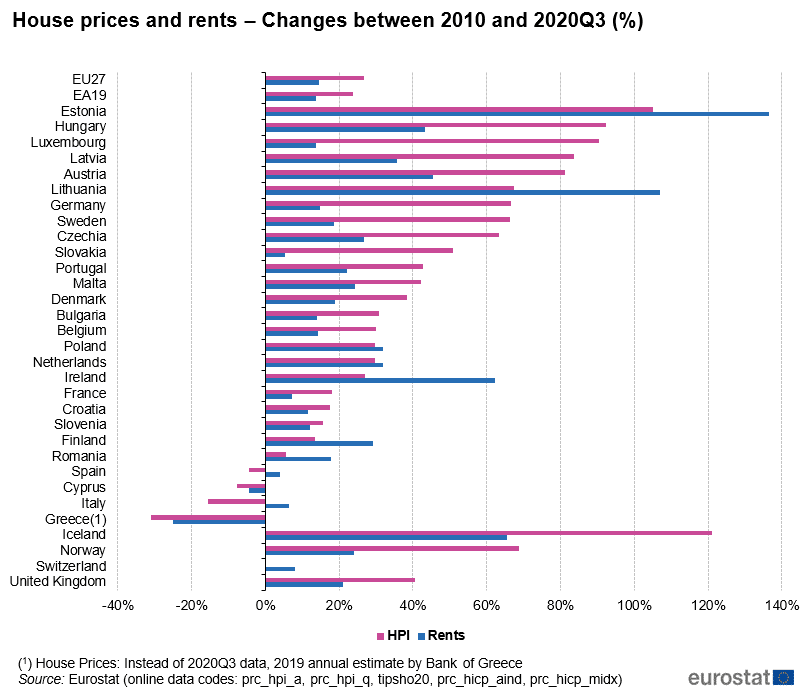
Eurostat reports house price trends and rents

Earlier today, the European Union published a newsrelease reporting house price movements throughout the EU member states.

Eurostat reports that compared with the second quarter of 2020, house prices rose by 1.3% in the euro area and 1.4% in the EU in the third quarter of 2020.

House prices in Cyprus recorded the highest annual fall of 1.4% in the third quarter of 2020, the highest quarterly fall of -4.8%.

Cyprus had the third biggest fall in house prices (-7.7%) in the EU over the past decade behind Greece (-31.0%) and Italy (-15.5%)- and the second highest fall in rents (-4.5%) behind Greece (-25.2%).

House Prices Rents in the EU


Will Cyprus real estate market hold in 2021?

While uncertainties remain for 2021, the Cyprus property market will continue to show its strength.

With at least two viable vaccines, low mortgage rates, tight supply and supportive government initiatives; the housing market will remain stable in 2021.

Property sales in 2020 fell by 23% compared to 2019; while almost all of the year of 2020 was experiencing lockdowns, semi-lockdowns, travelling restrictions and huge uncertainty. Despite this environment, sales in 2020 were above 2016 by nearly 13% while they decline just 9% from 2017.

In contrast with the widespread belief that market and rental values will collapse in 2020, prices have instead hold quite well (RICS Cyprus & Central Bank of Cyprus Residential Indices). At a European level, according to Eurostat, in the second quarter of 2020 house prices rose by 5% in the euro zone area (and 5.2% in the EU area) compared to the second quarter of 2019.

Assuming we manage the current infections well, and on the back of historically low interest rates, abolishment of travel restrictions and government stimulus packages, it’s looking more and more likely that demand will keep being strong.

It is worth to highlight that the propensity of households to save has reached unprecedented levels in response to COVID-19. According to Eurostat, in 2020 the household saving rate in the euro area was the highest observed since the beginning of the time series in 1999. This is explained by a sharp decrease of the household’s consumption.

Real estate supply in 2020 is lower compared to 2019. The uncertainty associated with the pandemic has stalled new construction while property-owners pulled back considerably as they anticipate a more favourable sale price if they wait. This limitation of the supply is more likely to continue in 2021.

This combination of relatively strong demand and low supply, will keep the Cyprus real estate market at least stable in 2021.

However, there are some key things to watch that could potentially be signs of trouble. If unemployment stays elevated, interest rates unexpectedly increase and further economic stimulus is slow to come, it could hurt demand for property as well. And if COVID-19 vaccinations are unexpectedly delayed or become problematic it will be devastating to the anticipated normalization of 2021.

With so much uncertainty affecting employment and business, many have speculated whether we will be hit with a property market crash this year. To quell any concerns, the real estate market in 2021 will look a lot more normal than in 2020 and any recession is highly unlikely to happen in 2021. While we are facing another spike in COVID-19 cases, the most negative impact we are likely to see is a short-term decline during the first quarter of 2021 in the number of sales and values; before re-entering a period of steady recovery through the remaining year.

About the author

Charalambos Pitros has a PhD in Real Estate Economics and is a Member of the Royal Institution of Chartered Surveyors (MRICS) and a Member of the European Real Estate Society. He is a Real Estate Investment Consultant and MRICS Valuer at Zyprus Property Group – Property Consultants & Estate Agents.

Case against massive hillside development lost

Peyia is mulling what steps to take after losing a court case to block the development of a hillside above the Paphos town.

The local municipality had challenged the government’s decision to issue a planning permit for a massive development at Ayia Vouni (Sacred Mountain), a hillside that overlooks Peyia, saying that it would irreversibly damage the environment, put pressure on infrastructure and create new homes whilst thousands remain empty.

“We are looking into a possible appeal. We have 42 days from December 14, 2020, when the ruling was made, and I can’t believe the outcome,” Peyia councillor, Linda Leblanc told the Cyprus Mail.

“I didn’t see what papers were submitted by Peyia or what documents were given to the lawyer, but in my opinion, it should not have been dismissed by the judge as there is ample evidence on the two main points that are required.”

Planning permission for the project was granted on July 28.

Although the project is being pitched as green and sustainable, Leblanc points out that it will be built next to the protected Pikni forest and a small part will also fall within the Natura 2000 network.

The development was proposed after changes were introduced to building policy in 2014, concerning the promotion, regulation and control of a new type of development in the countryside which aims to provide increased building efficiency.

The project’s developer is former president George Vassiliou who acquired around 330,000m2 in Peyia. The design, described as a ‘sustainable development project and a near zero energy settlement’, is receiving funding from the EU as part of its zero-energy initiative.

Leblanc explained that by law, Peyia had to demonstrate two points to halt the project, public interest and specific damages issues.

“The judge basically said, the government has said it’s all OK and there is not specific or sufficient evidence to support your case and it is dismissed.”

As part of studies undertaken for a masterplan of Peyia, the geology department have recently found issues of stability in a number of areas in Peyia, including the entire coast, the hills above the town, which includes the site of the proposed development, and other areas in between, she said.

“There is ample evidence to show that this huge development should not go ahead. It could destabilise the area and affect the centre of the town. There are also huge problems here when there is torrential rain.”

Klitos Papastylianou of the ‘initiative for the natural coastline and commons of Cyprus’, previously stated that the development should not go ahead as it failed to meet almost all sustainability criteria.

“We raised some concerns with the environmental impact assessment and filed an objection. According to the law on assessing, there is a definition of the environment: water, climate, habitat and so on. This project is unsustainable on almost all aspects,” he said.

Under the regulations, the investor has to meet certain criteria for the project concerning the ‘strategic use’ and ‘secondary use’, the latter should be a far smaller percentage. However, Papastylianou said in this case it is not.

Peyia council previously raised documented concerns over the development and requested that the town planning department refrain from approving any permits until all of the necessary studies were completed and examined.

Some of the concerns raised include height of buildings, possible landslides and flooding, water supply and public access roads.

The area proposed for the project is on a steep slope and will include four-storey apartment blocks of 145 units and 125 villas.

A spokesman for the company carrying out the studies previously informed the Sunday Mail that there would be no ‘significant impact’ on the flora and fauna in the protected area.

A geotechnical study was also carried out to identify the areas that have some geo instability. From the entire area of the project, only five per cent have some issues, such as unstable rocks, he said. There are also solutions to stabilise the area during construction.

However, Leblanc said that the environmental impact assessment, water assessment, geological assessment has to be undertaken independently and then assessed independently, which is not happening in Cyprus. This is an infringement by Cyprus and a failure to comply with new EU directives, she noted.

“These studies have never been independently analysed,” she said.

Studies are paid for by the developer, which is why the EU had to upgrade this practice, to give it some value, otherwise it’s just a piece of paper paid for by the developer, she noted.

“All of the environmental impact assessments used by the judge in this case, do not meet EU standards or directives, which are compulsory. Something is not right here.”

Loan repayment holiday until June 2021

The Central Bank of Cyprus (CBC) has approved a new loan repayment moratorium until the end of June because of the COVID-19 pandemic’s consequences on the economy at large.

The new payment holiday was also approved by the Council of Ministers as part of support package to mitigate the impact of a new three-week lockdown in Cyprus.

It is extended to borrowers who did not utilize the 2020 payment holiday which ended in December 2020 as well as to borrowers who obtained a moratorium but didn’t utilize the nine-month duration.

“With a view to alleviating this impact on businesses, households and on the banking sector so as to safeguard and strengthen financial stability of the country, the CBC decided to provide its consent to the Finance Ministry for a loan repayment moratorium to financial corporations in the framework allowed by the European Banking Authority Guidelines,” the CBC said in a press release on Saturday.

“Eligible borrowers are those who had arrears less than 30 days in the end of December 2020, a press release by the CBC also said. The loan repayment moratorium is targeted so it could support the liquidity of businesses and households which will face the biggest short-term liquidity problems due to the pandemic,” it added.

It also said that support will be given to vulnerable groups whose obligations are collateralized by primary residence worth of up to €350,000.

The new repayment moratorium will be enforced with a Decree to be issued promptly by the Finance Minister.

Furthermore, CBC decided to extent the relaxation of loan origination criteria until end-March with a view to allow easier access to short-term credit to businesses and households thus providing access to liquidity needed to cover their current obligations.

The relaxation of loan origination criteria concerns the evaluation of the borrower’s repayment capacity and the necessary documentation which borrowers are obliged to provide the banks, aiming to a faster loan origination procedures, it said.

– Cyprus News Agency