Golden passports: the EU must act

The problems and scandals surrounding the sale of ‘Golden Passports’, which allows their holders unrestricted access to EU members states and dozens of countries, have been brought to the fore by Al Jazeera’s recent investigative report.

Wider issues with golden passports

As of summer last year, 3 EU member states, Malta, Cyprus and Bulgaria, offered ‘citizenship-by-investment’ (golden passports) schemes and 20 EU member states, including the UK, offered ‘residence-by-investment’ schemes according to a report by the anti-corruption NGO Global Witness.

At that time, Tina Mlinaric, a campaigner at Global Witness said: “This exposes the whole of the EU to significant money laundering, tax evasion and corruption risks, as well as threatening its security.

“It’s also the case that these schemes are shrouded in secrecy so the impact is only understood when scandals hit the headlines, meaning the urgency of the issue is being ignored.”

In March 2018, Gold for Visa investigations by the Organized Crime and Corruption Reporting Project (OCCRP) illustrated rampant sale of EU citizenship and residency to ultra-rich foreign investors with little scrutiny, transparency or due diligence.

In October 2018, a report by Transparency International and Global Witness European Getaway Inside the Murky World of Golden Visas highlighted the corruption risks posed by the sale of citizenships (golden passports) and residency and how these schemes threaten the integrity of the EU.

Casey Kelso, advocacy director at Transparency International said: “Citizenship and residency are among the most valuable assets a country can offer an individual, but EU member states have not even been applying the same minimum checks that banks are supposed to apply to their high net-worth customers.”

The European Commission published a comprehensive report on ‘citizenship-by-investment’ (golden passports) and ‘residence-by-investment’ schemes operated by a number of EU Member States in January 2020.

The report highlighted the risks these schemes imply for the EU, in particular, as regards security, money laundering, tax evasion and corruption – and how a lack of transparency in how the schemes are operated and a lack of cooperation among Member States further exacerbate these risks.

Commissioner for Migration, Home Affairs and Citizenship Dimitris Avramopoulos said: “Legally residing in the EU and in the Schengen area comes with rights and privileges that should not be abused.

“Member States must at all times fully respect and apply existing obligatory checks and balances – and national investor residence schemes should not be exempt from that.

“The work we have done together over the past years in terms of increasing security, strengthening our borders, and closing information gaps should not be jeopardised. We will monitor full compliance with EU law.”

Commissioner for Justice, Consumers and Gender Equality, Vera Jourová, said: “Becoming a citizen of one Member State also means becoming an EU citizen with all its rights, including free movement and access to the internal market.

“People obtaining an EU nationality must have a genuine connection to the Member State concerned. We want more transparency on how nationality is granted and more cooperation between Member States.

“There should be no weak link in the EU, where people could shop around for the most lenient scheme.”

And in the last few days German MEP Sven Geingold said “The European Commission should put Cyprus before the European Court of Justice. The passport scheme of Cyprus is a risk to security in Europe.

“You should earn your passport and your citizenship by integrating in society. And not because you have a lot of money.”

Stop the EU from being a safe haven for the corrupt and criminal

It is clear from reports by Global Witness, OCCRP, Transparency International and the EU itself that Europe must do ‘something’ to regulate, legitimise, de-risk, or phase out the ‘citizenship-by-investment’ and ‘residence-by-investment’ schemes offered by EU members states.

Speaking on the subject last week, Transparency International EU’s Senior Policy Officer Laure Brillaud said:

“It has now been more than two years since the first golden visa scandals broke out. And yet, we are still waiting for the Commission to deliver on its commitment and stop the EU from being a safe haven for the corrupt and criminal.”

Curtain rising on citizenship-by-investment program

The Presidency has before it four scenarios for dealing with the issue of purchased citizenships. The most likely possibility is that of suspending the investment program for a short period, as revealed by Kathimerini on Sunday.

The four scenarios are as follows:

  1. Termination of the investment program
  2. Suspension for a period of time and examination of problematic cases for potential revocation of passports
  3. A more detailed briefing of the European Commission on the people receiving a Cyprus passport as a result of investment
  4. A continuation of the program as currently structured with a strict adherence to rules

Government circles are already sceptical about whether the scenario involving a suspension of the program could come about, as given the difficult economic period, stakeholders will push in the opposite direction, with a potential suspension expected to be short.

The issue of revoking passports, due to the serious blow suffered by the country, was raised by the President of DISY Averof Neophytou at a press conference on Monday morning.

Already in Brussels, resentment has flared once again, with the European Commissioner for Justice examining the possibility of legal action against Cyprus over the granting of citizenship through investments.

A timeline of warnings

Brussels has long been sounding the alarm and warning about the investment program. The first reactions came when a Cyprus link came to the fore in the case of the Russian oligarch Oleg Deripaska.

Indicative is what the President of the Republic heard from MEPs about the investment program in 2018, when he was in Strasbourg to speak before the European Parliament.

He then defended the program, noting that Cyprus gave only 0.3% of the citizenships granted by European countries to third-country nationals. “It is not in my country that third-country oligarchs own football teams, nor is it in my own country that large squares and buildings belong to oligarchs,” he said.

Besides, there was a serious dispute between the President and the European Commissioner Christos Stylianides over this issue, who unsuccessfully asked for restraint on the part of the Republic of Cyprus.

Le Monde and Vera Jourová

The issue certainly did not end there. There followed publications, shortly before the Report on the Cyprus program, dealing with controversial figures who were granted Cyprus citizenship such as the Malaysian fugitive Jho Low and the Cambodian dictator, that stirred discussions in Cyprus over the need to put an end to the program.

There was also the move of the Vice President of the European Commission for Values and Transparency, Vera Jourová, to share on her personal account an article of the French newspaper Le Monde entitled ‘The Golden Passport Scandal in Cyprus’.

A move that had its own semiology. Not only because it was published by a newspaper that has excellent relations with the Commission but also because it is a well-known secret that when the EU wants to send a warning to a Member State about its actions, but also about what it intends to do, it first channels the news in well-known media to cultivate the soil. This was also done before the slashing of deposits.

Cyprus put on the stand

It is in this context that everything that was published by the Al Jazeera Investigative Unit is considered to fall. European Commissioner for Justice Didier Reynders has already revealed in a comment to Al Jazeera that he is considering legal action against Cyprus over its citizenship-by-investment scheme.

He had noted that he would like to see some action from the European Union on new legislation, but most of the responsibility lies with Cyprus.

In addition to the Commission, German MEP Sven Giegold, who is a fierce critic of Cyprus’ investment program, raised the issue last Friday of referring Cyprus to the European Court of Justice for violating European law.

The truth, however, is that at the level of the College of Commissioners, the issue of Cyprus and the investment program has not been discussed at the moment. Political circles in Brussels note that it is acknowledged that Cyprus has made improvements on the investment program and that what is coming to light is a past ‘sin’.

According to the same circles, it is very likely that the Commission will make a proposal regarding the program, which will not only concern Cyprus but all EU Member States that implement such schemes.

There are also circles that estimate that although the Commission cannot impose a suspension of the program as it does not have such a mechanism, it will push through other channels to either suspend the investment program, or to tighten the implementation of the new regulations. Political circles note that while citizenship is within the jurisdiction of the Member States, the EU can initiate infringement proceedings by claiming that Union principles and values are being violated.

(This article was first published in KNEWS, the English edition of Kathimerini Cyprus,
on 31 August 2020.)

Call for freeze on ‘golden passports’ scheme

Cyprus’ Citizenship for Investment Scheme should be suspended until a consensus is found among the political leadership on whether it has a future, said House Speaker Demetris Syllouris on Monday.

He will send a letter to President Nicos Anastasiades, urging him to convene a meeting with party leaders to discuss the prospects of the Cyprus Citizenship for Investment Scheme.

Syllouris said his aim was to dispel any doubts about the programme and if there are lingering doubts among the political parties “there should be no programme”.

He said suspect foreign investors should have their Cypriot passports taken away.

“In relation to the programme, I suggest that by utilising the new regulations, as passed on 31 July 2020, and the existing legislation the investigation for possible revocation of passports be accelerated where possible,” the letter said.

Syllouris said that if the political decision is not to end it, then the party suggestions for improving the programme will be at the President’s disposal.

In the case of non-termination, Syllouris suggests “there should be a suspension of the programme until it is further improved, based on the concerns and suggestions tabled at the President’s meeting with the party leaders”.

Focus has shifted once again to the ‘golden passports’ scheme as a series of unflattering articles and videos were published by global media outlet Al Jazeera last week which essentially portrayed Cyprus as selling passports to criminals for cash.

The expose was based on the leak of over 1,400 documents related to the investment scheme, obtained by Al Jazeera, which in photos, appear to bear the seal of the Cyprus Parliament.

On Monday, ruling DISY leader Averof Neophytou said he suspects any one of 18 people, including the heads of parliamentary parties and members of the House interior committee as potential suspects of the leak.

Officially, the Cyprus government has refuted Al Jazeera’s claims as propaganda, with Interior Minister Nicos Nouris arguing they only served to damage the island’s economy and reputation through “deception” and “false information”.

Cyprus Papers push real estate sector into the unknown

Real estate market stakeholders perceive Al Jazeera’s expose on Cyprus’ citizenship scheme as a heavy blow to the construction industry which relies on the programme to sell luxury properties to foreign buyers.

In comments to the Financial Mirror, chairman of the Cyprus Property Owners Association, George Mouskides said the reports could not have come at a worse time as the real estate sector is reeling from the pandemic.

“The programme was hit hard after the lockdown, and the government estimates that the number of naturalizations will shrink to 200 per year from about 800 in the previous two years”.

However, the leak of documents on 2351 Cypriot naturalizations in combination with criminal activity, creates serious issues of credibility for the programme.

“We are talking about the scheme that pulled the Cyprus economy out of recession in 2013, breathing new life into the construction industry, and by default into the country’s economy.

“The scheme had a trickle-down effect on the majority of economic sectors,” argued Mouskides.

Unfortunately, as he added, the pandemic meant that surpluses created during the boom period in the construction industry have been ‘eaten’ away.

“What we in the real estate industry are hoping for, is that politicians will not turn the issue of unflattering reports on Cyprus’ CIS to kill the programme that has given so much to the country.”

“Parties will need to pull together if they want to save the scheme, allowing it to give more to the economy at a time of yet another crisis.”

Trust issues for investors

Mouskides said the government should boldly come out and admit to mistakes made in the past, stressing that it must focus on reforming the programme.

“The government should commit to bringing in third-party auditors to monitor the scheme, to regain investor trust.”

Antonis Loizou, CEO of Antonis Loizou and Associates told the Financial Mirror that discrediting the scheme will have a series of consequences.

He argued that merely the fact the names of investors were leaked to the media, will act as a deterrent for legit investors.

“While we should acknowledge that a large number of these investors are in it solely for the passport, a number of them, however, eventually stay in Cyprus making further investments.

“We know of cases of Chinese investors who had originally invested in Cyprus to obtain a passport but are now building hotels in Larnaca and Paralimni,” said Loizou.

The real estate agent argued that Al Jazeera’s accusations will bring about further damage as Cyprus will lose possible investors, leaving projects built or in the planning as unviable.

“What will happen with the marinas? Ayia Napa and Paralimni marinas have been designed having in mind the CIS programme will continue for some years.”

Loizou said that Cyprus should acknowledge that the authorities got it wrong on some cases involving foreign investors, but “the scheme is now tougher, with less scope for abuse”.

“The bad apples are just a small fraction of investors given a Cypriot passport. Why throw out the whole scheme for the sake of 30, or even 100 people who abused the system, out of a total of 4,000?”

Loizou argued that the government will have to work hard on rebuilding investor trust towards the scheme and investing in Cyprus in general.

The Citizenship for Investment scheme was launched when the cash-strapped government sought to attract foreign investments to boost a crumbling economy, after a series of austerity measures were introduced and a haircut imposed on unsecured depositors in 2013.

The investment programme is responsible for the flow of billions into the economy, mainly in the construction sector.

Investors’ focus is mainly on luxury apartments in high-rise buildings and luxury villas by the sea.

As of 15 May, stricter criteria include an investment of €2.5 million (including a minimum €500,000 residence) and a €75,000 contribution to the state Land Corporation and another €75,000 to the Innovation Fund.

There are tighter due diligence procedures which are expected to exclude many investors.

Parliament last year, tightened procedures and eligibility criteria for the maligned “golden passport” investment programme, which has yielded over €7 billion in revenue since 2013.

The passport has attracted many Russian and Chinese investors because a Cyprus passport automatically grants its holder citizenship to the entire 27-member European Union.

Under the recent changes, new anti-money laundering rules will be used to bolster how prospective investors are vetted.

It is now easier for investors involved or convicted of a serious crime to have their Cypriot citizenship revoked.

No better way to shoot yourself in the foot

The ‘Cyprus Papers‘ revealed by Al Jazeera that humiliated the administration should be a wake-up call to everyone on this island that the goose that lays the golden egg has long gone.

It was probably cooked by some oligarch and the prize of a banquet with local politicians, lawyers and accountants.

It’s time to move on and ‘rediscover Cyprus’, not just as a tourist destination, but as a vibrant business model.

The services model of the 1970s, conceived out of a necessity to restart the economy in the wake of the Turkish invasion, which decimated our farming and destroyed half the country, is far outdated and should be mutated into something new.

A low-tax programme was developed to help Cyprus rise out of the ashes of the 1974 war.

It started well and soon spun off into two main areas – the ‘offshore sector’ with the “best-kept secret” and the shipping sector.

Both did well and attracted thousands of companies and personnel to place their business under the Cyprus tax umbrella.

By the 1980s, we had the expats who operated financial service companies.

Regional and global events, such as the Lebanese civil war, the collapse of the Soviet Union, the dismantling of Yugoslavia and others brought foreign communities to our island, transforming Limassol into a bustling multicultural port city, with brass-plate companies registered in every building in every neighbourhood.

Despite being ripped off with exorbitant rents, some stayed, while newcomers arrived bringing with them the benefits and ills of the lands they left behind.

However, our services sector, driven by complacency and the need for a quick buck, did not evolve as fast and gradually saw business going to rival destinations, the exception, again, being the maritime sector which started to become a proper hub.

In the meantime, we had the fallout from the first Gulf War in 1990-1991, the stock exchange boom and bust in 1999-2002, and a chain of economic aftershocks from the collapse of Lehman Brothers, culminating in our locally nurtured banking and financial crisis.

Throughout these troubles, the services survived and provided some cushion of safety.

However, this sector kept on losing ground to smarter and more versatile jurisdictions while the maritime industry quietly and safely evolved.

The final nail in the services coffin was the golden passports scheme, devised by a few to accommodate the few, lubricating the legal and financial services professions.

But this time it helped to save the over-borrowed property developers, who had earlier bankrupted the banks, exposing them to billions in non-performing loans which ordinary depositors were called to bail out.

After harshly criticised from day one, and with some government officials still keeping their heads in the sand, the investment-for-citizenship programme was adjusted to allow a small measure of transparency, a smokescreen for all those pointing their fingers at the evil Cypriots.

Instead of abolishing the programme altogether, another variation was concocted whereby a fraction of the €2.5 million ‘invested’ in Cyprus would be used to fund low-cost homes and some money trickling into innovation and research while we ‘sacrificed’ the project by lowering the ceiling to ‘only’ 700 passport applications a year.

Cyprus now has a mature and highly educated human resources treasure that remains unutilised.

European funds have been well invested in many areas of agriculture and rural Cyprus, manufacturing, albeit in specialised sectors are on the rise and some success stories, such pharmaceuticals and energy, are booming.

Shut the golden passports scheme down now, before it’s too late and we are humiliated even further, especially by our European partners, in whose eyes we are nothing but a joke.

If not, it just goes to prove that the present administration still has a few favours to pay off and needs to keep the programme going a while longer.

UK Nationals: the UK has left the EU building!

As you are all aware, the UK has left the EU and is now in a transition period. To that end, the UK government is working with organisations to help and assist UK Nationals living in EU countries who need residency advice and support.

One of those organisations is the Cyprus Residency Planning Group (CRPG) whose remit is to help UK Nationals who may find it hard to complete all the paperwork, particularly pensioners and disabled; those living in remote areas or with mobility difficulties and those needing assistance with language translation or interpretation and who, for whatever reason, cannot respond and help themselves.

In other words, people deemed at risk.

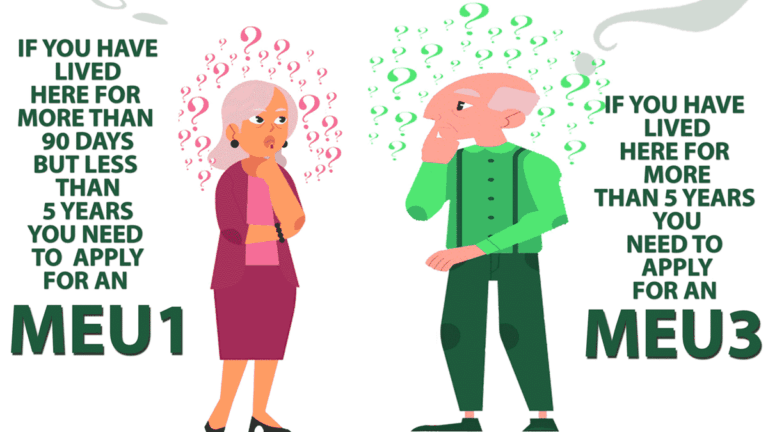
CRPG officially opened for business in April 2020, when the Help Desk sprang into action and began the process of taking calls from people seeking advice on whether to apply for an MEU1 or an MEU3 – and what the difference is.

There still seems to be some misinformation and confusion out there.

So, in a nutshell – if you have lived in Cyprus for more than 90 days BUT less than 5 years, you need to apply for an MEU1 and if you have lived in Cyprus for 5 years or more, you need to apply for an MEU3.

All old-style residency documents such as the blue form, pink slip, alien registration book or a stamp in your passport are no longer valid and must be replaced.

Please visit the CRPG website for more information and for those of you who are considering residency and who might be new to Cyprus please also look at the GOV. UK information site Living in Cyprus Guide

If you would like to chat about your own situation – or you know of someone who needs our help – please contact the Help Desk on 99826087 or email  [email protected].

We look forward to hearing from you.

PS: We are also looking for more volunteers to work as Case Workers, to help us manage individual cases. Volunteers are trained in Safe Guarding, Data Protection and will also be required to apply for CRO clearance. There is remuneration for mileage and an hourly rate – plus Case Workers are provided with a CRPG branded brief case and business card. It’s a great way to help your local community.

(Public Service Announcement)