Property sales collapse hits all markets

AS WE reported earlier this month, the effects of the corona pandemic have frozen the island’s property market with sales during April falling by 80 percent compared to April 2019.

Further analyses of the April sales by the Department of Lands & Surveys reveals that both the local and overseas market sales have been affected:

Domestic property sales

Property sales to the domestic market (which accounted for 58% of all sales in the month) fell by 85% compared to April 2019 with sales falling in all districts.

Limassol recorded the biggest fall, down 92% compared to the same month last year. Sales in Famagusta fell 90%, sales in Larnaca fell 82%, while sales in Nicosia and Paphos fell 79% and 70% respectively.

Domestic Property Sale Contracts – 2019/2020 Comparison

District Year Jan Feb Mar Apr May Jun Jul Aug Sep Oct Nov Dec
Nicosia 2019 127 164 115 137 168 121 153 90 114 163 187 154
2020 178 155 124 29
Famagusta 2019 32 19 16 58 45 25 2 13 16 33 13 26
2020 10 18 16 6
Larnaca 2019 54 82 47 73 83 42 90 53 67 81 69 88
2020 76 64 56 13
Limassol 2019 166 152 192 291 329 138 177 134 176 144 210 212
2020 98 136 76 23
Paphos 2019 30 31 28 69 175 69 54 54 34 66 64 69
2020 55 29 26 21
Totals 2019 409 448 398 628 800 395 476 344 407 487 543 549
2020 417 402 298 92

Overseas property sales

Property sales to the overseas market fell by 71% compared to April 2019 with sales falling in all districts.

Hardest hit was Famagusta, where sales were down 89%, followed by Larnaca, where sales fell 84% and Nicosia, where sales were down 72%. Meanwhile, sales in Paphos and Limassol fell 67% and 64% respectively.

Total Overseas Property Sale Contracts – 2019/2020 Comparison

District Year Jan Feb Mar Apr May Jun Jul Aug Sep Oct Nov Dec
Nicosia 2019 34 30 16 32 45 24 21 13 23 20 21 26
2020 19 23 15 9
Famagusta 2019 21 29 29 38 42 18 47 17 24 17 35 38
2020 40 29 25 4
Larnaca 2019 60 43 71 67 90 60 67 40 35 79 53 74
2020 71 54 50 11
Limassol 2019 85 104 95 137 217 81 109 62 64 84 86 72
2020 82 89 67 49
Paphos 2019 157 180 157 155 229 136 176 112 139 126 169 151
2020 113 142 55 51
Totals 2019 357 386 368 429 623 319 420 244 285 326 364 361
2020 325 337 212 124

Sales to EU citizens

Sales to EU citizens fell 66% compared with April 2019 with sales falling in all districts.

There were no sales of property to EU nationals in Larnaca, Nicosia reported an 84% drop and Nicosia an 82% drop. Meanwhile, sales in Paphos and Limassol fell 50% and 43% respectively.

Foreign (EU) Property Sale Contracts – 2019/2020 Comparison

District Year Jan Feb Mar Apr May Jun Jul Aug Sep Oct Nov Dec
Nicosia 2019 14 14 9 19 20 16 13 5 8 10 15 14
2020 9 12 9 3
Famagusta 2019 9 6 14 17 10 8 17 14 10 5 9 23
2020 6 14 10 3
Larnaca 2019 12 12 21 18 20 11 16 13 6 23 14 23
2020 21 13 11 0
Limassol 2019 16 25 20 21 28 26 27 17 25 30 26 25
2020 28 30 11 12
Paphos 2019 56 72 61 48 69 59 73 58 61 95 61 72
2020 40 60 25 24
Totals 2019 107 129 125 123 147 120 146 107 110 133 125 157
2020 104 129 66 42

Sales to non-EU citizens

Sales to non-EU citizens fell 73% compared to April 2019 with sales falling in all districts.

Property sales in Famagusta fell 95%, while sales in Larnaca fell 78%. Meanwhile sales in Paphos, Limassol and Nicosia fell by 75%, 68% and 54% respectively.

Foreign (Non-EU) Property Sale Contracts – 2019/2020 Comparison

District Year Jan Feb Mar Apr May Jun Jul Aug Sep Oct Nov Dec
Nicosia 2019 20 17 7 13 25 8 8 8 15 10 6 12
2020 10 11 6 6
Famagusta 2019 12 23 15 21 32 10 30 3 14 12 26 15
2020 34 15 15 1
Larnaca 2019 48 31 50 49 70 49 51 27 29 56 39 51
2020 50 41 39 11
Limassol 2019 69 79 75 116 189 55 82 45 39 54 60 47
2020 54 59 56 37
Paphos 2019 101 108 96 107 160 77 103 54 78 61 108 79
2020 73 82 30 27
Totals 2019 250 257 243 306 476 199 274 137 175 193 239 204
2020 221 208 146 82

What of the future?

Writing in the Financial Mirror, the CEO of Danos & Associates Panos Danos said “The effects of the pandemic on Cyprus real estate are intensifying” noting that “Demand from abroad, which has led to a market recovery in recent years, primarily in Limassol and Paphos, is now almost non-existent.”

But on a positive note he wrote that “Buying a home, however, both in times of crisis and otherwise, is always a necessity. People will never stop buying or renting homes. In Cyprus, most developments are qualitative and if their price levels remain reasonable, they will soon be met by demand.

“Of course, everything will depend on the length as well as the depth of the crisis and the economic aftershocks it will leave on the property market.”

Serious recession

Speaking to the media yesterday, Central Bank Governor Constantinos Herodotou warned that the economy will experience a “serious recession” in 2020.

“The economy’s prospects for 2020 and afterwards are dramatically overshadowed by the negative developments of the coronavirus pandemic.”

In its annual report, the Central Bank said the pandemic “constitutes an extremely serious internal and external shock which is affecting demand.

“The financial impact cannot be quantified with precision for the time being…given that there is insufficient economic data for 2020, nor can the pandemic’s duration be projected.

“The question is not whether a recession will take place but how extensive it will be.”

Cyprus Property Sale Contracts 2000 – 2020

Year Overseas Sales Domestic Sales Percentage
Overseas Sales
Total
Sales
2000 450 12,214 3.6% 12,664
2001 1,207 12,849 8.6% 14,056
2002 2,548 14,111 15.3% 16,659
2003 3,981 15,294 20.7% 19,275
2004 5,384 11,947 31.1% 17,331
2005 6,485 10,106 39.1% 16,591
2006 8,355 8,598 49.3% 16,953
2007 11,281 9,964 53.1% 21,245
2008 6,636 8,031 45.2% 14,667
2009 1,761 6,409 21.6% 8,170
2010 2,030 6,568 23.6% 8,598
2011 1,652 5,366 23.5% 7,018
2012 1,476 4,793 23.5% 6,269
2013 1,017 2,750 27.0% 3,767
2014 1,193 3,334 26.4% 4,527
2015 1,349 3,603 27.2% 4,952
2016
1,813 5,250 25.7% 7,063
2017
2,406 6,328 27.5% 8,734
20181 4,367 4,875 47.3% 9,242
2019
4,482 5,884 43.2% 10,366
2020 (Apr)
 998 1,209 45.2% 2,207
Totals
70,871 159,483 30.8% 230,354

1 The Department of Lands & Surveys has advised that overseas sales in 2018 and subsequent year should not be compared to sales in previous years due to changes in the methodology used to classify ‘Aliens’ (foreigners).

Historic collapse of property sales

PROPERTY sales in Cyprus collapsed in April as the coronavirus pandemic put the island’s real estate market into a deep freeze to a level only seen once before following the haircut of deposits in the island’s two largest banks that made Cyprus a household name around the world.

Almost every sector of the island’s economy and the global economy has been affected by the pandemic, resulting in a world-wide economic slowdown.

Although some pundits predict that the property market will rebound in 2021, many airlines around the world are planning their future. In the UK alone:

  • British Airways plans to lose more than 1,100 pilots and make heavy cuts to its Gatwick airport operation as part of 12,000 redundancies.
  • Easyjet plans to drastically cut its fleet and cancel an order for 107 new Airbus aircraft.
  • Irish airline Ryanair is planning to cut 3,000 jobs and has warned that passenger demand and pricing will take at least two years to recover from the coronavirus pandemic.

With the Cyprus real estate market heavily dependant on high-end sales to well-heeled overseas investors, it seems a rebound in the market in 2021 is somewhat ‘optimistic’.

April property sales

April saw a total of 216 property sale contracts deposited at Land Registry offices across the island compared to the 1,057 deposited in April last year; a fall of 80%.

(The high number of sales in April and May last year was helped by foreign investors rushing to buy property before Cyprus introduced more stringent criteria for those wishing to obtain citizenship under the government’s ‘Cyprus Investment Programme‘.)

Not surprisingly, sales plummeted in all districts. Hardest hit was Famagusta, where sales fell by 90% followed by Limassol and Larnaca, where sales in both districts fell 83%. Meanwhile, sales in Nicosia and Paphos fell 78% and 68% respectively.

Total Property Sale Contracts – 2019/2020 Comparison

District Year Jan Feb Mar Apr May Jun Jul Aug Sep Oct Nov Dec
Nicosia 2019 161 194 131 169 213 145 174 103 137 183 208 180
2020 197 178 139 38
Famagusta 2019 53 48 45 96 87 43 49 30 40 50 48 64
2020 50 47 41 10
Larnaca 2019 114 125 118 140 173 102 157 93 102 160 122 162
2020 147 118 106 24
Limassol 2019 251 256 287 428 546 219 286 196 240 228 296 284
2020 180 225 143 72
Paphos 2019 187 211 185 224 404 205 230 166 173 192 233 220
2020 168 171 81 72
Totals 2019 766 834 766 1057 1423 714 896 588 662 813 907 910
2020 742 739 510 216

Year to date

In the first four months of 2020, Limassol remains the most popular with those buying property followed by Nicosia, Paphos, Larnaca and Famagusta. However, the pandemic has resulted in falls in all districts.

To end on a more positive note, the government started a gradual relaxation of the lockdown rules on Monday. Assuming infection rates do not climb, further relaxations will take place, which could help spark a recovery in domestic sales.

Building permits maintaining strong growth

THE CYPRUS construction sector maintained its strong growth in February 2020 with 591 building permits issued compared to 525 in February 2019; an increase of 12.6% according to official figures released by the Cyprus Statistical Service.

Although the number of permits rose, their total area fell by 15.9% and their total value fell by 0.5%, reaching 149.7 thousand square metres and €167.5 million respectively.

They provided for the construction of 680 new homes, an increase of 18.1% compared to 576 in February 2019.

During February 2020, the 591 permits were authorised for:

  • Residential buildings – 417
  • Non-residential buildings – 77
  • Community residences – 3
  • Civil engineering projects – 31
  • Division of plots of land – 43
  • Road construction – 20

Building permits for new homes

The 417 residential permits provided for the construction of 680 new homes (dwellings). These comprised 264 single houses; an increase of 19.5% compared to the 221 authorised in February 2019. And 416 multiple housing units including apartments, semis, townhouses and other residential complexes; an increase of 17.2% compared to the 355 authorised in February 2019.

Building Permits Issued for the Construction of New Homes
(Number of Dwellings)

Month 2019 (Dwellings) 2020 (Dwellings) Increase/Decrease %age Change
January 548 696 148 27.0%
February 576 680 104 18.1%
Totals 1,124 1,376 252 22.4%

Of those 680 new homes, 262 are destined for Limassol, 255 for Nicosia, 109 for Larnaca, 44 for Paphos and 10 for Famagusta.

Annual construction figures

A total of 1,129 building permits were authorised during January and February 2020, compared to 1,069 in the same period last year. Their total value increased by 20.9% and their total area by 10.7%. The number of permits authorised for the construction of new homes rose by 4.2%.

The 815 residential building permits authorised during January and February provided for the construction of 1,376 new homes; 527 in Limassol, 440 in Nicosia, 187 in Larnaca, 118 in Paphos and 104 in Famagusta.

According to the Cyprus Statistical Service, building permits constitute a leading indicator of future activity in the construction sector.

Cyprus passport programme under fire again

CYPRUS’ embattled ‘golden passport’ programme has come in for a fresh round of criticism from the EU, but the government has rebutted their demands.

A request from the EU Commission was sent to member states on April 1 calling for the phasing out of such programmes.

There is no intention of ending the programme, Interior Minister Nicos Nouris was quoted as saying on Tuesday.

“With the measures which have been taken after May 2019 we see no reason as to why it should be stopped but also the checks now go above and beyond,” he told daily Phileleftheros.

According to reports, the EU further called for a plan to be devised detailing the winding down of operations, with the eventual closure of the scheme altogether. It also reportedly asked for the plan to be made available for review.

The measures to which Nouris was referring are, in part, reviewing previous applicants.

The government began a process of revoking citizenship should an “audit reveal that a person or a member of his family has been accused of any crimes, or are the objects of European or international sanctions.”

In November, it was reported that Oleg Deripaska – a Russian billionaire with ties to the Kremlin – had his Cypriot citizenship rescinded as part of the stricter measures and review process. He was granted citizenship in 2017.

It is understood that 26 people have so far had their citizenship revoked.

“It was a mistake not to have criteria, for instance, for high-risk persons,” former Interior Minister Constantinos Petrides said at the time.

The EU, however, insists that such programmes undermine the integrity of the bloc by granting access to individuals which it sees as questionable.

The Commission recently sent another round of requests to the Cypriot, Bulgarian and Maltese authorities in regards to the programmes, an EU representative said.

Questions have been raised over the timing as the Covid-19 pandemic threatens Cyprus’ and the bloc’s economies.

Proponents of the citizenship by investment programme say that it boosts the economy and creates jobs.

Critics, however, say that the programme is rife with corruption and creates major imbalances in key sectors such as housing and construction.

EU passports can be obtained in Cyprus for an investment of at least €2 million.

You have insurance but are you insured?

Over the past few of months I’ve had received several emails from people complaining about problems they’re having getting insurance companies to pay for the damage to their property caused by the winter’s heavy rains.

Without exception, all the complaints and enquiries I get about insurance issues are sent by those living in apartments, houses and other building complexes that are registered as ‘Jointly-owned buildings’.

A typical complainant will write:

“The roof of my apartment block is leaking and the Management Committee refuses to help.

“They say as the damage is in my apartment it’s up to me to sort it out. My insurance company doesn’t want to know.”

A couple of emails later it transpires that the Management Committee had only insured the ‘jointly-owned property’ (communal areas insurance); i.e. every part of a building under joint ownership which has not been registered as a unit, where they should have insured the ‘jointly-owned building’ as required by the law:

“The Management Committee must insure and always keep insured the jointly-owned building against fire, lightning and earthquakes with a licensed underwriter for the sum which the Management Committee considers as corresponding to its replacement value.” (Refer to Article 38L of the Immovable Property Law.)

The ‘jointly-owned building’ refers to the whole complex and not just the ‘jointly-owned property’. Even some of the ‘professional’ property management companies and lawyers, who should know better, get this wrong!
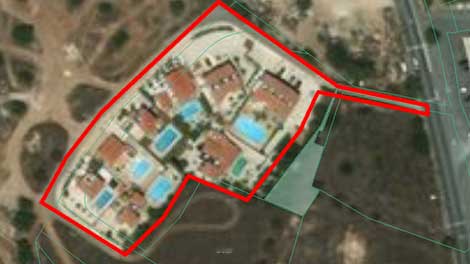
This image shows a jointly-owned building outlined in red. It includes some properties that share a pool and a number of other properties with pools for their exclusive use. It also includes car parking areas, gardens, drainage, pavements, roads, etc, etc. Everything within the red boundary line is the jointly-owned building.

But then there’s a second problem. Management Committees tend to buy get the minimum insurance cover as required by law – fire, lightning and earthquakes.

This will not help the complainant whose apartment is being damaged by a leaking roof; he needs insurance cover for storm and flood!

Comprehensive insurance

Management Committees should get comprehensive insurance cover for the jointly-owned building to protect the owners’ investments. A comprehensive policy should include cover for:

  • Fire & Lightning
  • Earthquake
  • Impact
  • Malicious damage
  • Aircraft
  • Explosion
  • Removal of Debris
  • Professional Fees
  • Escape of water
  • Accidental damage
  • Storm & Flood
  • Theft
  • Glass
  • Alternative Accommodation
  • Trace and access
  • Keys & Locks
  • Firefighting Expenses
  • Public Liability for the committee
  • Public Liability for the owners
  • Personal Liability of the committee

(Trace and access is insurance that covers the costs of detecting and repairing the source of a water leak.)

However, a Management Committee wishing to obtain additional insurance cover must convene a General Meeting of owners and put the proposal to a vote; at least 50% of the owners must vote in favour. (Refer to Article 38L of the Immovable Property Law.)

Insurance agents

I spoke with the head 3D Global’s insurance department, Andrew Stott, who said:

“Unfortunately, I hear of insurance agents offering very poor advice just to line their own pockets and have read articles from so-called ‘experts’ that are totally incorrect. One company even recommends you purchase literature them that’s available on the internet for free!

“It’s essential that any company or individual offering you advice or selling you insurance is listed on the Register of Insurance Intermediaries.

“One insurance broker advised his client that the renewal of his house insurance was due and that the renewal premium was €700. The client thought this was rather high so he spoke with another broker. The broker obtained a quotation from the same insurance company and advised him that the correct premium was €650!

“Following a change in the law last year, insurance premiums must be paid directly to the insurance company. This change was made because a number of cases were reported where people had paid insurance premiums to agents who pocketed the money rather than forwarding it to the insurance companies, which left the people uninsured!”

Further reading

Everything you need to know about the insurance of jointly-owned buildings. By Miltiades Miltiadou – Independent Insurance and Risk Management Consultant.

The Cyprus property market will rebound in 2021

SUPPLY-SIDE in recent years saw an increasing pipeline of high-priced residences come to the market with values derived primarily from the Cyprus Passport Scheme benefits rather than any Real Economy market drivers.

The main bulk of buyers for these passport properties have been Russian and Chinese citizens but demand has waned increasingly over the last 12 months.

Chinese activity has been almost absent from the market since the onset of COVID-19 in December 2019 introduced severe restrictions for potential buyers to travel to the island and made it impossible for many to send funds to complete purchases.

The new reality since the lockdown in Cyprus is that all sectors of the real estate market have come to a standstill and many transactions already agreed in principle or even midway through have been frozen or postponed.

Many developers with their finger on the pulse had been scaling down activity during 2019 but many others who got late into the development of residences for passports (particularly multi-unit towers) have a large stock of unsold units.

Developers are now planning to change use from residential to office or hotel accommodation which they hope will be in greater demand when the market starts to move again.

With construction now at a standstill, there is a multitude of projects that are unfinished.

The prominent marina, casinos and Larnaca port projects will all suffer in the short-medium term.

This can only mean a softening of pricing through the market, but quite how low prices will fall remains to be seen.

One thing is certain – the task of valuing a property just got much, much harder.

The Retail sector will be hit most both in terms of a halt in the expansion plans of the Retailers as well as a reduction in rental values imposed by the Government to help the Retail Sector survive after the lockdown and loss of considerable income.

The Residential market will also bear the impact of the lockdown since Foreign Investors will be reluctant to invest in foreign markets due to the general insecurity and problems in their home countries as well as the revision of the Investment Plans (for Cyprus, foreigners accounted for 50% of the buyers in many cases).

Limited buyers

Limited demand on behalf of Cypriot buyers due to the rise in unemployment and the reduction in banking financing through loans will also lead to pressure on prices.

Interest in the big Marina projects will be influenced and it will take a while to re-gear the investment programs and communicate it.

I believe 2020 and 2021 will be two difficult years and the government will need to step in and create the “investment environment” to bring back interest in the Cyprus Market.

The Russians, Chinese and Israeli demand will be on hold at least for 2020.

The loss in demand for Airbnb will bring a reduction both in the sale and rental values.

The rate of the reduction in prices will be based on when the demand will start again and what incentives the Cyprus Government will be willing to give.

The Office market is a big question since this lockdown created a new “working from home” trend and companies saw that employee’s productivity can be at the same level and even higher from home.

This will lead Organizations to reconsider their plans for new offices.

Logistics, Warehouses and Industrial have benefited from this crisis due to the massive increase in e-commerce.

The real estate market (which is always a good investment market to have in mind) is expected to rebound in 2021.

About the author

Panos Danos is the CEO of Danos/BNP Paribas Real Estate and has a Bachelors in Land Management and Development and is a Fellow of the Royal Institution of Chartered Surveyors. He is a registered valuer of RICS (VRS), member of Investment Property Forum (IPF) and a Chartered member of the Society for the Environment.