The three mutually supporting pillars of the Basel II Accord
IN AN ATTEMPT to prevent the “fictitious restructuring of loans” that might affect the level of Non-Performing Loans that the banks include in their accounts, the Central Bank of Cyprus issued a circular asking the banks to register new loans granted for the restructuring of existing ones some weeks ago.
According to the International Monetary Fund “A loan is nonperforming when payments of interest and principal are past due by 90 days or more, or at least 90 days of interest payments have been capitalized, refinanced or delayed by agreement, or payments are less than 90 days overdue, but there are other good reasons to doubt that payments will be made in full.”
The Basel II Accord requires that all loans that have been unpaid for more than 90 days must be classified as Non-Performing.
During the first half of the year, the three largest Cypriot banks classified some 5% to 7.5% of their loans as Non-Performing. And although over the past year the Non-Performing Loan index Increased as a result of households and businesses failing to pay their loan instalments, the Central Bank circular implies that it should have been higher.
The circular, which was released in the Phileleftheros today, confirms reports that the banks “redeploy” existing loans that are not being repaid before the 90 days to avoid them being considered as being problematic. The bankers’ actions allegedly focus on the construction and real estate sector, where the sharp shrinkage together with large investments over the past three years has left hundreds of businesses exposed.
According to the latest figures, domestic banks have injected new loans amounting to €4 billion in the construction and real estate sector over the last 12 months.
If the Central Bank includes the “loans that have been restructured” category into Non-performing Loans, the delayed loans will increase sharply at the end of the year. And as the increase in Non-performing Loans will probably increase the problematic loans, Banks will then be forced to include them as bad debts in their profit and loss accounts.
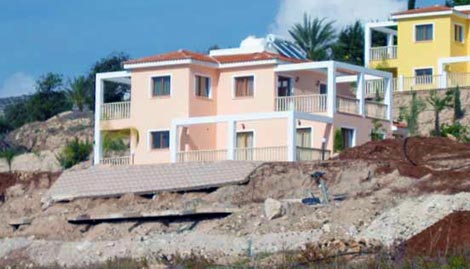
A villa in Paphos whose foundations have been washed away by the winter rains
THE GOVERNMENT is planning on revising the state maps of rivers and tributaries, to put an end to the practice of buildings being constructed in flood-prone areas.
The House Environmental Committee yesterday discussed the problem of building in riverbeds and related problems caused by preventing the usual flow of water.
The president of the committee, Andres Facontis, underlined that the problem is prevalent in the district of Paphos. The main cause of concern is the improper registration of river tributaries and streams, many of which do not show up at all on government plans.
This means that in many cases, permission has been granted for construction and development on ravines and in riverbeds. This has caused major problems during the winter when rainfall is at a maximum. The committee will now attempt to register all of the waterways in Paphos however small, in an attempt to prevent further problems.
Building in these conditions has created untold problem and caused misery for many homeowners who end up with severe flooding of their properties during the winter months.
One couple, who wished not to be named for legal reasons, told the Cyprus Mail, “We bought a house in a village close to central Paphos about five years ago. It was supposed to be our dream home, but it’s turned into a nightmare.”
The couple say they had no idea that their luxury villa was built on a riverbed until returning home one day to find the entire ground floor under water. According to the couple, torrential rain had caused the main artery of the river to overflow and spill over into the smaller tributary.
Thousands of pounds worth of damage was caused and the couple were subsequently informed that their house had been built on a river.
“We couldn’t believe it,” they said. “And now we are having a fight with the developer, who says he obtained all of the correct building permits despite the fact that a house should obviously not have been built on the site.”
The couple say they are one of four houses, which have been affected to some extent by flooding.
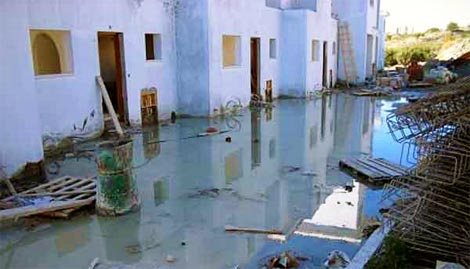
Flood damage to 'luxury' apartments in Paphos while they are still under construction
This situation is also a problem in Peyia, where local councillor Linda Leblanc says she is concerned for the safety of many buildings.
“In some cases, the town planning department in Paphos seems to have no understanding of what they are approving.”
“For example, there is a huge problem in Lasa village where a lot of the ground is clay bentonite. This is completely unsuitable for buildings.”
In addition to the environmental committee’s plans, the councillor said she believed action by the geological survey department should also help.
“I heard the geological survey department have accurately mapped Cyprus using satellite technology and GPS. This will help to identify sensitive spots and hopefully development of these areas will no longer take place,” she said.
In theory, the plethora of new information should help the town planning and ensure co- ordination between the authorities. It should also ensure the no build areas are correctly noted.
Leblanc said, “We are moving in the right direction. The problem is that it’s misleading for authorities to pretend that they don’t know where these sensitive areas are. Everyone knows.”
The councillor regards recent progress as positive and pointed out that photographs of the proposed site are required as part of being granted permission to build from the town-planning department.
“Now that everything is computerised in these offices, there will be permanent photos of the areas available, and there will be no excuse to give the go ahead to build on ravines, riverbeds or slopes.”
Leblanc underlined that one of the problems in Peyia are the loopholes in the regulations.
“In Peyia, only five metres of the course of the river each side is protected. Obviously this doesn’t include the sloped sides of the river.”
“We have places in Peyia which are a nightmare. For example, there is a hotel built in the middle of two riverbeds. Flooding in the storms of 2006 badly damaged it.”
But the councillor pointed out that Peyia municipality has made positive moves and have created an anti-flood drainage system. So far there hasn’t been a repeat of the severe weather of a few years ago.
“Permits are still being given out to build on unstable slopes and river beds,” said Leblanc.
“These kind of actions are criminal, reckless and endanger human lives.”
“The authorities must stop from turning a blind eye to these matters. People have to start understanding that they can’t keep developing these unsafe areas, and most of the home owners have no idea of the danger they could be facing.”
Leblanc said that since the recent heavy rainfall in Paphos, many people have complained to Peyia council about flooding of their properties, caused by nearby houses being built on top of stream and river beds which are dry during warmer months.
“I am concerned that people are still thinking about money and how they can make millions from developing their land, even if the conditions are unsuitable.
“On the other hand, if areas are deemed protected, the landowners must be fairly compensated for this.”
Leblanc concluded, “We must encourage people to build safely and respect the environment. However, I am delighted that progress seems to be being made at long last.”
The Interior Minister Neoclis Sylikiotis explains how he is determined to cut through the Gordian knot of the Title Deeds issue.
Question: Could you start by clarifying what the new Title Deeds legislation is about?
There are five draft amending bills. The proposed legislation is not just about the town-planning amnesty. Although these bills also deal with a town-planning amnesty, they deal mainly with making issuing of Title Deeds easier, with the buyer at the very heart.
To give one simple example: Currently, if there is a property development involving 100 flats or houses, even if the majority of those units do not have a town-planning problem, the fact that a Completion Certificate cannot be issued for the whole development means that Title Deeds cannot be issued for those units. This is why we came up with the idea of differentiating between categories of Title.
Let’s be clear: we are not talking about three separate Title Deeds – there is only one Title Deed. What we are simply saying is that in particular cases, any [building permit] irregularity will be recorded as an appendix to the Title, which is why that Title will be designated “incomplete”. This will help the buyer because it will allow us to issue the Completion Certificate. So in my earlier example, say 70 property-owners will receive clean Title, say another 20 would get an “incomplete” Title due to the minor irregularities. With a lot of developments involving apartment-blocks, these irregularities are often no more than parking spaces not having been designated, or the use of common areas not being clearly defined. But these are the kind of irregularities which don’t affect neighbouring units.
In cases where there are major irregularities or illegalities, then a “limited” Title will be issued, in other words a Title Deed with an appendix of the illegalities which typically affect neighbouring units. This means that the owner cannot sell or otherwise transact unless he ends the illegalities.
Editor’s comments and questions
Regarding the Minister’s statement “there is only one Title Deed”, earlier reports have referred to “three types of Title” and “Title Deeds being divided into three categories”. Is the Minister now saying that these irregularities will be attached as an Encumbrance (in the case of incomplete) or a Prohibition (in the case of limited) to the property in question – or is some new mechanism being designed?
The paragraph on the subject of major irregularities or illegalities raises a number of questions.
Is the decision on whether there are major irregularities or illegalities with the property taken before the transfer of Title from the property developer to the buyer or after the transfer of Title has taken place?
If it takes place before the transfer of Title, does mean that the developer will have to compensate the buyer by refunding monies paid plus expenses?
If it takes place after the transfer of Title, I envisage situations (e.g. where a property developer has built an illegal three floor apartment block rather than a legal two floor block) where the demolition or partial demolition of the structure may be necessary to end the illegalities. In this eventuality who will compensate the buyers of the third floor apartments, who may have bought the properties in good faith, for their loss?
On a similar note, does this mean that the buyer who will have purchased property without knowledge of the illegalities be expected to somehow end those illegalities that resulted from the actions of the property developer?
If the irregularities/illegalities have reduced the market value of properties built in the vicinity of the illegal construction, will the owners of those properties be compensated by the offenders?
Who decides whether there are major irregularities or illegalities with the property? There have been cases in the Paphos area where although the Building Permit had been approved by the relevant authority, the Building Permit itself contravened the zoning regulations for the area.
Out of the 130,000 properties currently without Title Deeds, how many will this legislation address?
This is being done in order to enable Title Deeds to be issued for the whole development, to limit the problem of any illegalities with a few units. So in my example 70 Titles are clean, 20 are “incomplete”, and the remaining 10 “limited”.
Apart from the various provisions for a town-planning amnesty, something which appears for the first time in the new legislation is the “special execution” order. A buyer will no longer depend on the developer – he can apply directly to the Director of the Land Registry office, who will have the right to consider whether to issue the Title Deed without having to wait for the land-owner. Today, that possibility is only available after you have applied to a court for a special execution order, but with the new law the buyer will have this new right.
Editor’s comments and questions
Will the buyer be able to apply for the “special execution order” when they take delivery of the property?
On what bases or criteria will the Director of the Land Registry reach his decision?
How long will it take the Director of the Land Registry to decide whether to issue the Title Deed?
Assuming that a buyer’s application for a “special execution order” is successful, how long will it take for the Title Deed to be issued?
Bearing in mind that there are some 130,000 properties without Title Deeds, how many “special execution order” applications are anticipated – and have the Land Registries taken on extra staff to process those applications?
Question: But where does the problem of developers’ mortgages fit in? The laws create a right, but there are debts hiding behind that right.
That is irrelevant. Under the special execution order process, if the buyer can prove he has paid what he was supposed to, the Title Deed can be issued, and let the bank solve its problem with the developer.
Editor’s comments and questions
Later in the article the Minister advises Mr Charalambous that he has already turned down a request from the Banks Association for legislation that would make the liquidation process easier.
Do the banks and other interested parties support the proposed “special execution order legislation”?
In his deliberations regarding applications for a “special execution order” will the Director of the Land Registry take into account any views or objections raised by property developers and banks?
How many of the 130,000 properties waiting for Title Deeds are encumbered by developer’s mortgages and what is the value of those mortgages?
Question: So the new law will protect the buyer?
That’s exactly the point – the special execution order process applies to a specific property unit. The provisions also include an obligation on the developer to comply with the process and they give the authorities the power to impose a fine if the developer does not fulfil his obligations. The developer will be obliged to apply for a Completion Certificate, and once this is issued, there is the obligation to apply for the Title Deeds to be issued. This is the point where the mortgage question sometimes comes in. Up to now the developer could hold things up by saying “I have a mortgage, I can’t get the Title Deeds issued, because I would have to pay off the mortgage.”
But now there will be the burden of possible fines, and secondly there will be “naming and shaming” of developers who offend repeatedly. A company that is serious about its business will avoid this.
Another important aspect is the option of the seller lodging the sales agreement, because sometimes a lot of games can be played with this. Now there will be an obligation to do so, which will protect the buyer against a seller taking a deposit and then selling the property on to another buyer. Once a sale is agreed, the law says that when the signed sale agreement is lodged, it comes into force as far as the Land Registry is concerned. The buyer has ownership, even though he may not yet have received the actual Deed, and so can’t sell or transfer it.
Editor’s comments and questions
Fining, naming and shaming property developers who repeatedly offend is an excellent idea! Will the information on those offenders be widely available, such as on the Internet, and published in different languages that reflect the ethnicity of those buying property on the island?
Who will have the obligation of lodging signed sale agreements at the Land Registry – the vendor, the purchaser, the lawyer acting on behalf of the purchaser?
Question: But in practice, won’t the Land Registry simply say that, for the Title Deed to be issued, the mortgage has to be paid off first? Are you saying that the whole process will change?
Yes, this is where the special execution order comes in. When a third party can now apply for the Title Deeds, the obligations relating to mortgages are transferred from that party. Of course, very often this depends on the contract the buyer has signed.
This legislation does not only deal with the future; it deals with the past, because today we have some 100,000 cases that aren’t in the system. This legislation will help the whole process, since – through the town-planning amnesty, or the special execution order process, or the obligation to lodge a sales contract – we will force these deals to enter the system.
Editor’s comments
The Minister’s statement “Of course, very often this depends on the contract the buyer has signed” is absolutely correct.
It is well-known that lawyers have close personal and commercial ties with property developers as they rely on the income they receive from these relationships to sustain their businesses. They fail in their duty of care towards buyers by failing to advise them about mortgages and other problems and the sales agreements they draw up are heavily biased in favour of the vendors.
A simple way around this problem would be to mandate the inclusion of a series of standard clauses in all property sale agreements that would protect both the vendor and the purchaser from ‘indiscretions’ by the other party.
The Cyprus Bar Association has already offered to assist the Ministry in drawing up the new Title Deed legislation, and I’m confident they could draw up these clauses.
(Standard form contracts are available in Cyprus – I used one for the construction of my house).
I’d like to add a few things about developers’ mortgages and bankruptcies, because a lot is being said about this. The truth is that a lot of people don’t understand the system that operates in Cyprus, because they start from what happened in the United States or the UK with the banks holding toxic debt and having to take drastic measures. In Cyprus it is no simple step for a bank to liquidate a property [in order to recover a debt]. That has never happened here. Even in the case where a developer went completely bust – Pieris Estates – finally the banks, the liquidator and all concerned had to come to an arrangement, which allowed people to get their Title Deeds. OK, it may not have been an ideal solution, but at least people did get their Deeds.
Editor’s comments
When Pieris Estates went under back in the 1980s, the bankruptcy soured diplomatic relations with Kuwait as many of those who had bought property from the company were Kuwaiti.
The affair continued until 2006 at which time the European Court of Human Rights ordered the Cypriot Government to pay €29,000 to four Greek Cypriot buyers for allowing their case to drag on in Cypriot courts for more than two decades.
First of all, the bank does not have the power to move to liquidation on its own. Yes, it can go to court and obtain a winding-up order, but it then needs the Land Registry to do its part. So if the Land Registry says it will not do that, the bank cannot proceed. As Minister I already turned down a request from the Banks Association for legislation that would make the liquidation process easier.
Then again, Cyprus is such a small community that if the banks went ahead with liquidation [and seized property] in some cases, their indirect loss would eventually be bigger than any immediate gain, because people would be more wary of taking on the kind of debt they are nowadays – hence their incentive to reach an arrangement.
Editor’s comments
Two property developers have already gone bust and the banks have told a number of their buyers that their homes could be taken away to recover the debts.
Just last week a case was reported on the Greek language TV stations in which a bank was proceeding with the forced auction of a divorced woman’s house to recover her former husband’s debts.
So what are we doing? We are plugging the gaps in legislation in order to strengthen the position of the buyer, to give him more tools to use in relation to the seller. With the new legislation, both the seller and the bank will be forced to solve the problem. But there is another side: during the period of very high demand over the last 15 years or so, some people bought with their eyes shut. That’s not to say that some developers and lawyers locally did not take advantage of the situation in a way that created problems. But the main incentive with the new legislation is to create healthy conditions in the property market. When I say that we need to cut through the “Gordian Knot”, this is not a phrase I use lightly.
The Gordian Knot is a legend associated with Alexander the Great. It is often used as a metaphor for an intractable problem, solved by a bold stroke (“cutting the Gordian knot”).
WITH EVIDENCE submitted from both sides, all eyes are now on the British Appeals Court to await the outcome of the Orams property dispute.
On Thursday, it was the turn of British couple Linda and David Orams’ lawyers to tell the court why they believed their clients should keep the house they built on land owned by refugee Melitis Apostolides and his family. Yesterday Apostolides’ lawyers put the case as to why the Lapithos property should be returned to the man they see as its legal owner.
Now it is up to the court to decide.
Speaking minutes after leaving the courtroom, Apostolides’ lawyer Constantis Candounas told the Cyprus Mail the verdict could come at any time.
“It could come in a week or in the next few months,” Candounas said.
The case began in 2005, when Candounas crossed the Green Line into the occupied north and delivered a summons to Linda and David Orams demanding they appear in a Nicosia court to face accusations that they were trespassing on property owned by Apostolides.
The Nicosia court found them guilty of trespassing and the Orams were ordered to demolish the house they had built on Apostolides’ land and pay punitive damages and back rent.
When the Orams refused to adhere to the ruling, Apostolides took the case to the British High Courts, hoping that the fellow EU nation would use its courts to uphold the Nicosia ruling.
However, the British court, citing Protocol 10 of Cyprus’ EU accession agreement, said it could not rule against the Orams because the alleged crime had been committed in the north, a territory stipulated to be outside the influence and responsibility of Cyprus, and therefore also outside the jurisdiction of the EU and its courts.
For clarification on the issue, the British court asked the European Court of Justice (ECJ) to advise. This the ECJ did in April this year, ruling that Protocol 10 did not preclude the prosecution in EU courts of crimes allegedly committed in the northern part of Cyprus – a ruling that was perceived as a severe blow to many in the north as it made potential criminals of anyone, Cypriot or foreign, who had purchased property belonging to Greek Cypriots before the 1974 invasion.
The last two days of proceedings in the Appeals Court come as a result of Apostolides’ appeal against the initial British ruling that it could not act to uphold the Nicosia ruling. It remains to be seen whether the British court will adhere to the advice it asked for and received from the ECJ.
Last night Candounas told the Cyprus Mail he had spent the day responding to the Orams’ arguments. “It was a good day, I think our arguments we received well by the court and the judges,” Candounas said.
On Thursday, one of the Orams’ lawyers, former British Prime Minister Tony Blair’s wife Cherie Blair, called on the ECJ to review its ruling of last April that EU courts could rule on alleged crimes committed in the north.
Blair’s argument was that the ruling was ‘not impartial’ because of the involvement in the ruling of ECJ President Vassilios Skouris, who she said had links with the Greek Cypriots that rendered him partial in the case.
Skouris received the Grand Collar of the Order of Makarios III of the Republic of Cyprus in 2006 from then-Cyprus president Tassos Papadopoulos. The Grand Collar is an awarded presented to those deemed to have served the Cyprus Republic. The Orams lawyer also highlighted that Skouris had high-level friends in the government of Cyprus and was known to have visited Greek Cypriot refugees in the just months before the April ruling of the ECJ.
Another argument put forward by Blair was that upholding the Nicosia ruling would go against public policy in the UK. Furthermore, it was argued that the Orams case should not be seen as a case between individuals but as part of a wider political issue that could only be resolved by politicians.
Nicolas Green, another of the Orams’ legal team argued that the result of the ruling would effect a large number of people, and that this needed to be taken into account before the court rules on the case. The court was also told that while Greek Cypriots could claim their properties in the north, there was no mechanism for Turkish Cypriots to reclaim their properties in the south.
This the Orams’ lawyers described as a “great inequality”.
It was also argued that a win for Apostolides could be “dangerous” for Cyprus and would damage ongoing reunification talks.
The lawyer also requested that they be allowed to present further evidence of Skouris’ “biased” attitude to the court, a request that is being considered by the court.
ACCORDING to the Flash Estimate compiled by the Cyprus Statistical Service, the Gross Domestic Product (GDP) growth rate in real terms during the third quarter of 2009 is negative and estimated at -2.9% over the corresponding quarter of 2008.
Based on seasonally and working day adjusted data, GDP growth rate in real terms is estimated at -2.7%.
GDP at Constant Prices (source: Cyprus Statistical Service)
The contraction of the economy during the third quarter of 2009 is mainly attributed to the very negative growth rates observed in Construction and Hotels and Restaurants as well as the negative performance of Manufacturing, Trade and Transport activities.
The Financial Intermediation activities as well as the broad Services sector continue to record positive growth rates but at a decelerating rate.
A RECENT mini-poll conducted by the Cyprus Property revealed that approximately 4% of the 1,360 people who voted have been waiting for their Title Deeds for more than 20 years, while a further 6% have been waiting for their Title Deeds for more than 10 years.
How long have you been waiting for Title Deeds - Poll Results
The reasons for the huge delays in obtaining Title Deeds are well known (see Less than one in five has Title Deeds). However people do not always appreciate the consequences of not having Title Deeds.
Why is a Title Deed important?
Those buying property in Cyprus are not considered to be its owner until that property’s Title Deed has been registered in their name. This presents property buyers who do not have Title Deeds with a number of serious problems:
Buyers do not own the property and are therefore unable to enjoy the full benefits of property ownership; including the right to sell or transfer it to anyone they wish without the agreement of its registered owner.
Should buyers wish to sell before title to the property has been registered in their name, they must first come to an agreement with the property’s registered owner.
People who have been charged more than €34,000 by disreputable property developers from whom they purchased the property for this ‘agreement’. And although a prominent lawyer has stated that in his opinion, these so-called contract cancellation fees are illegal, it has not put an end to this despicable practice.
To supplement their retirement pensions or to raise money for a business venture, some people wish to raise money against the value of their property through equity release loans and other schemes.
As they are not considered to be the legal owner of the property until such time as its title has been registered in their name, they are unable to raise money using the property as collateral.
In some circumstances property developers can still raise a mortgage on the land on which they have built properties without their buyer’s permission or knowledge – even though the buyer may have paid for ‘their’ property in full and may have been living in it for many years.
Ultimately, property buyers are the ultimate guarantors for these mortgages which result from inadequate legal protection and unethical banking practices employed by many of the Cyprus banks.
Two property developers have already gone bust and the banks have told a number of their buyers that their homes could be taken away from them and sold to recover the developers’ debts.
Disreputable property developers prey on buyers without Title Deeds by extorting huge amounts of money from them claiming that it is Immovable Property Tax.
One property developer demanded more than €25,000 in unpaid Immovable Property Tax from an elderly British lady and threatened to withhold her Title Deeds until she paid up! Fortunately her lawyer pursued her case in court where, more than a year later, the judge ruled in her favour.
The amount of Immovable Property Tax she owed to the Government after living in her home for 26 years? A mere €430!
Title Deeds are not issued for properties that have been built illegally, i.e. constructed without Planning or Building permits or which suffer from other planning irregularities, until such time as those illegalities have been ‘regularised’.
If a property has been built illegally, its buyers are left at the mercy of the authorities. Ultimately, the authorities could issue ‘Demolition Order’ resulting in the destruction of the property even though buyers may have paid for the property in full and may have been living in it for many years. Buyers in this situation receive no financial compensation for their loss.
Buyers of apartments and other types of property in building complexes are unable to establish ‘formal’ management committees to manage, insure, maintain and repair the common areas.
Although they may establish ‘informal’ committees, those committees have no legal standing and cannot, for example, take action against non-payers of management fees.
Buyers, therefore, have no option but to rely on property developers to manage and maintain the common parts of their developments. Some developers shirk their responsibilities; others provide inadequate services, while others charge exorbitant management fees – increasing their charges by 30% each year.
Government legislation
As you may have read elsewhere in this magazine, the Cyprus Government is proposing a number of amendments to existing legislation to “untie the Gordian knot”.
But the amendments contain nothing to help those who have been duped into buying mortgaged property or those who are being financially abused and held to ransom by unscrupulous property developers.
The government has also suggested that aggrieved buyers should apply for a court order. But with 140 cases awaiting trial in the criminal court with 20,000 cases still pending registration to allow legal proceedings to begin, several cases involving foreigners have already been lost as they cannot stay in Cyprus forever to be called as witnesses.
Indeed the Cyprus Bar Association has publically condemned the government proposals saying that they “will lead us into a labyrinth without solving the problem”.
Property sales to foreigners are down by 76% this year resulting in serious financial problems for Cyprus. If the government wishes to encourage foreigners to buy property here and restore the island’s good name and reputation, it must take immediate and decisive action to resolve the Title Deed problems.
Latest poll
For the latest poll “Should the Cyprus government ban the sale of mortgaged property?” go to the Cyprus Property News and check out the ‘Have Your Say’ poll in the right hand column.