Orams case back in UK court today

UK Supreme Court - Copyright www.isharpdesign.com

THE LATEST chapter in the epic Orams case will unfold today when a Greek Cypriot refugee begins the appeals process against last year’s ruling by the British High Court that it could not force a British couple to return ownership of the property he abandoned during the 1974 invasion of Cyprus.

Melitis Apostolides’ case has returned to the UK courts after last April’s ruling by the European Court of Justice (ECJ) stipulating that although the north was outside the jurisdiction of Cypriot courts, rulings made by Nicosia or the courts of any EU country were enforceable on those deemed to have broken the law in the north. Apostolides and his lawyers will today seek to have the earlier UK court ruling overturned.

There is no precedent that the British court will ignore the advice of the ECJ,” Apostolides’ lawyer Constantis Candounas told the Cyprus Mail yesterday, adding that he was “very optimistic” of a win for his client.

Candounas’ confidence is boosted by the fact that it was the British court that last year asked the ECJ to advise it on how to proceed with the Orams-Apostolides case.

Linda and David Orams purchased Apostolides’ family home from a Turkish Cypriot who said he had received it as “compensation for lost land in the south” from the authorities in the north, however such a form of compensation is not recognised by any international court.

If the British Appeals Court does indeed heed the advice of the ECJ, the Orams face having to hand back the property to Apostolides, or possibly face the confiscation of their family home in Sussex to pay the Greek Cypriot refugee. They will also have to pay extensive punitive damages and court expenses that are believed to have exceeded €1 million.

The Orams case began in 2005 when the British couple was handed a summons from Apostolides’ lawyer demanding that they appear in court in Nicosia to answer accusations of trespassing on Apostolides’ property.

At first they failed to appear in the Nicosia court but attended a later hearing, where judges ordered the Orams to demolish the house they had built on Apostolides’ land and pay him punitive damages and rent.

The British couple ignored the ruling, feeling themselves to be safe from the court’s jurisdiction north of the Green Line. Apostolides, enacting EU law, then sought to have the Nicosia ruling enforced by the British courts.

To his surprise the British court prevaricated, saying it was not sure if it could intervene using EU law in a territory that was effectively outside the control and jurisdiction of any EU court.

It then asked the ECJ for advice, which it delivered in April saying EU courts, including those in Cyprus, could rule on legal matters that had taken place in the north. It now remains to be seen whether the Appeals Court will adhere to the advice it asked for earlier in the year.

Today, the Orams will be defending their claim on the Lapithos property by saying their case has wider political implications for Cyprus that can only be solved through a negotiated settlement of the property issue as a whole.

Indeed, the Turkish Cypriot side has long argued that legal action taken by individuals in the south against individuals in the north creates a negative climate that badly affects negotiations for a settlement.

Apostolides’ lawyer Candounas meanwhile maintains that forcing those in the north to recognise the legal implications of buying abandoned Greek Cypriot properties can only help negotiations. Earlier, he criticised those who sought to link the issue with ongoing peace negotiations saying, “This is a legal judgment. I don’t believe it will have any impact on negotiations whatsoever.”

The stark legality of the case will not however prevent a group of Turkish Cypriots calling themselves Embargoed! from protesting outside the court. A spokesperson from the group Ipek Ozerim said that while they respected the rights of Apostolides, they felt the rights of Turkish Cypriots had been ignored.

Apostolides has his rights, but he should not get them at the expense of others,” Ozerim said.

She added that Embargoed! and many others, particularly in Britain’s Turkish Cypriot community, regretted the way the Orams couple had been demonised by the media, both in Cyprus and in the UK.

They have been portrayed as thieves and used as scapegoats,” she said.

© Cyprus Mail 2009

Fall in tax revenue attributed to Cyprus property market collapse

TOTAL tax revenues collected by the Cyprus Inland Revenue Department during the first ten months of 2009 fell by 15% to €1.45 billion from €1.72 billion during the same period last year; a reduction of €261.71 million.

This drop is entirely attributable to the collapse of the property market. And it raises concerns that if foreign demand for property fails to recover the government will lose a significant source of much-needed revenue for ever.

Capital Gains Tax receipts in the Jan-Oct 2009 period fell by a massive 79% to €59.9 million from €278.86 million a year ago as the number of property transactions fell sharply and in some areas came almost to a standstill.

Inland Revenue Tax Collections Jan – Oct 2009
€ millions
Jan – Oct 2008
€ millions
Increase/ Decrease
€ millions
%age
Change
Income Tax
– Employees 399.61 355.35 44.25 12.5%
– Self employed 47.45 48.11 -0.66 -1.4%
– Corporation Tax 556.44 612.19 -55.75 -9.1%
Immovable Property Tax 9.77 10.63 -0.85 -8.0%
Capital Gains Tax 59.95 278.86 -218.91 -78.5%
Special Contribution to Defence Fund 306.18 313.68 -7.50 -2.4%
Stamp Duty 34.18 56.61 -22.43 -39.6%
Penalties 35.34 36.55 -1.21 -3.3%
Other Taxes 7.99 6.65 1.35 20.2%
Total Collections 1,456.92 1,718.63 -261.71 -15.2%

Inland Revenue Tax Collections (source: Cyprus Inland Revenue Department)

On the other hand, Income Tax from employees increased by 12.4% to €399.6 million, whilst Corporation Tax fell 9% to €556.4 million. Revenue from the 10% Special Contribution to Defence Fund imposed on bank deposits fell marginally by 2% to €306.1 million as total deposits placed with the banks also fell during the period.

The figures are in line with other government statistics, which show that that during the first ten months of the year, the number of property sale contracts deposited at the Land Registries fell by 50%.

Number of Properties Sales – 2008/2009 Comparison
Location Nicosia Famagusta Larnaca Limassol Paphos Total
Month 2008 2009 2008 2009 2008 2009 2008 2009 2008 2009 2008 2009
January 367 101 187 37 345 77 301 152 415 91 1615 458
February 349 161 269 52 312 112 345 132 306 101 1581 558
March 365 162 142 49 229 97 317 160 273 112 1326 580
April 296 162 143 71 296 122 310 126 291 122 1336 603
May 325 184 216 68 282 134 268 146 275 107 1366 639
June 298 188 166 82 289 152 297 189 336 142 1386 753
July 330 254 225 114 266 141 369 214 352 179 1542 902
August 155 173 128 64 165 135 236 148 252 122 936 642
September 238 235 196 83 241 113 233 174 249 152 1157 757
October 228 195 128 88 211 114 235 182 214 144 1016 723
Total Sales 2951 1815 1800 708 2636 1197 2911 1623 2963 1272 13261 6615
% Change -38% -61% -55% -44% -57% -50%

Cyprus Property Sales (Source: Cyprus Land Registry)

According to the October figures, the Finance Ministry estimates that the deficit in the first ten months of 2009 stands between 3% and 3.5%, paving the way for an excessive deficit procedure against Cyprus in the spring of next year

Working together for proper Title Deeds law

Mr Neoclis Sylikiotis - the Interior Minister of the Republic of Cyprus

I WRITE in response to the Cyprus Mail articles on November 7 under the title ‘Homeowners broaden fight: Title Deed legislation fails to tackle developers’ and ‘Planned Title Deed law misleads EU: categories of ownership are ‘unconstitutional’.

I would like to clarify the following:

1) Since the completion of the drafting of five legislations concerning property registration and building procedures, I have called for a dialogue with all the political parties and interested professional bodies or other organised groups in order to have their proposals and comments.

In addition, the Ministry has uploaded all five proposed draft bills on its website for any interested party. In this context, I have already met the leaders of all Parliamentary political parties, as well as many groups. At the moment, we are re-drafting the proposed bills in line with some of the suggestions we have received. I am sorry to say, that we have not had any feedback from the CPAG.

2) Irrespective of the above, the buyer’s interests are safeguarded against any mortgage taken out by the seller, as long as that mortgage has been registered with the Lands and Surveys Department after the signing of the contract between the buyer and the seller.

3) In addition, according to the proposed legislative amendments, any aggrieved buyer will have readily available the option of applying for a court order, which in effect will order the seller to transfer the Title Deed on the name of the buyer. If the seller is not willing to co-operate, the court orders another party to compulsorily transfer the Title Deed to the buyer. Furthermore, amendments will allow authorities to proceed with procedures leading to the issuing of all permits and certificates, as well as separate Title Deeds for individual property units (i.e. flats, attached holiday villas etc.), even without the consent of the original owner-seller. Authorities will also have the power to enforce a penalty on any unwilling original owner in order to encourage timely responses and the co-operation of original owners, while the Minister will have the power to publicise the names of sellers who are not co-operating with authorities in line with procedures defined by law. These significant improvements will undoubtedly benefit, not only new buyers, but also people who have already signed such a contract for buying a residential unit, and find difficulties in having their Title Deed.

4) I do not agree with the CPAG’s opinion that the provisions of proposed legislation are unconstitutional. Despite the fact that I respect any opinion put forward about the constitutional soundness of these bills, even when this opinion comes from non-experts, I would suggest that the legal vetting of draft bills by the Legal Service of the Republic will guarantee for this issue. I would not consider the CPAG as an expert body on constitutional questions.

I will repeat that the Ministry of the Interior has put a serious effort in order to bring about a drastic and definite solution on long existing problem of the issuing of Title Deeds.

That is why I believe that this is not the right time for complaints of this nature. On the contrary, I sincerely believe that this the good time for all to work together in order to solve this Gordian situation.

Neoclis Sylikiotis is the Interior Minister of the Republic of Cyprus

© Cyprus Mail 2009

Editor’s comments

CRITICISM is mounting that the government is not doing enough.

The Cyprus Bar Association is the latest group to condemn the proposals. In a press statement issued last month it said that they will result in even more bureaucracy and delays.

It will lead us into a labyrinth without solving the problem,” it said – and called on the Land Registry to issue Title Deeds immediately the structure is completed.

The Cyprus Property and Landowners Association (KSIA) agrees that government’s proposal fail to address the root cause of the problem but it praised the government for trying to sort out the mess.

The government is trying to do something about a huge problem. The positive thing is that they acknowledge that the problem is there. It’s criminal that successive governments have let the problem reach this point,” said George Strovolides, the Association’s President, in a press statement last week.

Although the Interior Ministry has been working hard on the Title Deed problem, it has failed to address the most serious issue; protecting buyers who have been deceived into buying property built on mortgaged land and who are at risk of losing their homes if the developer collapses or the bank forecloses.

Two property developers have already gone bust and the banks have told a number of their buyers that their homes could be taken away to recover the debts.

Building permit numbers for residential property improve

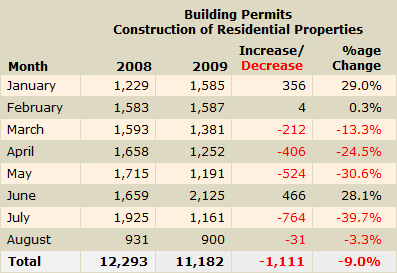
construction-permitsIN A PRESS release issued yesterday, the Cyprus Statistical Service (CYSTAT) announced that the number of building permits authorized by the Municipal Authorities and the District Administration Offices during August 2009 was 578.

The total value of these permits reached €153.8 million and their total area 176.6 thousand square metres and they provided for the construction of 900 dwelling units.

During the period January – August 2009, 5,897 building permits were issued; an increase of 5.1% compared to the corresponding period in 2008. The total value of these permits increased by 7.2%, while their total area decreased by 6.0%, reflecting a shift away from the construction of low value/low quality dwelling units to the construction of higher value properties.

The reduction in the number of residential properties for which building permits has improved. They fell back by just 3.3% compared to August last year, compared to a decrease of almost 40% in July.

Number of residential properties for which permits have been issued

Compared to last year, the total number of residential properties for which building permits have been issued has fallen by 9.0%.

Cyprus Bar Association rejects Title Deed proposals

thumbs-downLAST month, the Greek language newspaper Politis published an article containing the opinions and proposals of the legislative committee of the Cyprus Bar Association for an effective solution to the long-standing Title Deed problem. The committee opposed the Government’s proposed legislation unanimously!

The English translation of the article below has been provided by one of Cyprus’ leading legal firms:

“It is recognised that there is a serious problem in the delay of issuance of Titles of immovable property; therefore the Ministry of Interior prepared three amending bills (the amendments).

The amendments have been examined by the legislative committee, who set out the below opinions/suggestions made by President Doros Ioannides and the members Adamos Hadjichristodoulou, George Pittatzis and Andreas Georgiou.

There is concern that the amendments will not solve the problem, but add to it.

The Land Registry is the safest system for designating boundaries and safeguarding immovable property that no other country in Europe has, apart from Germany.

However its operation is frustrated as it has escaped its real purpose. Bureaucracy has stopped it from adapting to the increasing demands of the market, resulting in its current situation.

The philosophy behind the Land Registry was to map the island, designate boundaries of each piece of land and to register the owners as to undisputed boundaries or ownership which is most significant for the security of ownership in civilised communities.

Despite a few mistakes, we have had great results with the Land Registry. The problems arose with the complicated procedure of the subsequent division and issuance of separate Title Deeds for buildings and their units on a particular piece of land. The approval procedure involves architectural plans, town planning permission, building permission, certificates of final approval, parking space provisions, common areas, as well as the involvement of many government services from which applications would pass through. This in itself is complicated, difficult and time consuming.

In the cases where the structure consists of many units for each of which a separate Title Deed must be issued, the procedure is even more problematic especially if a problem appears in one of them.

If, say, in one unit the unit beneficiary carried out a prohibited construction e.g. converting the veranda into a room, then the Certificate of Final Approval would not be issued. If the act cannot be legalized then the Title Deeds for every unit will not be issued. If the act can be legalized then an application for the permission of converting a veranda will have to be submitted and the case will have to be re-examined by all the authorities.

If in the meantime some other unit beneficiary carried out a prohibited construction the previous procedure stops and a new one starts from the beginning.

When and if the procedure ever finishes and the Certificate of Final Approval is issued, then a new and unnecessary procedure for the division of the building and of issuing separate Titles for each unit starts from the beginning; for the issuance of the permit to divide the property in separate units.

And if in the meantime another prohibited construction is carried out the whole procedure is stopped and started from the beginning.

If the action for example of building a wall is against the regulations or the law, the guilty party will be liable to court proceedings or a long procedure for relaxation will have to begin.

If finally all the above procedures finish, then a new episode stars with the Land Registry for the issuance the Title Deeds. For this an application to the Land Registry will have to be submitted for registration of the new units which are covered by the said permit to divide.

The Land Registry to proceed to registration will have to carry out its own on-site searches and checks.

Meanwhile if another violation has been committed, the whole process is suspended until the violation is legalized.

All these procedures are time consuming and in many circumstances result to separate Titles not being issued.

Because of the above along with the boom of developing in the past years with sales to foreigners, we are at a deadlock.

We will not be able to solve the problem if these unnecessary procedures persist.

In other countries this problem does not exist. Once the erection of an apartment construction is completed, separate Title Deeds are issued the following day.

In Greece where a Land Registry does not exist, there are problems for securing ownership and boundaries. In eastern European countries where ownership and boundary problems should have existed, Title Deeds are issued in a short time.

We have the best system in the world so then why can we not issue Title Deeds? Because we didn’t understand nor apply the philosophy of the Land Registry and we are in a standstill because we got carried away with minor things like verandas, bedrooms, extensions.

The logic behind the Land Registry is two fold. Firstly, the survey of the immovable property and the definition of its boundaries and secondly the security of the ownership by the creation of a register of owners as to eliminate doubt.

Unfortunately the proposed amendments do not adopt the above logic and escape from the said purpose of the Land Registry. For this reason the amendments will not only not solve the problem but complicate the system even more.

The solution is very simple, as long as we have courage, are honest about the reality and understand/agree with the philosophy of the Land Registry being the security of ownership (by Title Deed) and of boundaries. If someone converts his veranda, adds a room or builds a wall, this is an issue that can be solved easily with other procedures.

This is an issue for the appropriate regulatory body. If someone wants to cover his veranda, he could just wait for the Certificate of Final Approval to be issued first and cover his veranda the next day! This will not affect the issuance of a Title Deed. So why should it be if he covers his veranda before the issuance of a Title Deed?

If a business man owns an apartment in a building, which has Title Deeds, illegally adds another storey, the Title Deeds of the other units will not be affected. So why are they affected if one of the fifty residents builds a pergola or a garage?

The purpose of all the examples mentioned above, was for the extent of the problem to be understood and to show that the procedure of obtaining Title Deeds and the amendments go against the logic and philosophy of the Land Registry.

The solution is simple. When a structure is finished and the ownership and boundaries are not doubted, then Title Deeds should be issued immediately.

For this to happen, some small amendments need to take place in the Streets and Buildings Regulation Law, Cap.96 and in the Immovable Property Law, Cap.224 in the spirit of the philosophy of the Land Registry.

If on an immovable property a block of buildings is constructed, comprising of 3 floors, 30 apartments, 10 shops and 10 ground floor dwellings, certificates of final approval can be issued for every individual unit which has been built according to the to the building and planning permits and so to immediately register it and issue a Title Deed at the Land Registry without new permission applications, certificates for approval and other time consuming, never ending and unnecessary procedures.

For the units that were built illegally and to which certificates of final approval are not issued, the appropriate authority will take legal action for compliance against the owner of land and every affected buyer of the unit and when the problem has been solved, then to proceed to issue a Certificate of Final Approval followed by the registration and issuance of Title Deeds.

The legislative committee of the Cyprus Bar Association is ready and willing to conduct legal drafting and wording of the amendments that are needed to solve the problem from the root and will be at the disposal of the government and the appropriate Minister.

It is therefore our recommendation with all respect, to oppose the three amending bills which will lead us into a labyrinth without solving the problem as has happened with Law 229(I)/2004 which had the same purpose but remained a dead letter.

If our suggestions are taken on board then very simply and soon the problem of many decades will be solved. Hundreds of millions of Euros will be collected by the government. Thousands of buyers will be secured and will only be too happy to pay the transfer fees. Cyprus’ image will be restored internationally and we can claim justly to have the best system of securing ownership in the world.

The above suggestions was prepared by the President of the Cyprus Bar Association Doros Ioannides and members Adamos Hadjichristodoulou and Andreas Georgiou and is supported and adopted by the rest of the committee members Costa Hadjioannou, Monica Sofocleous, Laris Vrahimis, Frangisos Hadjhannas, Melina Karaolia, Elena Nikolaidou and Mary Terpsopoulou.”

Property group condemns Title Deeds laws

burning-paper-mDRAFT legislation to deal with the estimated 130,000 unissued Title Deeds fails to “grasp the nettle” of the issue as it does not address in any way the main issue of developer mortgages, a leading property action group said yesterday.

In a statement to be circulated today to British and Cypriot MEPs – a copy of which has been obtained by the Cyprus Mail – the Cyprus Property Action Group (CPAG) contends that the government’s proposed legislation currently before the House Legal Affairs Committee “in effect is merely an amnesty for developers who have failed to adhere to planning/building permits issued or even built illegally without these permits”.

Consequently, it fails to address the main problem of “developers taking mortgages on properties they have also sold to unsuspecting buyers”. Buyers then “wait years to obtain Title Deeds and stand to lose their homes should the developer go bust and if the buyers cannot then pay off ‘their’ portion of the mortgage”.

After arguing that successive governments have “totally abandoned” enforcing the Completion Certificate law “which is designed specifically to protect buyers and the integrity of the planning system”, the CPAG statement also says that by creating three categories of Title Deed “the proposed legislation in our view also seriously undermines the rights of the buyers who may be subjected to the effects of such provisions.

The three new categories defined in the draft legislation are: “complete” or clean Title; “imperfect” Title, presenting minor irregularities in relation to the building permit; and “limited” Title, presenting substantial illegalities in relation to the building permit.

In CPAG’s view, anything less than a complete or clean Title Deed in practice would prevent a buyer from selling a property or taking out a mortgage. Since Article 23 of the Constitution (Property Rights) guarantees every owner the right to dispose of their property, CPAG considers “this particular amendment as being totally unconstitutional”.

The Government could appear to be colluding with dishonest developers to breach bona fide sales agreements through their ability to apply for these inadequate types 2 and 3 Title Deeds.

The statement also quotes a press announcement issued by the Cyprus Bar Association a month ago, which said that “there is concern that the amendments will not solve the problem, but add to it”, and recommended opposition to the three amending bills.

CPAG accuses the Cyprus government of “consistently misleading” the UK government and the EU – which have applied pressure for a resolution to the problem – by suggesting that the proposed legislation represents “action to address the serious issues raised by these bodies.”

The statement concludes: “Sooner or later they will have no choice but to address the issue of developer mortgages. The question is: just how much damage to the economy, the image of Cyprus and people’s lives will have been caused before the Government shoulders its responsibilities?

The Cyprus Property & Landowners Association agrees

The Cyprus Property and Landowners Association (KSIA) President Yiorgos Strovolides told the Cyprus Mail yesterday that KSIA, which has worked closely with CPAG in assessing the government’s proposed legislation, “in general agrees on the substantial points” made by CPAG.

Strovolides said that ”the government is trying to do something about a huge problem. The positive thing is that they acknowledge that the problem is there. It’s criminal that successive governments have let the problem reach this point.”

© Cyprus Mail 2009