Cyprus property sales: November 2009 report

THE total number of properties sold to both Cypriots and foreigners during the first ten months of 2009 has fallen by 52%; with the numbers sold to Cypriots and foreigners down by 28% and 76% respectively.

cyprus-property-sales-all
Property Sales to Cypriots & Foreigners (Source: Cyprus Land Registry)

Foreign demand

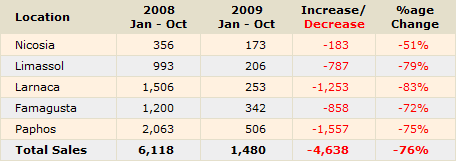
During the month of October, only 117 properties were sold to foreigners island-wide according to the sale contracts deposited at the Land Registry.

Twenty two properties were sold in Nicosia, sixteen in Limassol, nineteen in Larnaca, twenty seven in Famagusta and thirty three in Paphos.

So far this year just 1,480 properties have been sold to foreigners compared to the 6,118 sold during the same period in 2008.

Britain accounts for about half of all the overseas buyers. But the economic pressures at home, the Sterling/Euro exchange rate and media revelations about the many ‘property scams’ have deterred many of them from buying property in Cyprus.

They have little confidence in the off-plan deals being offered by property developers and are coming to believe that the Cyprus government has neither the will nor the ability to resolve the long-standing Title Deed issues.

Property Sales to Foreigners (Source: Cyprus Land Registry)

Local demand

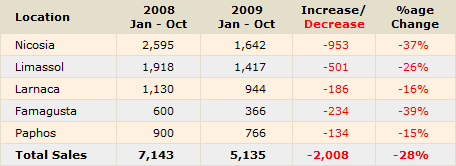
On a more positive note, there has been a slight improvement in domestic sales of property. In October, Cypriots bought 606 properties; 16% more than last year.

Real estate agents have said that this improvement is linked to ‘special’ offers being made by some of the property developers. But they believe the improvement will not last for long.

So far this year just 5,135 properties have been bought by Cypriots compared to the 7,143 bought during the same period in 2008.

Property Sales to Cypriots (Source: Cyprus Land Registry)

Construction sector unemployment at record level

Unemployment levels in the construction sector area have reached an all-time high.

According to the Labour Minister, Sotiroula Charalambous, the number of unemployed in the sector has reached 3,134 – an increase of 430%.

Sotos Lois, the chairman of the Cyprus Contractors Federation, has already expressed his concern that the number of unemployed in the industry could reach 20,000 next year.

Dark days ahead for Cyprus

cyprus-dark-daysA SLOW economic recovery in 2010 and 2011, with Cyprus lagging behind the EU average in both years is envisaged by the European Commission (EC), setting the scene for “the structural adjustment of the economy”, according to its autumn economic forecast issued in Brussels yesterday.

It expects that “private consumption growth is likely to be subdued” despite nominal wage growth above inflation and cheaper debts as interest rates fall, “due to a high household debt burden, tight financial conditions and downbeat consumer sentiment in an uncertain environment.

The report also contains a stark warning on wages growth, saying that “the disassociation between wages and developments in productivity is undermining the competitiveness of the Cypriot economy.

The EC is not optimistic about the housing market’s future contribution to investment either: “given the economic outlook in Cyprus’ main trading partners, foreign demand for dwellings by non-residents should remain weak. Domestic demand for housing and activity in real estate is also expected to stay subdued.

Finally, although various infrastructure projects promoted by the government should support investment somewhat, the report says they are unlikely to be sufficient to fully offset the impact of the contraction in housing on total investment.

The EC’s economists forecast that Cyprus’ gross domestic product (GDP) will decline this year by 0.7 per cent, reaching 0.1 per cent growth next year and 1.3 per cent in 2011.

Meanwhile, they estimate that the fiscal deficit will reach 3.5 per cent of GDP by the end of this year – “due to both lower than anticipated revenue and higher-than-planned expenditure” – climbing to 5.75 per cent in 2010. Unless there is a change in policy, the EC is forecasting a 6.0 per cent budget deficit for Cyprus in 2011.

The government’s Draft Budget Law for 2010 has set a deficit target of 4.5 per cent of GDP, based on an estimated deficit for 2009 of 2.9 per cent. However, the EC said that “although the Draft Budget mentions a series of supplementary measures that could be taken during the course of the year as a means to restrain the budgetary deficit in 2010 below 3 per cent, they are not accounted in the budget target.

The “supplementary measures” announced by Finance Minister Charilaos Stavrakis refer to recovering tax arrears and combating tax evasion, boosting duties on a one-off basis via the Title Deed “amnesty”, freezing public sector employment for the next 18 months and improving the state’s cash management.

Taking both forecasts into account, it is likely that Cyprus will come under EC supervision by spring 2010 and will be required to follow the excessive deficit procedure (EDP), along with 13 other eurozone countries.

The EC also forecasts that Cyprus’ public debt will reach 53.2 per cent of GDP this year, rising to 58.6 per cent in 2010 and 63.4 per cent of the GDP by the end of 2011.

Inflation is expected to be 0.8 per cent at the end of this year, reaching 3.1 per cent in 2010 before dropping back to 2.5 per cent the following year.

The EC expects unemployment to continue growing – “especially in the labour-intensive sectors” such as construction – from 5.6 per cent this year to “historically high levels” of 6.6 per cent and 6.7 per cent in 2010 and 2011.

In terms of analysis, the EC puts the economic slowdown in Cyprus down to “an adverse external economic environment, high household indebtedness together with tight lending conditions, restructuring corporate balance sheets and deteriorating confidence”, which all weighed on growth.

Its report said that “the crisis has also highlighted the accumulation of a high external [trade] imbalance, a particularly oversized housing sector and competitiveness losses”, adding, “these factors set the stage for the structural adjustment of the economy”.

© Cyprus Mail 2009

Click here to read the European Commission’s 2009-2010 autumn economic forecast for Cyprus

Cyprus golf courses at Tersefanou and Limni

golf-cyprusACCORDING to a report in today’s StockWatch, construction work on two of the eleven golf courses planned for Cyprus should start by the end of the year as the owners of the two projects should have secured the necessary approvals by then.

Urban Planning Department Manger, Christodoulos Ktorides told StockWatch that two of the eleven golf course applications are taking precedence over the others and that their owners are entering the final stage; the hearing and the safeguard of the license. The two projects are those at Tersefanou in Larnaca and Limni in Polis Chrysochous.

Mr. Ktorides said that the remaining applications are on track but it largely depends on the businessmen themselves to promote their applications and to comply with the Committee’s remarks.

There are several issues that can be only solved by the businessmen, such as the desalination stations with renewable sources of energy, the access to the courses, the offsetting measures and other issues that must be arranged so that they secure the final license”, he stressed.

The two businessmen that are just one step away from the start of the construction works spoke to StockWatch with enthusiasm and expressed their readiness to start works on the same day they secure the license.

Chairman and major shareholder of MED Golf, Dimis Karapatakis stated that works will commence right after the safeguard of the license; the hearing is scheduled for 27th November.

Executive Chairman of Cyprus Limni Resorts & Golf courses, Nicos Shacolas, who will build two golf courses in Limni told StockWatch that works will start immediately as soon as the master plan is approved. “Despite the economic crisis, the Company has secured the financing of the projects”, he noted.

With the safeguard of the urban planning and the housing license, the businessmen will submit 30% (€1.5m) of the €5 million that the total license costs, while the remaining sum will be paid gradually. The license will be valid for four years and in the meanwhile the businessmen are obliged to start the construction works otherwise the validation will expire.

BuySell Cyprus replies to report

Last month’s article made it clear that the Sunday Mail was quoting Mr Skierka’s views and that it was unsuccessful in obtaining BuySell’s side of the story when their reporter called its main office. We have now been given the opportunity to print BuySell management’s side of the story from Mr Demetris Demetriou.

Mr. Mike Skierka signed a sole agency listing agreement with Supertrust Estate Agents Ltd (BuySell). BuySell spent thousands of Euro advertising this property to thousands of potential buyers and produced over 40 showings for this house. Through the sole efforts of BuySell, a buyer was found, but Mr. Skierka tried to cheat BuySell out of its commission.

Below are just some of the false and misleading information contained in the article.

1. Supertrust Estate Agents Ltd (BuySell) was taken to court for not having a license.

a. This is not true. BuySell is a registered estate agent with registration number 482. BuySell has never been convicted of any crime in its 8 years of operation so far.

2. The article states “… due to the lack of results through BuySell…”

a. BuySell has completed 41 showings of Skierka’s house, a number that is about 8 times the average number of viewings any house in Cyprus receives, something that shows the efforts of BuySell. Attached are all 41 viewings that show the date, name of clients and their comments.

b. BuySell advertised the property in its magazine which was delivered to more than 260,000 homes in Cyprus and included Mr. Skierka’s house with photos, full street address and a location map.

c. BuySell advertised the property on its website.

d. A BuySell for sale sign was placed on the property.

e. A newsletter to over 50,000 potential buyers was sent by BuySell informing them about this property.

f. An advertisement was placed on the window of the BuySell shop in Coral Bay.

No other agent in Cyprus or in the UK does so much advertising or produces so many viewings for any property.

3. The article states “…the final sale of [the] property had had nothing to do with BuySell…”

a. BuySell advertised the property in its magazine, website, and office window with the full home address of the property and a map showing the exact location of the property, as part of a sole agent agreement signed by Mr. Skierka. Thousands of home buyers saw this advertisement, some of which came to BuySell and requested to see the property and some who went directly to Mr. Skierka. But the fact remains that all clients found the property through the advertisements of BuySell.

4. The article states “[The owner] had a large banner made up advertising his property for sale and attached it to an upstairs balcony.”

a. A picture of the property of Mr. Skierka clearly shows the banner all tangled up and placed in a less conspicuous place than BuySell’s For Sale sign. The banner is also a smaller size than BuySell’s professionally designed sign. Any buyer passing by would have definitely noticed the BuySell sign first.

5. The article states that the employee at BuySell “refused to listen to any questions, never mind answer them.”

a. The employee at BuySell was very accommodating and polite and tried in his best of knowledge to answer the reporter’s questions. But the reporter was asking legal questions for which the employee did not know.

b. No matter how rudely a BuySell employee might have responded to pressing questions from a reporter, that reporter ought to have asked to speak with a manager at BuySell before publishing the article.

6. The report also hints that sole agency agreements are something that Mr. Skierka or other clients are not used to.

a. As a matter of fact, sole agency agreements are the norm everywhere in the world and especially the UK where Mr. Skierka comes from. When you advertise a property with the address and map (as it’s the case overseas and something that BuySell pioneered in Cyprus), sole agency is the only option, otherwise no agent would ever get paid.

Furthermore, there are other vitally important facts that prove that Mr. Skierka was trying to cheat BuySell of its commission.

1. On 11/03/2009, BuySell produced a willing and able client who put in an offer for Mr. Skierka’s house. Mr. Skierka however turned down the offer saying he does not want to sell as he wants to use it for two weeks during the summer and that his wife wants to hold onto the property until the end of the year.

Thus not only BuySell has produced results, but even found a buyer whom Mr. Skierka turned down for dubious reasons.

After this response by Mr. Skierka in February, Mr. Skierka avoided most communication from BuySell, something that created suspicions that Mr. Skierka might be trying to fraud BuySell.

2. Then Mr. Skiera called BuySell asking to take the property off the market claiming he had rented it out for a year which was of course a lie, amongst many others. The house was not rented out to anyone! So why was Mr. Skierka afraid to tell BuySell he had sold the house, if he didn’t know what the agreement said.

3. Thus BuySell kept a close eye on the case and eventually discovered that Mr. Skierka had sold his property and had not informed BuySell in an attempt to fraud BuySell and not pay the commission he agreed to pay when signing the agreement.

4. BuySell also discovered that Mr. Skierka, after he sold the property and he tried to hide it from BuySell, changed lawyers because his original lawyer consulted him that according to the signed agreement, he must pay the owed fee to BuySell.

BuySell followed the procedures as defined by Cyprus law in order to ensure payment of its fees.

Editor’s comment

I have no wish to enter a debate on this particular case and the rights and wrongs of those involved.

But it is vital that anyone thinking of buying or selling property takes legal advice from a source that is independent from anyone else involved in the transaction. And it is essential that you do not sign any papers or hand over any money until you have done so.

As this case clearly demonstrates, attempting to save money on professional fees by cutting corners is a false economy that can result in severe problems at a later date.

For your convenience, the British High Commission publishes a list of lawyers on its website and I recommend that you visit their website for the latest issue.

Property buyers at risk as second developer collapses

facing-evictionLAST month, Lucie Robson reported on the plight of mainly British buyers who bought properties from developer Yiannis Liasides in Paphos who declared himself bankrupt. We have learnt that more home buyers without Title Deeds are now at risk following the collapse of a second property development company in Cyprus. Charles Charalambous reports:

The liquidation of A&G Property Wise Development Ltd (A&G), a company operating the Froiber brand in Cyprus, was executed officially on 18 September, leaving “at the mercy of the banks” any owner of A&G-built property who does not have a secure claim to a Title Deed.

A&G’s 2003 accounts, which in June of this year were the most recent ones lodged with the Companies Registry, show that its long-term loans and bank overdrafts were secured by C£10.07 million (around €17.1 million) in mortgages on land and buildings, C£2.04 million (around €3.5 million) in assigned sales contracts, and a further C£2.02 million (around €3.45 million) in current charges and guarantees. Some C£8 million or €13.6 million of the total debt was held by Universal Bank alone.

A senior source in Universal Bank – now renamed USB Bank – told the Sunday Mail that “property-owners are exposed if they don’t have any documentary basis for claiming Title”, adding: “Basically, they are at the mercy of the banks, who have to take care of the debt on their books.

The liquidation order had been requested on 4 May 2007 by the Social Security Fund (SSF) for repeated failure by A&G to make employer’s social security contributions. It was issued on 19 November 2008, with effect on 18 May 2009, but execution of the order was postponed twice at A&G’s request, each time for two months.

The USB source said that once the court issues its compulsory winding-up order and a liquidator is elected by the creditors, then the liquidation of assets can proceed. Where the main creditors are banks, which accept they cannot demand recovery of 100% of the debt, “a compromise will be reached between them to find an acceptable settlement, depending on the priority of rights and what mortgages or other financial charges on the available assets exist”.

He said that where a property offered as security has been bought by a third party, then how the liquidation is handled will depend on whether that person has lodged documents with the Land Registry which establish some claim to Title.

If not, “although one bank may want to be understanding, peer pressure between the banks or pressure on one bank’s liquidity due to the economic crisis can force the issue”, he added.

Maria (real name withheld at her request) is in a better position than her neighbours, but is still not sure that her right of ownership will be recognised.

She signed an agreement with A&G in April 2000 to buy a property in a Froiber block of nine flats, and took possession in August 2000. Maria has an official statement of account proving that all outstanding amounts had been paid. After years of waiting for A&G Director and company owner Georgios Andreou to settle the part of his debts that would allow her to receive a Title Deed, she consulted a lawyer in December 2008.

After making further payments against claims from A&G which in her lawyer’s view were excessive, in February 2009 Maria received a written commitment from Andreou that the company would transfer the Title Deed of her flat to her within three weeks.

Her lawyer obtained an execution order from Nicosia Court on the basis of Andreou’s written commitment, to be carried out on April 3. A&G failed to attend the Land Registry on the date set by the court, so Maria sued Andreou for non-performance of his various commitments. The writ was registered with Nicosia Court in May, and was heard on 17 September. As this was one day before the last grace period for the liquidation order against A&G was due to run out, A&G’s lawyer successfully argued that Maria’s execution order should be postponed until 14 October.

Maria told the Sunday Mail last week: “Lodging the writ means that the bank or any other creditor can’t seize my flat. But I was the only one out of nine flat-owners in my block to do so.

A&G’s official winding-up means that the Official Receiver has automatically replaced A&G in the case brought by Maria, as it is now responsible for ensuring that the interests of the defunct company are represented. As the Official Receiver’s Office comes under the Interior Ministry, Maria and her husband now want to meet Interior Minister Neoclis Silikiotis, to ask him what the government will do to help them and others in the same situation.

Maria’s husband told us that Maria had bought her flat with a refugee loan. He added: “My wife’s family lost its property once in 1974 to the Turks. Will the government now just stand by and let her property be lost to the developers?

Banks to blame

Maria’s husband is convinced the banks should not have approved loans against land containing property which Andreou no longer owned, and that they were aware of his financial limitations: “They are to blame for lending him such large amounts. Did they not know that sales contracts had been lodged with the Land Registry showing that people had bought the flats?” He added: “Our lawyer told us that Andreou was charged 1% for one loan, much more than the going rate at the time.

At this stage, it is not clear to what extent customers of other companies owned and run by Andreou might be affected by A&G’s bankruptcy. A&G’s 2003 accounts demonstrate a direct financial link with companies such as Froiber Land Developments Ltd, Froiber Estates Ltd and Froiber Marisa Developers Ltd. There is also a clear commercial link between A&G and Froiber Estates Agents Ltd.

The Official Receiver’s office said that when companies include the assets of affiliated or related companies in their official accounts, each case is decided on its own merits. The process starts with identifying any contractual arrangement between the bankrupt company and the other companies.

According to the Companies Registry website, Froiber Marisa Developers Ltd is “under receivership” as from 16 September 2009, but four other Froiber companies – Froiber Estates Agents Ltd, Froiber Estates Ltd, Froiber Land Developers Ltd and Froiber Ltd – are still active.

When contacted last week, Froiber Estates Agents said that they did not have any new flats for sale in Nicosia.

The USB source said: “Regardless of specific cases, we are keeping an eye on most of our customers in the property development sector. Unfortunately, we are one of the big creditors of A&G. These situations are never black and white, it depends on the interested parties. But it is a nasty case for us.

© Cyprus Mail 2009

Financial ruin for Cyprus is just a rip-off away

cyprus-rip-offI am from Russia and have long retired here, and have learnt to understand and speak a little Greek and English. When I go shopping, I hear the talk of local people, English tourists and retired residents. I am constantly surprised to hear that the locals have no respect for the English, and often see them charged much more – often double – for the same shopping items. Because I speak Greek and bargain, I am given the local prices.

Some of the English people shout about the prices and are told that ‘Cyprus is an Island’, and ‘these are the prices in Cyprus’, given with look of scorn. These prices are nonsense, because only in the last ten years have prices here been higher than England.

I just wonder what will happen to the local economy when the English do what the Cypriots want, and all go home? Who do the Cypriots expect to sustain their economy when 30% of people leave the island?

No one is buying the properties now, no one has any cash, the banks have no cash, my people have big problems, and the current scam of developers to get new customers from Iran has failed as they cannot get residence visas to live here, even though they were promised them by low government officials.

One Iranian who just bought a flat on my street has gone back now because he thought he would have all the benefits of living in the EU for him and his large family here. In the whole EU, you cannot come from outside without applying to Brussels for a visa, and Cyprus cannot give a permit alone It is EU law that applies, and no local Cypriot can make any decision beyond a tourist visa for 90 days twice a year, without residency, no matter what you buy or how large money you have.

The developers here have mostly sold their land twice, to the bank and customers and cannot issue title deeds because of the frauds – I don’t see any political solution, as these criminals have taken all the profit up front and not supplied the contracted goods. It’s simple theft. No wonder they just want the victims to leave the country. This is a financial, not political problem.

Do the Cypriots believe that the local economy can survive intact without 30 per cent of GDP? That tourists will come and spend twice the price for milk and bread when they have the choice to go somewhere else where prices are 50 per cent less than the local prices here? And that anyone will trust Cypriots again to buy any development without it being finished and with clear title deeds, like every other country in the EU?

I see these damages every day and this lovely country with so much potential for nice living and good economy, will take 20 years just to recover its reputation, before local people realise that visitors have had enough and have no reason to come here.

The whole economy is sustained on lies here and cash to support these lies is finished. The island is too small to ride out this storm, like stock market crash in 2001.

Property prices will collapse and there will be no cash or work anywhere. Shops will close. The infrastructure will break down, civil servants and pensioners will not be paid, because there is no cash to pay them.

In the end, 70 per cent of GDP will be lost, and Cyprus will be back 20 years. Houses that cost €200,000 will be selling for €60,000 and still no one will buy. Most of the Mercedes will be sent back to the UK for sale at 50 per cent losses.

What concerns me is that, none of this need happens. Why are the Cypriots throwing away their home to other countries? Why not just clean up this house, keep it clean, and give no man any chance to shout problem for any reason? Does the name Colonel Custer mean something to you?

My father would walk 2km to another shop to save two cents on bread. How far do you think people will go to save their livelihoods?

Alex Medhiedev,
Larnaca

© Cyprus Mail 2009