Property market report for Cyprus

market-rep-470ALTHOUGH increasing numbers of Cypriots are buying property, the lack of sales to foreign buyers continues to plague the island’s beleaguered property industry.

Lower demand from abroad is putting a downward pressure on prices and forcing developers to lay off staff. Many industry pundits are extremely concerned about the situation and have been voicing their doubts over the future of the sector, particularly if the Cyprus economy fails to grow in the coming months.

Property is the second largest business sector in Cyprus employing more than 40,000 workers and generating some €1.2 billion a year in foreign currency. According to a report last month 2,500 dismissals have already taken place in the construction sector and the chairman of the Cyprus Contractors Federation, Sotos Lois, is afraid that the number of unemployed in the industry could reach 20,000 in 2010.

Property sales

The latest figures published by Cyprus’ Lands and Surveys Department reveal the extent of the situation.

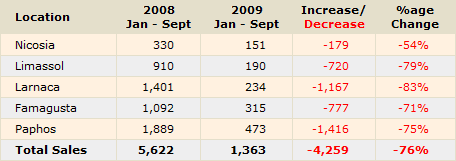
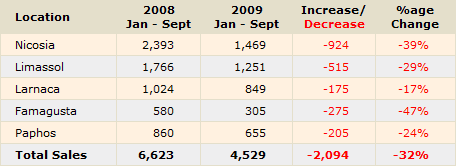
The total number of properties sold to both Cypriots and foreigners in the first nine months of 2009 fell by 52%; with the numbers sold to Cypriots and foreigners down by 32% and 76% respectively.

In the month of September, only 173 properties were sold to foreigners island-wide according to the sale contracts deposited at the Land Registry. Compared to the 574 sold in September 2008, this represents a drop of 70%.

The number of properties sold to Cypriots improved slightly at 584 compared to the 583 properties sold in September last year.
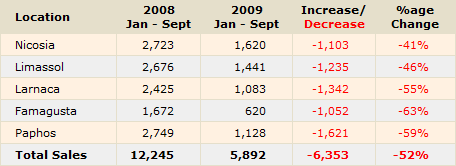
Property Sales to Cypriots & Foreigners (Source: Cyprus Land Registry)
Property Sales to Cypriots (Source: Cyprus Land Registry)
Property Sales to Foreigners (Source: Cyprus Land Registry)

As the Cyprus Lands and Surveys Department figures does not categorise the types of properties being sold, the figures above include sales of agricultural and building land, industrial and commercial properties as well as residential properties such as villas and apartments.

British buyers

Britain accounts for some 50% of all the foreign buyers. But the economic pressures at home, the Sterling/Euro exchange rate and media revelations about the many ‘property scams’ have deterred many of them from buying property in Cyprus.

These days, British buyers are being far more cautious with their money. They have less confidence in property developers and off-plan deals and are looking for “safe” markets. They are also looking for higher quality for lower price.

Britons selling up

Many Britons who have retired to Cyprus find that they can no longer afford to live on their pensions and investments. The rising cost of living in Cyprus coupled with Sterling’s reduced buying power has resulted in many of them selling up and moving back to the UK.

But the increased value of the Euro is helping in this respect. It means that they can sell their property for the same or less than its original Euro or Cyprus Pound purchase price and still make a profit on the deal. It’s been reported previously that Nicosians have been buying up these “distressed” sales.

Others are selling up too. Buy-to-let investors who were conned into believing that Cyprus has a very strong rental market and those who can no longer afford to keep up their mortgage repayments due to their financial situation. Some of these are selling to ‘vulture fund’ companies while others are offering their holiday homes for sale at BMV (below market value) in efforts to attract potential buyers.

The situation is causing much angst amongst the developers of holiday homes who are coming under increasing pressure to reduce prices to remain competitive. One company is advertising a 30% discount on some of its properties (although it appears that this is closer to a 10% reduction on the advertised selling price of these properties at the start of the year).

Property prices

The lack of an authoritative home price index means that it is impossible to provide an accurate assessment of current residential property prices in Cyprus.

The only publically available source of information is the ‘declared sales price’ for properties whose Title Deeds have been transferred by the Land Registry. This is the price paid by the vendor as stated in the contract of sale.

The average declared sale price of property transferred during the whole of 2008 was €170,031 compared to €132,293 for properties transferred during the first nine months of 2009.

Although these declared sales prices do not translate automatically into lower property prices, they may provide a good indication of an overall downward trend.

But please note that the figures above include the transfers of agricultural and building land, industrial and commercial property as well as residential property such as villas and apartments.

EU supervision looming

Tax receipts resulting from the sale and acquisition of property are down by more than €200 million so far this year compared to last, causing major headaches for the government.

Cyprus’ budget deficit is approaching the European Union limit of 3 percent of gross domestic product (GDP) and the Cyprus government is doing all that it can to avoid EU Supervision. It has taken action to accelerate VAT payments, which it hopes will add a temporary benefit of €50 to €60 million or 0.3% of GDP to state coffers.

The government’s much vaunted ‘town planning amnesty’ proposed by Interior Minister Neoclis Sylikiotis should provide the state with between €100 million and €120 million for every 10,000 titles and transfers completed.

The Minister hopes that 20,000 titles and transfers will be completed by the middle of 2010, resulting in a further inflow of some €200 million to €240 million into the state’s coffers.

Improvement in Cyprus direct tax revenues

ALTHOUGH overall direct tax collections for the first nine months of the year are down by more than 15%, there are some signs that the government has managed to halt the decline or at least  has managed to slow it down.

The amount of Immovable Property Tax collected during September alone was €5.7 million; more than 1.7 times the €3.4 million collected during the preceding eight months of the year

The collection of other property related taxes, Capital Gains Tax and Stamp Duty, has also improved compared to last month’s figures, but only marginally.

Cyprus Inland Revenue Department collections January – September 2008/2009

In total, the Inland Revenue Department has collected €231 million less in direct taxes during the first nine months of this year compared to last.

Virtually all of the shortfall can be attributed to the collapse of the property market, with Capital Gains Tax receipts down by more than €211 million compared to last year.

Building permits for Cyprus residential property falls

The Cyprus Statistical Service (CYSTAT) announces that the number of building permits authorized by the Municipal Authorities and the District Administration Offices during July 2009 stood at 804.

The total value of these permits reached €258.9 million and their total area 295.8 thousand square metres. These building permits provide for the construction of 1,161 dwelling units.

During the period January –July 2009, 5,319 building permits were issued, registering an increase of 4.1% compared to the corresponding period of the previous year. The total value of these permits increased by 7.8% and the total area decreased by 5.9%.

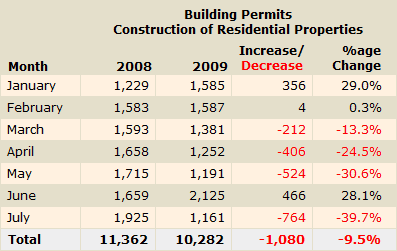
However, the number of residential properties for which building permits have been issued fell back by 39.7% compared to July last year, following an increase of 28.1% in June.

Number of residential properties for which permits have been issued

Compared to last year, the total number of residential properties for which building permits have been issued has fallen by 9.5%.

Looking at CYSTAT’s figures in more detail, the number of single houses for which building permits have been issued to the end of July this year has actually risen by five. The overall reduction results from fewer permits being issued for the construction of residential apartments and buildings with two residential units.

EU acts against Cyprus over estate agent curbs

European Court in Brussels

CYPRUS is in legal hot water with Brussels over restrictive practices that penalises estate agents from other EU-member states.

The European Commission has taken action to ensure that Internal Market principles of free movement of services and freedom of establishment are respected in Cyprus,” said a statement on Thursday.

The Commission said it will send a formal request to Cyprus concerning its national legislation restricting the activities of estate agents.

This formal request takes the form of reasoned opinion, if there is no satisfactory reply within two months, the Commission could refer the matter to the European Court of Justice.

Nicosia could receive a hefty fine if it fails to comply with the Luxembourg Court’s ruling.

This is not the first warning that the European Union has issued to Cyprus over its perceived discrimination against non-Cypriot EU citizens trying to establish themselves in property sales.

In Brussel’s view, the restrictions placed on estate agents are incompatible with EU rules and it is unhappy that would-be service providers must pass an examination proving knowledge of Cypriot legislation in this field.

The amended Law imposes certain conditions upon the recognition of the qualifications of professionals established in other Member States,” said the Commission.

These conditions concern qualifications and professional experience and therefore raise problems of conformity with Directive 2005/36/EC on the recognition of professional qualifications.

It argued that obliging European professionals to collaborate with at estate agent established in Cyprus goes against the fundamental principle of freedom to provide services.

Cyprus is also in the doghouse for snubbing European regulations by insisting estate agents in a company are required to exercise this activity exclusively in the company that employs them and may not act independently of their employer.

Local companies say the law is there to protect home buyers from ‘unscrupulous cowboys’ who parachute in to make a quick profit.

Services are crucial to the European internal market and account for between 60 and 70% of economic activity in the 27-bloc and a similar proportion of overall employment.

The key principles governing the internal market for services guarantees EU companies the freedom to establish themselves in other Member States, and the freedom to provide services in that territory.

© Cyprus Weekly 2009

Cyprus real estate agents – how to avoid the cowboys

estate-agent
An estate agency office

AS MANY of those buying and selling property have discovered to their cost, there are many illegal estate agents operating in Cyprus. Some companies, who describe themselves as ‘real estate advertisers’, ‘property consultants’, etc., trade in real estate illegally.

Although laws have been passed to rid the marketplace of these cowboys, those charged with its enforcement appear reluctant to take action against the offenders. Visit any of the seaside towns and you’ll probably find three times as many illegal estate agency businesses as legal ones.

We have warned you previously about retired Britons living in Cyprus who prey on the fears and wallets of their fellow countrymen; people like Andrew Nolan former manager at estate agents Peter Stephenson Properties and Ian Beaumont, his “partner in crime”. And we have also looked at various aspects of the real estate agents law.

In this article we look at the roles of the statutory body that regulates estate agents in Cyprus, the associations to which they may belong, and links to relevant websites.

Estate agent mandatory registration

Estate agents in Cyprus are regulated by law and need to be professionally qualified and registered with the Estate Agents Registration Council; a semi-state organisation under the Interior Ministry.

The Council has six members: a President (nominated by the Minister of the Interior), the manager of the Town Planning Department, the Manager of the Lands & Surveys Department (or his representative), and three registered real estate agents who are elected during the registered estate agents convention.

The legal obligations of registered estate agents are defined by law Real Estate Agents Law N.273(1)/2004 including amendment N.118(1)/2007.

Finding registered estate agents

On its website, the Estate Agents Registration Council maintains a directory of registered estate agents operating in Nicosia, Limassol, Larnaca, Paralimni and Paphos.

Cyprus Real Estate Agents’ Association (CREAA)

Once registered, estate agents may choose to join the CREAA – and anyone planning to use an estate agent to buy or sell property is strongly advised to use a CREAA member to protect their interests.

CREAA members are required to have a minimum of CYP 100,000 professional indemnity insurance cover, a detailed knowledge of Cyprus’ property laws, wide experience in selling property or hold a university degree in a relevant subject, possess an untarnished criminal and civic record and not be a bankrupt.

If you run into problems with a CREAA member, contact the CREAA and they will arbitrate on your behalf – and if it becomes necessary, they will appoint a lawyer for you at a nominal fee.

Finding CREAA members

On its website, the Cyprus Real Estate Agents’ Association maintains a list of its members in Nicosia, Limassol, Larnaca, Paralimni and Paphos.

Some of the estate agents listed are also member of the International Real Estate Agent Federation, which may provide buyers and sellers with additional protection.

Real Estate Agent Federation (FIABCI)

Headquartered in Paris, FIABCI is a worldwide network with 60 member countries and 115 different national professional real estate associations. FIABCI links 1.5 million real estate professionals worldwide representing every discipline in the industry and it is advisor to bodies such as the UN, the EU, NAFTA and MERCOSUR.

FIABCI represents surveyors, financiers, brokers, lawyers, architects, counsellors, accountants, builders, insurers and investors.

Finding FIABCI members in Cyprus

On its website, the Real Estate Agent Federation maintains a list of its members throughout Cyprus.

Finally

If you plan to use an estate agent to buy or sell property in Cyprus, use one who is a member of the CREAA – and for your added protection, one who is also a member of FIABCI.

The commission charged by Estate Agents in Cyprus is about double that you would expect to pay in the UK. As it’s normally at least 3% of the purchase price and usually around 5%, it will pay you to negotiate!

If you’re buying property using an estate agent, remember to ask them my top 8 questions.

And last, but by no means least, whether you are buying or selling property use the services of an independent lawyer to protect your interests.

British police probe Cyprus villas scam

Centre of the morairaway.com scam (Times online)

BRITISH POLICE are set to investigate a villa scam that robbed hundreds of Britons of their dream holidays in Cyprus and Spain over the summer.

The fraud, which spanned several tourist hotspots, included scamming up to 100 British families into renting a non-existent luxury apartment in Ayia Napa.

Many of the victims were forced to cancel their summer holidays or book again.

Thames Valley Police spokesman David Staines told the Cyprus Mail that officers will lead the investigation in the UK.

Thames Valley Police have completed a lengthy assessment of this matter and have identified that, although the vast majority of victims reside in the UK, indications are that the offenders have operated from a number of foreign jurisdictions,” he said.

The story was highlighted by the Cyprus Mail after desperate pleas for help from victims and was later picked up by the BBC and The Times newspaper.

The full extent of the fraud is still unravelling, but it’s known that the simple internet con netted over €50,000 just for the fake Cyprus apartment, with some estimating the overall figure to be closer to €1,000,000.

The scam kicked off when the popular online rental site Holiday Lettings was taken in by a fraudster advertising a bogus seaside apartment for rent and was quickly flooded with bookings.

The advert boasted a luxurious spacious villa, with swimming pool, fully fitted kitchen, air conditioning and fantastic view of Ayia Napa.

But an investigation by the Cyprus Mail revealed that the non-existent apartment’s location was large empty expanse of dusty wasteland scattered with old oil drums and cardboard boxes.

So far it is known that nearly 100 Britons went on to make bookings, with most accounts reporting customers coughing up between £850 and £2,300 for holidays scheduled between May and October this year.

The scammers took deposits and full payments from unsuspecting customers using online checkout systems such as PayPal.

Alarm bells began ringing back in June when several families, who had paid in full for the ‘apartment’ could not contact the vendor and became suspicious that they had been fleeced.

Our money was sent via PayPal, the apartment owner has not made any contact with us since, many people have been left with no alternative but to try and find other means of accommodation and to pay again,” one victim customer told the Cyprus Mail.

Last night, Holiday Lettings’ media officer Kate Stinchcombe confirmed that police investigations had been launched in the UK to the Cyprus and other tourist hotspot villa scams.

Holiday Lettings has been working with Thames Valley Police since the discovery of this fraud and is delighted that the investigation is continuing and proving successful. We remain hopeful that those affected will see a positive outcome in the coming months.

Many victims are fighting for redress from their banks, saying they could have acted quicker to stop money transfers if Holiday Lettings had issued a quicker warning.

The company removed the fake adverts from its site on June 18 – but did not email customers with a warning until June 22.

The UK’s trading regulator has repeatedly issued warnings about online scams and advised caution when booking holidays through private vendors.

Be careful, double check on places like Google and if you are caught by fraudsters report it to the European Consumer centre or Consumer Direct in the UK,” a statement said.

Copyright © Cyprus Mail 2009