Cyprus property sales to foreign buyers nose-dives

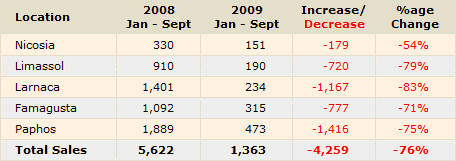
THE DRAMATIC decline in the number of foreigners buying property in Cyprus is reflected in the latest Land Registry figures. These show that during the first nine months of 2009 property sales to non-Cypriots are down 76% compared to the same period last year.

Property developers and real estate agents sold more than 5,600 properties to foreigners during the first nine months of 2008, but sold a mere 1,363 during the first nine months of 2009.

In July the Interior Minister, Neoclis Sylikiotis, sent a reassuring message to property investors: “property investment is much safer in Cyprus than anywhere else,” he said, blaming adverse reports on the Title Deed situation in the foreign media for adding to the property markets’ woes. However it would appear that Minister Syliokotis’ message has done little to gain investor confidence.

The districts of Cyprus suffering most from the drop in foreign demand are Larnaca, where property sales are down 83%, and Limassol, where sales have fallen by 79%. The area least hit by the fall is Nicosia, but even there sales to non-Cypriots have dropped by 54%.

Sales of Property to non-Cypriots (Source: Cyprus Land Registry)

High interest rates are compounding the problem. Although interest rates for housing loans in Cyprus have come down, they are still amongst the highest in the euro area, at 5.53%, according to the European Central Bank.

Unrealistic asking prices are further exacerbating the situation. Even though some developers are offering 30% price reductions, they are finding buyers hard to come by.

The Royal Institute of Chartered Surveyors (RICS) anticipates that total property sales (i.e. sales to both Cypriots and non-Cypriots) this year will be more than 50% lower than any of the years 2001-2008. RICS Cyprus expects the year to end with total sales of around 7,900.

Row brewing over the Cyprus property price index

price-index-methodLAST week we reported on the demise of the BuySell Cyprus Home Price Index. In an announcement on their website MAP S Platis, the organisation that produced the Index on behalf of BuySell, said “In anticipation of an official Index from the Statistical Service of the Republic of Cyprus, the BuySell Home Price Index shall stopped being produced, as of the First quarter of 2009”.

From MAP S Platis’ statement everyone assumed that the Cyprus Statistical Service (CYSTAT) would take on the responsibility of producing the property index. (CYSTAT functions under the Ministry of Finance and is the authority responsible for compiling and publishing most of the official statistical data in Cyprus).

Local banks to produce a property price index

However, the local banks have got in on the act and will also be preparing a Property Price Index for Cyprus; some pundits are extremely concerned over this development.

In an interview with the Financial Mirror George Mouskides, chairman of the Association for the Promotion of Property Developments, said that:

“A Property Price Index is a positive and useful tool. Provided it is accurate, it is a useful statistical tool for all those involved in the property sector. But it is worse to have an unsound PPI than not to have one at all. This is why the banks should approach this particular issue without agendas and ulterior motives if they really want to have positive results.

Moreover, banks should not proceed alone with this. It is essential that the Land Registry be involved, not simply as a partner, but as a protagonist.”

RICS Cyprus jumps on the bandwagon

In the last week we have learnt that the Royal Institute of Chartered Surveyors (RICS) has plans to produce yet another Property Price Index for Cyprus.

RICS Cyprus has commissioned the University of Reading in the UK to produce a methodology for a ‘RICS Cyprus Property Index’; the first in its series of indexes will be presented in January 2010. According to reports, the index will cover the price of homes and offices, shops, warehouses and industrial estates in all districts of Cyprus.

But yet again, concerns have been expressed over this latest development. As a number of RICS Cyprus members are known to have interests in other real estate related businesses (including estate agencies, property construction, banking and property investment) they may be motivated to manipulate the index in their favour. (This was the major concern over the validity of the now defunct BuySell Home Price Index).

Editor’s comment

Although the intentions of the banks and RICS Cyprus may be honourable, questions will always be raised on the independence and validity of any Cyprus Property Price Index they may produce.

Surely the only way to avoid potential conflicts of interests is for the Cyprus Property Price Index to be produced by a competent Government authority with no connections to or interests in the property business or construction industry; i.e. the Cyprus Statistical Service (CYSTAT).

With 146 permanent staff based in Nicosia, Limassol, Larnaca and Paphos, CYSTAT is ideally located to collect property sale data from the Land Registries and already has the necessary infrastructure in place to publish its analysis of that data.

Title Deed problems tarnishing Cyprus says minister

PROPERTY values in the urban centres of Cyprus have fallen by more than 10% as the property slump spreads beyond the prime tourist areas, experts said on Thursday.

The global financial crisis has not only seen holiday home prices plummet but had a knock-on effect on the local housing market, according to the President of the Cyprus Land & Building Developers Association Lakis Tofarides.

The price of a main residence in the centres of Nicosia, Larnaca, Limassol, Paphos and Famagusta has dropped by over 10%,” he told reporters on the sidelines of the 5th real estate conference.

He suggested that now was the best time to buy as the housing market had reached its lowest point while land has retained its value.

Between 2004 to 2007 property prices enjoyed an average annual increase of up to 20%.

The government was also urged to be extra flexible in helping first time buyers in the shape interest-free mortgages and widening the income criteria imposed by the Housing Finance Organisation.

Although the government has pumped €200 million into the organisation to help revive the housing sector, Tofarides said less than 50% of this money was being loaned because of the €40,000/year income limit.

In addressing the conference, Interior Minister Neocles Sylikiotis said the failure to process a 130,000 title deeds snared in the system was tarnishing Cyprus’ reputation among foreign investors.

It is estimated that for every 10,000 title deeds still pending, the state loses a €100 million in lost revenue plus interest.

Another survey suggested that Cyprus ranked 7th among the countries in which UK buyers had shown an interest during August (Spain was top).

Among Russian holiday home investors, Cyprus is ranked 8th with Bulgaria taking top spot.

The average budget among Russians for a Cyprus holiday home is about €240,000 with many buyers preferring Limassol.

Most foreign residential purchases are in Paphos (45%), followed by Limassol and Larnaca (both 20%).

Some 50% of British buyers prefer Paphos while 80% of Germans and 60% of Russians opt for Limassol.

According to the Land Registry Department, property sales have nose-dived 52% in the first eight months.

The end-of-year outlook is unlikely to change with Cyprus suffering its worse slump in over a decade.

Another main concern is the ratio of house prices to incomes widening between 1998 and 2008 thus making homes less affordable.

© 2009 Cyprus Weekly

Golf course at Ayia Napa

0

THE CONSTRUCTION of an 18-hole golf course near Ayia Napa is expected to start next year pending approval from town planning authorities, a spokesman for the joint venture behind the project told The Cyprus Weekly.

The necessary documentation – including an environment impact study – is being prepared by a Swedish firm to be submitted for approval some time in October, said Famagusta Tourism Coordinating Committee marketing officer, Lakis Avraamides.

A joint venture of 36 hoteliers and Paralimni and Ayia Napa municipalities, the project provides for a golf course, club house, management offices and storerooms. There will be no holiday homes.

The key to the project which will be built on land granted by the government is finding the investment to build and operate it. We are in contact with various, Swedish, British and Cypriot companies that have expressed an interest.

We believe that it will not be very difficult to find an investor, although not having a housing complex makes it more difficult. Depending on procedures construction work for the project should start sometime in 2010,” said Avraamides.

The proposed golf course in Ayia Napa Forest is expected to attract high-earning tourists to the resort.

The aim is to attract quality tourists and upgrade tourism in the Ayia Napa and Protaras area and to bring tourists to play golf in the winter months in order to extend the tourism season and solve the chronic problem of seasonality in the area,” said Avraamides.

A proposal for a second golf course in Ayia Napa by a private venture is currently before Cabinet.

The development of a golf course in the Ayia Napa area will be good for tourism and boost the area especially during the winter months, when Cyprus offers good weather compared to northern European countries, during the high golf season, between October and April. This will help alleviate the seasonality problem and attract winter tourism to the island,” Cyprus Tourism Organisation (CTO) golf tourism coordinator Maro Kazepi said.

The government policy is to build up to 14 golf courses on the island. There are currently three.

More than 4 million Europeans are registered golfers in clubs’ members of the European Golf Association.

© 2009 Cyprus Weekly

Concerns over the Cyprus property price index

last-price-indexRecently MAP S. Platis, the organisation that produced the Cyprus Home Price Index, announced that “In anticipation of an official Index from the Statistical Service of the Republic of Cyprus, the BuySell Home Price Index shall stopped being produced, as of the First quarter of 2009”.

But in contrast to MAP S. Platis announcement that an official index would come from the Statistical Service, it appears that the Commercial and Cooperative banks have set up a committee to prepare the index.

Writing in yesterday’s Financial Mirror, George Mouskides, the Chairman of the Association for the Promotion of Property Developments and Manager of Fox Smart Estate Agency, raised his concerns over this latest development:

“During the past few weeks, information has come to the fore according to which the Commercial and Cooperative banks have created a special committee that will prepare a Property Price Index for Cyprus.

We consider this development as very important and with this particular article will try to set out certain conditions and suggestions in order to contribute to matters related to this issue moving in the right direction.

From the start we must clarify that a Property Price Index is a positive and useful tool. Provided it is accurate, it is a useful statistical tool for all those involved in the property sector.

It is worse to have an unsound PPI than not to have one at all. This is why the banks should approach this particular issue without agendas and ulterior motives if they really want to have positive results.

Moreover, banks should not proceed alone with this. It is essential that the Land Registry be involved, not simply as a partner, but as a protagonist.

It is unheard of that the banks prepare the PPI alone because with their recent history, their involvement in the ‘property bubble’ and the global financial crisis, they do not inspire the necessary confidence that they will function fairly and objectively.

The ‘property bubble’ and the global financial crisis began in America, reached Europe and unsurprisingly our island too, mainly because of the banks. The reason was the excessive and uncontrolled lending that resulted in property prices throughout the world booming, and then with the abrupt restriction on loans everything got muddled. Consequently, it is primarily the banks that created the crisis and no one can dispute this.

Therefore, with such information before you, you can only look at new ventures carried out by the banks with a critical eye.

Justifiably, certain questions emerge: will the banks deliberately or involuntarily manipulate the index to their advantage?

In periods when the banks want to grant loans, they will raise the Index and in the event of the opposite they will lower it.

Perhaps every piece of data should be checked and only the government can do that through the Land Registry.

We wish to draw your attention to the preparation and use of a PPI. What is the information they will use in order to prepare the PPI? The banks preparing a PPI must disclose their methodology and data to the public. Such a PPI should reflect the trends of the market and its implications should be understood by all potential users. There should be complete transparency with the data they use and their weight in the PPI. Also, several sub-indices must be compiled, e.g. by type of property and by geographical district the averaging of which should create the general PPI. Sub-indices are usually more helpful for drawing meaningful conclusions.

Therefore, we say yes to the establishment of a PPI but under the right conditions and certainly with the Land Registry at the helm. And why shouldn’t the government proceed with establishing a PPI, an action that no-one will dispute and which won’t be in danger of being manipulated?”

Editor’s comment

Unlike the UK, where members of the public can find prices that were paid for properties in different areas and towns using websites such as Up My Street, such information is not available in Cyprus. (The information used by Up My Street and other UK websites is provided by the UK Land Registry).

In Cyprus, the BuySell Cyprus Home Price Index helped fill that void until the first quarter of this year, although many questioned the validity of the information provided. As the Index was based on a combination of prices at which properties were being offered for sale as well as the actual prices they achieved – and, as agents acting on behalf of those selling property, many felt that BuySell were motivated to report a higher Index than the true reality of the situation.

Last year when questioned by Stockwatch on how it determined property prices, the Central Bank of Cyprus was extremely reticent about revealing the details – saying only that its index was based on “estimates of the value of properties used as a security for the granting of loans by the banks.” (Read the article Cyprus property price confusion ).

Now Mr Mouskides is asking questions about the involvement of the banks in producing a ‘new’ Index. And he is absolutely correct when he says that “every piece of data should be checked and only the government can do that through the Land Registry”.

In my opinion, the banks should have no involvement in producing the new Cyprus Property Price Index. The Land Registry has this information at its fingertips; all contracts for the sale of property pass through their hands. But it seems that the authorities may be either unable or unwilling to release data collected by the Land Registry to the general public.

Cypriot developers must address issues to compete internationally

SPEAKING at the 5th Land Development Conference in Nicosia yesterday, Group Editorial Director of the Overseas Property Professional Magazine, Alex Evans, said that the recession has changed the typical profile of UK buyers of property abroad, driving out the “amateur” speculators in favour of the serious property investor or holiday home buyer.

UK buyers are more cautious. They are looking for higher quality for lower price.

Nowadays, he said, UK buyers are far more cautious, showing low confidence in developers and off-plan deals and preferring “safe” markets. He added that UK buyers have less equity at their disposal, partly due to the weakness of sterling, and so are looking for higher quality for lower price. Spain is now regarded as Europe’s new “bargain” distressed sales destination.

Cypriot developers must address issues to compete internationally.

Evans said that one of the things that Cypriot developers must do to compete in the international property market is to adapt their product to present a regulated and safe purchase process to their target market, addressing issues such as escrow deposits, title-deeds, planning and bank guarantees.

President of the Cyprus Land & Building Developers Association, Lakis Tofarides, told reporters: “The legislation in Cyprus relating to property purchases is very good, and will become even better when the proposed laws are passed”, referring to the five bills designed to help the Title Deeds problem.

On the subject of lower prices, Mr Tofarides said that although property prices have dropped by 10% in urban areas and by 30%-40% in coastal areas, the high cost of land means there is no further room for cutting prices. “Cypriot landowners are not selling their land, whatever form the crisis takes,” he said.

Mr Tofarides warned prospective buyers that in a crisis period they should be careful not to fall into the trap of dealing with a developer who is in financial difficulties. “You should take care to ensure that the sales contract is registered with the Land Registry, you should search for existing mortgages, look out for possible problems”, he said, adding: “Price cannot be the only criterion”.

According to Land Registry figures quoted by one of the conference speakers, the number of registered property transactions fell 32% from the 2007 market peak of 49,191 to 33,232 in 2008. The 2006 total was 40,166.

The number of transactions for the first eight months of 2009 was 11,788; a 52% fall compared to the same period last year.

Sales of property to foreigners have collapsed in 2009

Sales to foreign buyers have fallen dramatically in 2009. Having grown 32 per cent from 9,633 in 2006 to 12,732 in 2007, they fell 32 per cent to 8,600 last year. If the figures for the first eight months of 2009 were annualised, the 2009 total would be 2,220, representing a 74 per cent fall compared to last year.

Speaking yesterday, Cyprus Interior Minister Neoclis Silikiotis said that the government is “making a huge effort to improve legislation and plug gaps that have formed over decades, in order to fashion a more secure situation regarding Title Deeds in Cyprus.” Adding that the target is to have the bills approved by the House of Representatives “before the end of the year”.