Home Blog Page 679

Warnings for Overseas Property Investors

Investors looking to buy a property abroad are being warned to ignore the hype and look out for dodgy paperwork by overseas property experts.

Property Secrets say UK buyers are still making “fundamental mistakes” when investing in a property abroad.

“The perception that a property located near to a beach equals a safe and profitable investment incredibly still prevails,” said Neil Lewis, head of Property Secrets.

“A case in point is Bulgaria, where in the past year there’s a massive oversupply of beach-front property on the Baltic Coast standing empty and unsellable – yet UK investors continue to buy.“This highlights a real lack of strategy. Investors have made their purchases without due care and attention to the coast’s poor rental and resale markets. This then guarantees a limited and totally inflexible exit strategy.”Mr Lewis also warned British property buyers to look at the additional cost and problems with the paperwork involved.

Mr Lewis also warned British property buyers to look at the additional cost and problems with the paperwork involved.“Investors are often left in the dark over the contracts they sign due to inconsistent translation and subjective interpretation. This results in hidden costs, less than air-tight contracts and no control over issues like indexation.”

Over-hyping from property investment companies was also a factor buyers should be wary of, Mr Lewis advised.

“In 2005, we warned against investing along the Bulgarian coast and ski resorts. When there’s as much hype as seen about Bulgaria, my advice would be to show caution and conduct comprehensive research and due diligence before committing.”

Property Secrets top tips when buying homes overseas are to weigh up the “soft” and “hard” factors.

Hard factors include the country’s economy and infrastructure, whereas soft factors are not fact-based, and include the feel of the location, the name and reputation of the development.

“We find that the ‘soft’ factors are the ones most hyped – such as a potential bid for a major sporting event or the perception of a district amongst the local market – and it is this that highlights any gaps in research.“My advice would be to conduct detailed research into the ‘hard’ and ‘soft’ factors that make a good investment great.”

Copyright © 2004-2006 www.AboutProperty.co.uk
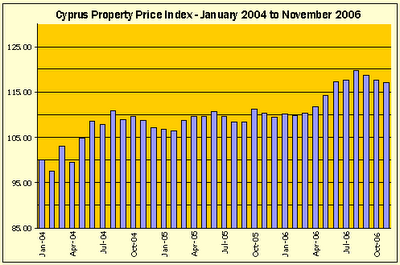
Cyprus Property Prices Fall for Third Successive Month

The Cyprus property price index is published monthly by BuySell Cyprus Real Estate, a real estate advertiser.

The company started to produce its property price index in 2004. It shows the movement of prices at which residential properties in Cyprus are sold and is based on an average of around 400 to 500 home sales/month.

When the index started in January 2004, the average residential property price was CYP 77,910. By the end of November 2006, it had reached CYP 91,203 – an increase of 17.07% over the 35 months since its introduction. This equates to an approximate annual growth of 5.85%.

Since the start of 2006, property prices have increased by 6.25%.

(The graph has been produced using the figures provided on the BuySell website)

Strong Pound and Booming House Prices Help Brits Move Abroad

More than 198,000 British nationals moved overseas last year, bringing the total number of Brits abroad to more than 5.5 million, according to new research from the Institute for Public Policy Research, published today (Monday). The report says that a strong economy at home has encouraged emigration and that very few Britons leave because they think ‘the country has gone to the dogs’.

IPPR’s report shows that almost one in ten Britons now lives abroad and that a British national emigrates every three minutes. The report predicts that another one million Brits will move abroad over the next five years.

The report shows that Britain has more people living abroad than almost any other country. The top 10 countries where Brits live, together accounting for around 75 per cent of all Brits living abroad, are:

Australia 1.3 million, equivalent to 2 per cent of UK population
Spain 760,000
USA 680,000
Canada 600,000
Ireland 290,000
New Zealand
215,000
South Africa 212,000
France 200,000
Germany 115,000
Cyprus 59,000

The report says that Brits living abroad are also more spread out than any other nationals, with more than 10,000 Brits living in 41 countries around the world and another 71 countries with more than 1,000 Brits.The report, which includes results from focus groups with Brits living abroad, identifies the inability to speak the local language as one of the biggest barrier to settling into an overseas community. The report highlights the difference between retired Brits living on the Costa del Sol where less than one out of four speak Spanish, compared to retired Brits in Tuscany where almost three out of four speak Italian. Brits in countries like Spain and Saudi Arabia also tend to flock together, in contrast to countries like Australia and the USA where they tend to be more dispersed across the country.

Greek Cypriot Property + Turkish Held Areas

The change in the Cyprus Government law on people buying property in the Turkish held areas (T.H.A.) is very important and it is worth mentioning it in our articles. The arrest of a Russian couple who have bought a house in the T.H.A. is a point to be noted, since, they stand to go to prison for a period up to 7 years. This does not apply only to the buyers, but also to developers, land buyers etc. The Cyprus Government has its Land Registry recording who the owners were prior to the 1974 invasion and as such it is easily checked. This stand of the Cyprus Government has been supported by the Orams case and it is noted that the British High Court has decided that the purchase done by Orams was quite illegal.

The Orams won (pending the appeal) on the point that the Cyprus Government cannot impose its Courts’ judgement in the U.K. So, the purchase remains illegal and the Orams still have to face the fact of having done an illegal act. This, coupled with the 7 years prison makes the buying of property in the T.H.A. a matter to consider seriously by the would be buyers. Be it very late, this situation is going to get more and more difficult and dangerous for those buyers, because it will be a matter of time when all the (pending) measures take place, a situation which we are not happy with, seeing people arrested when coming to Cyprus through the Governmental airports. To this, the possible pending measure of setting up a monitoring service to monitor those buyers, will cause a lot of upset.

So if anyone wishes to buy in the T.H.A., he must be absolutely sure that the land he buys/house on which the property is erected, belongs either to a foreign person/Co who was the owner prior to 1974 or land which belongs to a T/Cypriot owner prior to 1974.

The association of Estate Agents, Property Valuers and the Technical Chamber of Commerce will undertake shortly an information campaign on the matter, by giving out useful information through a leaflet, which they have prepared and which will be distributed both in the airports and the checkpoints leading to the T.H.A.

Nobody is, of course, happy by arresting people who might have placed their savings/investments in the T.H.A., but as the Russian couple said (“…. yes we knew it was illegal but we decided to go ahead since everybody else is doing it …” is not an excuse). It is a fact that investors/buyers are drawn by the comparatively lower cost of housing units in the T.H.A., as opposed to the Governmental controlled areas (approximately 30% less in the T.H.A.) and it is an evident attraction, but comparison must be made vis-à-vis the risk involved. For this reason we suggest that the Cyprus Government takes an appropriate advertising action by publishing informative articles, adds, etc, in those countries that the T.H.A. are popular (U.K., Israel, Russia) so that unsuspected individuals do not get themselves into trouble. As a projection of the new law, we wonder whether tourists can be arrested also if they reside in hotels which are build on Greek Cypriot land/or Greek Cypriot hotels (difficult to monitor – but worth the effort because people must understand that they take a risk).

Looking at it on the other side, i.e. through the eye of the Greek Cypriot property owners who see their property sold to others, the psychological feeling must be unbearable. We wonder, had Hitler won the Second World War, how the British would have felt if we, the Cypriots, bought property from the German occupiers?

By Antonis Loizou, FRICS
Antonis Loizou & Associates Ltd
Chartered Surveyors
Property Valuers – Project Managers

Copyright © Antonis Loizou & Associates 2006

A Reader’s Disgust

ONE of our readers, Kate Jones, wrote to us saying how disgusted she was on reading the facts of life about the incompetence of some of the lawyers in Cyprus.

We must make it clear from the start that this is not a Cypriot phenomenon but a worldwide one, since there are good and bad in any profession (remember the appendix operation in a London clinic of a young Cypriot man who died because nobody took any notice of him after the operation).

Surely the vast majority of Cypriot lawyers are of an excellent standard, but it takes a limited few to spoil the good name of the rest as well.

Regrettably, the property boom has brought a lot of good and a lot of bad things, with people waiting to get on this golden bandwagon of easy income.

For this reason we can tell you a couple of true stories that we have either experienced ourselves or that have happened to others, which we have double checked.

  • A lawyer drew up contracts using his own payment terms, contrary to the agreement of the buyer-seller. The buyer paid a reservation fee, the seller refused to sign the altered sales contract and now the buyer stands to lose his reservation fee of £5.000.
  • Another lawyer copied a previous contract of his own, which had nothing to do with the new sales agreement and its terms and even the project’s name was different!! The deal fell through.
  • A client of ours bought a home, the seller defaulted and she sued for breach of contract. Her lawyer, however, never appeared in court, the judgement was issued against her and she now stands to lose because of this. When she confronted the lawyer and fired him on the spot, she asked for the legal papers in order to make an appeal through another advocate. However, the original lawyer made her sign a “no claim” statement against him, in order to release the much urgently needed documents.
  • Cash paid to a solicitor to pay the developer, she (the lawyer) did not pay on time and the developer/seller now wants £1,000 interest charges on delayed payments.
  • We have called a certain lawyer several times (eight) in order to remind him that his client had to decide on the type of floor finishes as the house was under development. The same lawyer refused to give us the address or telephone number of the client. The result was that due to the delay in contacting his client, the developer placed tiles other than those the buyer wanted.
  • A contract produced by us was submitted to a solicitor to vet and comment. He claimed from the client fees of £1,500 without a single comment.
  • A lawyer wanted the whole project to be free of any mortgage prior to “letting her client sign” to buy an apartment in a 30-unit project (completed). It took a lot of persuasion to explain that the bank will give a mortgage release for the particular unit and that it is impossible worldwide to have a development project without a mortgage, but due care and protection can be offered to individual buyers. She told us that developers in Paphos develop projects on non-mortgaged land. What a joke!!
  • A lawyer asked the developer to provide a bank guarantee for the title issue. The developer agreed, subject to a reciprocal bank guarantee guaranteeing the buyer’s payment terms. The lawyer insisted otherwise and the deal fell through.

We can go on and on and what we can suggest to our readers is to apply to the Disciplinary Council of the Cyprus Lawyers Bar Association, but because some people might think that the Council, which comprises of lawyers, might not be independent, in order to get a fair decision, we can suggest to apply to the Oubudsman as an alternative.

We wish we had a list of reliable lawyers to provide to our readers. Surely after 30 years in property in Cyprus we do know the good and the bad (at least we know the good) but this will get us into a lot of trouble. For this reason it is our suggestion that perhaps the British Association of Cyprus Residents could create a list of recommended solicitors and other professionals, based on the experiences of its members.

It is a difficult situation, but at least this could be a start in order to correct a situation which, although not found on a wide scale, it is large enough to spoil the business (and Cyprus’ name) of others, as well as to protect the thousands of good quality and top standard correct legal professionals.

By Loizou – Antonis Loizou & Associates Limited

Property Nightmare

Last November, whilst on holiday in Cyprus, my husband and I decided to look for property with the view of moving to Cyprus. We went to a well-known real estate agent in Protaras and spoke to a gentleman there.

Before we knew it, we were having a bungalow built in Avgorou, and were choosing tiles, bathroom suite, kitchen units etc. On the same day, the estate agent took us to a law firm in Paralimni to sign the contract.

We were bewildered by the way everything had happened so quickly and there was no way turning back. We were very foolish and naive, but at the time everything seemed OK. We returned to Scotland and quickly put our home up for sale, as this was the only way we could afford buying in Cyprus.

We got a place to rent in Cyprus from the estate agent until July 2006, when we were assured the bungalow would be completed and ready for delivery to us.

In May, my husband asked for a loft to be made and this was agreed to by the developer. What a shock we got when he actually made a roof-garden for a loft, and on top of that even charged £2,000 extra,

According to the contract, if the property is not ready by the delivery date, the developer is allowed a 30-day grace period. Towards the end of August I went to the developer’s office and he assured us that the bungalow was ready to move into there and then. When we got there we found there was no water or electricity, it was filthy, it was not painted on the outside, and there was no access to the unwanted roof garden. When we asked him about that, he said he would want an extra £500 or so to make a staircase. Next I noticed there was no air-conditioning or heating.

When asked, he said he wanted a further £900 for it!

When we inquired about cancelling the contract, we were told that it was too late.

We went to a different lawyer who told us that it was a mistake on our side to have had the sale contract drawn up by the lawyers of the estate agency. We were also told that because of this, no other lawyer could act for us.

It is as if nobody wants to hear our plight in this matter. Amidst it all, my husband and I split up, due to the strain, both mentally and financially.

I am appealing for help as I just don’t know what to do or where to turn anymore.

Daphne MacLean,
Paralimni

Copyright © Cyprus Weekly 2006