

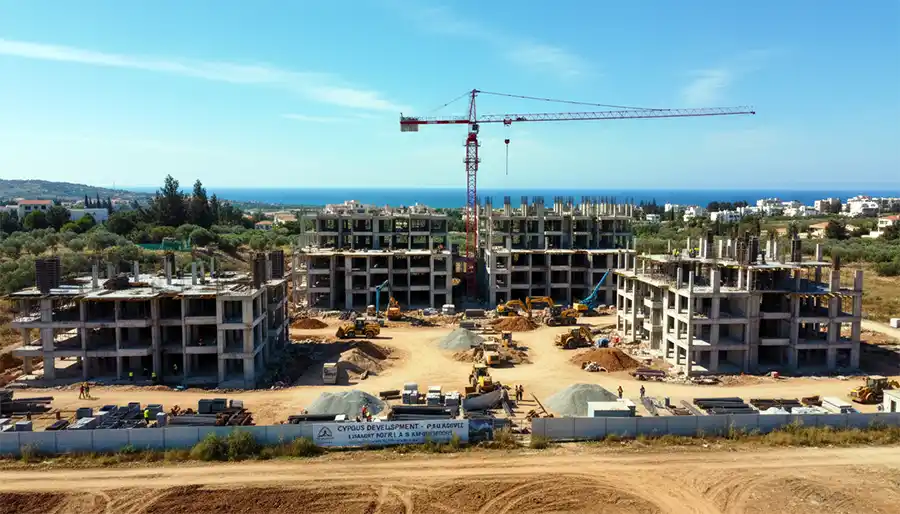
Cyprus’ property market suffered a sharp fall in the second quarter, but the figures do not point to a complete freeze. Sales of new-build apartments and houses fell by 42.2% compared with the first quarter. Their total value dropped by 46.6%.
Yet an analysis by Landbank Analytics, obtained by Kathimerini, suggests that buyers did not simply disappear. Instead, demand shifted towards lower- and mid-priced homes, while Nicosia gained ground and several local markets proved more resilient.
The luxury end of the market also remained active, with high-value sales recorded in areas such as Germasogeia and Pegeia.
Sales fall sharply in the second quarter
The number of contracts of sale fell to 1,317 in the second quarter, from 2,277 in the first three months of the year.
Their combined value dropped from €748.6 million to €400.1 million. That means 960 fewer contracts were recorded over the period.
The average value of each contract fell by 7.6%, from €328,762 to €303,808. The median value also declined, falling 6.3% from €240,000 to €224,850.
The lowest recorded sale rose from €42,000 to €55,000. At the other end of the market, the highest transaction fell from €13 million to €4.69 million.
Apartments saw their average value fall by 5.5% to €262,574. Their median value declined by 7.3% to €204,000.
Houses recorded a larger fall. Their average value dropped by 12.7% to €501,800, while the median fell by 10.5% to €340,000.
Buyers turn towards more affordable homes
The biggest change came in the lower price brackets.
Homes priced below €300,000 accounted for 68.1% of all new-build apartment and house sales in the second quarter. That was up 5.5 percentage points from the first quarter.
The €300,000 to €499,999 bracket moved in the opposite direction. Its share fell from 27.1% to 23.1%.
The strongest gain was recorded among properties priced between €150,000 and €199,999. Their share rose from 21% to 24.8%.
Homes priced between €200,000 and €299,999 also increased their share, from 27.1% to 28.2%. Properties below €150,000 recorded a smaller rise.
The figures suggest that affordability became a bigger factor in the market during the quarter.
Nicosia emerges as a stronger market
Nicosia was one of the clearest bright spots in the second quarter.
The capital’s share of all new-build apartment and house contracts rose from 26.7% to 34.5%. Its share of total transaction value increased even more, from 17.1% to 26.2%.
Average transaction value in Nicosia rose by 9.3%. The median value remained unchanged at €185,000.
Limassol remained the leading district by total sales value. However, its share fell from 40.8% to 32.4%.
Larnaca was more stable, with a median transaction value of €190,000 and a slight rise in its share of total value.
Paphos continued to have the highest median value among the districts, at €352,500. Its overall market share, however, edged lower.
Limassol leads the busiest local markets
Looking at individual areas, Limassol recorded the highest number of deposited contracts in the second quarter, with 129 transactions.
Aradippou followed with 122, while Lakatamia ranked third with 92. Paphos recorded 79 transactions.
Strovolos and Larnaca each recorded 71 transactions. Livadia and Latsia completed the top eight.
However, transaction numbers alone do not show which markets performed best during the downturn.
Lakatamia recorded the smallest fall among the busiest areas, with transactions down by 14.8%. Aradippou followed, with a 17.6% decline, while Latsia recorded a 24% fall.
That compares with a 42.2% decline across the wider market.
The figures point to a clear difference between areas. Price levels, location, property type and the balance between supply and demand may all help explain why some markets have held up better.
Some areas actually recorded growth
A small number of local markets managed to increase sales during the quarter.
Agios Dometios was one of the strongest performers. Sales of new-build apartments and houses rose by 22.6%, while the median value increased by 7.7% to €154,000.
Dali also recorded growth. Transactions rose by 15.8%, from 19 to 22, while the median value increased by 8.1% to €194,500.
The Municipality of Nicosia saw almost no change in the number of contracts, with a decline of just 4.4%. However, total transaction value rose by 31.3%.
Average transaction value in the municipality jumped by 37.4%.
Ypsonas was another relatively resilient market, with transaction numbers falling by just 9.1%.
Luxury property market remains active
The fall in overall sales did not prevent strong activity at the top end of the market.
Germasogeia recorded 43 transactions worth a combined €27.6 million in the second quarter. Its average transaction value reached €640,970, while the median stood at €400,000.
Across the first half of the year, Germasogeia recorded 132 transactions worth €89.1 million. The median transaction value was €472,500.
Potamos Germasogeias recorded even higher values. Its median transaction value reached €600,000 in the second quarter, while the average rose to €838,783.
Pegeia recorded the highest median value among areas with at least 10 transactions. Its median reached €855,000, while its average transaction value topped €1 million.
The figures show that the luxury market has not moved in line with the wider slowdown.
A market reshaped rather than frozen
The second-quarter figures paint a more complex picture than a simple market downturn.
Overall sales and values fell sharply. But demand has also shifted towards properties that are more affordable, while some districts have retained a much larger share of their activity.
Nicosia has gained market share, several areas have shown resilience and a number of local markets have even recorded higher sales.
At the same time, premium locations continue to attract buyers willing to spend large sums.
“The true appeal of an area is determined by a combination of sales volume, resilience, median value, and the types of homes it offers,” said Andreas Christoforides, Founder & CEO of Landbank Group.
For Cyprus’ property market, the second quarter therefore looks less like a broad collapse in demand and more like a period of adjustment. Buyers appear to be changing what they buy and where they buy it, with affordability playing a greater role in the market.
(Translated from an article in Kathimerini)
