

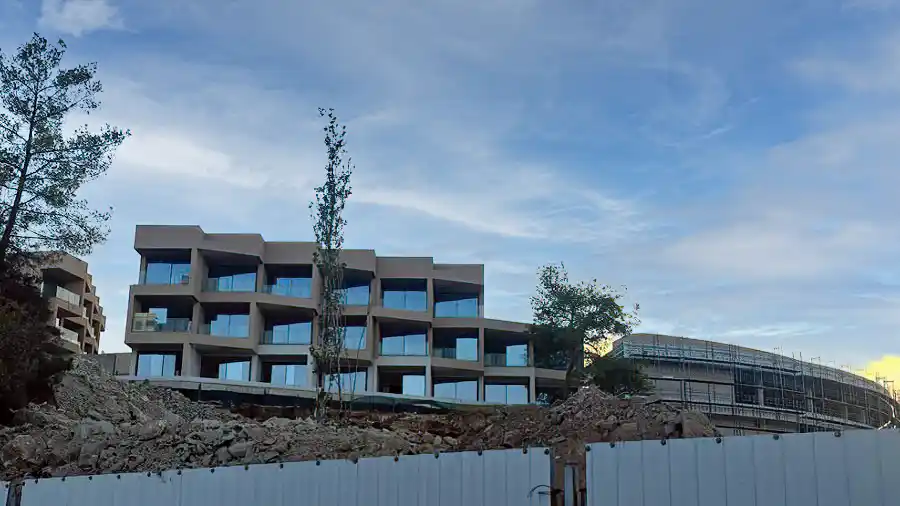
Three different Israeli-linked developments have made headlines in Cyprus in recent months. Each has raised questions about planning or environmental approvals, site selection and the impact of development on the surrounding area.
In Latchi, a major hotel complex reached the final stages of completion while key licensing issues were still unresolved. In Trozena, an almost deserted village in Limassol district became the focus of an ambitious revival plan backed by an Israeli-linked investor. The project had already made significant progress when authorities found that the required permits had not been secured.
In Polemidia, meanwhile, plans for a Jewish school for up to 1,500 pupils are being advanced in an area already facing serious traffic and planning pressures. The local municipality has complained that it was not even asked for its views on the development, while earthworks had already begun on the site.
Taken together, the three cases could be seen as examples of a familiar problem in Cyprus: development moving faster than the planning system.
Build first, ask for permission later
The hotel development at the former Elia Latchi/Zening Hotel Eco Resort was the subject of an investigation by Kathimerini. It found that construction had progressed, and in some areas was completed, despite delays and outstanding building and planning permits.
The investigation also highlighted unauthorised additions, including a third floor and other facilities. Instructions to stop work and demolish unapproved additions were reportedly ignored. Subsequent decisions and administrative handling effectively allowed the owner to regularise or legalise the deviations.
The case was particularly striking because Iraklis Achniotis, former director of Licensing at the Paphos District Local Government Organisation, reportedly refused for months to sign off the building permit despite pressure to bring the matter to a close.
His position was based on the fact that the owner had continued construction and completed the hotel while breaching the planning framework. Significant unauthorised structures and other irregularities on the site were still outstanding.
That raises a basic question for any planning system: what is the value of a permit if a developer can build first and resolve the paperwork later?
Trozena: regeneration versus environmental protection
The Trozena project presents a more complex picture.
The village was abandoned decades ago. The investment plan includes 60 homes based on the restoration of old properties, tourism facilities, a camping site and a winery.
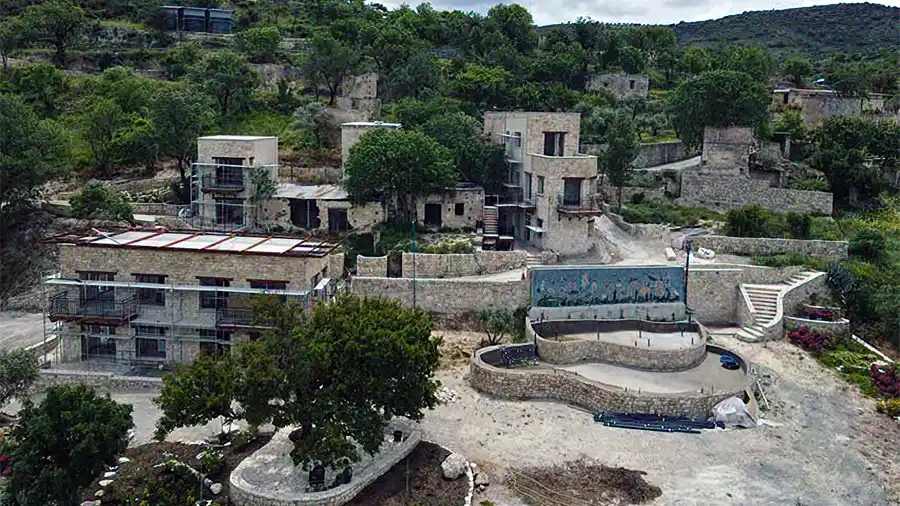
Earthworks and other interventions were carried out in the area, along with extensive heavy construction work, while planning applications were still under review. The Department of Environment and the Limassol District Local Government Organisation subsequently called for an overall master plan and for work requiring permission to be suspended.
The issue is even more sensitive because the area is linked to the Natura 2000 network.
Environmental groups have alleged land filling, tree cutting and work affecting a riverbed. They have also raised the possibility that the interventions may be linked to the drying up of the well-known Trozena waterfalls.
That last claim remains an allegation rather than an established causal link. But this is precisely why the sequence matters. Environmental assessment is meant to come before intervention, not to explain afterwards how the consequences of work already carried out should be managed.
There is also a strong argument in favour of the investment from local stakeholders. They say it could bring economic activity and infrastructure back to a place that has been abandoned, while helping a wider area that has suffered from decline.
That argument cannot simply be dismissed. But it does not answer the central question: why should construction come before the necessary permits and rules?
Polemidia school raises planning concerns
The Polemidia project is one of the largest private education investments in Cyprus in recent years.
Originally presented as the Cyprus Jewish Academy of Excellence and now promoted by the Yael Foundation as Yael Private School of Limassol, the project is worth more than €50 million. It is planned for up to 1,500 pupils and is intended to open in 2027.
The project is led by Rabbi Yehoshua Smukler, an educator with extensive experience running Jewish schools and a long professional career in Australia. He has described the new school as a future “cornerstone” of Cyprus’ Jewish community, arguing that it will make the island even more attractive as a place to live for members of the community.

Smukler has spoken of a small but rapidly growing Jewish community in Cyprus, which he estimated at about 4,000 families. The vision is for the school to become more than an educational institution. It is intended to be a focal point for Jewish life on the island.
Here, the objections have mainly been about planning, location and infrastructure.
The Polemidia municipality has raised concerns that such a large development will add to traffic congestion and put further pressure on local infrastructure. It has also complained that the project was decided without consultation with the municipality.
“Instead,” municipal secretary Yiannakis Kallikas told StockWatch on 15 May 2025, “the company has fenced off the site and earthworks have begun.”
The statement inevitably brings the issue back to licensing, where an interesting contradiction emerges.
In February 2025, Israeli media were already presenting the project as a confirmed development. Journalists were shown around the site and heavy machinery was already operating there.
Yet on 7 February 2025, the Ministry of Education said that no application had yet been submitted to establish the school.
The ministry also made clear that Cyprus law does not permit an exclusively religious school in the sense of requiring pupils to follow specific religious teaching. The statement came in response to the way the project had been presented by its own promoters.
By May 2025, the picture had changed. Reports said the architectural plans and application to the Ministry of Education were being completed, while sources close to the foundation viewed the ministry’s position as positive.
The outstanding approval matters because no private school can operate in Cyprus without the approval of the Minister of Education. Among other requirements, this includes planning and building permits for use of the premises as a school, a final approval certificate, suitability and fire-safety certificates, and approval of the educational programme.
In October 2025, the Ministry of Finance included the Cyprus Jewish Academy of Excellence on its list of major investment projects under way or being planned in Cyprus.
The project appeared in the ministry’s Macroeconomic Outlook presentation under “Major investment projects”. Its timetable stated that the architectural plans and the application for approval of the private school by the Ministry of Education were being completed.
In other words, as late as October 2025, the Ministry of Finance was still describing the school’s licensing application as a process nearing completion.
There has been no publicly identified announcement confirming that the Ministry of Education’s licensing process for Yael Private School has since been completed.
What can be confirmed is that, on 10 July 2026, the business name “YAEL PRIVATE SCHOOL PRIMARY” was registered with the Registrar of Companies. Its registered address is 1 Filias Street, Polemidia, and its owner is THE PRIVATE SCHOOL YAEL LTD.
That registration is a commercial-name registration. It is not, by itself, an operating licence for a private school from the Ministry of Education.
There is another detail that raises questions. According to the Polemidia municipal secretary, the municipality had previously sought to create a sports centre on the site but was unable to secure permission for such a project.
Is there a question of “soft settlement”?
The three cases could, in isolation, be viewed as episodes of the familiar Cypriot disorder in planning and other areas of public administration.
But they have emerged at a time when the growing Israeli presence in Cyprus, particularly in property and major developments, has triggered a wider social and political debate.
That presence is becoming more visible and, above all, more permanent. New infrastructure is being created to serve a community that is not simply investing or holidaying on the island, but is increasingly establishing and organising parts of its life here.
This debate cannot be ignored. Nor should it slide into easy generalisations.
It is in this context that references to “Israeli penetration” and even “soft settlement” have begun to appear. Such descriptions should not be adopted without careful evidence.
The risk of exaggeration is especially high while the conflict in the Middle East continues to make public debate politically and emotionally charged.
It would be wrong to demonise the Israeli presence. It would also be wrong to dismiss every concern as prejudice, xenophobia or, more seriously, antisemitism.
There are legitimate issues beneath the public unease: rapidly growing economic and social activity, strong demand for property at a time of housing pressure, foreign ownership of land and developments that raise questions about whether investors receive preferential treatment.
Those issues are sufficient to justify serious political debate.
Cyprus and Israel: the bigger property question
Israeli presence in Cyprus has clearly increased in recent years. So too has concern that the change is no longer limited to isolated voices.
The property market is perhaps the most visible sign.
Israeli buyers are among the most important groups of foreign purchasers, particularly in Larnaca, Limassol and Paphos. This is happening while affordable housing is becoming increasingly difficult for Cypriots to access.
That does not mean foreign demand is the only cause of rising prices. It is not.
But the debate becomes more serious when it turns to how much land is changing hands, which strategic areas are being acquired and which parts of the country are becoming concentrated in foreign ownership.
At the same time, the creation of businesses and facilities serving a growing Israeli and Jewish community reinforces the impression of a presence that is no longer simply investment or tourism.
It is taking on elements of settlement and permanence.
That has prompted concerns about changes to the character of some areas and the emergence of more closed communities. Those concerns deserve scrutiny, without assuming that the outcome is necessarily negative.
Larnaca may be the clearest example of this change.
For decades, the city felt it was lagging behind Limassol and Paphos. It has now attracted greater investment, more construction, new businesses and a much stronger international presence.
Israeli demand has contributed to that transformation. Its positive effect on the local economy cannot be ignored.
But success also creates pressure.
When demand for property rises much faster than supply, prices follow. When new families settle permanently, they naturally create demand for schools, places of worship, businesses and community facilities.
The result is not necessarily negative. But it is a real social change, and social change cannot be left entirely to market forces.
The state’s responsibility
Ultimately, the greatest responsibility lies with the state.
Cyprus has learned to measure the success of investment in millions of euros, companies, tourists and jobs. It is less clear that it has learned to measure it with the same care in square metres of land, ownership concentration, pressure on housing costs, strain on infrastructure and changes to the character of particular communities.
An investment can be good for GDP while making housing less affordable.
It can increase the value of an existing property while putting it further out of reach for a younger buyer. It can create jobs while placing new pressure on local infrastructure.
There is no contradiction in that. There are different interests that the state must balance.
Cyprus needs foreign capital, businesses, expertise and people who will settle here and create economic activity.
But an open economy does not mean an unprotected state. Nor does a business-friendly investment climate mean flexible rules that change according to the size or nationality of the investor.
The test should be simple and consistent: the same planning, environmental and licensing rules must apply to everyone.
If society begins to believe that the strategic importance of the Nicosia-Tel Aviv relationship means tolerance, exceptions or a “come one, come all” approach to regulation, the damage could be serious.
It would not only weaken confidence in Cyprus’ planning system. It could also undermine public support for a bilateral relationship that Cyprus has every interest in keeping strong.
The real issue, therefore, is not whether Israeli investment is good or bad.
It is whether Cyprus has a planning and regulatory system strong enough to manage major investment fairly, transparently and in the public interest – whoever the investor may be.
(Translated from an article first published in Kathimerini)
