Concerns are growing over a possible resurgence of discussions around investor citizenship schemes, following the eagerly awaited ruling on Malta’s controversial “golden passport” programme.
The outcome could reignite interest in reinstating such programmes across EU states, including Cyprus, which scrapped its scheme under international pressure.
Malta’s citizenship-by-investment programme is under intense scrutiny, with the Court of Justice of the European Union (CJEU) expected to rule this week on its legality. According to the Financial Times, a ruling in Malta’s favour could open the door to renewed debates about investor naturalisation schemes, even in countries like Cyprus that had previously abandoned them.
Malta’s golden passport programme on trial
The Financial Times (FT) reports that Russian businessmen, later subject to sanctions over links to the war in Ukraine, acquired Maltese passports through the scheme, allowing them to circumvent travel bans. One Russian businessman reportedly obtained Maltese citizenship in 2015 and has since appeared on the EU sanctions list due to his business activities, which the Union claims generate significant revenue for the Russian government.
In total, seven individuals who gained Maltese nationality via the programme later found themselves subject to EU, US, or Ukrainian sanctions. The investigation further reveals that 16 politically exposed persons (PEPs) or individuals facing criminal charges also obtained Maltese citizenship.
Among the recipients were members of the Saudi royal family, although no allegations of corruption have been levelled against them.
EU reaction
The European Commission has taken Malta to the CJEU, arguing that the sale of citizenship undermines “the essence and integrity of EU citizenship.” The Commission maintains that “EU values are not for sale” and has called for an end to such practices.
The CJEU is expected to deliver its decision on Tuesday, a ruling seen as pivotal for the future of similar initiatives across Europe.
The Cyprus connection
The Financial Times also recalls Cyprus’ investor citizenship programme, which was “definitively and irrevocably terminated” in 2020 after international backlash and revelations of widespread abuse. The scheme had drawn significant concern over potential corruption risks and had been placed under the European Commission’s microscope.
According to the FT, a legal victory for Malta could encourage discussions in countries like Cyprus about whether such programmes could be revived under new legal frameworks.
Experts such as Eka Rostomashvili from Transparency International warn that a favourable ruling could trigger a “race to the bottom” in terms of vetting standards and transparency.
The FT notes that other European nations, including Portugal and Spain, have limited their offerings to residency permits rather than full citizenship.
They further highlight that Malta’s scheme remains the last active golden passport programme in the European Union.
Cyprus rose from the sea millions of years ago and would only be inhabited long after its geological formation. The geological processes that shaped the island created areas of solid ground in some parts, while other regions were composed of unstable rocks, unable to support buildings or withstand natural forces.
One of the most geologically “sensitive” areas is the Paphos district. Its story reads like a fairy tale – but it’s based firmly on the rigorous research of the Cyprus Geological Survey Department, which has studied the island’s geology in depth over decades.
According to their findings, much of the Paphos region is covered by displaced and metamorphosed rocks dating from the Triassic to the Cretaceous periods. In simple terms, Paphos stands on a geological foundation that dates back around 70 million years. These rocks, known as the “Mamonia Complex“, were transported to their current position from areas south of Cyprus, and can trace their origins back to Africa.
Interestingly, the famous “Petra tou Romiou” (Aphrodite’s Rock) and the lava formations exposed along the cliffs of its namesake bay are in fact exotic rocks belonging to the Mamonia Complex.
Even the brightly coloured stones used in the mosaics of Kourion and Paphos were sourced from the erosion of these multicoloured Mamonia rocks. However, the complex geology of the area – together with the nearby Kannaviou Formation – has led to problems with landslides across parts of the district.
The geological history of Paphos tells us that the Mamonia rocks were deposited during the thrusting of African plate rocks over the advancing edge of the Troodos ophiolite complex as Africa moved northwards beneath the Eurasian plate some 70 million years ago, during the Maastrichtian stage.
Fast forward millions of years, and unaware of the geological risks, the people of Paphos built homes and villages on these unstable foundations. Over time, several communities, including Pentalia, Choletria, Melamiou, Agios Fotios, Statos, Fasoula, Foinikas, Korphi, and Kivides, had to relocate to more stable ground.
One of these was Theletra. In a somewhat “informal arrangement” with the government, the villagers cited instability to justify their relocation – though the real reasons seem to have been a lack of space for expansion and the Cyprus Electricity Authority’s inability to fully electrify the area.
A visit to old Theletra: a village frozen in time
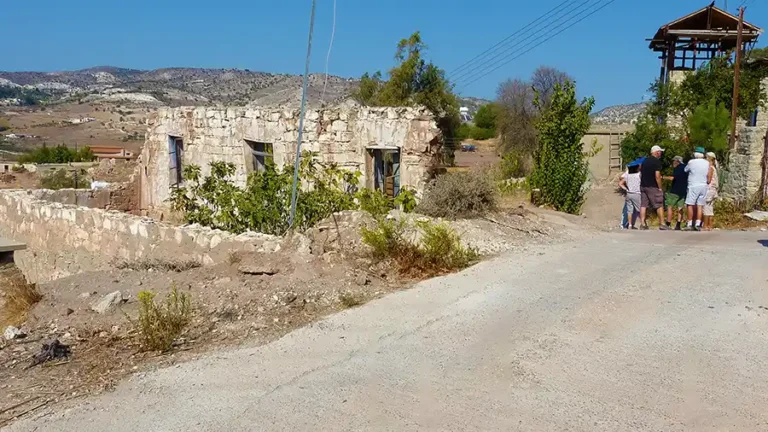
We recently visited the abandoned village of Old Theletra. Leaving the main Paphos-Polis road, one approaches the village where some farmland and a few structures mask the sense of abandonment.
The abandoned village of Theletria
On the outskirts, large boulders the size of barrels – and larger – litter the roadside. At the entrance to the village, two forlorn construction columns point skyward, while next to them a partly concrete-block-built stone house stands precariously. Across the road, homes sit atop retaining walls.
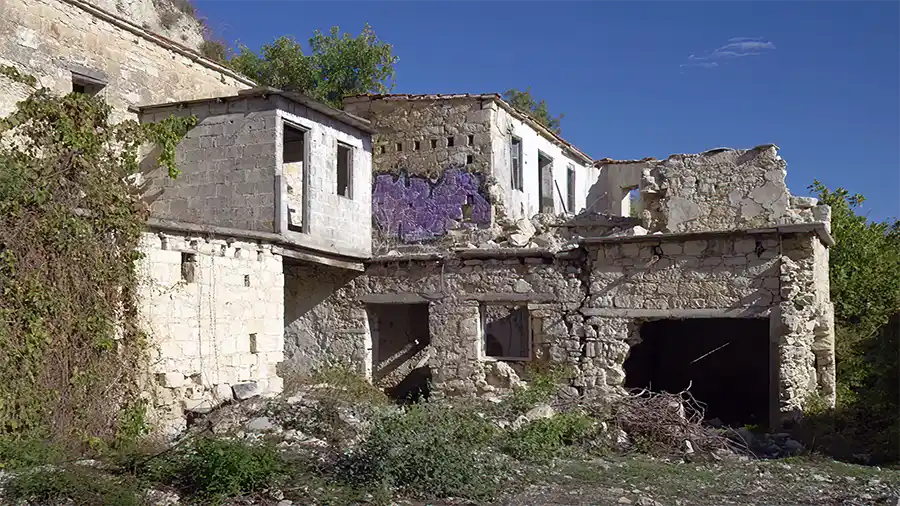
Electricity poles and overhead lines remain in place, though nature has reclaimed much of the village. Many houses are roofless, missing doors and windows, with obvious signs of decay and decades without maintenance. A large patch of reeds has overtaken an area just outside the village, and a beautiful stone arch hides behind a prickly pear tree.
On higher ground, other stone houses resemble what Odysseas Elytis might have described as “beautiful ruins”. Further down the village’s central path, there are more series of arches, amid dense wild vegetation.
Walking further, we found the old road leading to the abandoned church, a date scribbled on a crumbling wall, and even graffiti adorning a few surfaces – signs that despite its abandonment, people still pass through.
Interestingly, among the ruins, a few homes appear to have been renovated and are possibly used as holiday homes, judging by the occasional car parked outside. A worn cement fountain bearing the emblem of the Republic of Cyprus stands proudly among the decay.
On the left side of the village, towering hills remind visitors of the constant threat of landslides that once loomed over the community.
According to the village’s official website, during the presidency of Archbishop Makarios III, the Republic of Cyprus decided to relocate the village. Officially, the reason was the danger of landslides and earthquakes, given the steep hillside on which Old Theletra sat.
When Makarios visited by helicopter and saw the village clinging precariously to the mountainside, he reportedly described it as resembling “pigeon nests”.
New Theletra: a community reborn
Land was expropriated for the relocation, with the government covering around 70% of the costs and residents paying the remaining 30% in instalments. Thus, New Theletra was born.
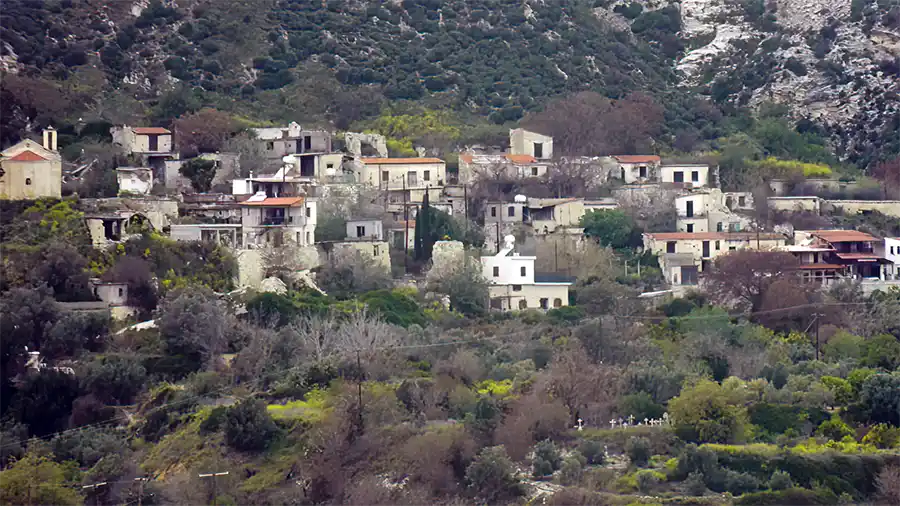
Efforts to move began in 1968–69, and by 1980, the villagers were resettled atop the hill, in a new amphitheatrically built settlement offering stunning east-facing views toward the Paphos Forest and the Troodos Mountains. A new church, dedicated to Panagia Chryseleousa, now crowns the community.
Photo credit Philenews: ‘New’ Theletria village, Paphos
Although the old properties remained under the ownership of the villagers, the new plots were officially compensated at prices between 25 to 50 Cyprus pounds of the time.
When asked whether Old Theletra was truly at risk, a former village leader said that during past earthquakes, “not even a pebble fell”, suggesting that the threat might have been exaggerated.
In recent years, there have been efforts to restore some of the old houses, with hopes that people might return or repurpose the buildings. Around half of the 200 houses were deemed salvageable, most built side by side in traditional stone masonry, which helped them survive.
However, building regulations now make any new extensions impossible, as the old village has a zero-development coefficient.
In the past, companies showed interest in developing Old Theletra for agritourism, but negotiations with private owners stalled. Nevertheless, if restoration efforts had succeeded, Old Theletra might have become a unique attraction.
Even today, despite its dereliction and narrow streets that fit only one car, the village retains a timeless charm – a place where, as a 1970s visitor once put it, “they live hidden away from God”.
The Geological Survey Department mapped the region, recording over 2,000 landslides – some dating back centuries. This mapping aimed to ensure future construction would be safer, as many owners had found their newly built homes developing cracks within months.
The clay (including montmorillonite) found in some areas can expand up to nine times when wet and then shrink dramatically during dry spells, damaging both buildings and roads.
While some damage stems from poor foundations, in many cases, the soil conditions themselves are to blame. In such areas, “white zones” are declared, where construction is prohibited.
Affected communities include Episkopi Paphos, Choletria, Nata, Armou, Marathounta, Fyti, Lasa, Agios Dimitrianos, Kritou Marottou, Mamonia, Statos, Pentalia, Koilinia, and more. In western Paphos, Arodes and Droushia also suffer, while in central Paphos, Stavrokonnou, Episkopi, Filousa, and Salamiou face similar challenges.
Further north, Drinia, Peristerona (Paphos), and Makounta also bear the scars of an unstable underground.
(Translated and summarised from the Greek article in Philenews)
Cyprus’ property market has hit the ground running in 2025, with property transfers worth an impressive €1.1 billion completed nationwide and 4,137 sale contracts filed during the first quarter alone.
The start of the year has seen strong performance, with a notable 15% year-on-year increase in the number of sale contracts filed across the Republic.
According to data from the Department of Lands and Surveys, the total number of sale contracts rose to 4,137 compared to 3,597 in the first quarter of 2024.
While the overall volume of property transfers dipped slightly by 2.9%, the total value climbed sharply, reflecting a significant 15% rise that pushed annual transaction values beyond €1.1 billion.
A positive outlook
Marinos Kineyirou MRICS, President of the Council for the Registration of Estate Agents, commented:
“There is no doubt that 2025 has made a positive start for the property market. The outlook remains encouraging, with demand still running high and supply increasingly meeting market needs. Factors such as potential further interest rate cuts by the European Central Bank could stimulate even more buyer activity. On the other hand, risks remain — particularly in the housing sector — with the ongoing trade war and the potential for rising construction costs likely to pose challenges.”
A closer look at the districts
Limassol: retaining its crown
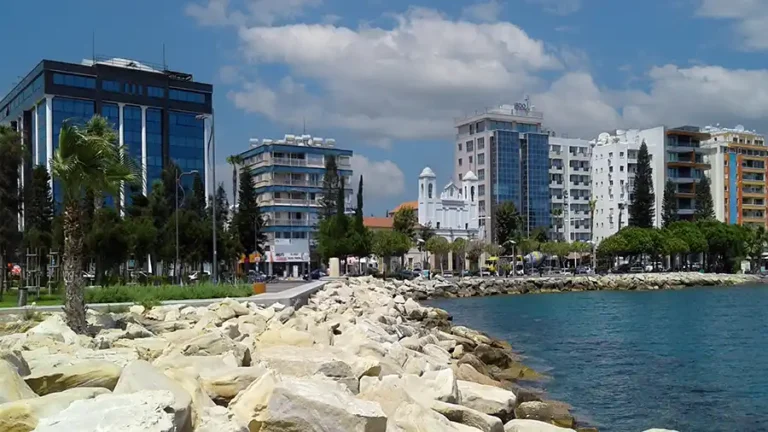
Limassol continues to reign supreme, leading both in transaction value and volume of sale contracts.
The district recorded the highest transaction value at €428.7 million and topped the charts with 1,295 sale contracts filed.
With 1,203 property transfers completed, the figures highlight the district’s vibrant investment activity and the strong demand for both resale and newly built properties.
Nicosia: consistent and steady
Nicosia maintained a strong and stable market presence, achieving 1,304 property transfers worth €283.5 million, and 932 sale contracts filed during the first quarter.
This steady interest, particularly in new developments, confirms the capital’s enduring appeal.
Paphos: building on momentum
Paphos continues to thrive, building on its success in recent years.
During the first quarter of 2025, the district recorded 811 transfers worth €199 million, and 829 sale contracts filed.
Strong demand, especially from international buyers, underscores the district’s ongoing vitality in both residential and investment sectors.
Larnaca: a market on the rise
Larnaca is emerging as a dynamic force in the market, registering 843 property transfers valued at €154 million, and 910 sale contracts filed — a clear sign of growing demand.
Ongoing investment projects within the district are expected to fuel further market expansion in the months ahead.
Famagusta: quiet growth with potential
Although Famagusta reported the lowest figures in terms of transaction value (€48 million) and volume (251 transfers) compared to other districts, the signs are far from discouraging.
With 171 sale contracts filed during the first quarter, the district is experiencing a steady rise in interest, likely driven by comparatively lower property prices and promising development prospects, particularly linked to its strong tourism profile.
Conclusion
The property market in Cyprus has made an undeniably strong start in 2025, with momentum evident across all districts.
With buyer demand remaining robust and positive market fundamentals in place, the outlook for the remainder of the year appears bright — offering exciting opportunities for investors and homebuyers alike.
(Translated and summarised from the Greek article in Economy Today)
The Chairman of the Parliamentary Legal Affairs Committee, Nicos Tornaritis, has hit out at vulture funds for refusing to suspend property repossessions ahead of new legislation aimed at protecting “trapped buyers.”
In a strongly worded letter to the head of the Association of Credit Acquiring and Credit Servicing Companies (ACACS), Mr Tornaritis urged firms to freeze auctions, sales and repossessions until the law is finalised. The intervention follows a recent Court of Appeal ruling, which ruled that existing legal protections were unconstitutional.
In his letter Mr Tornaritis also points out that pressure is on the Committee to find a solution within tight deadlines, “following actions by credit institutions, despite earlier commitments made during the passing of the original legislation.” He further reminds that “the issue under consideration is complex and requires careful and thorough study.”
He goes on to say that “the Parliamentary Committee on Legal Affairs, Justice and Public Order is already at the final stage of drafting legislation to resolve the problem faced by trapped buyers, with the proposal expected to be submitted and debated shortly.”
Mr Tornaritis urged ACACS members to halt all repossessions, auctions, and property sales until at least the end of July, when debates are expected to conclude, and expressed hope that the Association would comply.
Background
Non-performing loans and Vulture Funds
To address their high levels of non-performing loans (NPLs), Cyprus banks sold much of this distressed debt to Vulture Funds.
Vulture Funds specialize in purchasing non-performing loans at a steep discount – believed to be between 15% and 20% of their original value.
This helped Cyprus banks reduce NPL ratios from 49% in May 2016 to a record low of 6.8% in August 2024. While this was a success for the banks, the consequences for buyers have been severe. These distressed debts included the underlying non-performing loans on properties purchased by trapped buyers.
Vulture Funds use aggressive tactics to recover more than they paid for these loans, including legal action, demanding repayments, and seizing assets like real estate.
Debt-free trapped buyers targeted by Vulture Funds
Even buyers who are debt free are being pursued by Vulture Funds. These funds are demanding additional payments, despite buyers having paid in full for their properties.
In one case, a Vulture Fund demanded over €20,000 from a trapped buyer.
In another, a trapped buyer was asked to pay €5,000.
These Vulture Funds also demand proof that payments were made directly into the developer’s bank account, even though developers ceased trading over 15 years ago and the records demanded are no longer available.
Property development and construction remain one of the most vital pillars of the Cypriot economy, contributing close to 15% of GDP and employing over 40,000 people. This sector plays a substantial role in the country’s development journey.
In an interview with InBusinessNews, Yiannis Misirlis, President of the Cyprus Land and Building Developers Association, describes the criticism often directed at the industry as both unfair and oversimplified – particularly when driven by isolated incidents.
He makes it clear that the vast majority of companies operating in the sector do so with responsibility, adhering to strict standards and working under a robust regulatory framework. At the same time, he stresses that those who break the law must face the consequences without exception.
Property sector has enduring strength and resilience
Despite global uncertainties, Cyprus’ property market continues on a steady upward trajectory. All indicators for 2025 suggest that this momentum will not only continue but could even accelerate.
Official data from the Department of Lands and Surveys shows a 15% year-on-year increase in the number of sales documents filed across Cyprus in the first quarter of 2025. Larnaca leads with a 26% surge, followed by Nicosia and Limassol at 15%, Paphos at 7%, and Famagusta at 4%.
This growth across all districts highlights the sector’s healthy state and its appeal, driven by a consistent supply of modern, high-quality, and energy-efficient properties.
In terms of sales value, 2024 saw €1.5 billion in new flat sales and €510.6 million in new house sales. Projections for 2025 suggest that similar or even higher figures may be achieved.
Key challenges: labour, licensing, and going green
Despite its strong performance, the real estate sector still faces significant challenges. Chief among them are:
Shortage of skilled labour: A pressing issue that can delay project delivery, inflate costs, and reduce the sector’s competitiveness. There is a critical need for a comprehensive strategy to attract and retain skilled workers.
Delays in building permit processes: Recent government moves to expedite licensing for low- to medium-risk developments—allowing permits within 40 days—are promising. However, ensuring this system works efficiently for larger projects is now a top priority.
Green transition: As sustainability becomes a necessity rather than a choice, incorporating eco-friendly practices and aligning with the EU’s Fit for 55 package is essential. A well-structured green strategy with targeted incentives will be crucial for the sector’s future.
Misirlis emphasises that dialogue and collaboration – with the Ministry of Interior and all relevant bodies – are key to overcoming these hurdles and ensuring the sector’s ongoing evolution.
Stability amid global uncertainty
The recent trade tensions sparked by US tariffs have disrupted the global economic landscape. While this has created widespread uncertainty, Cyprus’ property market remains a resilient and attractive investment option.
Cyprus offers a stable environment, favourable tax policies, and consistent growth—all of which appeal to investors seeking safer havens in turbulent times. Misirlis notes that this reputation for resilience and adaptability in crisis periods only strengthens the country’s position on the international investment map.
Property sector’s contribution to the economy
The real estate and construction industry is not just a driver of GDP – it’s also a major source of employment and tax revenue. Its role in shaping Cyprus into a global business and investment destination is clear and ongoing.
The industry has proven its worth even in the most challenging of times, continuing to support the economy and act as a growth engine.
Affordable housing remains a concern
Access to affordable housing remains a significant issue. While there has been some stabilisation in property prices, trends vary depending on property type, region, and other factors.
Recent data shows that in Q4 of 2024, house prices fell by 1%—the largest quarterly drop since 2022. However, rental prices increased by 4.6% in 2024 compared to the previous year.
Looking ahead, there’s hope that government housing policies will boost supply, especially in the affordable segment, helping to ease price pressures. The industry is well-placed to support these efforts with its expertise, resources, and workforce.
Misirlis stresses that housing is a fundamental human right and a cornerstone of social cohesion. The private sector must work hand-in-hand with public bodies to ensure all citizens have access to appropriate and affordable accommodation.
Unfair targeting: a call for balanced dialogue
The real estate sector, being highly visible and economically significant, is naturally subject to public scrutiny. However, Misirlis argues that the criticism it faces often misrepresents the reality.
The majority of developers operate ethically and within the law. It is unjust to tarnish the entire sector over the actions of a few. Misirlis is firm that legal violations must be punished – but stresses the need for balanced, informed debate.
Constructive criticism, grounded in facts and driven by meaningful engagement, is not only welcome but essential. Through such dialogue, the industry can continue to improve and evolve for the benefit of both society and the national economy.
(Translated and summarised from the Greek article in INBusinessnews)
MP Kostis Efstathiou has submitted a proposal to amend existing property law, aiming to bring greater transparency to property transactions and protect unsuspecting buyers from hidden legal and financial burdens and prevent them becoming trapped.
Under the proposed amendment to the Sale of Property (Specific Performance) Law, the Land Registry would be legally required to disclose any encumbrances such as mortgages, loans, or legal claims before a sale is completed. The Land Registry would issue a written statement to all parties involved in the transaction, confirming whether any such burdens exist on the property.
The MP’s proposal comes in response to a February ruling by the Court of Appeal, which clarified that the Department of Lands and Surveys (Land Registry) is under no current obligation to inform buyers of pre-existing sale agreements.
The ruling raised serious concerns, especially given the thousands of property buyers who have found themselves “trapped” in complex legal limbo due to encumbered properties.
Thousands of property buyers trapped by encumbrances
Over the years, thousands of property buyers in Cyprus have become victims of either poor legal advice or their own misplaced trust. In many cases, lawyers acting on behalf of buyers failed to carry out proper due diligence, buyers failed to use an independent lawyer or used the same lawyer as the vendor or in some cases used no lawyer to save themselves money.
To address this, the government passed the so-called “Trapped Buyers Law” in 2015. This law had the objective of transferring a property to its purchaser(s) who, although they had fulfilled their contractual obligations to the vendor, were unable to obtain its Title Deed.
However, that safety net collapsed in June 2024, when the Appeals Court declared the law unconstitutional. At that point, around 11,462 Title Deeds had been successfully issued, while another 9,497 cases remained pending at Land Registry offices.
A partial solution in the works
In response to the court’s ruling, the Ministry of Interior has been developing new regulations aimed at resolving these cases. According to Interior Minister Constantinos Ioannou, the updated framework should help resolve around 50% of the cases. According to reports, the new regulation allows forced transfer of Title Deeds to buyers if no property encumbrances existed at the time the sales document was submitted.
This still leaves a glaring issue: how will the government help the remaining 50% of buyers who purchased in good faith, paid in full, but remain without legal ownership of their property?
A step toward accountability
Efstathiou’s proposed amendment represents a significant step toward restoring trust in the property market by holding the Land Registry accountable for disclosing vital information before a sale is finalised.
If passed, it will help prevent future property buyers from becoming trapped by pre-existing encumbrances such as mortgages, loans, and legal claims.