Building permits fell 4.8% in 2024

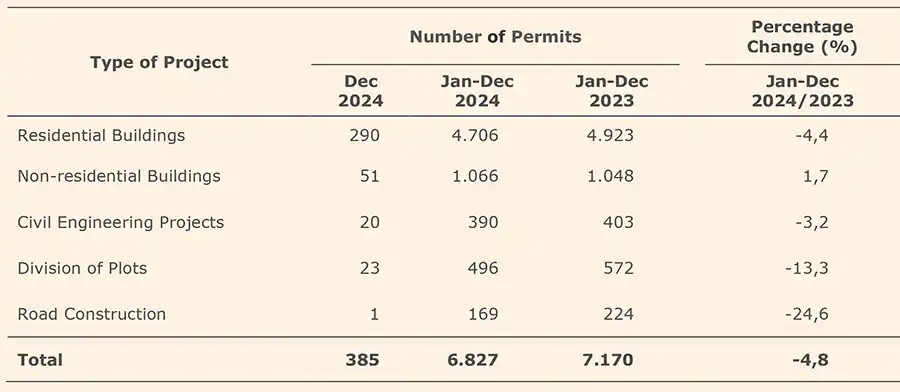
The number of building permits issued in 2024 fell 4.8% compared to the number issued in 2023, according to figures released by CySTAT.

During the period from January to December 2024, a total of 6,827 building permits were authorised, compared to 7,170 in the same period of the previous year.

Of these, 4,706 permits related to residential buildings, while 1,066 were issued for non-residential structures.

Additionally, 390 permits were granted for civil engineering works, 496 for the division of plots, and 169 for road construction. Notably, the categories showing the most significant declines were those for plot division and road construction, which dropped by 13.3% and 24.6% respectively.

cyprus building permits 2023 2024

Despite the fall in the number of permits, the total covered area increased marginally by 1.2%, while the total value of the permits remained largely unchanged.

From 1st July 2024, responsibility for issuing building permits was officially transferred from the municipalities and district administration offices to the newly established Local Government Organisations (LGOs). Since then, the permit application process has been handled via the new integrated digital platform, “Ippodamos“.

In December 2024 alone, 385 building permits were issued, compared to 587 in December 2023—marking a notable year-on-year drop of 34.4%. The total value of these December permits amounted to €181.4 million, with a total area of 144.9 thousand square metres. These permits allow for the construction of 745 new housing units.

Overall, while construction activity remains relatively steady in terms of value and area, the decline in the number of permits – particularly in infrastructure-related categories – reflects a cautious trend in the sector during 2024.


Incentives every now and then, but still no housing

2

In Cyprus, housing remains a pressing issue. While the government continues to roll out new incentive schemes and planning tweaks every few months, the core problem remains unchanged: there simply aren’t enough homes.

Despite the flurry of announcements, residents still struggle to find affordable housing, and experts warn that the situation is only getting worse.

Too many promises, not enough results

Property developers, students, and international investors are all chasing the same shrinking pool of housing stock. Meanwhile, government policies appear reactive and inconsistent. The frequent revisions to housing incentives are raising eyebrows, with many calling for a more stable, long-term strategy.

Poly Kourousides, President of the Cyprus Association of Property Valuers, recently spoke on SIGMA’s “Mesimeri kai Kati“, shedding light on the government’s latest efforts — and their shortcomings.

According to Kourousides, the amended Housing Incentive Scheme approved by the Cabinet is less a product of strategic foresight and more a reaction to earlier failures. “The essence of the policies is correct,” he said. “We need more supply to bring prices down. But the incentives offered so far just haven’t been attractive enough to developers.”

What’s new in the latest housing incentive scheme?

Here are the key changes:

  • Wider application areas: The scheme now includes Commercial and Tourist Zones where residential development is permitted.
  • Expanded eligibility: Certain areas within the Policy Statement that border Local Plans are now included.
  • Higher building allowances: The allowable building coefficient rises to 35% (from 30%) where incentive combinations apply.
  • Smaller minimum plot sizes: In zones with a building factor below 100%, the required land area drops from 3,000 sqm. to 2,000 sqm.

These may sound promising, but as Kourousides noted that, many of these adjustments reflect feedback that was given from day one – and largely ignored. “We warned early on that requiring such large plots wasn’t realistic, especially within city limits.”

Universities are coming – but where will students live?

Adding to the pressure: new universities are setting up in Cyprus, and they’re bringing thousands of students with them. This means skyrocketing demand for accommodation – but again, no solid plans to meet it.

“We’re just hoping the private sector decides to build student flats or dormitories,” said Kourousides. “But even if they do, that takes 2–3 years. We need action now.”

His association is recommending that universities house at least 10–15% of their student body in dedicated student residences — a move that could ease the burden on the private rental market.

Who’s getting priced out?

Cyprus’ property market is heating up again. Falling interest rates and the easing of conflict in Israel are drawing investors – especially Israelis – back to the island. Land Registry stats show a 15% jump in property activity in just the first three months of the year.

The downside? More demand means higher prices. And many Cypriots are being left behind.

“We estimate that around 30% of our fellow citizens won’t be able to buy or rent a home,” warned Kourousides. “That’s the unfortunate reality for the years ahead.”

Global challenges, local impact

And it’s not just internal issues causing concern. The global economy, trade tensions, and geopolitical events are having knock-on effects in Cyprus too.

“Nothing happens in isolation anymore,” said Kourousides. “We’re part of a global market. When Europe feels economic pressure, Cyprus does too.”

Final thoughts on housing

The housing situation in Cyprus isn’t just about bricks and mortar – it’s about long-term planning, social equity, and adapting to a rapidly changing economic landscape.

If the country wants to avoid a full-blown housing crisis, now is the time for consistent, coordinated action. Because right now, it seems like the only thing increasing faster than property prices… is confusion.

(Translated and summarised from the Greek article in Economy Today)

What impact will trade war have on property market?

0

The real estate sector in Cyprus is currently waiting to see the potential impact of US President Donald Trump’s trade war with China, Europe, and many other regions.

The ripple effects of this so-called trade war could have far-reaching consequences, and the property market is no exception.

Cautious optimism or warning signs?

Market insiders suggest that if the economic conflict continues, the effects will gradually begin to be reflected in the property market.

The most immediate effects would likely include a freeze on new investments and downward pressure on prices.

However, some experts are not entirely pessimistic. They point out that, compared to more volatile investments such as stocks and bonds, real estate remains a relatively low-risk long-term investment.

Property market performed strongly in first quarter

Cyprus real estate sales saw a 19% year-on-year increase in the first quarter of 2025 recording the highest number of sales in the first quarter (4,137) since 2008.

According to the Department of Lands and Surveys, March 2025 recorded 1,491 property transactions, up from 1,257 in March 2024.

Real effects on the property market after September

Stelios Gavriel, President of the Federation of Building Contractors Associations (OSEOK), told StockWatch that it is still too early to assess the full impact on the property sector. He believes the true effects will become apparent only if the tariff war continues beyond the summer.

“If tariffs rise on a wide range of goods globally, we could see inflation rise again, which might put psychological pressure on the property market,” he explained. “This would manifest as a pause in new investments and a general cooling of interest from foreign buyers.”

So far, no price increases have been seen in construction materials as a direct result of tariffs. Still, Gavriel expressed concern about imports from China and other non-EU countries, noting the uncertainty around how these nations might respond.

Uncertainty is the enemy of investment

George Mouskides, Vice President of the Property Owners Association and CEO of FOX Estate, echoed a mixed sentiment. Speaking to StockWatch, he acknowledged that the trade war will inevitably affect the property market – though not necessarily in a negative way.

“Real estate is considered a low-risk investment,” he said. “If people become wary of putting money into traditional markets like stocks and bonds, they might turn to property instead, which currently offers more security.”

That said, he also warned that uncertainty could cause buyers to hesitate, leading to a drop in transactions and potentially discouraging international firms from relocating their investment operations to Cyprus.

“In weighing these opposing forces, I’d say that uncertainty generally works against investment, including in property,” Mouskides concluded. “We’ll have to wait and see how this new economic war unfolds and what effect it will ultimately have on real estate sales.”

(Translated and summarised from the Greek article in Stockwatch)

Housing incentives for the construction sector

In a significant move to tackle the ongoing housing shortage, the Cabinet on Wednesday approved key amendments to a special incentives scheme aimed at increasing the supply of affordable homes.

The revamped policy is expected to open up new opportunities for developers while also addressing the growing demand for housing among foreign workers.

More attractive incentives package for developers

Interior Minister Constantinos Ioannou, speaking after the Cabinet meeting, announced that the scheme has been broadened to better appeal to the construction sector. By extending development opportunities and relaxing certain requirements, the government hopes to spur more residential projects across the country.

“Today’s Cabinet decision marks a significant step towards achieving our objectives through a comprehensive housing policy,” said Ioannou.

What’s new in the incentives scheme?

Here are the main updates to the revised scheme:

  • Wider Scope: The scheme now includes commercial and tourist zones where residential development is allowed.
  • Expanded Eligibility: Certain areas adjacent to Local Plans, identified in the national Policy Statement, are now eligible under specific conditions.
  • Increased Building Potential: The maximum allowable building coefficient has been raised from 30% to 35% for areas where multiple incentives can be combined.
  • Smaller Plot Size Requirement: The minimum net plot size for developments in zones with a building coefficient below 100% has been reduced from 3,000 sqm to 2,000 sqm.

New directive for collective housing

Alongside the scheme expansion, the government is introducing a framework to guide the development of collective residential complexes, which is designed primarily for foreign workers.

“These units are intended to meet the housing needs of specific groups on a short to medium-term basis,” Ioannou explained, adding that this move also aims to support employers and key sectors of the economy.

The upcoming directive will outline clear rules and planning criteria, including minimum bedroom sizes, private bathrooms, and shared living spaces for up to eight people that are similar in concept to student dormitories.

Easing market pressure & building for the future

By offering dedicated accommodation for foreign workers, the government hopes to relieve pressure on the broader housing market, freeing up conventional units for local residents.

Ioannou emphasized that this initiative strengthens one of the two key pillars of the government’s housing policy: increasing the overall housing stock, especially through partnerships between the public and private sectors.

“Our ministry remains committed to delivering practical, actionable solutions that will gradually ease the housing crisis affecting many of our fellow citizens,” he said.

Cyprus plans to modernise planning & permit processes

In a bid to modernise land development and construction across the island, Interior Minister Constantinos Ioannou has announced a wave of legislative reforms designed to streamline processes and strengthen collaboration between the public and private sectors.

Speaking at the 15th Nicosia Economic Congress during a roundtable with real estate professionals, Minister Ioannou outlined key initiatives under way, including plans to simplify permit fee structures, a forthcoming bill on jointly-owned buildings, and legislation to facilitate urban land redistribution.

“Our goal is to make daily interactions between citizens, businesses, and the state more efficient,” he said. “We envision a sustainable, resilient construction and development sector that continues to thrive.”

Reducing bureaucracy to boost private sector growth

Central to the government’s agenda is the simplification of the building permit process. Ioannou highlighted the fast-track licensing system introduced, which hands over much of the responsibility to private sector planners. This move has already seen 756 residential permits and 56 apartment block applications submitted through the scheme.

“This is the most significant reform to date,” Ioannou said, explaining that the new process dramatically cuts down on approval times and reduces the administrative burden on local authorities.

To bolster the effort, the ministry has increased staffing levels in district self-governance organisations (EOAs) by 24 per cent, approved over 300 new positions, and more than doubled the number of employees handling licensing.

A total of 22 simplification measures have been introduced since the reforms began, helping local authorities standardise their procedures and operate more effectively.

Further changes are on the horizon, with a proposal to simplify permit fee structures expected to go to public consultation by May, ahead of Cabinet approval in June.

Urban planning and infrastructure

Minister Ioannou also underscored the importance of two key bills: one on jointly-owned buildings, currently under legal review, and another on urban land redistribution, which has already been submitted to the House of Representatives. The latter aims to unlock the development potential of landlocked plots, a long-standing issue for property developers.

He reaffirmed the government’s commitment to working closely with the private sector. “We have established a framework for cooperation with all organised entities in the land development and construction space,” he said. “By listening to their concerns, we can offer effective, targeted solutions.”

Despite the progress, Ioannou acknowledged there is still work to be done. Revisions to local development plans and a thorough overhaul of the land registry are among the major challenges still to be tackled.

Industry cautiously optimistic

Real estate stakeholders present at the event responded positively to the reforms, though they did not shy away from highlighting ongoing concerns.

Platon Eliades of the Lanitis Group (Cybarco) welcomed the government’s direction but cited delays caused by local government restructuring. He also noted the challenges many face in buying property, due to escalating prices, and praised government efforts to ease access through housing schemes.

Michael Leptos of the Leptos Group pointed out that the rise in residential permits is encouraging but flagged concerns over the stagnation in large-scale projects. He called for policy consistency and deeper collaboration between the government and private firms, particularly on infrastructure.

Melina Rafti of Korantina Homes described the permit backlog – especially for applications submitted in 2021 and late 2023 – as a “cancer,” proposing that older files be handed over to private sector planners to relieve local authorities. While Ioannou said such decisions rest with individual EOAs, Rafti stressed the need for supportive infrastructure like marinas and cultural venues to attract real estate investment.

Despina Chrysosthou of Cyfield echoed support for fast-track licensing but added that titling procedures must also be accelerated. She praised the Cyprus Land Development Corporation’s affordable housing programme as the most effective to date, and highlighted labour shortages as a significant concern. Chrysosthou welcomed the Labour Ministry’s new licensing scheme for third-country nationals but urged a re-evaluation of Greek language requirements in certain professions.

Finally, she proposed a fresh look at urban zoning laws, suggesting reduced coverage ratios and greater building heights in city centres to encourage revitalisation and higher population density.

Forward-looking approach

As Cyprus continues to modernise its land development framework, both the government and private sector appear aligned on a vision for efficiency, sustainability, and growth. While challenges persist, the tone from both sides signals a willingness to collaborate for long-term progress.

With draft laws advancing and new systems already making an impact, the foundations are being laid for a more responsive, investor-friendly property sector – one that aims to balance robust development with practical governance.


Mega redevelopment project at historic KEAN factory in Limassol

Russian property developer BBF is planning to build a €189 million development project on the historic KEAN soft drinks factory site in Limassol.

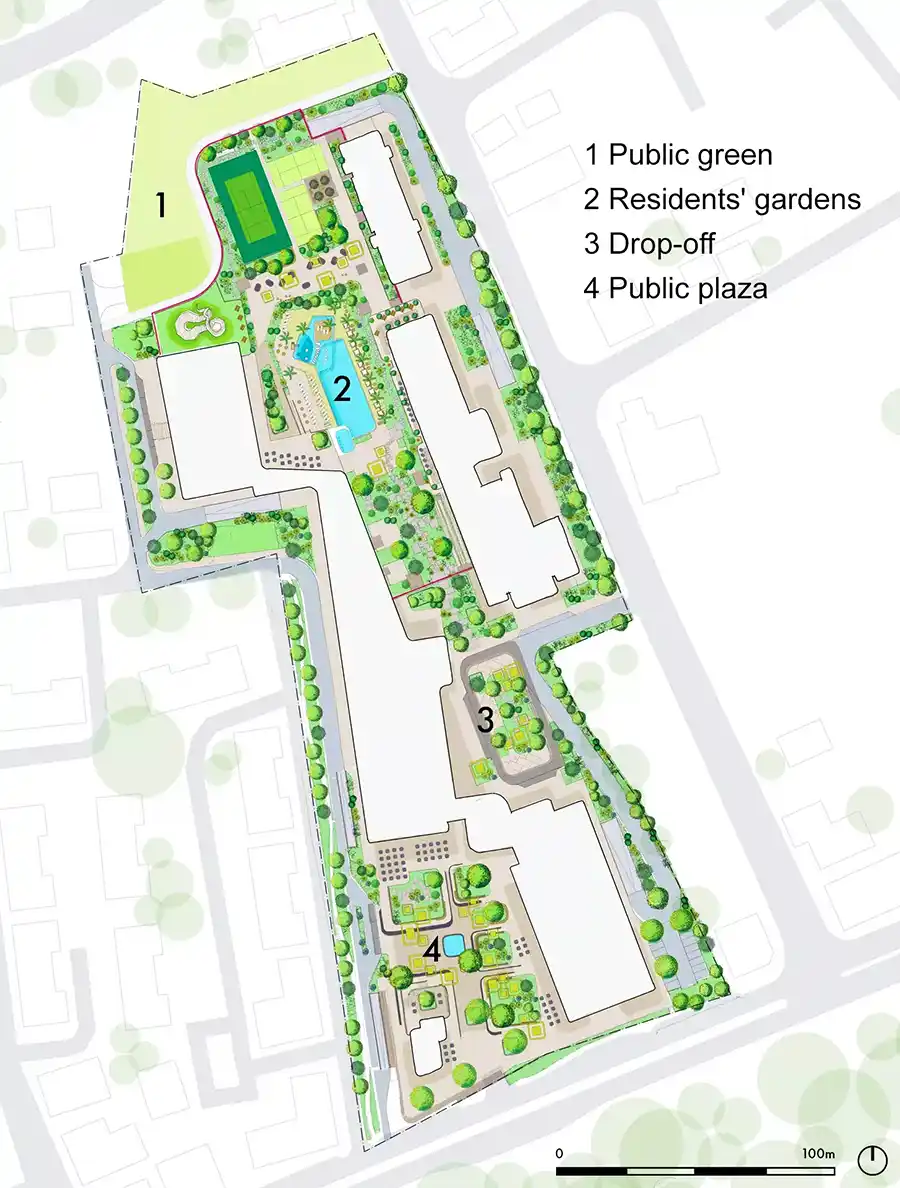
The project, in the Agios Athanasios area, will include five hi-rise buildings with a mix of office and residential spaces, underground parking, space for shops and businesses, and a central public square.

According to the environmental impact assessment submitted by the company, the project will consist of four residential buildings and one office building.

The development will span 46,162 square metres in total, with 40,768 square metres available for building after setting aside land for public infrastructure.

KEAN factory redevelopment Master Plan
KEAN factory redevelopment master plan – design by: Upton-Hansen Architects Ltd

Buildings over 80 metres

Buildings 1 and 2 will be on the southeast and southwest corners of the site, each with a ground floor and 19 floors of apartments. Their height will be about 84 and 85 metres. Shops and leisure areas will be located on the ground floor, while parking will be in the basement and semi-basement.

Building 3, on the eastern side, will be for offices. It will have a ground floor and 17 floors, with a total height of around 71.15 metres. Parking will also be on the ground, basement, and semi-basement levels.

Buildings 4 and 5 will be on the northwest and northeast parts of the site. Building 4 will have 13 floors above the ground floor and be about 58.25 metres high. Building 5 will have 9 floors and stand around 39.15 metres tall. Both will also have parking on the ground, basement, and semi-basement levels.

There will also be a shared space between buildings 3 and 5 on the eastern side of the site, serving as a community centre for residents. This building will not exceed 10 metres in height.

KEAN factory in Limassol
KEAN soft drink factory site in Limassol as it is today

Three phase project

The whole project is expected to be completed over six years (72 months) in three phases.

  • Phase 1: Starts in January 2026 and focuses on the residential buildings. Expected to finish in 2029.
  • Phase 2: Includes the construction of the office building, to be completed by December 2029.
  • Phase 3: Involves the remaining residential buildings and will be finished by December 2031.

During an environmental survey, 16 types of plants were found on the site, including cypress trees and decorative plants like oleanders. An olive grove with 150 olive trees of various ages was also identified in the northeast corner.

The site falls under three urban planning zones: commercial, tourist, and mixed residential. The wider area includes residential and tourist developments, as well as other construction projects currently underway.

KEAN factory relocation

Meanwhile, KEAN is relocating its production factory to a new site with the aim of modernising operations and strengthening its position in the Cypriot market.

The factory will be moved to the first industrial area of Ypsonas, at the former Couvas cardboard box factory site, which has already been purchased by KEAN investors, the company’s General Manager Marios Kasapis told philenews.

The relocation is expected to take approximately two years to complete and will be implemented gradually without any interruption to production, Kasapis said.

“All KEAN products will continue to be available uninterrupted on supermarket shelves and in every Cypriot household throughout the transition period,” Kasapis assured consumers.

The plot where the new facilities will be built is government-owned and has already been acquired through Gordian company.

The company is currently awaiting approval from the Ministry of Commerce for the transfer of the lease before commencing works.

KEAN remains one of the last major Cypriot brands in the consumer goods sector and is “committed to maintaining local production and employment”. The company has assured that all its operations will continue to be conducted in Cyprus, securing employment for all its staff.

KEAN has more than 25% market share of local juices and citrus fruits-based soft drinks.

In recent years, the company has expanded its presence in the HORECA (Hotel, Restaurant, and Café/Catering) industry by importing brands such as HEINZ/KRAFT, HP, L&P, AMOY, VITALIA, FARLEY’S CALVO (tuna and salads), GO TAN (noodles and sauces), PELLITO NUTS and other food products.