What a mess in Latchi: my thought of the day!

What Incompetence! Corruption and probably cover-ups, backhanders and a bureaucratic nightmare with everyone passing the decision-making process down the line.

The facts are simple: Do we live in a land governed by Rule of Law or not? If not, then obviously: Where there is no Justice there exists no Crime and all illegalities are justified under the Rule of the Jungle.

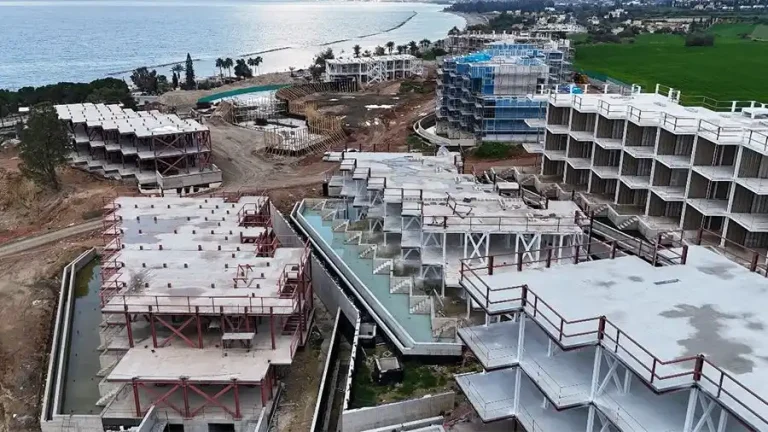
But if we are supposed to live in country governed by Rule of Law then this controversial project built in Latchi by the Leonardo Israeli consortium, it should have never been allowed to start in the first place. It abused every building and planning regulation and continues to play ignorant but also shows no respect of the authorities or the Republic of Cyprus.

The Paphos Provincial Government Organization (EOA) has filed a lawsuit to stop the illegal construction, while the Planning Authority has asked the courts to issue a demolition order for the unauthorized structure. That’s a joke! No illegal structures in Cyprus are demolished and cunning developers know that!

Meanwhile an incompetent Environmental Department has failed miserably by “approving” this massive Israeli hotel/apartment complex of 20 buildings in a delicate environmental zone and for certain is to accept the blame for starting this mess. But in Cyprus no incompetent institution has ever been prosecuted for wrongdoings but is protected by the system, as long as the public pays for their ineptitude!

Latchi will never be the same again because of Corruption; all I can say: “Thank you Mr Phedon Phedonos-Mayor of Paphos” for speaking out to protect beautiful Latchi. Meanwhile, no other politician or MP has publicly taken a stand on the issue! Silence is bliss!

But it’s too late now: too many barracudas within the system are ready to dance on the grave of Latchi in the name of greed and corruption.

About the author

Andreas C Chrysafis is a UK published author of five books and over 450 press articles but also a recognized artist. He is not political-affiliated but a strong advocate for Democracy, Transparency, Equality and Human Right and a robust opponent to Corruption.


Take part in building amnesty, secure Title Deeds

Far fewer applications have been received than anticipated for the small-scale building violations amnesty, Interior Minister Constantinos Ioannou said on Friday.

The measure announced in September had been intended to run for a period of six months and resolve a number of problems.

Owners would receive withheld Title Deeds through a simplified process, the authorities’ bureaucratic workload would be eased, and revenue generated from fines was to go into a fund for promotion of affordable housing by the land development organisation.

However, only 550 applications have been received to date although properties with small deviations run into the thousands, the minister told CyBC radio.

Strict terms are in place for the amnesty grants which aim to free up owners and prevent future legal hassles should they decide to sell, Ioannou said.

The measure allows for scale-scale planning deviations to be legitimised after payment of fees ranging from €400-€3,000, he said, and a list of infractions which may be legalised is available on the ministry website.

Owners must provide the original planning and building permit, as well as certification from a registered architect or civil engineer for the arbitrary alterations.

It is known that in their vast majority, these concern expansion of the building’s size and distance from the plot perimeter, the minister said.

Amnesty eligibility

Residential properties may be eligible for amnesty for building factor deviations of 20 per cent, up to 60m² both vertically and horizontally including spaces such as enclosed verandas and pergolas.

In the case of apartments, the arbitrary constructions may be legalised only with the consensus of all unit owners.

The amnesty decree also provides for unapproved constructions in livestock operations and leisure venues.

In the case of livestock operations, the cutoff is for infractions in building coefficient of up to 20 per cent, while for leisure venues the terms are 20 per cent, up to 100m².

District administrations (EOAs) had sent out notifications with water bills in a bid to push property owners to respond by the time of the decree’s expiration at the end of March.

No renewed decrees will be issued over the exceptional measure, although a minor extension of two weeks would be considered if interest peaks, Ioannou said.

As for the issue of foreign trapped buyers who are not covered by the decree, the matter will be addressed in the near future and new legislation will be proposed, in cooperation with banking institutions and all relevant authorities, he said.

CM

Call to end short-term rentals

The Real Estate Agents Registration Council has proposed ending daily accommodation rentals to protect consumers and the property market, maintain tourism standards, and uphold the country’s international image.

On Tuesday, the Council participated in a House Committee meeting on Energy, Trade, Industry, and Tourism. It presented its views and concerns regarding short-term property rentals.

The Council stated that increasing short-term rentals reduces the availability of long-term rental properties. Combined with high interest rates and inflation, this puts upward pressure on rental and property prices.

It cited examples of cities such as Barcelona, New York, and Athens, where short-term rentals have been fully or partially banned. These measures aim to protect the housing market and prevent unfair competition.

The European Union has recognised short-term rentals as a problem requiring regulation. A new EU policy seeks to increase transparency and data collection to develop suitable legislative measures.

The Council highlighted the lack of regulations in this sector. Many properties fail to meet safety and quality standards, exposing consumers to financial risks and exploitation by unregulated estate agents.

It also stressed the government’s responsibility to introduce legal and regulatory frameworks. These would set clear property standards for safety and suitability while ensuring fair competition within the market.

A key concern is the discrepancy between registered accommodations and those advertised online. Monitoring short-term rentals is difficult, leading to the creation of a register to legalise unregulated properties.

The Council warned that the current situation damages the country’s reputation in tourism. It also creates unfair disadvantages for licensed accommodation providers who follow government rules and regulations.

Housing crisis in Cyprus & EU affordability concerns

0

The cost of housing in Cyprus has become a major financial burden, with rent or mortgage payments often exceeding 40% of household income.

In response, the European Union has established a specialised task force to examine the issue and propose solutions to the housing crisis across Europe, including in Cyprus.

A growing housing affordability crisis

According to Polys Kourousides, President of the Association of Property Valuers, the formation of the EU task force is a positive step in recognising the severity of the issue.

Despite strong family support networks in Cyprus, the problem persists, particularly among young people and middle-income families. The costs of a home are not limited to mortgage payments or rent but also include expenses like utilities, communal fees, and internet charges.

One major concern is that house prices in Cyprus are roughly seven times the annual household income, far exceeding the affordability threshold of five times annual earnings. The average home costs approximately €270,000, while the typical family earns around €38,000 per year. This significant disparity makes homeownership increasingly difficult.

The need to increase housing supply

Mr Kourousides has stressed that the only viable solution is to increase the supply of residential properties to meet growing demand. However, despite high demand, supply remains limited, keeping prices elevated.

The inefficiencies of the Ippodamus system, which governs building permits, have contributed to delays in housing developments. Efforts to streamline approvals and introduce self-regulation have been proposed to accelerate construction and stabilise the market.

The role of the EU task force

The newly established EU task force aims to explore ways to lower housing costs across member states. One proposal under consideration is exempting newly built rental properties from VAT, though this would require changes to EU legislation. Another potential approach is incentivising rental markets through public and private sector collaboration, offering tax and planning incentives to encourage affordable housing projects.

The EU may also encourage member states to co-invest with private developers in new housing schemes. If successfully implemented, these measures could lead to a more sustainable housing market and improved affordability in Cyprus.

Regulatory reforms and prospects

Recent regulatory changes have attempted to address bottlenecks in the housing sector. The self-regulation approach for building permits is expected to improve efficiency, particularly for mid-sized developments of up to 20 apartments. Additionally, reinstating reduced VAT for certain applications could alleviate financial burdens on homebuyers.

While these initiatives offer hope for more affordable housing, experts stress that continued policy adjustments and increased housing supply remain crucial for long-term stability in the property market.

Short-Term rentals surge in Cyprus

The number of registered short-term rentals in Cyprus has increased significantly. It grew from 4,765 in April 2025 to 8,248 properties, Deputy Minister of Tourism Kostas Koumis announced on Tuesday.

Speaking after a Parliamentary Committee on Tourism meeting, he discussed the progress of legislation regulating short-term rental accommodations. The discussion focused on the implementation of regulations for self-catering properties.

Tourism outlook for 2025

Koumis highlighted the record-breaking revenues and arrivals achieved in 2024. He expects 2025 to be just as strong. However, extending the tourism season remains a major challenge.

Pending applications will further boost registration numbers. Currently, 1,275 applications await approval. Another 1,170 remain pending due to delays from applicants. Once processed, the total number of registered properties will increase further.

“The hotel industry took 50 years, from 1974 to 2024, to build its current inventory of approximately 90,000 licensed hotel beds, while the short-term rental sector reached similar numbers in less than a decade,” Vavlitis said.

The recent surge in registrations resulted from targeted awareness campaigns by the Deputy Ministry. In April 2023, the registry listed 4,765 properties with 7,138 beds. Today, 8,248 properties provide a total of 36,640 beds.

However, only about 30% of Cyprus’ short-term holiday rentals are officially registered. Industry estimates suggest there are between 80,000 and 90,000 short-term rental beds in operation across Cyprus.

Short-term rentals regulatory challenges

Koumis emphasized the need for a holistic approach to regulating short-term rentals. A proposed legal amendment is under review by the Legal Service.

Different areas in Cyprus, such as Nicosia and coastal regions, require distinct policy approaches. Short-term rentals contribute to the economy but also compete with the hotel industry. This competition presents regulatory challenges.

“The broader tourism experience depends on a destination’s image and hospitality,” Koumis stated. He stressed the importance of maintaining high-quality services in all accommodations.

Tourism records and future growth

Koumis remains optimistic about 2025. He expects another record year following the strong revenue and arrivals of 2024.

“In two years, we recovered from the loss of the Russian market,” he said. “Arrivals and revenue increased by over 25%.”

The main challenge now is extending the tourism season. Sustaining growth beyond the usual peak months will be crucial for the sector’s continued success.

Land Registry has no duty to inform buyers of prior sale agreements

The Court of Appeal ruled that the Department of Lands and Surveys (Land Registry) has no legal duty to notify property buyers of pre-existing sale agreements, the Law Office said.

The ruling followed a lawsuit by a buyer who claimed the Land Registry failed to disclose that the apartment he was purchasing had already been sold to another party.

“No law, constitutional provision, or regulation requires the Land Registry to inform buyers or their representatives of previous sale agreements when submitting a contract,” the Law Office said in a statement.

No evidence of Land Registry negligence

The District Court dismissed the buyer’s claim, finding no evidence of negligence by the Land Registry. It also noted that, while legislation allows buyers to request property information beforehand, the plaintiff had not exercised this right.

The Court of Appeal upheld the ruling, affirming that the Land Registry could not refuse a contract that met legal requirements under the now-repealed Sale of Land (Specific Performance) Law.

The Supreme Court later rejected the buyer’s application to submit legal questions related to the decision, viewing it as an attempt to reopen a settled matter.

The Law Office said that “The Supreme Court saw no grounds for intervention, as the application was based solely on the buyer’s disagreement with the Court of Appeal’s ruling.”

Editor’s comments and recommendations

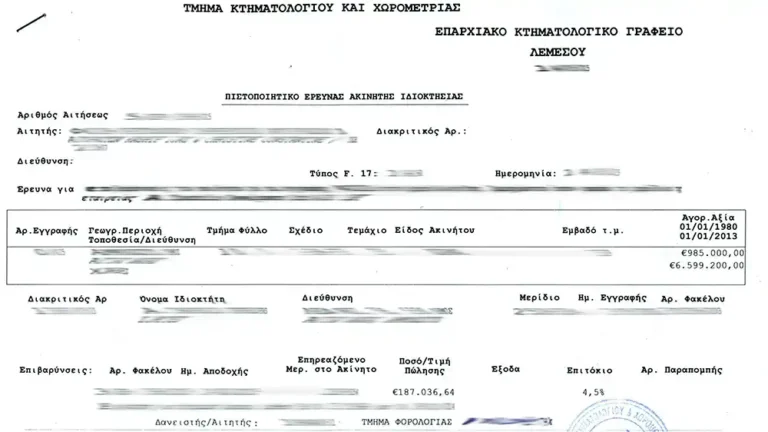
This Court of Appeal ruling underscores the absolute necessity for anyone considering purchasing a property in Cyprus to request a Title Search from the Land Registry for the property in question. The Land Registry fee is €5.00 per application.

Those unable to request the search themselves must instruct their independent lawyer to do so on their behalf.

When completing the form (N.50), request the following information:

    1. All contracts of sale
    2. All mortgages
    3. All memos, encumbrances, and prohibitions

The Search Certificate provided by the Land Registry will be in Greek. If the buyer requires the Certificate to be translated and any issues clarified, along with their implications, they should consult their independent lawyer.

By independent, I mean a lawyer who is registered with the Cyprus Bar Association and who has no connection whatsoever with any other party involved in the sale.

For the benefit of British nationals, the UK Foreign, Commonwealth and Development Office publishes a list of English-speaking lawyer in Cyprus on its website.

Note. You should do your own research before deciding which lawyer to use.