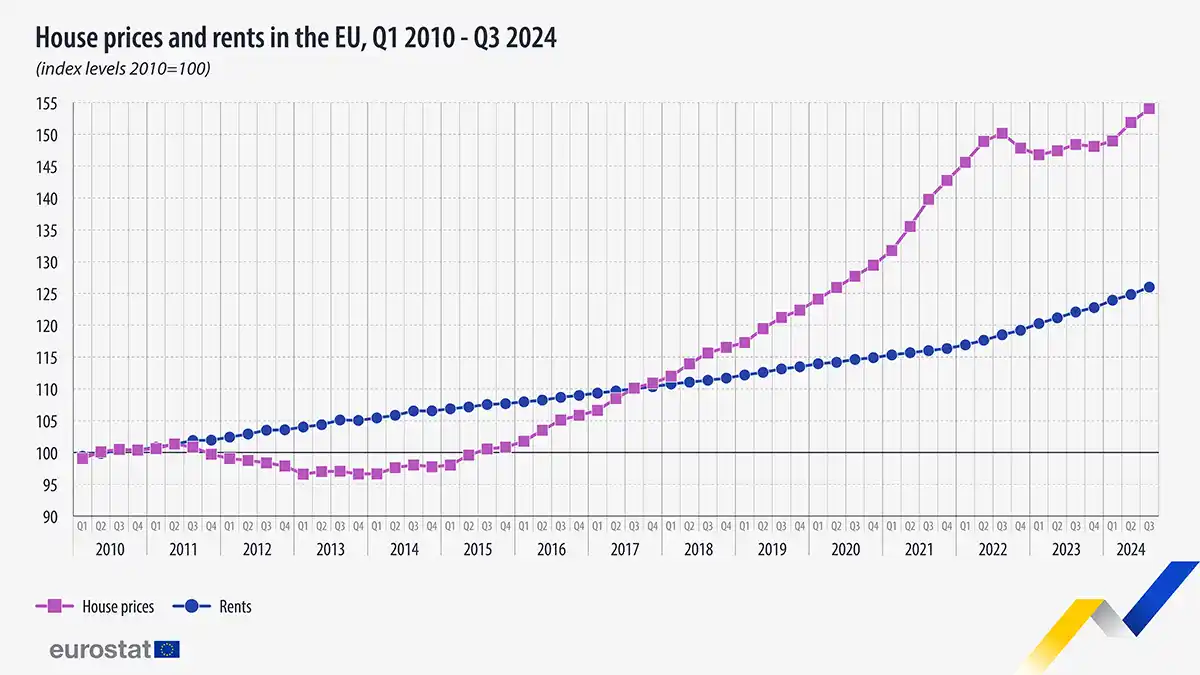
In the third quarter of 2024, both house prices and rents in the EU showed increases compared to the same period in 2023. House prices rose by 3.8%, while rents saw a 3.2% increase.
Compared to the second quarter of 2024, house prices went up by 1.4% and rents by 0.9%. This data, released yesterday by Eurostat, summarizes key findings from their detailed Statistics Explained article on housing price statistics.
From 2010 to the second quarter of 2011, house prices and rents in the EU exhibited similar trends, but their trajectories diverged thereafter. Rents have shown a steady increase, whereas house prices have been more volatile, experiencing periods of decline followed by rapid growth.
Between 2010 and the third quarter of 2024, house prices in the EU climbed by 54.1%, while rents increased by 26%.
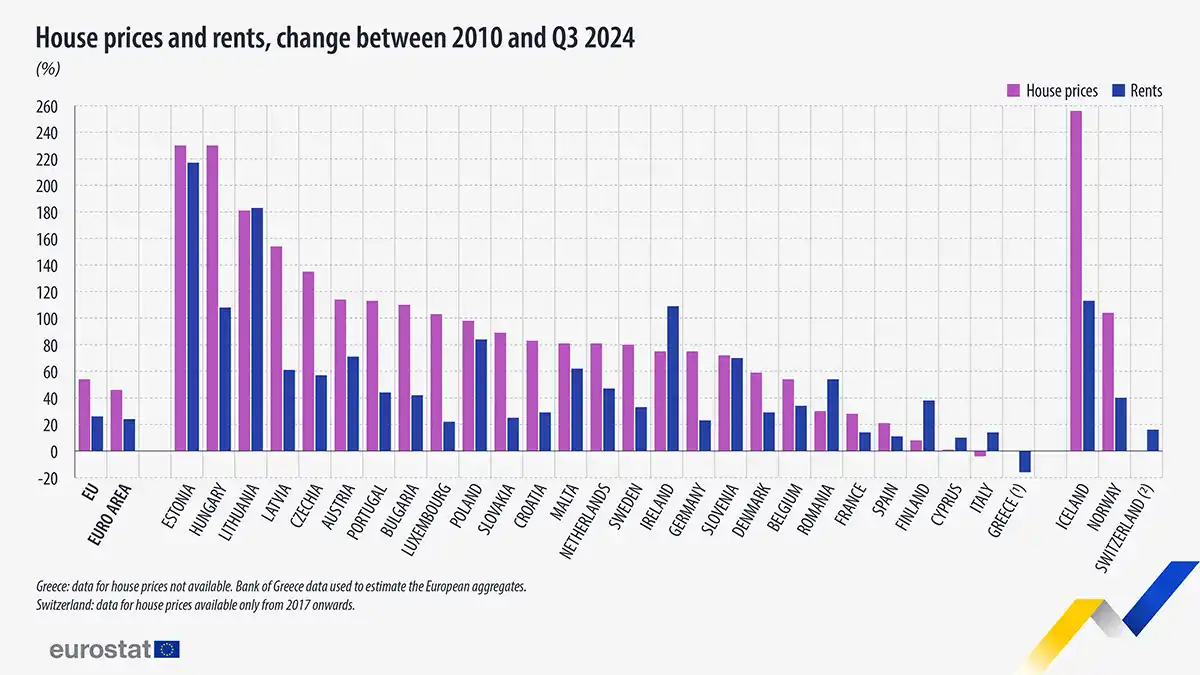
(Cyprus had the lowest increase in house prices between 2010 and the third quarter of 2024, compared to the rest of the EU member states.)
Analysing national data, house prices outpaced rents in 20 EU countries when comparing the third quarter of 2024 with 2010. Hungary and Estonia saw the most significant house price increases, more than tripling (+230%), followed by substantial increases in Lithuania (+181%), Latvia (+154%), Czechia (+135%), Austria (+114%), Portugal (+113%), Bulgaria (+110%), and Luxembourg (+103%). Italy was the sole country where house prices declined (-4%) during this period.
Meanwhile, rents increased across 26 EU countries during the same timeframe, with Estonia (+216%), Lithuania (+183%), Ireland (+109%), and Hungary (+108%) registering the highest rises. Greece was the only country where rent prices decreased (-16%) over this period.
The Deputy Ministry of Tourism has announced a January 25 deadline for stakeholders to submit suggestions on the Paphos Marina project, following the release of its basic specifications.
George Mais, president of the Paphos Chamber of Commerce and Industry, explained that the ministry published the marina’s key features before Christmas to enable potential bidders and consortia to begin preparations.
Speaking to the Cyprus News Agency (CNA), Mais noted that after the consultation period concludes, the ministry will invite expressions of interest. This will be followed by a pre-selection process to identify consortia that meet the project’s criteria, paving the way for the tender stage.
As part of the ministry’s stakeholder engagement efforts, representatives from the firm responsible for drafting the tender documents recently met with officials from the Paphos Chamber, Mais added.
“We are maintaining communication and will submit our written feedback by the January 25 deadline specified in the ministry’s publication. Some of our suggestions, which appear to have been partially overlooked, will be included,” Mais told CNA.
Local stakeholders are keen to avoid further delays in securing an investor for the large-scale development planned at Potima Bay in Kissonerga. While the current timeline is unlikely to be shortened, efforts are focused on establishing clear and precise terms to prevent complications during the bidding process. This aims to avoid issues experienced in the past, such as unsuccessful bidders appealing to the Review Authority and courts.
If interest is forthcoming, the project tender is expected to be awarded by early 2026. Authorities are placing significant emphasis on carefully crafting tender terms to minimize future disputes and ensure a smooth process.
Paphos marina more than 30 years and still not built
Since an initial study was carried out more than 30 years ago, the Paphos marina project has been stalled by bureaucracy and legal battles.
Eventually, in May 2016, the marina contract was awarded to the Poseidon consortium following a legal battle. Although the consortium secured a letter from the Bank of Cyprus in which the bank guaranteed to fund the entire project, Poseidon was unable to demonstrate that it had €122 million or 60 per cent of the total project cost of €215 million.
In 2017 Pafilia Developers, which was next on the list of tenders, was invited to tender for the marina’s construction and operation.
In 2019, the possibility of building facilities for cruise ships as part of a proposed Paphos marina was discussed at a meeting on Tuesday between the Transport Minister and the deputy tourism minister with the leadership of the Paphos Chamber of Commerce.
In 2020, the ministry of tourism announced that the process to open a tender to secure the services of a specialised consultant to examine the proposal of establishing a combined marina and cruise ship docking facility in Kissonerga.
In 2021, the Paphos marina was delayed yet again when one of the interested parties raised an objection with the ‘tenders review authority’, which meant that nothing could continue until the matter was resolved. Two moths later the objection was rejected.
In 2023, the process of hiring consultants to prepare documents for the marina was postponed due to issues with the documents submitted for legal review.Bottom of Form
Later in 2023, the president of the Paphos Chamber of Commerce and Industry said that the procedures regarding the submission of bids for the consultancy services for the project have been completed. He expected the tendering process to be concluded by the end of 2024, if no-one raised objections before the end of April 2024.
In 2024, the Deputy Minister of Tourism and Deloitte Triton Paphos Marina Consortium signed on Monday a 30-month contract to provide consulting services over the tender process for the Paphos marina development.
If there are no more hiccups and delays, it’s anticipated that the project will be awarded to the successful bidder by the end of 2026 and the marina completed by 2029. (But don’t hold your breath.)
The number of properties sold in Cyprus during 2024 reached the highest level on record since 2007, with a total of 15,797 contracts deposited with the Department of Lands and Surveys.
However, as you will read later in this report, sales to the overseas market have been falling, while sales to the domestic market have been slowing. How the market will perform in 2025 remains to be seen.
December 2024 property sales
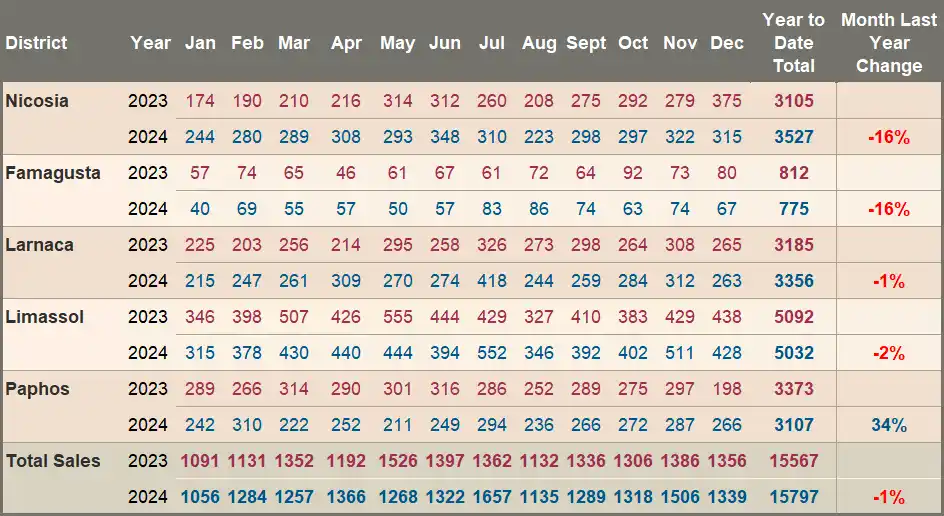
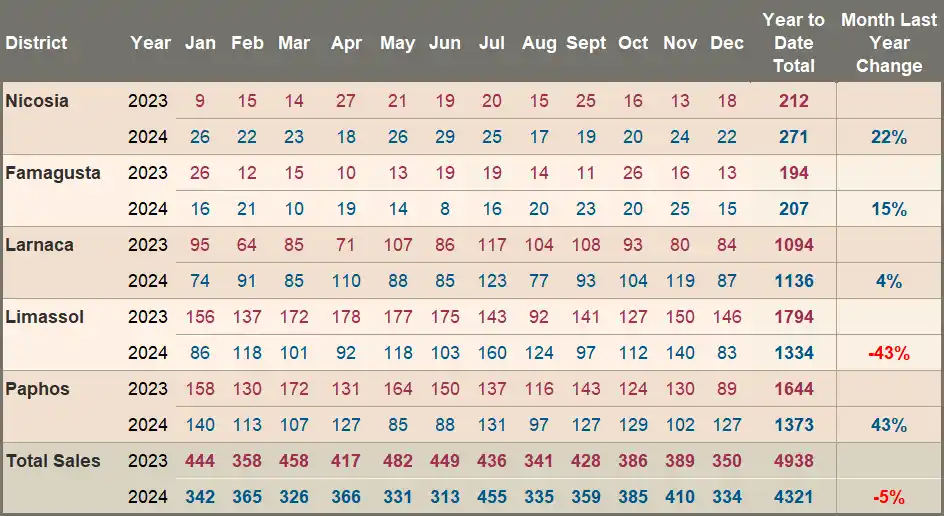
Sales in December, as measured by the number of contracts deposited at Land Registry offices, fell 1% compared to December 2023 according to official figures from the Department of Lands and Surveys.
Although sales in the popular coastal areas of Paphos rose 34% compared to December last year, falls in the number of sales of 16% in both Nicosia and Famagusta and falls of 2% and 1% in Limassol and Famagusta respectively pushed the total into negative territory.
Total Property Sale Transactions – 2023/2024 Comparison
Over the 12 months of 2024 sales rose by 1% compared to 2023. Although sales in Nicosia and Larnaca rose by 14% and 5% respectively, they fell 8% in Paphos, 5% in Famagusta and 1% in Limassol.
Total contracts of sale deposited – 2023/2024 Comparison (Jan-Dec)
Market segment analysis
Property sales to the domestic market
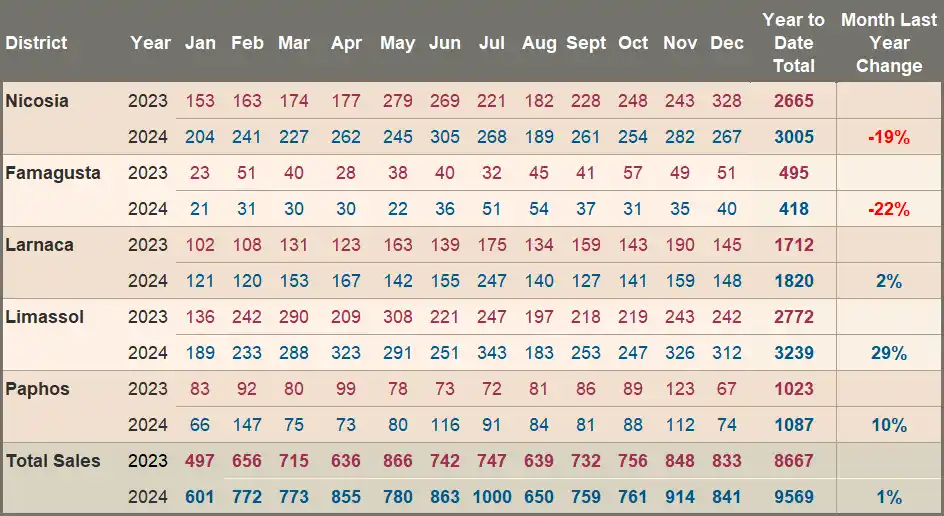
The total number of sales to the domestic (Cypriot) market December 2024 rose 1% compared to December 2023 and accounted for 63% of the total number of sales in the month.
Although sales in Limassol, Paphos and Larnaca rose by 29%, 10% and 2% respectively, the number of sales fell by 22% in Famagusta and 19% in Nicosia.
Total Domestic Property Sale Transactions – 2023/2024 Comparison
Over the 12 months of 2024 sales to the domestic market rose by 10% compared to 2023. All districts gained ground with the exception of Famagusta, where sales fell by 16%.
Domestic contracts of sale deposited – 2023/2024 Comparison (Jan-Dec)
Property sales to the overseas market
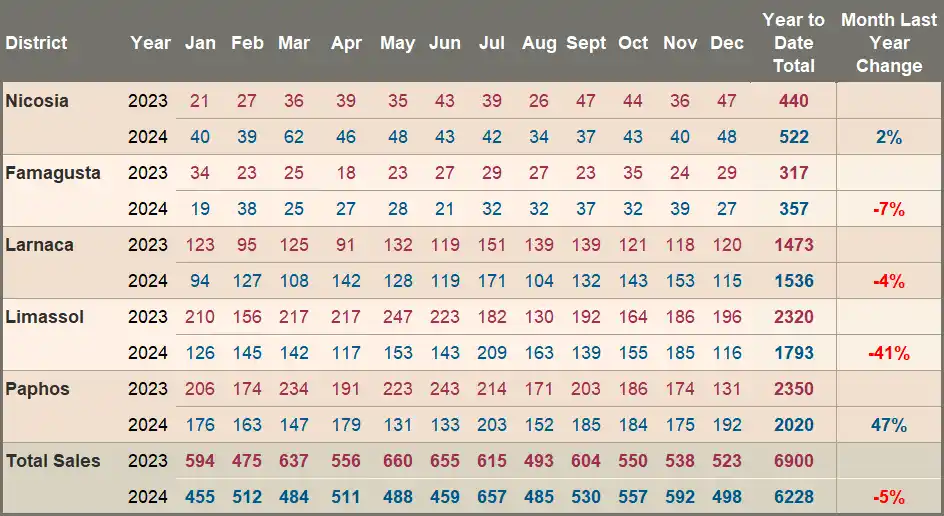
The total number of property sales to the overseas market (both EU and non-EU citizens) in December 2024 fell 5% compared to December 2023.
Although sales in Paphos rose by 47% and sales in Nicosia by 2%, They fell 41% in Limassol, 7% in Famagusta and 4% in Larnaca.
Total Overseas Property Sale Transactions – 2023/2024 Comparison
Over the 12 months of 2024 sales to the overseas market fell by 10% compared to 2023. Although sales in Nicosia, Famagusta and Larnaca rose by 19%, 13% and 4% respectively, they fell by 23% in Limassol and 14% in Paphos – the two most favoured areas of the island for overseas investors looking to buy a place in the sun.
Overseas contracts of sale deposited – 2023/2024 Comparison (Jan-Dec)
Property sales to EU nationals (excluding Cypriots)
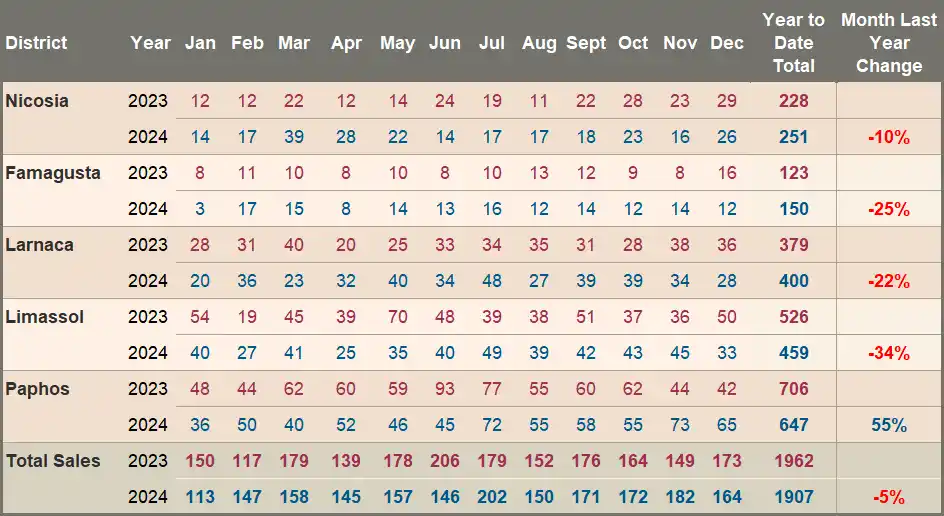
Sales to EU nationals fell 5% compared to December 2023 and accounted for 12% of the total number of sales (1,339) achieved during the month.
Paphos was the only district where more properties were sold, up a remarkable 55% compared to December 2023.
Total Property Sale Transactions to EU Citizens – 2023/2024 Comparison
Over the 12 months of 2024 sales to EU nationals fell 3% compared to 2023. Although sales in Famagusta, Nicosia and Larnaca rose by 22%, 10% and 6% respectively, these were more than wiped out by a 13% fall in sales in Limassol and an 8% fall in Paphos.
Contracts deposited by EU Nationals – 2023/2024 Comparison (Jan-Dec)
Property sales to non-EU citizens
Sales to non-EU citizens in December 2024 fell 5% compared to December 2023 accounting for 25% of the total number of sales (1,339) achieved during the month.
While sales in Paphos rose 43% and sales in Nicosia, Famagusta and Larnaca rose by 22%, 15% and 4% respectively, a fall of 43% in Limassol pushed the total into negative territory.
Total Property Sale Transactions to Non-EU Citizens – 2023/2024 Comparison
Over the 12 months of 2024 sales to Non-EU nationals fell 12% compared to 2023. Although sales in Nicosia, Famagusta and Larnaca rose by 28%, 7% and 4% respectively, falls of 26% in Limassol and 16% in Paphos were recorded by the Department of Lands and Surveys.
Contracts deposited by non-EU Nationals – 2023/2024 Comparison (Jan-Dec)
The last quarter of a century in perspective
During the run-up to Cyprus accession to the EU in 2004, the number of property sales and their prices soared with many Cypriots finding themselves priced out of the market by foreigners looking for a place in the sun.
Driven by foreign buyers, property sales peaked at 21,245 in 2007. However, the global financial crisis – the most severe economic downturn since the Great Depression of the 1930 – triggered the collapse of property bubbles worldwide.
In Cyprus, property sales steadily declined until the country faced its own economic crisis in 2012-2013 that resulted from the exposure of Cypriot banks to overleveraged local property companies, the Greek government-debt crisis, the downgrading of the Cypriot government’s bond credit rating to junk status by international credit rating agencies.
In March 2013, Cyprus secured a €10 billion bailout package from a troika of international lenders, comprising the European Commission, the International Monetary Fund, and the European Central Bank. As part of the bailout conditions, the troubled Laiki Bank was shut down, uninsured bank deposits exceeding €100,000 were subjected to a “haircut,” and the remaining assets of Laiki Bank were absorbed by the Bank of Cyprus.
The economic turmoil had a profound impact on the property market, with only 3,767 properties sold in 2013.
Since then, the Cypriot banks have become more ‘responsible’ and the property market has recovered to a degree, albeit with challenges along the way. These include the effects of the COVID-19 pandemic in 2020, controversies surrounding the “Golden Passport Scheme,” and persistent issues such as title deed delays, property repossessions, non-performing loans, and trapped buyers, which remain unresolved.
Property Sale Contracts Deposited 2000 to 2024
EU involvement
One of the reforms necessary for Cyprus to meet the strategic objectives of its Recovery and Resilience Plan (RRP), which is co-funded by the European Union and will provide a grant of €1.0 billion and a loan of €200 million, is designed to address inefficiencies of issuing and transferring Title Deeds, namely:
examination of pending cases for the issuance of title deeds or rejection of the cases,
extension of the new planning and building permit policy, currently up to two residential units, to four residential units in a plot, which shall reduce the time needed to issue building and spatial permits,
review of the Streets and Buildings Regulation Law to introduce the right incentives for the supervising engineer to further discourage irregularities that would result in title deeds not being issued,
amendment of the Sale of Property (Specific Performance) Law, which shall ensure in advance that the transfer of immovable property is executed as soon as the buyer fulfils his/her contractual obligations.
If implemented correctly, these changes should help alleviate some of the issues facing those who buy property in Cyprus.
Applications for a 2% mortgage interest rate subsidy opened on Thursday 2 January for households that have taken out loans for owner-occupied housing. The scheme aims to mitigate the negative effects of inflation and rising interest rates on disposable incomes
Information provided to StockWatch by the implementing agency, the General Accounting Office of the Republic, indicates that the scheme is available to individuals who secured loan agreements between 1 January 2022 and 31 December 2023 for the purchase or construction of their first home. However, in its initial two days, the scheme has seen limited uptake.
Despite this, many prospective applicants had previously sought details about the programme, which offers a 2% subsidy for a period of 24 months following loan approval.
The scheme provides a subsidy covering 50% of the average increase in the interest rate experienced by borrowers compared to the rate in effect at the time of signing their loan agreement. This support is available for two years from the initial disbursement of the loan.
To qualify, applicants must meet specific criteria: the mortgage must be performing and not exceed €400,000.
Additionally, eligible households must have a family income below €50,000 and must have resolved all tax obligations up to 2023.
The Mortgage Interest Subsidy Scheme, approved by the Council of Ministers on 11 December 2024, is part of a broader set of government measures aimed at alleviating the financial strain on citizens caused by rising costs of living.
The scheme is backed by a budget of approximately €33 million.
Eligible individuals must submit their applications using the form available on the General Accounting Office’s website. Completed forms, along with required documentation, must be delivered in printed form to Citizen Service Centres (KEP) or District Citizen Service Centres (KEPO) by 28 February 2025.
The ten most expensive property sales across Cyprus in November totalled €20.9 million, with the most expensive being offices in Neapolis, Limassol, which sold for €5.4 million, according to technology driven company Ask Wire.
The list of the 10 most expensive properties is dominated by Limassol district with seven transactions worth a total of €17 million. The top ten is completed by Paphos district with two sales worth a total of €5.1 million and Nicosia with one sale worth €2 million.
The 10 most expensive property sales in November
Top Ten
Property Type
Location
Price
1
Offices
Limassol / Neapolis
€4.1m
2
Offices
Limassol / Neapolis
€4m
3
Offices
Paphos / Agios Theodoros
€4m
4
Land
Limassol / Amathus / Agia Paraskevi
€2.5m
5
House
Nicosia / Agios Andreas
€2m
6
House
Limassol / Amathus / Mouttagiaka
€1.9m
7
Commercial Property
Limassol / Apostolos Andreas
€1.8m
8
Land
Limassol / Agios Georgios
€1.4m
9
Apartment
Limassol / Amathus / Potamos Germasogeias
€1.2m
10
Land
Paphos / Geroskipou / Timi
€1.1m
Source: Department of Lands and Surveys, Analysis: Ask Wire
The 50 most expensive sales
The fifty most expensive property sales in November totalled €47.3 million compared with the €68.4 million achieved in October.
Commenting on the figures, Pavlos Loizou, CEO of Ask Wire said “The high value real estate market slowed down in November compared to October, with the value of the top 50 transactions dropping by nearly 31%. This decrease was observed across all districts.”
Of the 50 most expensive property sales, 41.6% of the total value came from the 10 properties in the Limassol district, amounting to €19.7 million. 22.8% came from the top 10 properties in Paphos district, which totalled €10.8 million.
Trailing behind are Nicosia, contributing 17.5% (€8.3 million), and Larnaca with 11.8% (€5.6 million). The 10 highest-value transactions in Famagusta amounted to €2.9 million, representing 6.2% of the overall value of these top 50 sales.
High-value property sales in November
The 50 highest-value property sales in November 2024 totalled €47.3 million.
Limassol: €19.7 million (41.6% of the total)
Paphos: €10.8 million (22.8%)
Nicosia: €8.3 million (17.5%)
Larnaca: €5.6 million (11.8%)
Famagusta: €2.9 million (6.2%)
November’s most expensive property sales/district
District
Highest Transaction (€)
Type of Property
Share of District Total (%)
Famagusta
€462,000
House
15.9%
Larnaca
€800,000
Field
14.3%
Limassol
€4.1 million
Offices
20.8%
Nicosia
€2 million
House
24.1%
Paphos
€4 million
Offices
37%
Source: Department of Lands and Surveys, Analysis: Ask Wire
Market trends
Pavlos Loizou, CEO of Ask Wire, commented on the data, stating:
“The high-value real estate market slowed in November compared to October, with the value of the top 50 transactions dropping by almost 31%. This decline affected all districts. The fact that the top three sales were office spaces highlights the demand in this category, particularly from foreign companies in Limassol and Paphos. Residential properties still dominate high-value sales, with 26 houses and apartments included in the 50 most expensive transactions.”
For more information and insights on the real estate market, visit Ask Wire’s website.
Approximately 60,000 photovoltaic systems are currently installed on household rooftops, according to statements by the Minister of Energy, George Papanastasiou.
Speaking on state radio, Mr. Papanastasiou noted that energy production from renewable energy sources in Cyprus today has reached 950 MW, while consumption peaks at around 400 MW on the most demanding days.
Mr. Papanastasiou highlighted that the majority of the 950 MW comes from photovoltaic systems, specifying that over 300-350 MW is generated by residential photovoltaics installed on approximately 60,000 households.
He said that the ministry’s goal is to introduce more photovoltaic installation schemes so that every home can have photovoltaic systems to produce energy to meet its needs.
Focus on energy storage
The minister emphasized that in addition to installing photovoltaics, energy storage is a widely discussed issue within the Ministry of Energy.
He referred to two aspects of energy storage: centralized energy storage systems and systems within photovoltaic parks, which will extend the availability of electricity generated by photovoltaics.
Mr. Papanastasiou reiterated the need for Cyprus’ energy mix to include production through renewable energy sources (photovoltaics and wind power), along with the cleanest possible conventional energy, to ensure sustainable production costs.
He pointed out three main pillars of the ministry’s focus:
Production and use of renewable energy (RES).
Introduction of liquefied natural gas (LNG) for conventional energy production.
Electrical interconnections.
Regarding the second pillar, Mr. Papanastasiou noted that efforts are ongoing, with the ship Prometheus currently anchored in Malaysia for necessary inspections and certification to facilitate LNG imports.
Speaking about conventional energy production, the minister stressed that this issue is not limited to the Cyprus Electricity Authority (EAC) as a private conventional energy production plant is ready to begin operations soon.
Additionally, he mentioned that within the current month, the competitive electricity market will enter a trial phase for a six-month period.