Home Blog Page 9

Cyprus building inspectors bill ignores developer planning violations

2

The Cyprus government’s latest draft bill introducing building inspectors has been presented as a major step towards improving oversight and preventing future planning violations. However, for many property owners, it arrives decades too late.

The proposal is a belated response to a crisis that has been allowed to grow and fester through years of regulatory failure, weak enforcement and political inaction.

While stronger inspections may help reduce future violations, the legislation does nothing to address the thousands of existing cases that continue to trap property buyers in legal and financial limbo.

Buyers continue to pay for developers’ planning violations

The most glaring weakness in the proposed legislation is its failure to tackle the imbalance at the heart of Cyprus’ planning violations scandal. Developers responsible for illegal constructions and planning breaches continue to avoid meaningful accountability, while innocent purchasers are left carrying the financial burden.

Under the current system, buyers frequently find themselves paying substantial sums to rectify planning violations they neither caused nor knew existed when purchasing their homes. Only after funding these remedial works can they begin lengthy and expensive legal proceedings in an attempt to recover their losses from developers.

This approach effectively shifts responsibility away from those who created the problem and onto those who are its victims.

Thousands of Title Deed victims still trapped

The scale of the crisis has been evident for many years. In November 2022, then Interior Minister Nicos Nouris disclosed that around 15,000 Title Deed applications remained stuck in the approval process. Many, he admitted, involved planning violations that could not be regularised, with demolition identified in some cases as the only solution.

Government efforts to resolve the backlog have produced limited results. The Urban Planning Amnesty Scheme, launched in September 2024, was promoted to regularise minor violations and unlock stalled property transfers.

Slow progress raises serious questions

Yet the Urban Planning Amnesty Scheme has highlighted the continuing dysfunction in the system. Although 2,841 applications were submitted before the programme closed, reports suggest that only around 20 per cent had been examined a year later.

Such figures inevitably raise questions about the authorities’ capacity – and perhaps their willingness – to resolve a small part of Cyprus’ long-running planning and Title Deed crisis.

Generally speaking, an amnesty is an official forgiveness for past wrongdoing, which may be given to many people at the same time, usually without payment.

However, Cyprus’ Urban Planning Amnesty Scheme requires applicants to pay reported fees ranging from roughly €300 to €3,000 to regularise planning infringements affecting their property.

This merely rubs salt into the wounds of the applicants as many of these minor planning infringements were caused by developers ignoring the rules. Once again, the victims must pay for the offences caused by the property’s developer.

Until developers face direct consequences for planning breaches and enforcement targets those responsible rather than unsuspecting buyers, new legislation risks becoming little more than another bureaucratic exercise. The symptoms may be treated, but the underlying disease remains firmly embedded within Cyprus’ property sector.

Cyprus apartment prices jump 11% as demand surges

Apartment prices across Cyprus surged 10.8% in the first quarter of 2026, compared with the same period a year earlier, according to new figures released by the Cyprus Central Bank published earlier today.

The latest data highlights the continued strength of the island’s residential property market, driven largely by robust demand from overseas buyers, easing borrowing costs and persistently high construction expenses.

Overall, the House Price Index rose 7.5% year-on-year during the first three months of 2026. Apartment prices recorded the strongest growth, rising 10.8%, while house prices increased by a more modest 3%, indicating a slight slowdown in that segment of the market.

The figures also underline the long-term rise in property values. Compared with the Central Bank’s 2010 benchmark year, apartment prices nationwide are now 27% higher, while Limassol has recorded a striking 53% increase over the same period.

Foreign buyers continue to drive demand

The Central Bank attributed the ongoing rise in residential property prices primarily to strong demand from foreign buyers, supported to a lesser extent by domestic purchasers. Rising construction costs have also contributed to upward pressure on prices, although housing supply is gradually increasing.

On a quarterly basis, the overall House Price Index rose by 2.3% in the first quarter of 2026, slightly below the 2.4% increase recorded in the final quarter of 2025. House prices accelerated by 1.5% quarter-on-quarter, while apartment prices increased by 2.4%, although at a slower pace than previously.

District performance was mixed. Annual house price growth accelerated in Nicosia, where prices rose by 2.8%, and in Larnaca, which recorded an 8.9% increase. Growth slowed in Limassol and Paphos, where prices rose by 9.1% and 6.4% respectively. Famagusta remained broadly unchanged compared with the previous quarter.

Within the housing sector, Nicosia returned to annual growth of 1.8% after a period of declines, while Famagusta recorded a slight annual fall of 0.7%.

Apartment prices, meanwhile, accelerated only in Limassol, where values climbed by 10.7% year-on-year. Growth moderated in Larnaca, Paphos and Famagusta, while Nicosia maintained a steady annual growth rate of 3%.

Property sales and mortgage lending strengthen

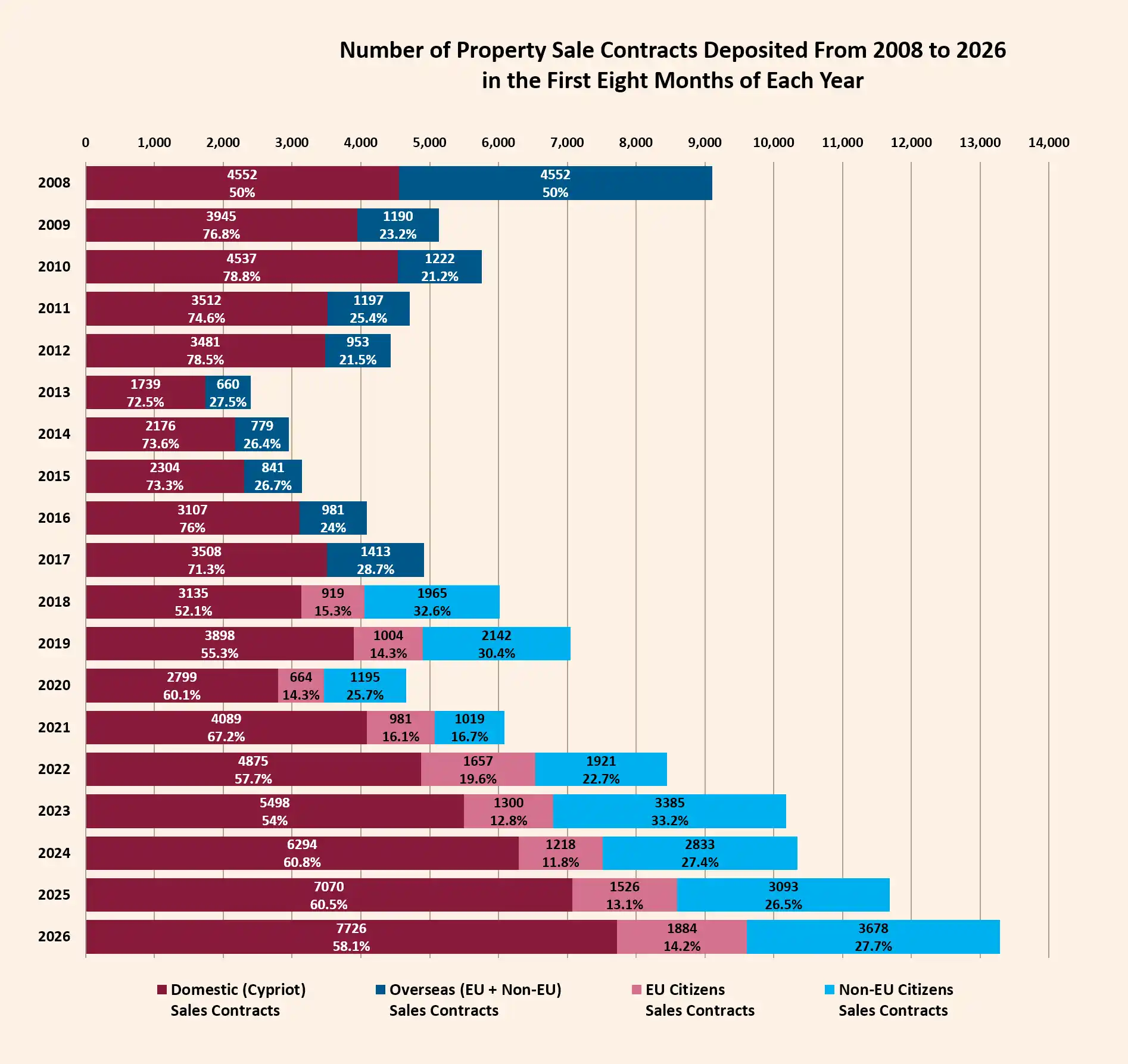
Demand for property remained strong throughout the quarter. According to the Department of Lands and Surveys, the total number of sales contracts increased by 13.8% year-on-year, reaching 4,709 transactions compared with 4,137 in the first quarter of 2025.

The increase was largely driven by international buyers. Property purchases by foreign investors rose by 22.3% to 2,044 transactions, while purchases by domestic buyers increased by 8.1% to 2,665.

Limassol recorded the highest number of transactions at 1,499, followed by Nicosia with 1,065, Larnaca with 994 and Paphos with 919. Famagusta recorded the fewest transactions at 232.

Domestic buyers accounted for 84% of purchases in Nicosia, while local purchasers represented around 60% of buyers in both Limassol and Famagusta. In Larnaca, domestic and foreign demand was broadly balanced, whereas overseas buyers dominated the Paphos market, accounting for 75% of transactions.

Mortgage activity also continued to strengthen. The Central Bank reported that lending to households for home purchases maintained a strong upward trend during the first quarter.

Net new mortgage lending increased by 24.5% year-on-year, reaching €353.6 million, compared with €284.1 million during the same period in 2025.

The weighted average mortgage interest rate fell to 3.15% in March 2026, down from 3.53% a year earlier. The decline reflects the gradual easing of monetary policy by the European Central Bank since mid-2024 and has helped support housing demand.

The Central Bank’s April 2026 Bank Lending Survey also showed rising demand for housing loans during the quarter, while lending criteria remained unchanged at relatively strict levels. Banks expect mortgage demand to remain stable during the second quarter of 2026, although lending standards could tighten further.

Housing supply expands but cost pressures remain

On the supply side, there are signs that new housing stock is gradually entering the market.

According to the Cyprus Statistical Service, the number of residential units granted building permits rose by 79.2% year-on-year during the first two months of 2026, increasing from 1,932 units to 3,463 units.

The Central Bank believes this trend will support a gradual increase in housing supply over the medium term. Survey data from the European Commission also points to continued expansion in construction activity, with the sector remaining in positive territory for a tenth consecutive quarter.

However, cost pressures remain significant. Construction material prices increased by 0.9% year-on-year in the first quarter, remaining close to historic highs due to ongoing geopolitical disruptions and supply chain challenges.

Looking ahead, market sentiment suggests further price growth may be on the horizon. The European Commission’s property price expectations indicator rose to 32.8 in the first quarter of 2026, up from 24.6 a year earlier, indicating that a growing number of market participants expect residential property prices in Cyprus to continue rising in the coming months.

Labour shortages within the construction sector are also contributing to upward pressure on prices. The Central Bank noted that wage growth in the industry remains elevated compared with pre-pandemic levels, adding further costs for developers and builders.

Despite a gradual increase in housing supply, strong foreign demand, improving mortgage conditions and persistent construction pressures continue to underpin the upward trajectory of Cyprus’s residential property market.

People kept waiting as Cyprus planning amnesty grinds to a halt

When the Cyprus government unveiled its Urban Planning Amnesty Scheme in September 2024, it was presented as a practical solution to a long-standing property problem.

Thousands of homeowners who had made minor unauthorised alterations to their properties would finally be able to regularise those changes, secure planning compliance and, crucially, obtain title deeds.

The initiative generated considerable public interest. Property owners responded exactly as the government had hoped, submitting thousands of applications and paying the required penalties. The scheme was designed not only to resolve planning irregularities but also to generate funding for affordable housing through contributions to the Cyprus Land Development Corporation’s Affordable Housing Fund.

Yet what began as a promising reform now risks becoming another example of bureaucratic dysfunction.

Reports indicate that around 3,000 applications were submitted under the amnesty programme, but a year after the scheme closed, only around 20 per cent have reportedly been processed. People who acted in good faith, complied with the rules and paid the required fees are now left waiting for outcomes that should have been delivered months ago.

Amnesty backlog raises serious questions

The District Local Government Organisations (DLGOs), which are responsible for processing applications, have attributed the delays to workload pressures.

While no one disputes that local authorities face significant demands, this explanation is becoming increasingly difficult to accept. The amnesty scheme was announced well in advance, its popularity was predictable, and the administrative burden should have been anticipated from the outset.

If staffing shortages were inevitable, why were temporary resources not allocated? Why were overtime arrangements not introduced? Why were qualified members of the Cyprus Scientific and Technical Chamber (ETEK) not engaged on a contractual basis to assist with the workload?

These are not unreasonable questions. They are precisely the questions applicants are now asking as they watch their cases languish in administrative limbo.

Property owners have held up their end of the bargain

The Urban Planning Amnesty was introduced to address minor planning infringements such as enclosed verandas, pergolas, balcony glazing and other small-scale deviations from approved plans. It was also intended to help unlock title deeds for thousands of properties that had become trapped in Cyprus’ complex planning system.

The government encouraged participation. People responded.

Many applicants incurred professional fees, commissioned consultants and paid penalties ranging from hundreds to thousands of euros. The understanding was clear: comply with the process, pay the prescribed fee and receive a timely resolution.

Instead, many applicants remain stuck in uncertainty, unable to move forward with property sales, transfers, refinancing or title deed applications.

For a country striving to modernise its property sector and improve confidence among homeowners and investors, such delays send entirely the wrong message.

Confidence in the property system is at stake

Property markets depend on certainty, transparency and trust. When governments launch schemes and people participate in good faith, there is an expectation that public authorities will deliver on their commitments within a reasonable timeframe.

Failure to process applications efficiently risks undermining confidence not only in this amnesty scheme but also in future housing and planning initiatives.

Cyprus has made significant progress in addressing historic property issues over the past decade. The Urban Planning Amnesty was supposed to be another step forward. Instead, the growing backlog threatens to become a case study in how good policy can be undermined by poor implementation.

The message from those affected by the delay is increasingly clear: the state cannot invite participation, collect the fees and then leave applicants waiting for results indefinitely.

If the authorities are serious about restoring confidence, clearing this backlog must become an urgent priority rather than a bureaucratic afterthought.

New building inspector rules proposed in Cyprus

The Cyprus government has launched a public consultation on draft legislation that would introduce an independent Building Inspector regime for the first time, marking one of the most significant reforms to construction oversight in decades.

The proposals, published by the Ministry of the Interior, are designed to strengthen compliance with planning permissions, building permits and approved construction plans through mandatory inspections at key stages of development.

The consultation period will remain open until 7 July 2026.

Building inspector framework to improve compliance

Under the proposed amendments to the Roads and Buildings Law, independent Building Inspectors would carry out on-site inspections on behalf of the competent authority throughout the construction process.

The new framework would establish Building Inspectors as independent professionals responsible for verifying that developments comply with approved permits and statutory requirements.

A central electronic register of Building Inspectors would be maintained by the Cyprus Scientific and Technical Chamber (ETEK).

To qualify, inspectors would be required to:

  • Have been registered members of ETEK for at least 10 years.
  • Possess a minimum of 10 years’ professional experience.
  • Demonstrate extensive experience in design, project supervision or licensing procedures.
  • Hold a valid professional licence.
  • Maintain professional indemnity insurance.
  • Complete specialist training programmes.
  • Pass examinations jointly determined by ETEK and the Ministry of the Interior.

The legislation also proposes strict conflict-of-interest rules. Individuals involved in the ownership, development, design, supervision, construction or management of a project would be prohibited from acting as its Building Inspector.

Mandatory inspection stages for larger projects

The draft legislation introduces three inspection stages for developments covered by the new regime:

  • Initial inspection following completion of foundations.
  • Intermediate inspection following completion of the building’s structural frame.
  • Final inspection upon completion of construction.

Following each inspection, the Building Inspector would issue an official report to the property owner, supervising engineer and relevant authority. Any irregularities identified would also be reported to ETEK and other competent authorities where necessary.

Developers and project teams would be required to rectify any breaches before works can continue. Authorities would retain powers to halt construction activities and seek court orders where serious non-compliance is identified.

A new Appeals Committee would be established, allowing parties to challenge inspection findings within 10 days. A €50 fee would apply for appeals.

Development categories and inspection requirements

The accompanying draft decree categorises developments into four groups:

Category A – Residential developments of up to two units, where inspections remain primarily with the competent authority and at least 15% of permits are subject to sampling checks.

Category B – Certain residential developments already covered by existing fast-track planning procedures, with Building Inspectors conducting sample checks on 25% of permits.

Category G1 – Larger developments where Building Inspector inspections would be mandatory.

Category G2 – Complex developments including schools, hospitals, commercial schemes and tourism projects exceeding 1,500 square metres, where mandatory inspections would also apply.

The proposed rules would additionally cover extensions and alterations to existing buildings where the enlarged development falls within Categories G1 or G2.

Appointments of Building Inspectors would be made automatically through the government’s electronic ‘IPPODAMOS‘ system using a digital allocation process designed to ensure a fair distribution of assignments among registered inspectors.

Inspectors would be permitted to decline appointments up to five times within a three-year period. Beyond that threshold, they could be removed from the register for two years unless there is a valid justification or conflict of interest.

Building inspector: proposed fees and penalties

The draft regulations also establish the financial framework for the new inspection system.

Inspection fees would vary according to the size and category of the development and the inspection stage involved.

For developments up to 250 square metres, fees would start at €200 for initial and intermediate inspections and €250 for final inspections. For larger schemes, fees would increase progressively, with maximum charges ranging from €500 to €1,000 depending on the inspection stage.

Where multiple inspectors are required, fees would increase accordingly.

The proposals also introduce enforcement measures for Building Inspectors who fail to meet their obligations. Potential sanctions include:

  • Suspension from carrying out inspections for up to three years.
  • Permanent removal from the register.
  • A ban on preparing designs or supervising projects for up to 12 months.
  • Administrative fines of up to €5,000.

The competent authority would continue to conduct sample inspections and investigate complaints, while retaining the power to take enforcement action against both supervising engineers and Building Inspectors where breaches occur.

What the reforms mean for the Cyprus property sector

The proposed introduction of independent Building Inspectors represents a major shift in how construction compliance is monitored across Cyprus.

Supporters argue that the reforms could improve transparency, strengthen regulatory oversight and reduce unauthorised deviations from approved plans. However, developers, consultants and property owners will also be assessing the potential impact of additional inspection requirements, compliance procedures and costs.

With the consultation running until 7 July 2026, stakeholders across the construction and real estate sectors now have an opportunity to review and comment on what could become a significant new layer of development regulation in Cyprus.

Further Reading

Read the Unofficial translation: Draft Law Amending the Streets and Buildings Regulation Law

Further documents (in Greek) including the Consultation letter, Consulting Building Inspectors, Draft Regulation may be found on this page of the Cyprus Employers & Industrialists Federation website.

Legal delays holdup evacuation of unsafe Limassol apartment block

Nearly a month after authorities applied for a court order to evacuate the Seagate apartment complex in the Germasogeia tourist area of Limassol, no decision has yet been issued, highlighting what local officials describe as a slow and ineffective legal framework for dealing with dangerous buildings.

According to Yiannis Tsouloftas, President of the Limassol District Local Government Organisation (DLGO), the ongoing case demonstrates that while legal mechanisms exist, they incapable of delivering swift solutions when public safety is at risk.

The matter returned to the Limassol District Court for a procedural hearing concerning the organisation’s application for an evacuation order, originally filed on 20 May.

Mr Tsouloftas explained that property owners have lodged an appeal against the authority’s request, which is currently being reviewed by the Ministry of the Interior.

If the court eventually grants the order, the owners will be required to vacate the residential complex, which is home to approximately 60 families. Failure to comply could lead to legal consequences, while responsibility for enforcing the order would fall to the police.

Faster powers needed to address unsafe buildings

Speaking after the hearing, Mr Tsouloftas argued that the current legal framework leaves local authorities unable to respond quickly to dangerous structures.

“Legal tools may exist, but they are time-consuming and ineffective,” he said. “They do not allow the organisation to provide an immediate solution to a problem involving a dangerous building.”

He called for legislative reform that would give local authorities stronger powers to deal with hazardous properties swiftly and effectively, reducing risks to residents and the wider public.

Funding questions add to property safety challenge

The DLGO has also raised concerns about how the costs of dealing with dangerous buildings should be funded.

As a self-financing organisation supported by revenue from water supply, sewerage services and licensing activities, the authority has been assigned responsibilities that generate no direct income.

Mr Tsouloftas questioned whether residents should face higher utility charges or increased building permit fees to fund intervention in privately owned properties that have fallen into disrepair.

He argued that such measures would be unfair and potentially unlawful, noting that European regulations require the authority’s different services to operate as separate business units without cross-subsidisation.

Housing pressures leave residents with few options

The social impact of building evacuations remains another significant concern.

Mr Tsouloftas noted that some tenants may lack the financial means to secure alternative accommodation if an evacuation order is enforced.

With Limassol continuing to experience a severe housing affordability crisis and some of the highest rental costs in Cyprus, lower rents in ageing and poorly maintained buildings can leave residents with little choice but to remain in potentially unsafe accommodation.

He stressed that the issue extends beyond local government and requires a coordinated response involving central government, local authorities and other public bodies.

“The DLGO cannot solve these problems alone,” he said. “There must be cooperation between local government and the state, which has access to broader taxation revenues and greater financial resources.”

Limassol has around 1,000 potentially dangerous buildings

The challenge faced by Limassol is substantial.

According to the DLGO, around 1,000 potentially dangerous buildings have been recorded across the district. Of these, 262 have undergone visual inspections by civil engineers from the Cyprus Scientific and Technical Chamber (ETEK) under an agreement with the authority.

Inspection reports have been completed for 220 properties and are currently being assessed by DLGO engineers. The aim is to determine whether buildings require immediate evacuation or whether maintenance and repair work can sufficiently address safety concerns.

Properties classified as extremely dangerous will be given a deadline for remedial action by owners. Should owners fail to act, the authority intends to pursue legal measures to compel safety improvements.

To date, 96 buildings in Limassol have officially been declared dangerous. Of these, 70 were designated under the current DLGO framework, while 26 cases were inherited from previous building authorities.

The Seagate case is now emerging as a significant test of Cyprus’ ability to address deteriorating residential buildings amid growing concerns over housing safety, affordability and the effectiveness of enforcement powers available to local authorities.

Construction material costs continue to rise in Cyprus

The cost of construction materials in Cyprus continued to move higher in May 2026, according to the latest figures released by the Statistical Service earlier today, adding further pressure to the country’s building sector.

The Construction Materials Price Index reached 122.07 points in May, based on 2021=100, representing an increase of 1.16% compared with April and a year-on-year rise of 2.62%.

Over the first five months of 2026, the index increased by 1.32% compared with the corresponding period in 2025, highlighting the continued upward trend in construction-related costs.

Construction material price index chart

Metal products lead annual price increases

The largest annual increases were recorded in metal products, which rose by 4.31%, followed by wood products, insulation materials, chemicals and plastics, up 3.49%. Electromechanical equipment also posted a notable increase of 2.97%.

Mineral products recorded a 2.03% rise, while other mineral-based materials saw a more modest increase of 0.22%.

Looking at individual categories, aluminium and other metal products recorded the strongest annual growth, climbing by 7.17%. Electrical materials followed with a 5.97% increase, while plastic products rose by 5.93%.

Not all categories moved higher. Heating and cooling equipment prices fell by 1.65%, while ceramic products recorded a decline of 0.74% compared with a year earlier.

Monthly increases driven by aluminium and timber

On a monthly basis, aluminium and other metal products again led the gains, rising by 3.82% in May. Wood products increased by 2.08%, while overall metal products rose by 2.20%.

These increases were among the key contributors to the rise in the overall construction materials index during the month.

Construction sector still facing cost pressures

The latest data suggests that the cost of essential construction materials continues to trend upwards, maintaining pressure on contractors, developers and the wider property sector.

However, the pace of price growth remains significantly lower than the sharp increases experienced during previous years, offering some signs of stabilisation despite ongoing inflationary pressures across parts of the construction supply chain.