

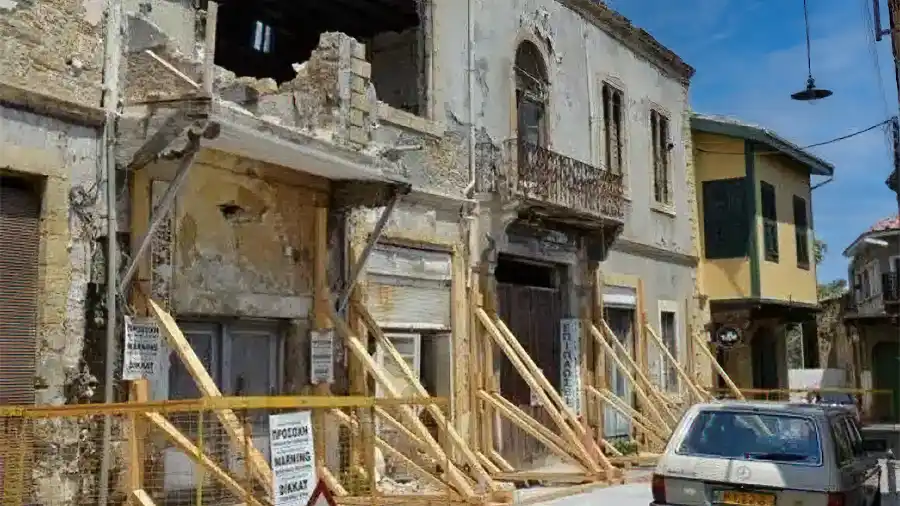
The debate over how Cyprus should deal with dangerous buildings intensified this week as the House Interior Committee continued its clause-by-clause review of a bill designed to strengthen safety regulations.
The proposal, submitted by DIPA MP Marinos Mousiouttas, seeks to amend the 2025 Roads and Buildings Regulation Act to allow authorities to respond more effectively when a structure is deemed unsafe.
According to the Interior Ministry, the updated legislation would close long-standing loopholes that have complicated efforts to shut down dangerous buildings. Officials said the clearer framework is intended to prioritise public safety and ensure that dangerous structures can be evacuated and sealed off without delay.
However, several MPs voiced concerns that the bill falls short on social protections for residents forced to leave their homes at short notice. EDEK MP Marinos Sizopoulos questioned how families would cope without guaranteed housing support, urging lawmakers to include explicit safeguards. Mousiouttas echoed the call, stressing that any technical assessment or intervention plan should be paired with social assistance, particularly in cities such as Limassol where building safety issues are more pronounced.
The attorney-general’s office reminded the committee that certain tenant protections are already in place. Nevertheless, officials emphasised that when public safety is at stake, authorities retain the power to order immediate evictions.
Under current law, occupants have 14 days to vacate a building declared dangerous. The technical evaluation procedure remains unchanged: an engineer or technician must inspect the structure and deliver an assessment within three days, confirming whether the building represents a hazard.
Further complexity emerged when the Nicosia District Local Government Organisation (NDLGO) submitted a memorandum highlighting that it had not been consulted during the drafting of the bill. The document raised technical questions surrounding articles 15A and 15B, particularly the definition of the “competent authority” responsible for action on dangerous buildings.
The NDLGO also sought clarification on whether technical reports submitted by engineers are intended solely for information, require approval, or fall under regulatory control. It questioned who bears responsibility when property owners refuse to leave a dangerous building, and how fines, linked in the bill to the “seriousness of the offence”, should be calculated.
NDLGO general director Konstantinos Parmaklis warned of significant complications in multi-owner buildings, noting that while some owners comply readily, others do not, making enforcement unpredictable and potentially hindering timely safety interventions.
As the committee continues its examination, the central challenge remains balancing urgent public safety needs with the practical realities and social implications of displacing residents from their homes.
