

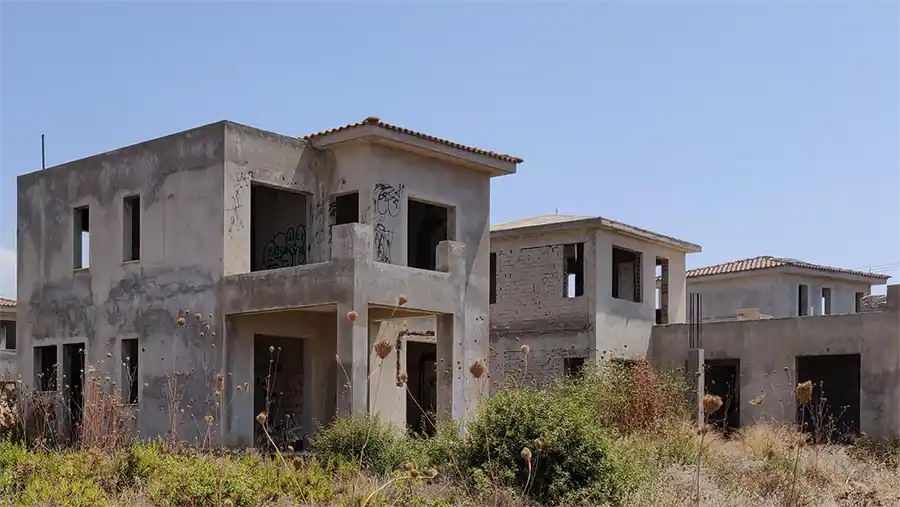
Cyprus could have a significant source of new housing sitting in plain sight. An estimated 30,000 buildings across the island are not being lived in and could potentially be repaired and brought back into use.
The figure comes from estimates by the Cyprus Scientific and Technical Chamber (ETEK). The properties could help increase the housing supply, particularly for people who cannot afford to buy and have little choice but to rent.
The issue has been raised by Charalambos Theopemptou, former chairman of the parliamentary Environment Committee. He began looking into the problem after moving to Agios Andreas in Nicosia, where he noticed a large number of abandoned buildings, including old mansions.
His research showed that the problem is not limited to Nicosia. Empty and abandoned homes can be found in rural areas and across Cyprus, at a time when housing costs remain a major concern.
What other EU countries are doing
Theopemptou examined how other European Union countries encourage owners to bring unused buildings back into use.
- Ireland provides grants to renovate vacant and derelict homes. Funding can reach €50,000 for a vacant property and €70,000 for a derelict property.
- France uses tax measures in areas facing strong housing pressure. These include specific taxes on homes that remain empty.
- Spain allows municipalities, under certain conditions, to impose an additional charge on property tax for homes that have been vacant for a long period.
- Portugal, meanwhile, promotes the restoration of buildings through a dedicated fund for urban renovation and the reuse of existing properties.
Cyprus already provides some support. The Ministry of Interior can offer up to €40,000 towards the renovation of a three-bedroom residential unit.
Theopemptou believes more could be done without creating a costly new system.
A national register of empty buildings
His first proposal is for every municipality and community to work with the Ministry of Interior and the relevant technical services to create a register of vacant, abandoned and dangerous buildings.
The register would need to distinguish between different types of property. A vacant building is not necessarily abandoned, while a dangerous building requires a different response from a listed property with architectural or historic value.
Buildings could then be ranked according to their potential for reuse. The register could record whether a property can be renovated, has historic value, is close to schools or public transport, or sits in an area where affordable housing is in high demand.
Such a system would allow local authorities to set priorities instead of responding to individual complaints.
Combine incentives with action
Theopemptou also proposes a mix of incentives and obligations for owners.
Owners willing to bring buildings back into use should receive fast technical advice, simpler procedures and targeted financial support. Existing schemes could provide a starting point.
He points to Cyprus’s energy upgrade programmes, including Exoikonomo – Anavathmizo, as examples of tools that could be adapted. These programmes could give priority to vacant and abandoned properties that are being returned to lawful use.
The aim would be to make renovation easier while ensuring public funding is directed towards properties with the greatest potential benefit.
Empty buildings could support local communities
Bringing abandoned buildings back into use could have benefits beyond housing.
Cyprus needs more affordable homes for students and other households. There is also scope for small shops, cultural spaces and other local facilities that can reduce the need for residents to travel by car.
Theopemptou argues that abandoned properties, especially in city centres and older residential areas, could form part of this solution.
The state and municipalities could consider long-term leases, partnerships with property owners and social enterprises. They could also look at public buildings that are currently unused.
Such approaches could bring dormant property back into economic and social use without relying solely on new construction.
Faster permits could unlock renovation
Another proposal is faster planning and building approval for small and medium-sized works.
Many abandoned buildings may not require major redevelopment. Instead, they may need a structural assessment, cleaning, removal of dangerous materials, basic repairs, energy improvements, better accessibility and reconnection to utilities.
A quicker approval process could make these projects more attractive to owners and investors. It could also reduce the time between identifying a property and putting it back into use.
Theopemptou believes Cyprus should also make better use of European funding.
Cyprus can tap into the EU renovation drive
The European Commission’s Renovation Wave aims to increase the annual rate of energy renovation and support the renovation of 35 million buildings by 2030.
Theopemptou argues that Cyprus should turn this wider European ambition into simple, fast and locally focused projects. It should also seek European funding to support the work.
For the property market, this could provide an opportunity to link housing policy with urban regeneration and energy efficiency.
Measure results and publish the data
Transparency would be another key part of the proposed system.
Local authorities could publish the number of abandoned buildings identified, how many were deemed dangerous, how many were cleaned or renovated and how many returned to use.
They could also report how many properties were converted for social purposes. Publishing the figures would make it easier to assess whether the policy is working and could strengthen applications for future funding.
Theopemptou says the issue affects far more than the appearance of individual neighbourhoods. It involves pedestrian safety, the protection of communities, the use of public and private property, the revival of town centres and access to housing.
For Cyprus, bringing abandoned buildings back into use could therefore offer a relatively practical way to add homes while improving existing neighbourhoods.
The challenge is turning the idea into a clear system of identification, funding, regulation and delivery. If that can be achieved, thousands of buildings that are currently a burden could become part of the island’s future housing supply.
