Larnaca port & marina saga now ‘at a critical stage’

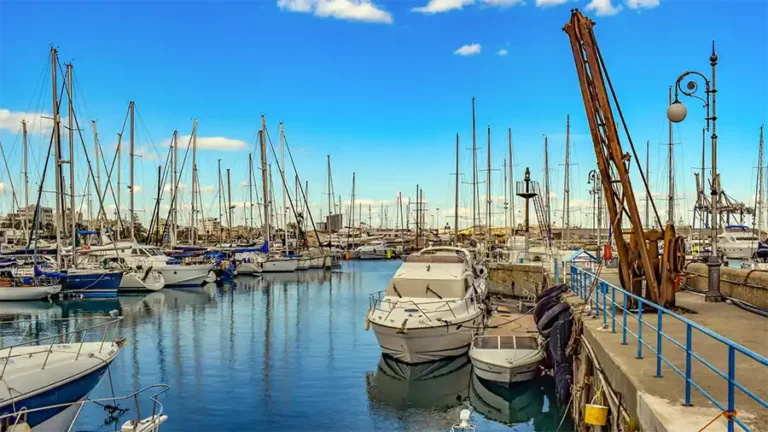
In two weeks’ time the government “may” take a decision on the ongoing dispute with the joint venture holding the concession over the redevelopment and operation of the Larnaca port and marina area – a €1.2 billion project. And although the government is holding its cards close to its chest, it’s no secret that terminating the contract is one of the options.

The issue is that since signing the contract in 2020, the joint venture – Kition Ocean Holdings – has done virtually nothing at the marina and port apart from raising the docking fees for boat owners and the businesses leasing boats. The project should have been completed by 2025. The joint venture had received several extensions because of the Covid situation, but the government is concerned with the lack of progress.

The latest showdown came about over the Operation and Maintenance (O&M) guarantee for the port which had expired and Kition was refusing to renew. It went to a meeting at the presidential palace to discuss it on April 15 and there it was apparently agreed that it would pay a guarantee for €4.2 million – significantly lower than the €10m it had been and the government was demanding.

Transport Minister Alexis Vafeades said at the time that it was agreed for Kition to pay €4.2m by April 23, and the two sides would go to arbitration to decide the size of the guarantee in the meantime.

April 23 came and went, and the guarantee was never renewed. So, Vafeades turned to the attorney-general’s office for legal advice, to see how the government could proceed.

Meantime the Larnaca mayor and the town’s players were alarmed about a potential contract termination, as it would mean a new tenders process from scratch that would take years to finalise – assuming anyone showed interest. Past experience had shown it was difficult to spark interest.

When contacted, Larnaca mayor Andreas Vyras told us that they’re waiting on the government to take whatever steps necessary.

“What do we want? For the government to clear up the situation, one way or another,” the mayor said.

“That means either with the current contractor, or with someone else…but so long as the project isn’t derailed.”

Vyras, who could not speak long due to a prior engagement at the time, added: “Of course we’re worried. Judging by public statements on the matter, it looks like things have reached a critical stage.”

We next reached out to the transport minister, who gave the government’s version of events.

He said the contract stipulates that concessionaire must submit three letters of guarantee. For example, these guarantees relate to construction, as well as to operation and maintenance.

If, for instance, the concession holder doesn’t build well, the state can cash the relevant guarantee – which is like an insurance policy. The guarantees are held by a bank.

Guarantees have a cutoff point, after which their validity is renewed. The issue at hand is that Kition did not renew the validity of the O&M guarantee.

“These guarantees are an essential term of the contract,” Vafeadis told the Sunday Mail. “If not renewed, to us this means that a basic component of the agreement is missing.”

But why? What’s the dispute really about?

Officially, Kition say the project as it stands is not viable under the current circumstances. They want to revise certain aspects of the agreement. It’s understood that they’ve cited the adverse environment due to Covid, the Ukraine war and the ongoing conflict in Gaza.

Kition has thrown the idea of being allowed to start the more profitable aspect of the project – building villas and flats – before beginning work on the port and marina. The government has refused to discuss this – perhaps because it has lost faith in the joint venture. It’s understood that Kition have to date carried out only minor infrastructure works – some maintenance work on the old pier (a listed building) plus creating a parking space. No substantive work has begun on either the marina or the port.

On its part, the government says it won’t – and can’t – discuss any changes to the agreement unless the guarantee is renewed first. Once it’s renewed, only then will the government be willing to renegotiate aspects of the contract.

So, this can be likened to a Catch-22. By not renewing the O&M guarantee, the concessionaire is holding the government to ransom, in a manner of speaking.

According to the minister, it was Kition itself who proposed downsizing the O&M guarantee to €4.2 million. This happened in late January.

In the minister’s opinion, the concession holder is now “in default” in the sense of keeping to the contract.

“We got the legal opinion from the attorney-general beginning of this week [meaning last week],” Vafeadis confirmed. “We’re currently studying the legal opinion and its ramifications and are in touch with the AG’s office.”

Asked directly whether the drastic option of terminating the contracting is on the table, the minister replied in the affirmative.

“But we have not decided anything yet,” he hastened to add.

“Even if the contract were terminated, we are committed to pressing on with the project, it won’t be the end of it. But yes, it would have to be a new tender from scratch, so more delays.”

Vafeadis would not comment on whether they’ve set any deadline for action. “We’re proceeding step by step,” he offered.

But a decision, based on the AG’s legal advice, “may” be taken in two weeks.

Other sources apprised of the matter told us that one of two things are happening: either Kition have concluded the project is not viable and they want to renegotiate; or the concession holder faces financial trouble.

The parent company of Kition are Aroundtown SA, a public limited liability company listed on the Frankfurt stock exchange. Aroundtown, which has Israeli interests behind it, holds 80 per cent of the stake in Kition.

At the close of the markets on Friday, May 10, Aroundtown’s share traded at €2.07. The company has a market cap of €2.26 billion.

The company’s stock price has been trending down in the last three years. For example, in early 2020 the shares were trading at €8.

In a press release dated March 27, 2024, regarding Aroundtown’s results for fiscal year 2023, the company stated it had “strong liquidity and solid operations”.

The same press release said the company had secured a “new bank debt of ca. €1 billion signed in 2023”.

It added that due to “current macro-economic environment, the company will not pay dividend for 2023.”

As at the end of 2023, its assets consisted of (by value): 40 per cent office space, 33 per cent residential, 21 per cent hotels, and the rest in logistics/retail.

According to its Wikipedia entry, the majority of Aroundtown’s real estate portfolio is located in the cities of Berlin, Frankfurt, Munich, Cologne, Hamburg, Amsterdam, London and other major European metropolitan areas. The company owns hotels such as Hiltons in Berlin and London, the Sheraton in Rome and the Marriot in Paris.

Back to the minister, who says he fully understands the fears of Larnaca people that the entire project might face the chop.

“I’ve discussed the matter with local Larnaca reps, explaining to them that we cannot give in to unreasonable demands. But naturally, they’re not happy with the situation.”

Plans for expanding and privatising the Larnaca marina have been plagued by years of delays and failure to find investors.

Back in 2010 the government struck a deal with Zenon Consortium for a €700 million project to transform both the existing port and marina. The consortium failed to raise the necessary funds even though the government extended the deadline up to 20 times until 2015 when the deal fell through.

Much of the blame fell on the recession and the 2013 banking crisis.

CM

Average apartment values highest in Limassol

The Cyprus Real Estate Agents Registration Council on Wednesday released a breakdown of property transactions and average values during the first quarter of 2024, according to property type, across all districts.

The council said that the analysis of comparative sales data, which are provided by the Department of Lands and Surveys, “offers significant insights into the transactions and property values in Cyprus during the first quarter of 2024”.

Moreover, the council noted that its analysis primarily concentrates on four key property categories, including apartments, houses, plots, and fields.

The objective of this analysis, the council continued, is to capture the average value of completed sales in each district alongside the corresponding transaction volumes.

Crucially, the council said that “it is important to clarify that the data for average prices do not only concern sales made in the cities of free Cyprus”.

“Instead, they are derived by considering all sales made within the geographical boundaries of each district,” it added.

According to the council, a total of 421 apartment transactions were recorded nationwide during the period. The majority of these transactions occurred in the district of Nicosia.

Limassol boasted the highest average apartment value at €208,220, significantly surpassing other districts.

Nicosia followed with an average value of €131,841, Larnaca at €116,914, Paphos at €107,175, and Famagusta at €105,182.

“The analysis of property transfers shows that apartments attract greater purchasing interest when compared to houses, while the sales of plots and residential fields attract the interest of land development companies,” council president Marinos Kineyirou said.

The market for houses encompassed 244 transactions across Cyprus from January to March 2024, with Nicosia leading with 137 sales.

Notably, Famagusta surpassed Larnaca in house sales and recorded the highest average value at €393,497.

Limassol saw an average value of €209,917, slightly lower at €206,436 in Larnaca, €138,488 in Nicosia, and €96,925 in Paphos.

What is more, Nicosia and Limassol dominated plot sales, accounting for 284 out of 462 transactions nationwide.

However, the highest average plot values were found in Paphos (€276,468) and Limassol (€207,875).

Famagusta followed closely with an average value of €196,857, while Larnaca recorded €182,350, and Nicosia €167,966.

It’s worth noting that plot sizes and the inclusion of buildings may contribute to the variations in average values.

Nicosia and Limassol collectively registered the highest number of field transactions, totalling 735 out of 1,206 transactions nationwide.

In terms of average values, fields were pricier in Paphos (€119,249) and more affordable in Nicosia (€82,192). The average values in the remaining three districts were relatively consistent.

The data underscores the regional variations in property transactions and values, reflecting the diverse preferences and market conditions across the island.

CM


April saw strong growth in property sales

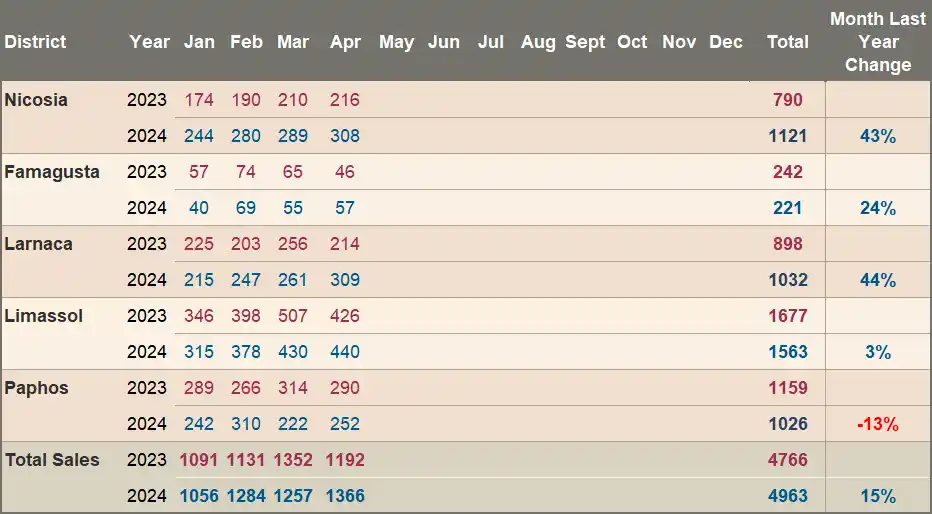
Property sales bounced back In April 2024, following a disappointing drop on sales of 7% in March, with the total number of sales contracts deposited at Land Registry offices across Cyprus reaching 1,366; a 15% increase compared with the corresponding month in 2023.

This is the highest number of April sales since the height of the boom in 2007, when they reached 1,556.

As well as residential properties, the figures from the Department of Lands and Surveys include commercial property, retail premises, offices, warehouses, and land. Regrettably, the Department doesn’t provide a more detailed analysis.

Although sales in Paphos fell by 13%, this was outweighed by increased sales in Larnaca (44%), Nicosia (43%), Famagusta (24%), and Limassol (3%.)

Cyprus property sales achieved in April 2024

Sales in the first four months of 2024 rose 4% compared with the same period last year. While property sales in Nicosia and Famagusta are performing better than last year, sales in Paphos, Famagusta, and Limassol have some catching up to do.

Total Property Sale Transactions – 2023/2024 Comparison (Jan-Apr)

Holiday home rents & prices surge

The Cyprus holiday home market has risen to unprecedented heights, shaking off the lingering effects of the COVID-19 pandemic. Both rental rates and selling prices have soared, reaching their highest point in the last eight years.

Holiday rentals, whether apartments or houses, have surged to levels not seen since 2016, with Limassol experiencing a staggering price hike of over 100%. According to data from Danos International Property Consultants and Valuers, nationwide rental increases hover around 80% for apartments and 60% for houses, compared to 2016 figures.

Similarly, selling prices have surged, with apartments and houses seeing increases of 40% and 20% respectively. These increases follow a slump in 2020 due to the pandemic, but since 2022, prices have been rising steadily.

Larnaca leads in rental increase for holiday homes, with rents rising 74% since 2016 and 41% since 2019. Notably, many of these properties are also marketed as permanent residences.

Holiday rentals now command between €25 and €30/sqm, a significant jump from the €18 to €22 range in 2019. Prices vary based on factors like location, age, and outlook.

Larnaca is followed closely by Paphos in rent increases, with rates climbing by 24.5% compared to 2019, fetching between €25 and €30/sqm.

Interestingly, Limassol, although ranking third in rent increases, is witnessing a narrowing gap with other districts, with rents ranging from €23 to €70/sqm, compared to €20 to €60 in 2019. Holiday homes in Limassol are also in high demand as permanent residences, especially if they offer proximity to amenities and commercial areas.

In Famagusta, rental prices are on par with Limassol, with increases of 16% and rates ranging from €21 to €25/sqm for high-standard accommodations.

As for selling prices, Limassol commands the highest figures, exceeding €4,000/sqm, marking a 20% increase since 2019. This suggests a growing inclination towards property ownership over renting.

Famagusta follows suit, witnessing a 20% increase in selling prices since 2019, averaging between €2,760 and €3,000/sqm.

Larnaca comes next in selling prices, experiencing a 7% rise since 2019, with prices ranging from approximately €2,300 to €2,900/sqm.

In contrast, Paphos sees a modest increase in selling prices, making it an attractive investment prospect compared to rental rates. Purchasing a holiday home in Paphos has seen a 15% increase since 2019, with prices averaging around €3,000/sqm.

Larnaca port & marina must be concluded “at all cost”

Positive messages about the prospects of Larnaca and the certainty that the development of the Larnaca port & marina will be completed at all cost, was the conclusion of the “Larnaka Property Show 2024” organised by FMW Conferences.

More than 20 speakers referred to Larnaca’s development prospects, the new projects being planned, the coastal town’s competitiveness in the real estate sector and its attractiveness to foreign investors.

In his address, Interior Minister Constantinos Ioannou said that the state aims to energise the real estate sector in order to create affordable housing for all income groups, through the continuation of incentives to increase the maximum building coefficient.

Ioannou’s speech, read out by Lena Zachariou of the Larnaca Town Planning Department, referred to the increase of the total buildable area of the development, which is foreseen to create additional residential units for disposal for community purposes, and in parallel with this action to encourage the creation of new options in the construction sector and related jobs.

Referring to the recent approval by the Council of Ministers of the bill for the facilitation of large and strategic developments, which simplifies and speeds up the licensing procedures for large and strategic developments, the minister said that “through this particular bill, the state seeks to define a regulated urban planning and building framework for rapid licensing of a development, within a period of one year, in a modernised one-stop-shop framework, thus freeing the service of foreign and local investors from delays and bureaucratic inefficiencies”.

Larnaca Chamber President Nakis Antoniou referred to the unified development of the port and marina and praised, “the commitment of the Minister of Transport, Communications and Works Alexis Vafeadis that the project will be done one way or the other. The development of our city will not stop here, but will continue with the creation of the great project of the port and marina.”

Also referring to the reconstruction of the port and the marina, Mayor Andreas Vyras emphasised that despite any problems, this will be completed one way or the other and added that in the coming years projects with a total value of 100 million euros are planned in Larnaca.

Dinos Lefkaritis, Chairman of the Larnaca Tourism Promotion Board, said that tourism in the town and the district is on a significant development path, since arrivals in the last six years have increased by approximately 100,000, while the region’s share has also increased to 12.1%. During this time, 15 new hotel units were opened in the town and along the tourist area of Larnaca, with a total capacity of 1,472 beds, international chains such as Radisson, Intercontinental, Best Western and Accor were successfully attracted, while within the city limits, at least 25 applications have been submitted for new units.

Michalis Tiniozou, Regional Director at the Bank of Cyprus, main sponsors of the conference, said that the development path of the town is reflected in the data from the land registry department, according to which in 2023 the volume of transactions recorded an increase of 22%, while in the first quarter of 2024 sales closed with a positive sign, registering an increase of 6% on an annual basis, with half of the 723 sales going to foreign buyers.

Larnaca rents tripled since 2019

Warning that any delay in the development of the marina and port could have negative repercussions on the general development of the town, Panos Danos, CEO of Danos Real Estate said that Larnaca has enjoyed phenomenal growth in recent years.

He presented rental data, showing that in some areas these have tripled from 2019.

Danos said that the rent in Larnaca for a one-bedroom apartment is between €450 and €550. Two-bedroom apartments cost from €550 to €650, while the rent for a three-bedroom apartment is from €750 to €850.

Andreas Lefkaritis, head of sales at the Petrolina Group that is developing the coastal “Larnaca Land of Tomorrow” mixed-use project worth €1 billion, said that the company after dismantling the oil facilities ended up with 450,000 square meters, on the Dhekelia road seafront, stretching 2.5 kilometres.

“Immediately, an internal team of four managers was set up within the Group with the aim of proceeding with a plan to utilise the specific area.

“It will be an extension of the city of Larnaca and will be consistent with its character.

“The three pillars of the project are the community, greenery and the sea,” he said.

On behalf of the Patroclos Group, Andreas Georgiou referred to the prospects of Larnaca, but also touched on negative points that affect the land development companies. He said there is a lot of bureaucracy in the licensing of projects, refusal of the banking system to respond to business plans and confusion regarding how everyone wants Larnaca to develop.

Georgiou said that the Patroclos Group is constantly growing and has projects in many areas of Larnaca and Crete. As he explained, “the Group’s plans in the coming years are very ambitious and we will achieve them.”

The deputy managing director of the Quality Group, Iraklis Zavos, referred to a large project promoted by the group, “Q City Oasis” on Spyros Kyprianou Avenue, next to Petraki Kyprianou high school.

He said, “it will offer urban innovative development with various residential, commercial and communal uses, luxury apartments, multiple parks, playgrounds, restaurants, gyms, cafes and wellness centres.”

Sunshine and strain – a market divided

0

A booming economy (projected 2.7% growth in 2024), resurgent tourism, and impressive fiscal discipline (budgeted surpluses averaging 2.3% of GDP from 2023 to 2028) create a narrative of prosperity. Construction flourishes, with coastal hotspots like Limassol leading the charge.

However, beneath this sun-drenched exterior lies a tale of two markets, each with its own set of challenges.

Locals feeling the squeeze

While foreign investors flock to Cyprus, lured by the “golden visa” program, low corporate and income taxes, and the promise of sunshine and stability, locals face a different reality. In February 2024 loan restructurings comprised 45% of new lending for home purchases, highlighting the financial strain on some Cypriots. Rising interest rates and inflated property prices – exacerbated by raw materials, energy, and overall inflation – further tighten their grip. This financial squeeze is particularly concerning for local residents, who generally earn less and are taxed more compared to their foreign counterparts.

Foreign investment

A Double-Edged Sword: Foreign investment, particularly from non-EU countries, has fuelled the coastal boom in places like Limassol and, to a secondary extent, Paphos and Larnaca. However, this reliance on external capital creates a vulnerability. Sanctions on traditional investor pools like Russia, coupled with a potential market correction (indicated by a downturn in property transactions, especially for higher-end residential properties), could see some foreign buyers shift their focus. The occupied part has already become more attractive to certain demographics, such as Russian (circa 70,000 already live there), Israeli and Lebanese investors.

A history of overlooking problems

Cyprus has a track record of overlooking problems, as evidenced by past economic crises, as well as taking a short-term view when trying to address them. A proactive approach from the government is crucial to ensure long-term stability. This includes addressing the affordability concerns of local residents, mitigating the risks associated with overdependence on foreign investment, and building the mechanism to ensure that all locals benefit from the increase in overseas companies and residents. We are not hopeful, as politicians are currently focused on the upcoming municipal and European elections, with the parties in parliament remaining divided and lacking vision.

Foreigners everywhere

One-in-four persons living in Cyprus was born overseas, they own established businesses, and form part of the country’s fabric. They are here to stay. For good. They are Cypriots. Ignoring one quarter of the population isn’t the way to build a sustainable future. The fact that some (many) don’t like that the cost of living has increased, that working hours are longer, and that there are more technically savvy people around, doesn’t mean that by ignoring “the foreigners” all of these problems will go away. The competition is here, now. Whether you decide to enter the race is your choice, but the race is still going to take place and you will still feel the consequences of its outcome.

Immigrants and their descendants are playing an increasingly central role. They own a significant part of Cyprus’ infrastructure (both airports and ports, three out of four telecommunication companies, all banks, an increasing number of hotels, etc), they start businesses, contribute to the local culture, and participate in community life. This not only enriches the cultural landscape but also boosts the economy by creating jobs, increasing demand for goods and services, and bringing in new skills and perspectives.

However, this influx also presents challenges for the housing market. Increased competition for jobs often puts pressure on local wages, which can make affording property more difficult. Furthermore, the growing population creates a higher demand for housing, potentially leading to rising prices and pressure on public services. This rapid change can cause friction among some locals, who may feel left behind or displaced.

These concerns sometimes manifest in the rise of right-wing political parties. It’s crucial to recognize, however, that these anxieties are not unique to Cyprus. Globalization and technological advancements are reshaping economies and labour markets globally, leading to similar concerns about living costs and competition.

Moving forward, a sustainable future requires acknowledging the contributions and needs of all residents. Integration policies and inclusive economic planning are essential. These policies should aim to ensure that the benefits of immigration – economic growth and cultural diversity – are distributed fairly across the population. This may involve supporting affordable housing initiatives and developing programs that equip locals with the skills they need to thrive in a changing market.

Only one future is sustainable for Cyprus real estate: one that bridges the divide and fosters a shared prosperity for all residents.

Copyright © 2024 All rights reserved to WiRE