New Bill for Jointly-Owned Buildings

In order to avoid misunderstandings, we have to admit that there is currently relevant legislation regulating jointly-owned buildings, which, however, is not without significant shortcomings.

First problem: Quite often there are difficulties in collecting common expenses from late-paying owners. In order to collect, a claim through courts must be launched, through civil action, something which is both a time-consuming and costly procedure, for any Management Committee, (MC), to embark on.

Fines

With the recently-introduced bill, which is currently under discussion in the House of Representatives, the MC can impose a fine on an owner who owes common expenses.

The new Authority that will be created at the level of the municipalities concerned (the Authority) will be in a position to impose a management fine on an owner. The Authority shall be able to sue a non-payer by filing a civil or criminal case.

In order for the defaulters to present a defence in the civil action, they will first have to pay the utilities they owe, either to the court clerk or to the MC., and then have a lawyer prepare a defence.

MCs will be in a position to exercise the right to limit the defaulter’s rights, barring the option of limiting access to the defaulter’s property.

This provision of the bill begs for further explanation. Namely, what exactly will the MC be allowed to do to exercise pressure on the defaulter to pay? With the new bill, the Land Registry will require a certificate of payment of common expenses before authorizing a property transfer.

Sinking Fund

Another problem is that both in the existing legislation as well as the bill, there is no provision mandating the creation of a sinking fund.

Currently, just a small percentage of buildings have an established sinking fund, used to collect money that will be used for major building repairs such as roof insulation, elevator replacement, entryway landscaping, and maintenance (repair of major cracks, painting, etc.) on the outer shell of the building.

It is much easier and sensible to already have a significant amount of cash in the building fund at the time of major repairs instead of requiring owners to come up with a substantial sum of money in a relatively short period of time when the need arises. We believe the new legislation should mandate the creation of a sinking fund.

Major Problem

But what seems to be the biggest problem of all? Perhaps the biggest shortcoming of the new bill is that there is no requirement for transparency through a regular and reliable supply of information to owners from the MC.

In the existing legislation, there is a general reference for quarterly flow of information while in the bill there is a provision for either bi-annual or annual provision of information during the Annual General Meeting of owners. This provision is far from satisfactory.

Transparency in finances is necessary in order not to generate doubts that the Management Committee may be cannibalizing the financial resources of the building and to avoid most misunderstandings and friction between owners.

Electronically

In today’s era of information, we would expect the MC to have this information posted electronically and on a 24/7 basis. If continuous information is not possible then at least establish a once-monthly flow of information in which all of the following are released:

  1. the payments and collections of the month.
  2. the financial obligations of the building and the receivables of the apartment building from the owners.
  3. offers secured for repairs as well as details of work assignments to service providers, etc.

The bill amended the apportioning of common expenses so that only 40% of the covered verandas and 20% of the uncovered verandas will be taken into account in the calculation of the total surface area of the unit.

It is understood that owners in jointly-owned buildings continue to have the right to establish their own Regulations in deviation from the Standard Regulations that accompany the legislation. This means that owners with a majority of 75% can alter the provisions of the Standard Regulations.

The new bill improves the procedures, rights, and obligations of the involved owners and the MC in case a unit creates a problem either in relation to another unit or in the common areas.

Keeping records

The bill assigns the supervision of the jointly owned buildings to a district authority of the municipalities instead of the Land Registry, which is currently the established procedure.

The involvement of the Land Registry in the problems of jointly-owned buildings up until now has been almost non-existent. We hope that the new Agency, within the municipalities, will be able to cope with its mission, so that problems such as the absence of an Administration Committee, delayed payment of utilities by owners, and timely repairs, will find their resolution in a short period of time.

We must emphasize that the bill requires Administration Committees to secure a certificate of building suitability from consultants (a sort of MOT for buildings), which is also a requirement of other legislation that regulates citizens’ safety issues.

Jointly owned buildings shall be required to register with the Agency’s records and to inform it on an annual basis of the establishment of the Management Committee, paying a relevant annual fee (€20).

In summary, the new bill provides some solutions to the main problem of non-collection of common expenses. The second main issue, that of the lack of transparency with the provision of correct and timely information, is not addressed by the new bill and is something that the House of Representatives should rectify during the discussion of the bill.

A final concern we have is that with the increased obligations and responsibilities of MC members, there is bound to be little if any, interest on the part of owners to participate in Administration Committees. Our suggestion is that all owners should be appointed as members of the MC by law, but for practical reasons, a small group of owners should act as the Executive Committee of the MC.

About the author

George Mouskides is the Director FOX Smart Estate Agency and Chairman of the Cyprus Association of Property Owners.
 

Tall buildings policy to be reviewed

2

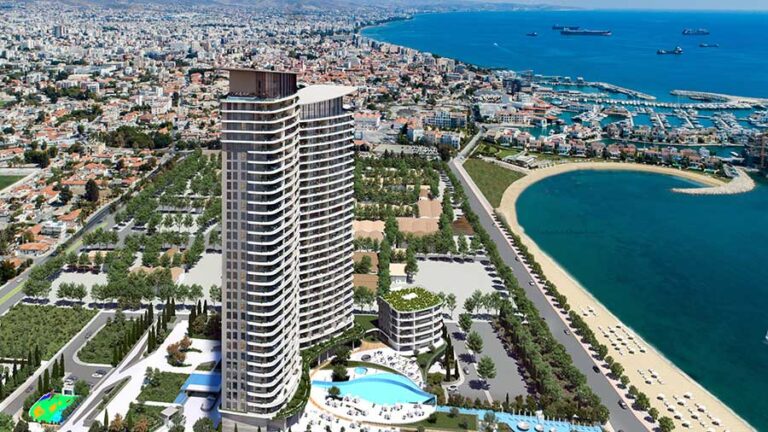
A study into the impacts of tall buildings has been commissioned by the urban planning council of the interior ministry.

According to a statement, the study, to be carried out by the architecture school of Neapolis University in Paphos, focuses on evaluating the impact of the construction of tall buildings in Cypriot cities, particularly in Limassol and Nicosia, and on examining new policy frameworks for their regulation.

The study is expected to be organized in three parts, the first of which will focus on understanding the current situation and a review of permit and construction processes. Researchers will map the locations of tall buildings and analyse their effects on the urban skyline, view, microclimate and shading, and interview residents living in their vicinity.

In the second part, the researchers will record best practices of countries and cities abroad in terms of view directions, building aesthetics, and urban planning procedures for high-rise developments.

The third part of the study will focus on determining siting parameters for tall buildings in Cyprus and propose mechanisms for urban planning control.

The study is expected to last five months and is supervised by the Department of Urban Planning and Housing, which will also be providing data and information.

Residents living near high rises, especially in Limassol and Nicosia, are invited to contribute their opinions by participating in the study’s questionnaire which can be found here.

Fresh trial for Al Jazeera passport sting

A fresh trial of key figures accused of selling Cypriot passports to dubious investors, exposed by an Al Jazeera sting, was launched Wednesday, with the prosecution dropping all charges against lawyer Andreas Pittadjis, one of the four accused.

On Wednesday, the Nicosia Criminal Court announced the latest charge sheet, removing Pittadjis, dropping all charges him.

The new trial was adjourned until November 14.

In September 2022, he faced five counts related to corruption offences and conspiracy to extort.

Charges emerged following a gotcha video from Qatar-based Al Jazeera network portraying senior officials caught on camera ready to assist a fictional Chinese businessman with a criminal past to obtain a Cypriot passport in exchange for money.

The passport cases involve Jordanian businessman Almi Hilmi Munib Armoush, Zaineh Ali Himli Armoush, Russian businessman Nikolay Gornovskiy and the case of the alleged Chinese investor with a criminal record.

Pittadjis was connected to the case of former Gazprom executive Nikolay Gornovskiy, who obtained a Cypriot passport through the now-defunct Citizenship for Investment Scheme.

Gornovskiy is wanted in Russia in connection to corruption involving abuse of power.

Following the cases against him being dropped, Pittadjis posted on Facebook about an “obscenely edited video of Al Jazeera” and “those who know the truth” but remained silent while hinting against the government for wrongfully targeting him.

In a long emotional post, Pittadjis also fired against the Cyprus Bar Association, who took disciplinary action against him when the Al Jazeera story broke.

The charge sheet now includes former Speaker of the House Demetris Syllouris, former AKEL MP Christakis Giovanis and Antonis Antoniou, a director of the latter’s companies.

Pittadjis will now be acting as the latter’s defence lawyer.

The trial of the original four started in September last year but was abandoned after the Nicosia Criminal Court was forced to discontinue due to a change in the composition of the bench at the end of June.

Prosecutors were then forced to resubmit the case.

Attorney General George Savvides decided to prosecute them after assessing the findings of a public enquiry conducted by former Supreme Court judge Myron Nikolatos.

The probe was prompted by the Al Jazeera expose.

Nikolatos’ damning report found that over half (53%) of the 6,779 passports granted were done so illegally, encouraged by a due diligence vacuum or insufficient background checks.

As a result of the undercover Al Jazeera video showing Syllouris and Giovanis offering help to the fictional Chinese businessman, the country’s citizenship for investment programme was axed in November 2020.

Non-EU nationals driving property market

The latest sales figures from the Department of Lands and Surveys shows that non-EU nationals are driving the property market, with foreign buyers accounting for 45% of sales in September; up from 30% in August.

Market segment analysis

Property sales to non-EU citizens

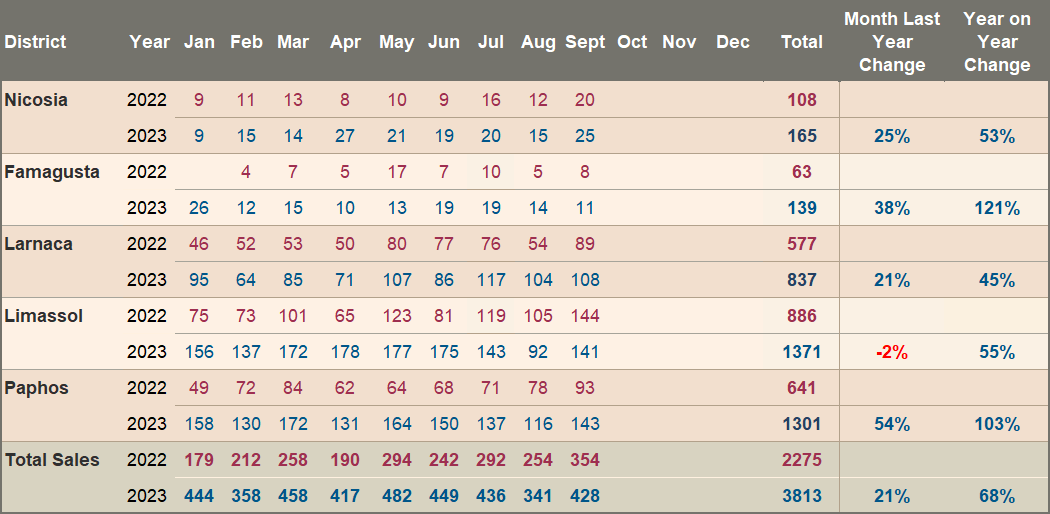
Sales to non-EU Nationals rose 34% compared to August 2022 and accounted for 30% of the total number of sales achieved during the month.

With the exception of Limassol, where September sales fell by 2% compared to the same month last year, they rose by 54% in Paphos, 38% in Famagusta, 25% in Nicosia and 21% in Larnaca.

Paphos recorded the highest number of sales, followed by Limassol, Larnaca, Nicosia and Famagusta.

Non-EU property sales September 2023
Overseas (non-EU) Sale Transactions – 2022/2023 Comparison

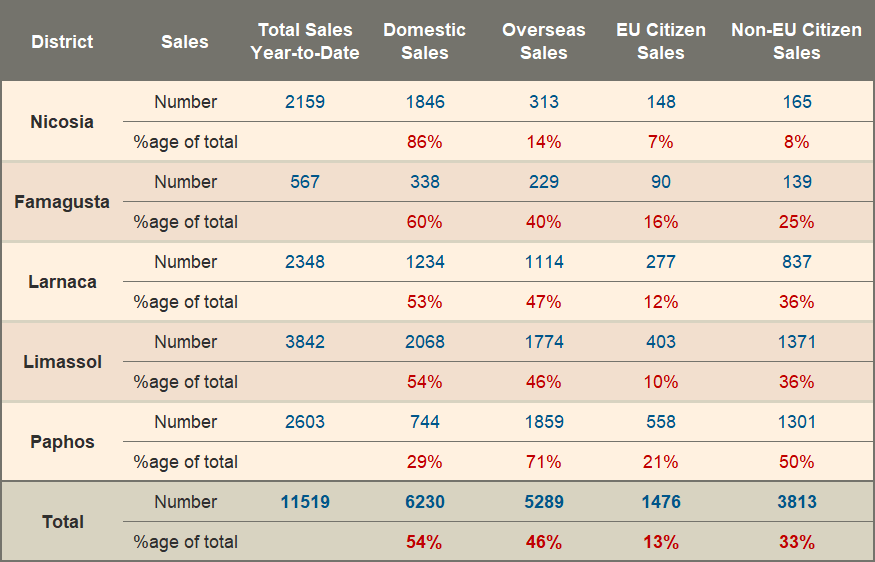
Sales to non-EU nationals during the first nine months of 2023 reached 3,813; a 68% increase on the 2,275 achieved in the first nine months of 2022.

Property sales to EU citizens

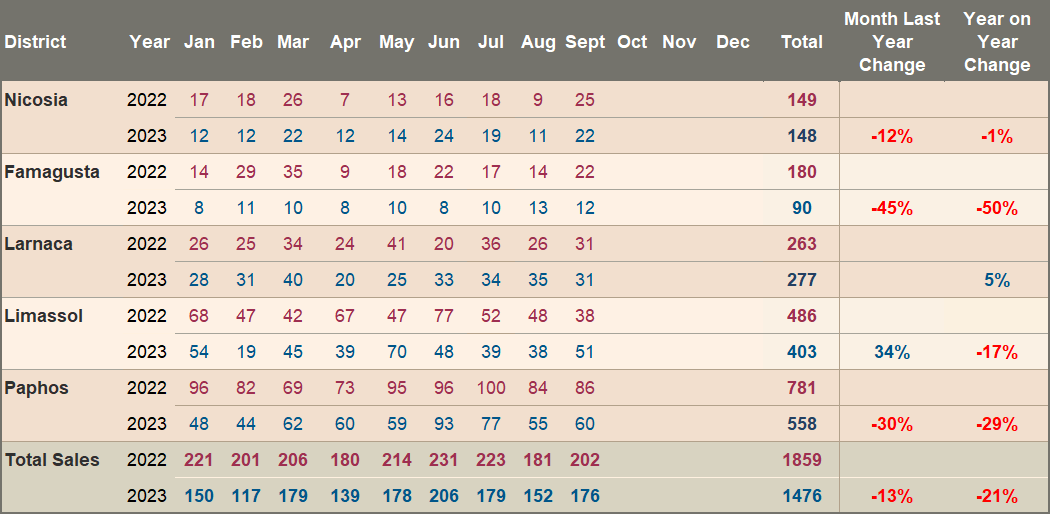
Sales to EU nationals continued their downward trend, falling by 13% compared to September 2022. Limassol, where sales rose by 34%, was the only district to buck the trend.

Sales in Larnaca remained steady, while sales in Famagusta, Paphos and Nicosia fell by 45%, 30% and 12% respectively.

Property sales EU citizens September 2023
Overseas (EU) Sale Transactions – 2022/2023 Comparison

Sales to EU nationals during the first nine months of 2023 reached 1,476; a fall of 21% compared to the 1,859 achieved in the same period last year.

Total property sales to the overseas market

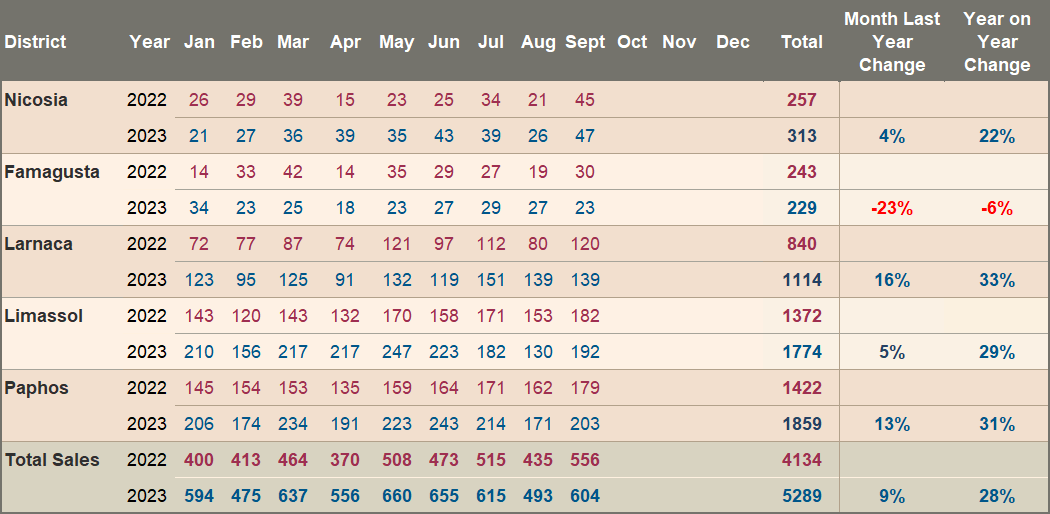
Sales to foreigners (both EU and non-EU citizens) in September rose 9% compared September 2022, despite the 13% fall in sales to EU citizens.

Sales rose in all districts with the exception of Famagusta, where they fell by 23%.

Paphos recorded the greatest number of sales (203), followed by Limassol (192), Larnaca (139), Nicosia (47), and finally Famagusta (47).

Property sales to EU and non-EU citizens September 2023
Property sales to the overseas market – 2022/2023 Comparison

Foreign real estate sales during the first nine months of 2023 reached 5,289; a 28% increase on the 4,134 achieved in the same period last year.

Overseas market preferences

An analysis of property sales to the overseas market over the first nine months of 2023 reveals that foreign buyers prefer to buy in the coastal areas of the island:

buying preferences by districtProperty sales to the domestic market

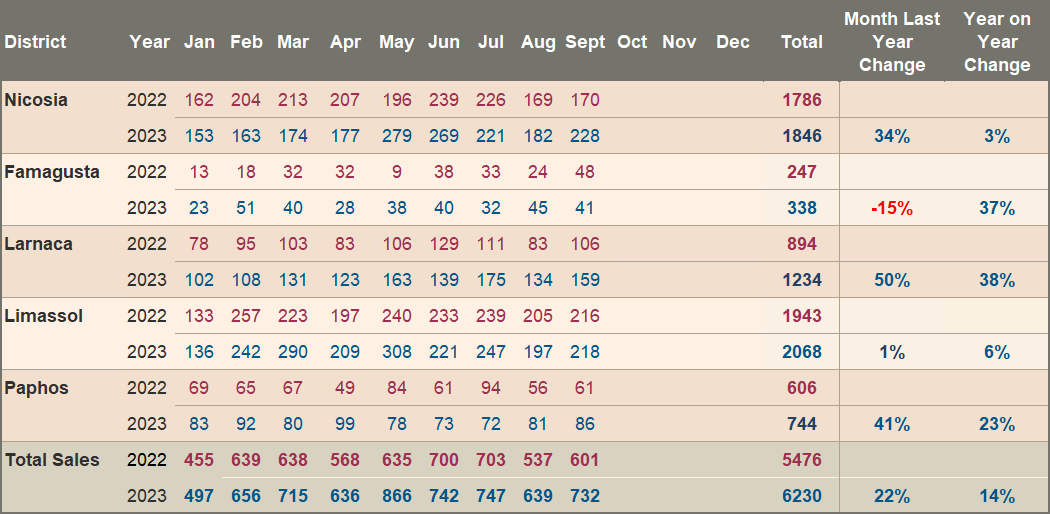
Real estate sales to the domestic market in September rose 22% compared with September 2022 but with Famagusta reporting a fall of 15%.

Nicosia recorded the greatest number of sales (228) followed by Limassol (218), Larnaca (159), Paphos (85), and Famagusta (41).

Property sales domestic market September 2023
Domestic Sale Transactions – 2022/2023 Comparison

Sales to the domestic market during the first nine months of 2023 reached 6,230; an increase of 14% on the 5476 achieved during the same period last year.

Monthly property sales 2008 to September 2023


House price index up 3.2% year-on-year

The Cyprus House Price Index (HPI) rose by 3.2 per cent on an annual basis in the second quarter of 2023 according to preliminary figures in a press release issued by the island’s Statistical Service (CYSTAT).

However, HPI fell by -0.4 per cent in the second quarter of 2023 compared to the previous quarter.

The base year for the HPI is 2015=100 and the Index now stands at 109.72.

According to the CYSTAT, the Cyprus House Price Index (HPI) “is a quarterly index which measures the change in the average prices of residential dwellings. It captures all types of residential properties, both new and existing. The land component of the residential property is included.

“The data source used for both, indices and weights, is the Department of Lands and Surveys, Ministry of Interior. The data cover all areas which are under the control of the government of the Republic of Cyprus.

“Data are marked as provisional and are revised as soon as new information is available.”

Year Quarter House Price Index
(2015=100)
Quarterly Change
(Compared to the
previous quarter) (%)
Annual Change
(Compared to the same quarter
of the previous year) (%)
2010 Q1 114.37 -1.6 -6.6
Q2 112.79 -1.4 -6.9
Q3 112.39 -0.4 -5.7
Q4 112.05 -0.3 -3.6
2011 Q1 111.56 -0.4 -2.5
Q2 113.99 2.2 1.1
Q3 111.22 -2.4 -1.0
Q4 107.60 -3.2 -4.0
2012 Q1 106.40 -1.1 -4.6
Q2 106.02 -0.4 -7.0
Q3 110.14 3.9 -1.0
Q4 108.22 -1.7 0.6
2013 Q1 104.54 -3.4 -1.7
Q2 104.77 0.2 -1.2
Q3 103.05 -4.7 -9.3
Q4 100.78 0.9 -6.9
2014 Q1 98.08 -2.7 -6.2
Q2 103.55 5.6 -1.2
Q3 102.70 -0.8 2.8
Q4 101.56 -1.1 0.8
2015 Q1 97.52b
Q2 100.59 3.1
Q3 102.49 1.9
Q4 99.40 -3.0
2016 Q1 97.29 -2.1 -0.2
Q2 99.18 1.9 -1.4
Q3 101.87 2.7 -0.6
Q4 102.72 0.8 3.3
2017 Q1 99.64 -3.0 2.4
Q2 102.74 3.1 3.6
Q3 102.46 -0.3 0.6
Q4 105.24 2.7 2.4
2018 Q1 103.10 -2.0 3.5
Q2 104.01 0.9 1.2
Q3 103.12 -0.9 0.6
Q4 107.04 3.8 1.7
2019 Q1 107.93 0.8 4.7
Q2 112.73 4.5 8.4
Q3 105.64 -6.3 2.4
Q4 106.51 0.8 -0.5
2020 Q1 109.13 2.5 1.1
Q2 109.48 0.3 -2.9
Q3 104.21 -4.8 -1.3
Q4 109.10 4.7 2.4
2021 Q1 102.82 -5.8 -5.8
Q2 104.07 1.2 -4.9
Q3 106.55 2.4 2.2
Q4 103.28 -3.1 -5.3
2022 Q1 103.95 0.5 1.1
Q2 106.35 2.3 2.0
Q3 112.51 5.8 5.3
Q4 108.03 -4.0 4.4
2023 Q1 110.14 2.0 5.9
Q2 109.72 -0.4 3.2

b There is a break in the series in the first quarter of 2015 due to redefinition of the model variables.

In an article published on 23rd September, we reported that the rise in property prices in recent years has been driven by the rising cost of construction materials and increased demand.

In that article Marinos Kineyirou, the president of the Council for Registration of Real Estate Agents, noted “We have noticed in recent times that many property owners, land development entrepreneurs, and even private individuals are seeking unnaturally high selling and rental prices for their properties,” adding “currently, there are prices that do not align with the traditional and logical parameters of the Cypriot property market.”

Property sales continue to grow

The number of property sales in September rose compared to September 2022 and despite the marginal slowdown in the rate of growth that we reported last month, Cyprus remains set to achieve the highest number of property sales on record since 2008 by the end of the year.

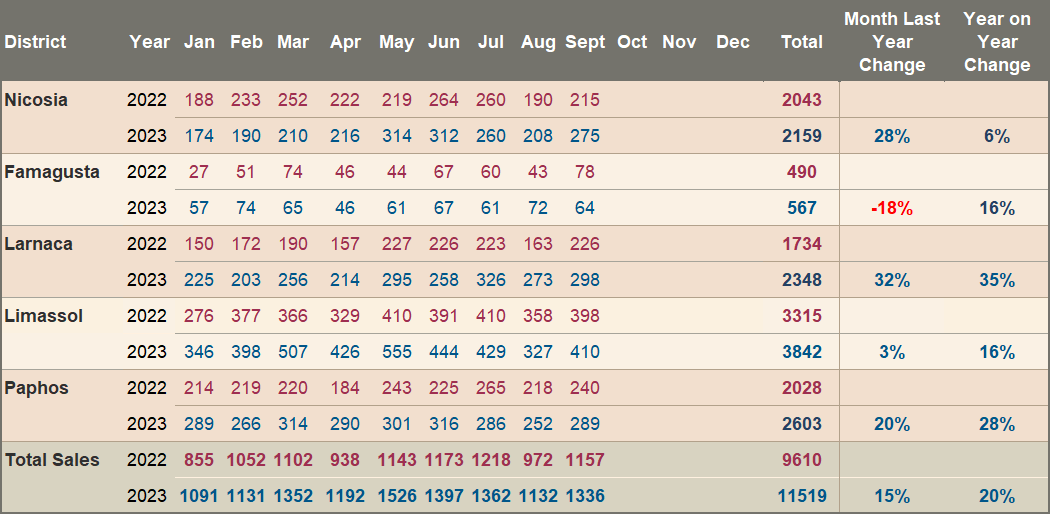
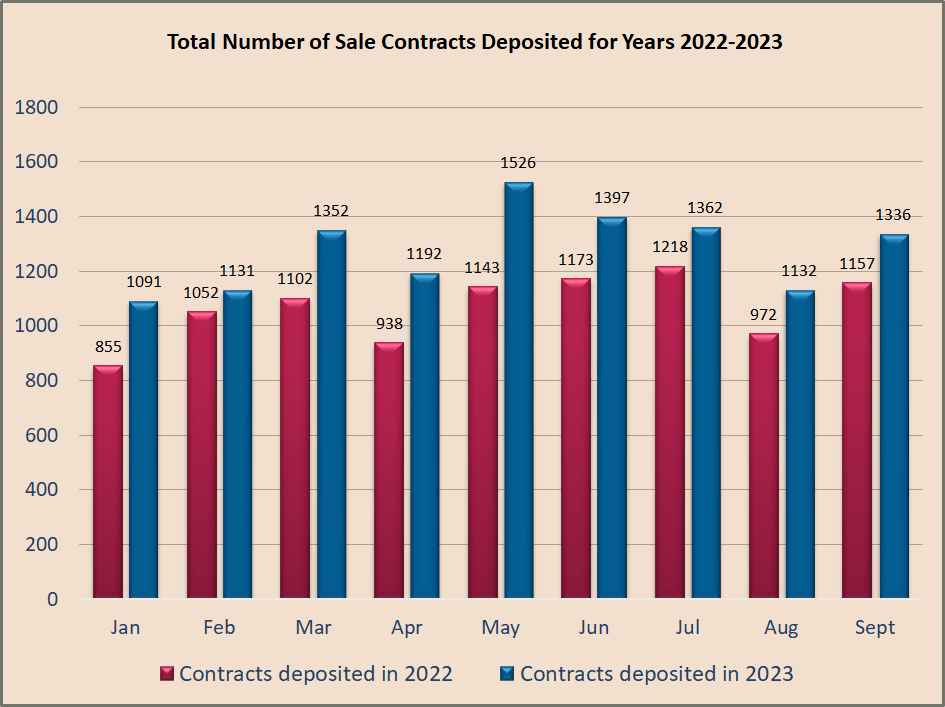
The latest official figures from the Department of Lands and Surveys show that the number of properties sold in September (as measured by the number of contracts deposited at Land Registry offices) rose 15 per cent compared to September 2022.

The total number of property sales, which include domestic dwellings, retail premises, offices, warehouses and land (fields and plots) reached 1,336 compared to 1,157 in September 2022.

Although sales in Famagusta fell by 15 per cent, they rose in remaining four districts. Limassol recorded the highest number of sales (410), followed by Larnaca (298), Paphos (289), Nicosia (274) and finally Famagusta (64).

Total property sales to September 2023
Total Property Sale Transactions – 2022/2023 Comparison

Year to date property sales

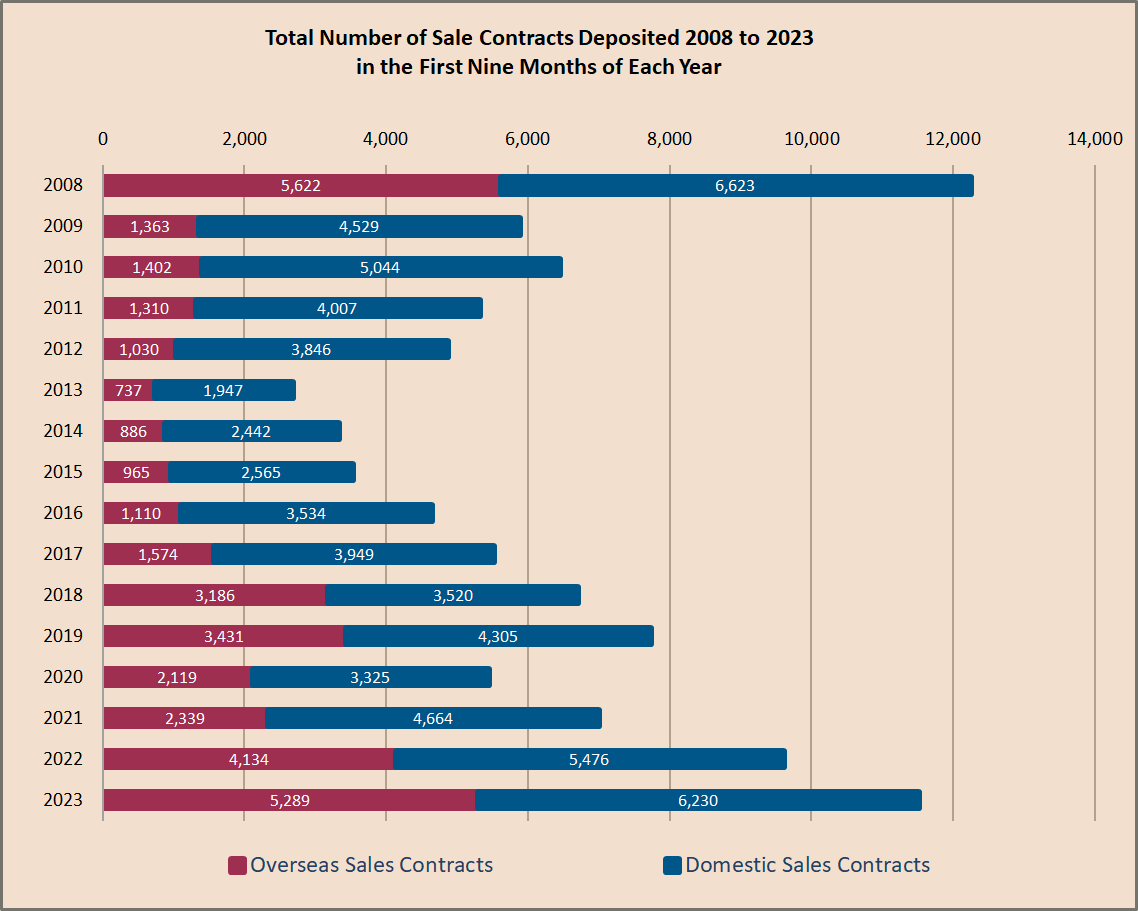
Sales during the first nine months of 2023 sales reached 11,519; an increase of 20% compared to the 9,610 achieved in same period last year with sales rising in all districts.

It is also the highest number of contracts deposited since 2008 when the number reached 12,245.

Year to date sales 2023