Rise in sales starting to slow

While the number of property sales in August rose compared to August 2022, the increase of 28% in the year-to-date sales reported at the end of June had fallen to 20% by the end of August, which indicates that the market may be slowing down.

The slowdown is likely due to rising interest rates and increased construction costs. However, despite the apparent slowdown in sales, Cyprus is heading for the second highest number of property sales on record by the end of the year.

The latest official figures from the Department of Lands and Surveys show that the number of properties sold in August (as measured by the number of contracts deposited at Land Registry offices) rose 16 per cent compared to August 2022.

Property sales refer to sales of domestic dwellings, retail premises, offices, warehouses and land (fields and plots.)

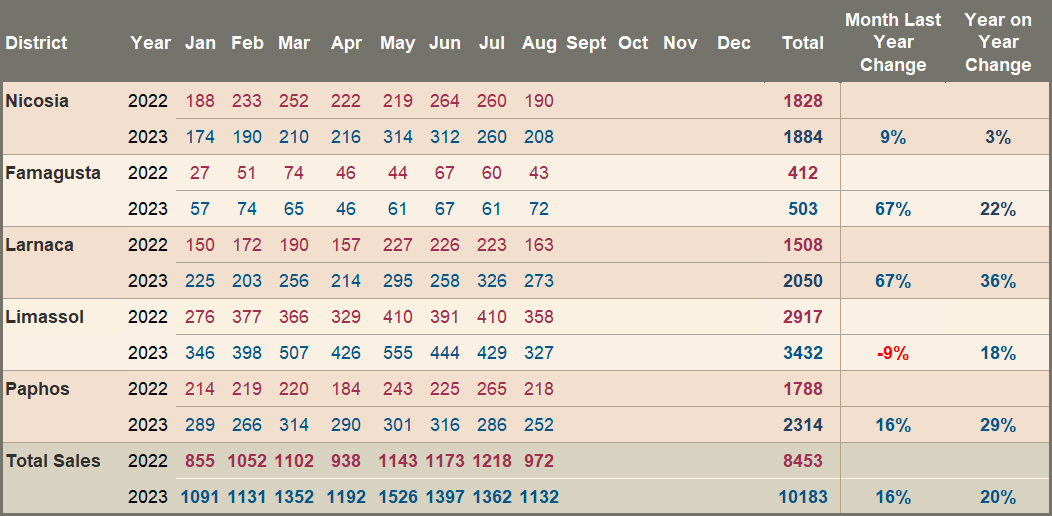
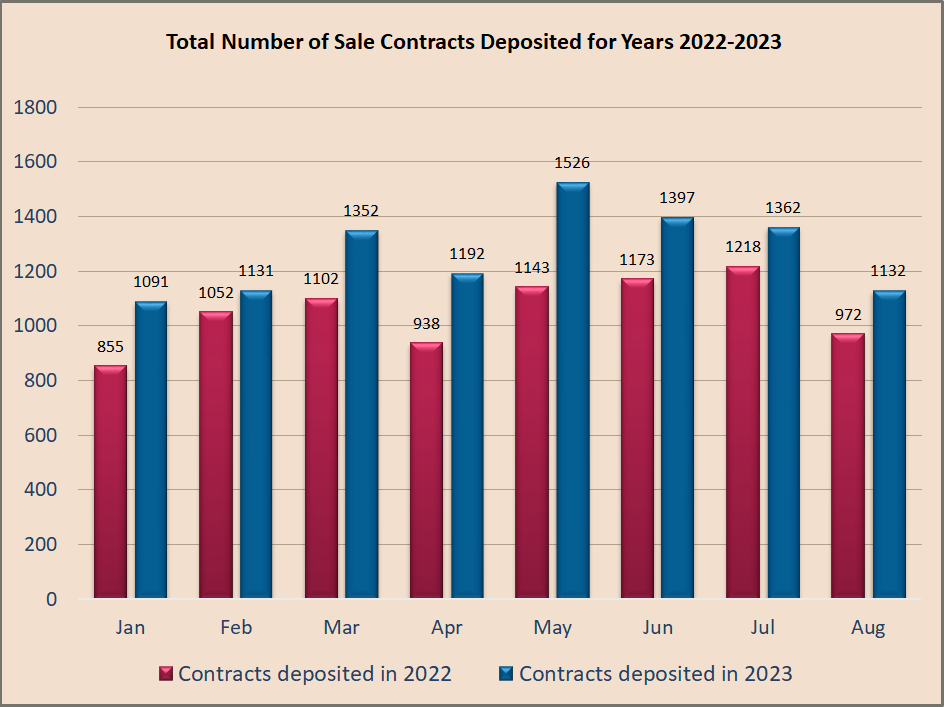
The total number of sales in August 2023 reached 1,132 compared to 972 deposited in August 2022.

Sales rose in all districts with the exception of Limassol, where the number of sales fell by 6 per cent. But despite the fall Limassol, it still recorded the highest number of sales (327), followed by Larnaca (273), Paphos (252), Nicosia (208), and Famagusta (72).

Pancyprian property sales
Total Property Sale Transactions – 2022/2023 Comparison

Year to date property sales

Sales during the first eight months of 2023 sales reached 10,183; an increase of 20% compared to the 8,453 achieved in same period last year with sales rising in all districts.

It is also the highest number of contracts deposited since 2008 when the number reached 11,088.

The government’s international headquartering initiative has increased the demand for properties from foreign business and investors from Russia, Israel, Ukraine, the United Kingdom, Lebanon, and Belarus.

Sales transactions chart
Total Property Sale Transactions – 2022/2023 Comparison

The real estate market: supply and trends

0

Buyers are more cautious, taking more time to decide

In response to the increase in interest rates, we’ve observed several budget adjustments among borrowers. Also, currently, property buyers are opting for more deliberate and considered purchases. This means, the duration required from estate agents and property professionals to guide clients towards finding their ideal property has lengthened.

Reduction in lending and high lending rates

In April 2023, Cyprus saw a big drop in new lending, according to the Central Bank of Cyprus. New loans decreased to 473.9 million euros, down from 922.5 million euros in March 2023. This decline affected various areas, including consumer loans, house purchase loans, and loans to non-financial companies.

Based on recent ECB data, Cyprus has some of the highest lending rates in the Eurozone. Specifically, the average interest rate for housing loans is 4.45% in Cyprus, compared to the Eurozone’s 4.03%. By taking as example few countries, Greece stands at 4.06%, Spain at 3.47%, France at 2.99%, Luxembourg at 4.11%, Malta at 2.56%, Austria at 4.06%, Slovakia at 3.71%, and Finland at 3.62%.

When we consider the anticipated decline in demand, evident from the reduction in lending activity and the fact that borrowing capacity decreases when interest rates rise, it presents a significant challenge to current price levels. This prompts a re-evaluation of market dynamics and raises questions about the sustainability of existing prices.

Construction costs are stable

As per the Statistical Service of Cyprus, the price index of construction materials has remained relatively stable since the beginning of the year.

Supply of resale properties will increase

Anticipated increases in non-performing loans are expected to drive property sellers to list their properties, resulting in a larger inventory for sale. Especially those who purchased properties for investment might find themselves at a crossroads, deliberating whether servicing the loan remains a viable option or if liquidating their property proves to be the wiser choice.

The GDP is also expected to slightly shrink, adding pressure to the labour market, which, in turn, is likely to lead to an increase in unemployment or, at the very least, pose challenges to some extent. Following this, along with the erosion of households’ purchasing power, it leads to additional reasons why the supply of resale properties and the motivation of existing owners to sell are expected to rise during 2023 and throughout 2024.

Yet, the supply of resale properties from the funds is expected to remain stable.

Supply of new housing is expected to rise

Fewer building permits/projects are anticipated, but an increase in the number of units and larger projects is expected to enter the market.

As per the statistical service of Cyprus, when comparing January to May 2023 with the same period in 2022, all types of residential building permits fell by around 9%. However, they have increased by 3% in size/area (m²), 3.5% in the number of units, and approximately 18% in value. This trend of increasing size and units can be attributed to recent legislative announcements about reduced VAT policies that impose size (and value) restrictions. As a result, developers have rushed to secure valid building permits to ensure that their foreseeable medium-term projects won’t be affected by the new changes. Additionally, the increase in value is attributed to rising construction costs. Overall, considering only the data from permits issued between January and May 2023, it is expected that approximately 4,135 new residential units will enter the market in Cyprus in the coming years.

Conclusion

Based on the above-mentioned trends, it appears that prices are currently in the process of stabilization. This is expected to be accompanied by downward pressure, leading to a minor decline in nominal prices. Nonetheless, it is crucial to note that if inflation persists at high levels and nominal prices remain stable for an extended period of time, the ‘real’ prices of properties will inevitably erode. In our opinion, this scenario appears to be the most plausible.

About the author

Charalambos Pitros holds a PhD in Real Estate Economics and is a Member of the Royal Institution of Chartered Surveyors (MRICS), of the European Real Estate Society (ERES) and of the Cyprus Scientific and Technical Chamber (ETEK). He is a Lecturer in Real Estate at American University of Cyprus (AUCY) and a Chartered Surveyor Valuer at Zyprus Real Estate – Property Valuers & Estate Agents.

The views and opinions expressed in this article are solely those of the author.

Larnaca dominates apartment sales

During an upward trend in property sales, the Real Estate Agents Registration Council highlighted the Larnaca district’s remarkable performance in the first half of 2023.

According to data from the Land Registry cited by the Council, Larnaca recorded a significant performance in the first six months for houses, apartments, plots, and fields, surpassing the Paphos district and closely trailing Nicosia.

A notable indication of the Larnaca market is its apartment sales dominance.

Of particular interest is that out of all the apartments sold, 627 were in Larnaca, equivalent to 28.7% of total apartment sales.

Across the board, during the first half of 2023, there were 11,564 property transactions encompassing houses, apartments, plots, and fields in all districts.

Among these transactions, fields accounted for the majority at 42.2% of total sales, followed by land plots at 23.5%, apartments at 18.9%, and houses at 15.3%.

Leading the pack is Limassol, with a 32.3% share in property sales, followed by Nicosia at 25.7%.

Larnaca claimed the third spot with 20.9%, followed by Paphos at 16.8% and Famagusta district at 4.1%.

It is noted that these percentages are for sales volume and not property values.

The Council notes that Limassol district has played a catalytic role in the property market’s trajectory in recent years.

Limassol’s size and foreign companies’ active presence have sustained high demand.

Despite the city and suburbs being associated with large-scale developments, Limassol continues to achieve strong performance in field sales.

The 924 completed transactions in this category during the first half of the year account for 34% of island-wide field sales.

Conversely, the property market in the Nicosia district remains steady across all four property categories.

It closely follows Limassol in apartment sales and holds a significant share in field sales.

However, the Council points out that Nicosia lags in apartment transactions, overtaking only Famagusta, and ranks third behind Paphos in house sales.

The increased sale of houses has been a defining feature of the market in the Paphos district in recent years.

It is also reflected in the statistics, which show that one in four house sales in the first half of 2023 were in the Paphos district.

Investment in Larnaca booming

Once lagging in urban development compared to the other cities, Larnaca is undertaking multimillion projects, says the town’s mayor and local economy stakeholders.

In comments to news site Stockwatch, Larnaca Mayor Andreas Vyras said the coastal town’s future looks brighter, as foreign investors are excited about its potential.

“New life is expected to be breathed into an area covering more than 3 square kilometres in eastern Larnaca as private development companies have drawn up their master plans, including multimillion projects,” said Vyras.

The Larnaca Mayor was referring to plans for new investments with upscale tourist projects destined on the Dhekelia coastal front, once occupied by fuel and gas storage tanks.

The largest property owner on Dhekelia Road, Petrolina Holdings, is exploring projects like holiday homes or hotels.

CSE-listed Petrolina Holdings set up a subsidiary company, Petrolina Bayfront, acquiring three plots from ExxonMobil on the Larnaca-Dhekelia road.

After dismantling their fuel tanks, Petrolina acquired ExxonMobil’s properties through a €30 million deal, which they plan to incorporate in their bayfront property development.

Petrolina presented its plans for the area in April.

The development is a mixed-use complex, including a hotel, office space and residencies, entitled the “Land of Tomorrow”. The cost of the whole project is expected to exceed €1 billion.

Larnaca municipality will also contribute to the area’s development with infrastructure projects along the Larnaca – Dhekelia road.

“At the same time, western Larnaca is getting a facelift, as a municipal scheme to improve and restore the facades of houses on Piale Pasia Street will highlight the city’s traditional architecture and historical character”.

Vyras expressed his confidence that western Larnaca will get its share of the city’s ‘building frenzy’ currently taking off in the area of Mackenzie Beach.

Applications worth millions for hotels, apartment buildings, and mixed-use developments submitted by local businesspeople and foreign investors are pending before the municipal authorities.

The local Chamber of Commerce and Industry chair, Stavros Stavrou, said they were pleased with the plans for the suburbs but noted that the historical centre should not be left out.

“The heart of the city beats in the urban centre where the traditional character has been preserved.

“However, further improvement projects are needed to attract new businesses,” said Stavrou.

He added the area hosts several boutique hotels, which have boosted the town centre’s attractiveness.

Larnaca marina

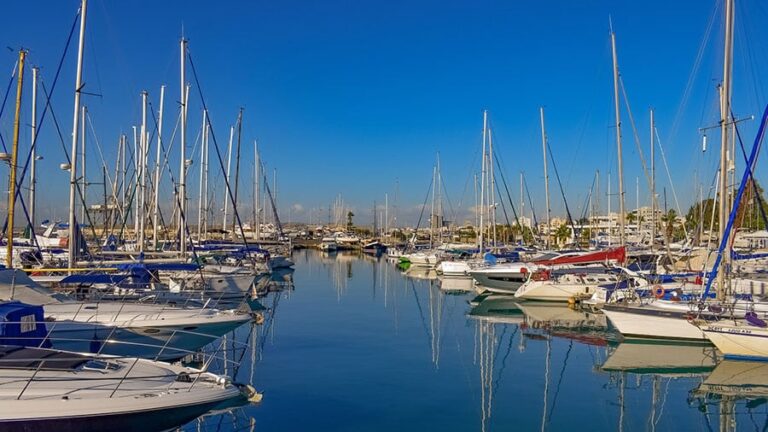
Stavrou did express concern over the largest investment in the town’s infrastructure, the Larnaca Marina and port, noting that significant delays have been recorded.

“Local stakeholders have expressed concerns over when the project will take off, as heavy construction works have yet to start, despite contracts being awarded and signed in December 2020.”

Stavrou noted the company awarded the contract for the redevelopment of Larnaca marina and port Kition Ocean Holdings Ltd has played down concerns, reassuring stakeholders that the project is on track.

In an earlier comment to the media in July, the CEO of the Cypriot-Israeli consortium, Panos Alexandrou, said the redevelopment of the Larnaca marina and port will be in full swing from the beginning of 2024, with the €1.2 billion project taking shape.

“From the beginning of the year, the area around the marina will be a huge construction site,” said Alexandrou.

According to Alexandrou, the contractors will need four years to complete the work from the beginning of the project, estimated to generate around €12 billion for the government.

It will create 4,000 new jobs, calculating those directly tied to the marina operations and businesses that will open outlets in the commercial areas.

Reconstruction of the existing marina will accommodate 650 yachts and offer facilities such as boat repairs.

An upgraded Larnaca port will accommodate ships up to 450 metres in length, such as luxury cruise ships, energy exploration vessels, military, and other merchant ships.

The real estate is expected to include luxury hotels, apartment buildings, a convention centre, shopping malls, educational spaces, research auditoriums, a medical school, a tourism college and an environment and energy university.


More people, smaller families, more homes, less holiday homes

The Cyprus Statistical Service (Cystat) has released a snapshot of the 2021 census which includes the numbers of people and dwellings (houses and apartments) for each municipality and community across Cyprus.

A prior snapshot provided information on Cyprus’ household size, broken down by district. Combining the two datasets gives us a great insight into how the country has changed over the period.

In 2011 Cyprus had 840,407 permanent residents and 433,212 dwellings. In 2021, they increased to 923,272 permanent residents (+82,865 / 10%) and 492,555 dwellings (+59,343 / 14%). Household size in 2011 was 2.8 persons, compared to 2.6 persons in 2021. From 2011 to 2021 the population increased, but households (families) decreased in size.

The tables below break down population and dwellings by district, noting how each has changed.

What is happening?

Overall Insights for Cyprus

  • The overall growth in both population (10% increase) and dwellings (14% increase) indicates a robust real estate market with expanding demand. The discrepancy between the population and dwelling growth rates indicates potential for higher density or multi-family developments.
  • A reduction in household size from 2.8 to 2.6 over the decade suggests evolving living preferences and might imply a growing market for smaller, more modern housing units or apartments, a trend often seen in urbanizing regions.
  • The decrease in the percentage of empty/second homes from 31% to 28% shows that more properties are transitioning from being investment or vacation homes to primary residences. This shift suggests potential for long-term real estate investments as more people commit to living in these areas permanently.

Population and Dwellings Growth

  • From 2011 to 2021, Cyprus saw a 10% (82,865-person) increase in its population, growing from 840,407 to 923,272.
  • The number of dwellings, on the other hand, grew at a faster rate of 14% (59,343 additional dwellings) over the decade.
  • A decrease in household size, which went from 2.8 to 2.6 persons per dwelling.

Urban Centres and District Dynamics

  • Limassol saw the most significant population growth in absolute terms with an increase of 26,908 residents, while Nicosia followed closely with 23,844 new inhabitants.
  • In percentage terms, Famagusta led with a 16% increase in its population, and Paphos was close behind with a 13% growth.
  • While the urban centres are growing in absolute numbers, other districts are growing faster in relative terms.

Household Size & Second Homes

  • The declining household size trend mirrors global patterns and could be attributed to various factors like urbanization and changing societal norms.
  • More dwellings are now permanently occupied. In 2011, 69% of dwellings were occupied, which increased to 72% in 2021.
  • Paphos and Famagusta maintained a significant percentage of empty/second homes, at 48% and 46% respectively in 2021, indicating their potential roles as vacation or investment hotspots.

Dwelling Allocation Dynamics

  • The districts of Paphos, Famagusta, and Larnaca showed the most considerable shift in permanently occupied dwellings. Paphos saw an increase of 7,002 (22%), Famagusta by 4,443 (26%), and Larnaca by 8,310 (17%).
  • Nicosia and Limassol had more stable figures. Nicosia’s permanent dwellings rose by 13,829 (11%), and Limassol saw an increase of 12,508 (15%).

Second Homes Trend

  • There’s a nationwide decrease in the percentage of empty/second homes, from 31% in 2011 to 28% in 2021.
  • Larnaca is particularly interesting: it witnessed a significant 8,310 increase in permanent dwellings but a mere 247 increase in second homes. This means while more people are making Larnaca their home, its attractiveness as a vacation or investment destination remains relatively consistent.

To sum it up, between 2011 and 2021, Cyprus experienced notable demographic and residential shifts. The nation’s urban centres, Nicosia and Limassol, continued to swell in population and housing numbers. Meanwhile, the reduced household size and an increased percentage of permanently occupied homes hint at evolving economic, social, and property market dynamics.

PS The above number has have been significantly skewed from 2022 onwards, when Cyprus saw an influx in population from Ukraine, Russia, Belarus, Lebanon and Israel. An estimated 30,000-40,000 persons have moved to Cyprus, primarily in the coastal cities of Limassol, Larnaca, and Paphos.

2021 Census

District Population Total
Dwellings
Household
Size
Permanent
Dwellings
Empty/Second
homes
Empty/Second homes
of Total Dwellings
Nicosia 350,824 163,239 2.6 134,932 28,307 17%
Limassol 262,238 132,305 2.8 93,656 38,649 29%
Larnaca 155,753 82,233 2.7 57,686 24,547 30%
Paphos 100,175 74,498 2.6 38,529 35,969 48%
Famagusta 54,282 40,280 2.5 21,713 18,567 46%
Total 923,272 492,555 2.6 355,105 137,450 28%

2011 Census

District Population Total
Dwellings
Household
Size
Permanent
Dwellings
Empty/Second
homes
Empty/Second homes
of Total Dwellings
Nicosia 326,980 144,556 2.7 121,104 23,452 16%
Limassol 235,330 114,662 2.9 81,148 33,514 29%
Larnaca 143,192 73,676 2.9 49,377 24,299 33%
Paphos 88,276 66,168 2.8 31,527 34,641 52%
Famagusta 46,629 34,150 2.7 17,270 16,880 49%
Total 840,407 433,212 2.8 300,145 133,067 31%

Change (2021 vs 2011)

District Population Total
Dwellings
Household
Size
Permanent
Dwellings
Empty/Second
homes
Empty/Second homes
of
Total Dwellings
Nicosia 23,844 18,683 — 13,829 4,854 26%
Limassol 26,908 17,643 — 12,508 5,135 29%
Larnaca 12,561 8,557 — 8,310 247 3%
Paphos 11,899 8,330 — 7,002 1,328 16%
Famagusta 7,653 6,130 — 4,443 1,687 28%
Total 82,865 59,343 — 46,091 13,252 22%

Copyright © all rights reserved to WiRE

Paralimni marina project is taking shape

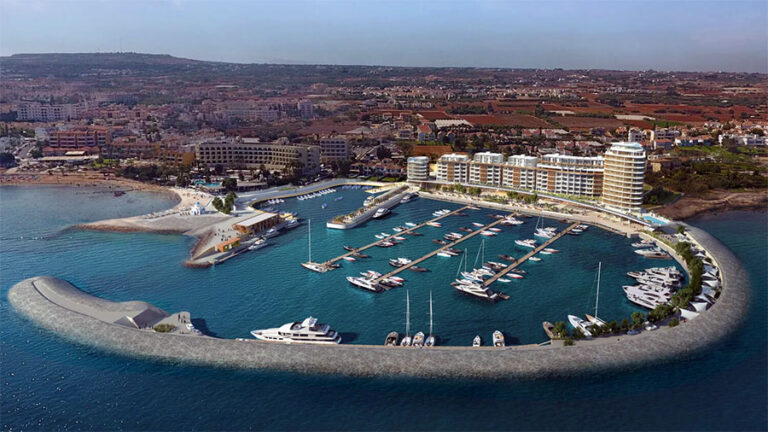
The long-awaited marina of Paralimni is taking shape, with construction work progressing at a rapid pace.

It should be noted that the development project has already become a pole of attraction for investors and, according to the schedule, will be fully completed in the summer of 2024, with the first phase ready at the end of 2023.

The development agreement for this €100 million investment was signed in 2017 between the Ministry of Energy, Commerce, Industry and Tourism and PMV Maritime Holdings Ltd, which is the construction and management company.

The project is expected to give further impetus to the district of free Famagusta, contributing significantly to the upgrading of the tourist product and in general to the promotion of maritime tourism in Cyprus as a whole.

Nicolaides & Kountouris Metal Company Ltd, a company among the project’s contributors recently published photos demonstrating the progress of the work on their social media.

The Paralimni Marina, once complete, will be able to host 300 boat berths. However, with the completion of the first phase of the project, at the end of 2023, the marina will be able to accommodate 150 boats.

It will also consist of 195 residential units, the majority of them apartments, as well as 27 spaces for commercial use, such as restaurants, cafes, bars, and shops. During the first phase of the project, a total of 44 residential units and the commercial zone will be delivered.

It should be noted that the Ferretti Group will open offices in various areas of Cyprus, with the headquarters located in Paralimni Marina.

The group includes all the high-end luxury yacht brands, such as Feretti Yachts, Riva – which is described as the Ferrari of the seas -, Pershing Yachts and Itama Yachts.

Other marinas in Cyprus currently include Limassol Marina, St. Raphael, Ayia Napa Marina, and Larnaca Marina of Larnaca, which, however, is in the stage of reconstruction.

In addition to Paralimni Marina, meanwhile, another new addition to the island will be the Marina in Latsi, a project that according to the schedule will start in 2024 and be completed in 2026.

The way has also been opened for the creation of Paphos Marina, efforts for the creation of which first began back in 1990.

More generally, marinas in Cyprus have attracted the interest of foreign investors, who have contributed to the development of the grand projects. In a few years, the island is expected to have no less than seven marinas in total.

(Source: InBusinessNews)