Index of prices & rental values Q2 2023

The 55th quarterly publication of the RICS Cyprus Property Index with KPMG in Cyprus records the property price and rental index, tracking property and rental prices across all Cyprus districts and main property types.

Market values year-on-year

During the second quarter of 2023, a further increase was recorded in the prices of residential properties (with apartments leading ahead of houses) offices and warehouses, while the prices of retail premises continued to stagnate.

  • Apartments up 12.11%
  • Houses up 9.03%
  • Retail premises up 1.57%
  • Warehouses up 6.95%
  • Offices up 8.46%

Holiday home prices

The price index of holiday apartments and holiday houses increased over the year with holiday apartments leading the way:

  • Holiday apartments up 9.00%
  • Holiday houses up 8.53%

Rental values year-on-year

Rental values increased over the year, with holiday apartments leading the way, followed by residential apartments, houses and holiday houses. The rental values for offices, warehouses and retail premises also rose:

  • Apartments up 18.99%
  • Houses up 14.46%
  • Retail premises up 2.90%
  • Warehouses up 3.07%
  • Offices up 8.30%
  • Holiday apartments up 20.01%
  • Holiday houses up 11.24%

Rental yields

In the second quarter of 2023, rental yields stood at:

  • Apartments 5.44%
  • Houses 2.93%
  • Retail 5.81%
  • Warehouse 4.27%
  • Office 5.39%
  • Holiday Apartments 5.73%
  • Holiday Houses 2.77%

Notional buildings

The RICS Cyprus Property Price Index with KPMG in Cyprus monitors hypothetical or notional buildings, each having specific characteristics. The methodology underpinning Index was developed by the University of Reading.

The price per sqm is based on the Gross External Area of the property (as defined in the RICS’ Code of Measurement Practice 8th Edition), which includes the living area and covered verandas but excludes common areas.

The estimation of price levels is carried out by accredited RICS property professionals who are active in the relevant markets.

New Jointly-Owned Buildings law approved

A new Jointly-Owned Buildings law, which aims to resolve chronic problems of management committees and various other practical problems with the current law, has been approved by the Council of Ministers according to reports in the Greek language media.

Once the precise legal wording of the new law has been prepared it will be placed before a parliamentary plenum for debate and amendment. If all goes well, the bill will be in place by the end of this year.

(It’s anticipated that details of the bill will be published in an announcement by the Ministry of the Interior.)

In a written statement, government representative Konstantinos Letymbiotis, said that:

“The bill aims to resolve the weaknesses and some gaps found in the implementation of the current legislation, including the need to define the rights and obligations of the main units to regulate various issues, but also the weaknesses in the existing management practices of such buildings as and the need to ensure a more effective implementation of management considering that unit owners escape their obligations and many properties are not adequately maintained, resulting in risks for their safety and the safety of third parties.”

Although the contents of the bill have yet to be published, we understand that every jointly-owned building that has been issued with a building and division permit will be required to have a management committee. This will be the case regardless of whether the building has been issued with a certificate of approval, or registered with the land registry, or Title Deeds for the individual units have been issued.

  • Changes will be introduced to alleviate the problem of owners who refuse to pay their communal fees.
  • The management committee will be obliged to maintain the jointly-owned building (an important health and safety issue.)
  • Management committees will be able to incur expenses for the maintenance and operation of the common areas of the jointly owned building, which the offending owner has not paid.
  • The introduction of administrative fines and other legal measures against offenders and powers for management committees enabling them to sue and to be sued.
  • The establishment of a regulatory authority responsible for overseeing compliance with the new law. The new authority will be responsible for registering jointly-owned buildings, the registration of management committees with the Service and maintaining a register of the buildings and their management committees.
  • The role of the Department of Lands and Surveys will be limited to issues relating to the occupation and registration of jointly-owned buildings.

It’s anticipated that the new law will alleviate many of problems faced by some 30,000 jointly-owned buildings, which it total comprise in the region of 200,000 individual units.

Communal fees & other jointly-owned building matters

In my 20+ years’ experience of helping people to deal with the problems they face with jointly-owned buildings the most common issue by far is non-payment of communal fees.

Although changes will be introduced in the new law alleviate the problem, it must not oblige the owners who pay their communal fees to pay the debts of other owners. These owners will refuse to pay the debt and, as a consequence, often refuse to pay their communal fees as well – “Why should I pay when someone else is not paying?”. Such a move will have a domino effect until no-one pays, the management committee resigns and the jointly-owned building falls into disrepair.

Management committees need to establish a ‘sinking fund’; money set aside for unscheduled maintenance and repair of equipment that is not part of the planned annual maintenance activity. A few years ago, courts in Paphos and Famagusta ruled that if the communal fund was in surplus further contributions to the communal fees we not needed. Under the present law, there is no provision that would enable a management committee to establish a sinking fund. There are ways around this problem as I described in Communal fees – sinking fund, but it needs to be included in the new law.

Management committees have been known to ‘do deals’ with ‘koumbaroi’ (friends) to carry out maintenance and repair work on jointly-owned buildings and pocket some of the monies. This practice must be outlawed and management committees should be obliged to tender for maintenance and repair work.

Management committees should be obliged to have annual communal fee accounts audited. Depending on the turnover, these would be audited by a professionally qualified auditor or, for smaller turnovers, three unit owners who are independent of the management committee.

Is the red-hot property market starting to cool?

Although the number of property sales in July rose compared to the same month last year, there may be signs that the remarkable 28% increase in the number of sales reported in the first half of the year may be slowing.

In a statement yesterday, the president of the Cyprus Real Estate Agents Registration Council (Marinos Kineyirou) said that “It is evident that this year’s data is significantly better compared to the first half of 2022,” but noting that “we should recall that the first half of 2022 was particularly problematic as pandemic measures were still in effect, and we also faced the outbreak of the war in Ukraine and an increase in economic uncertainty, which restrained the market”.

Adding that “I believe more meaningful conclusions will be drawn when we have the data for the second half of 2023.”.

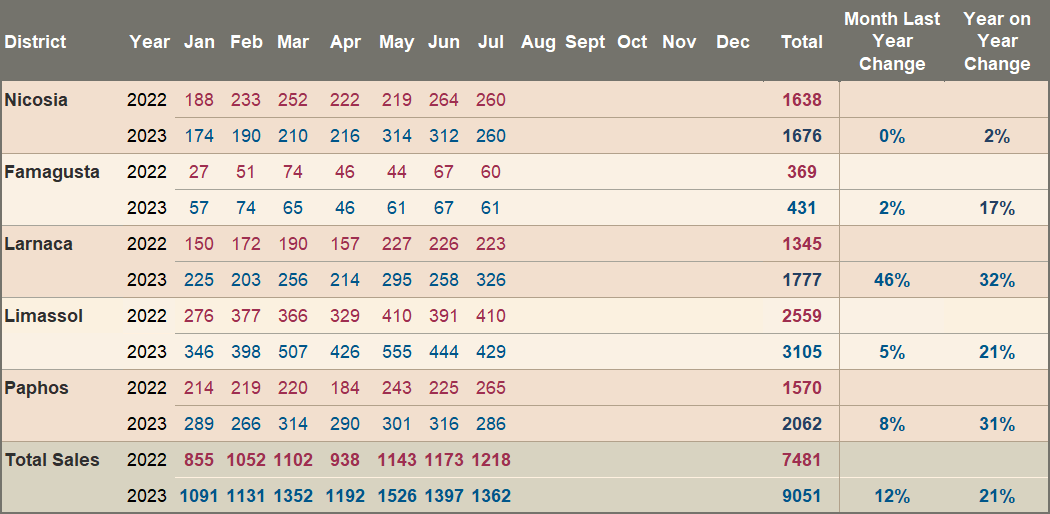
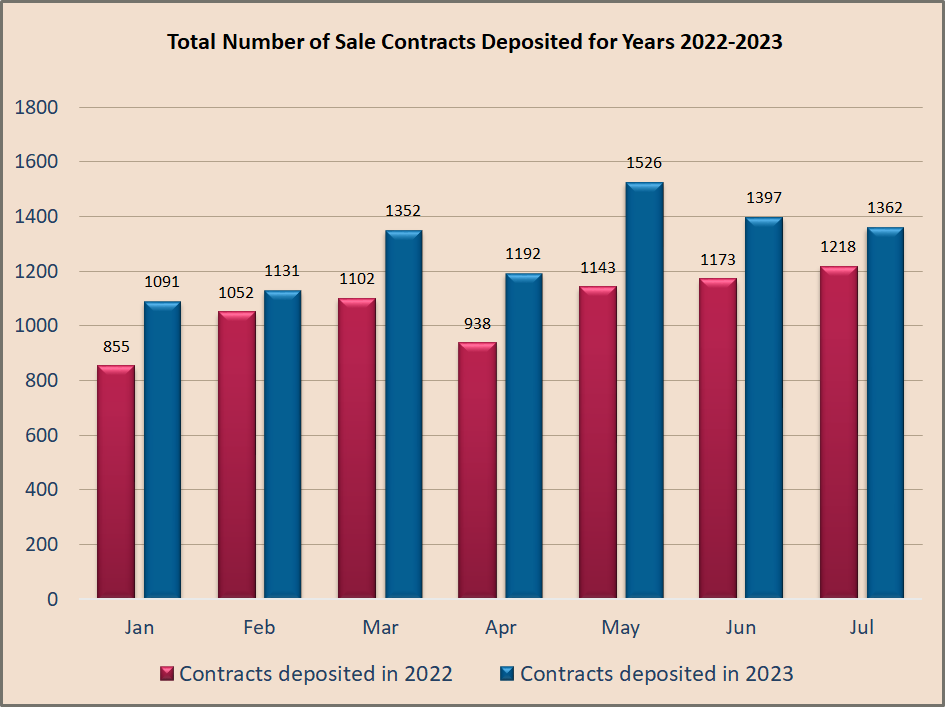
The latest official figures from the Department of Lands and Surveys show that the number of properties sold in July (as measured by the number of contracts deposited at Land Registry offices) rose 12 per cent compared to the same month last year; the second smallest monthly increase this year.

The total number of sales in July 2023 reached 1,362 compared to 1,218 deposited in July 2022.

Sales rose in all districts, with the exception of Nicosia where the number of sales remained unchanged. Limassol recorded the highest number of sales (429), followed by Larnaca (326), Paphos (286), Nicosia (260), and Famagusta (61).

Pancyprian property sales
Total Property Sale Transactions – 2022/2023 Comparison

Year to date property sales

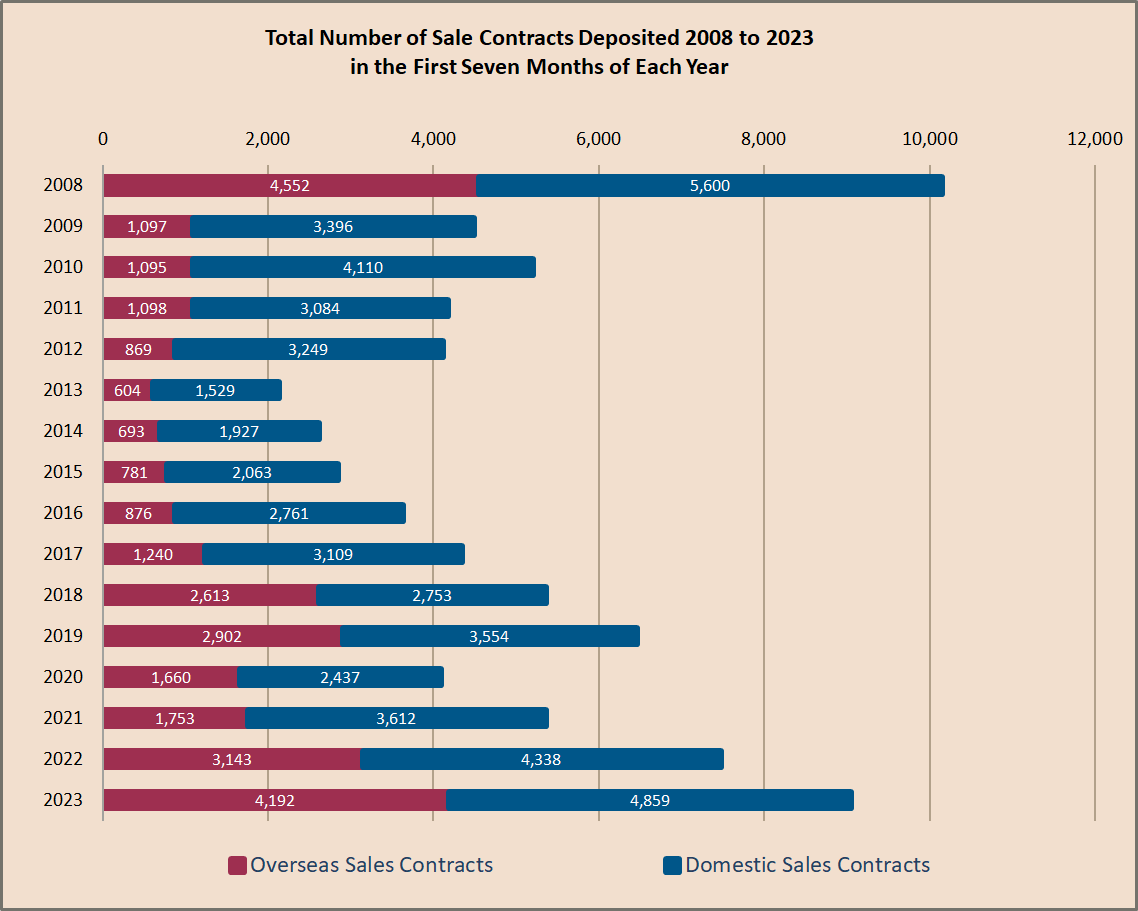
Sales during the first seven months of 2023 sales reached 9,051; an increase of 21% compared to the 7,481 achieved in same period last year with sales rising in all districts.

chart
Total Property Sale Transactions – 2022/2023 Comparison

Market segment analysis

Property sales to the domestic market

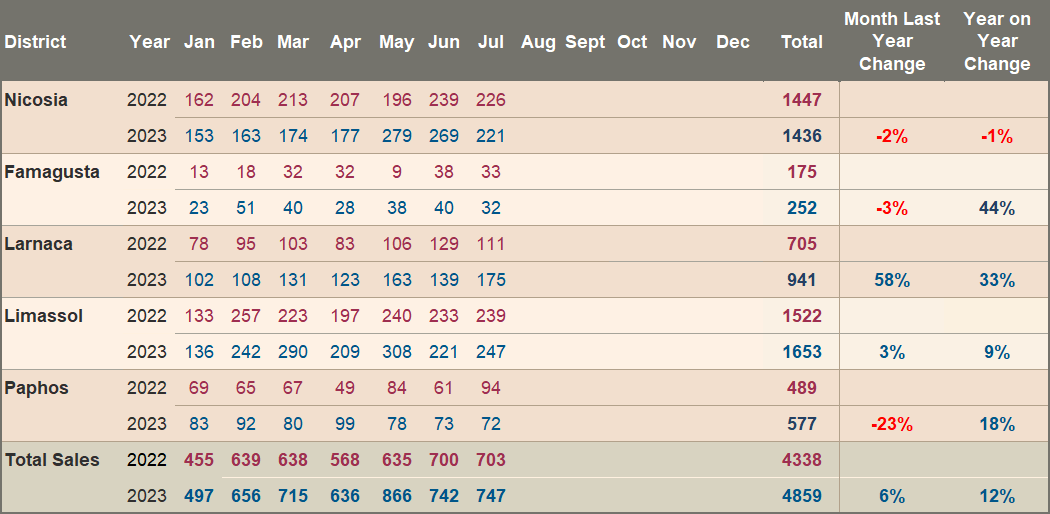
Real estate sales to the domestic market in July rose 6% compared with July 2022 but with Paphos, Famagusta, and Nicosia reporting falls of 23%, 3% and 2% respectively.

Limassol reported the highest number of sales (247), followed by Nicosia (221), Larnaca (175), Paphos (72) and Famagusta (32).

Domestic sales
Domestic Sale Transactions – 2022/2023 Comparison

Sales to the domestic market during the first seven months of 2023 stood at 4,859; an increase of 12% on the 4,338 achieved over the same period last year.

However, these figures may include an unreported number of ‘non-sale’ agreements such as loan restructurings, recoveries and debt-to-asset swaps agreed between financial institutions and defaulting borrowers in efforts by the banks to reduce their non-performing loan portfolios. Unfortunately, the Department of Lands and Surveys does not record these separately.

Property sales to the overseas market

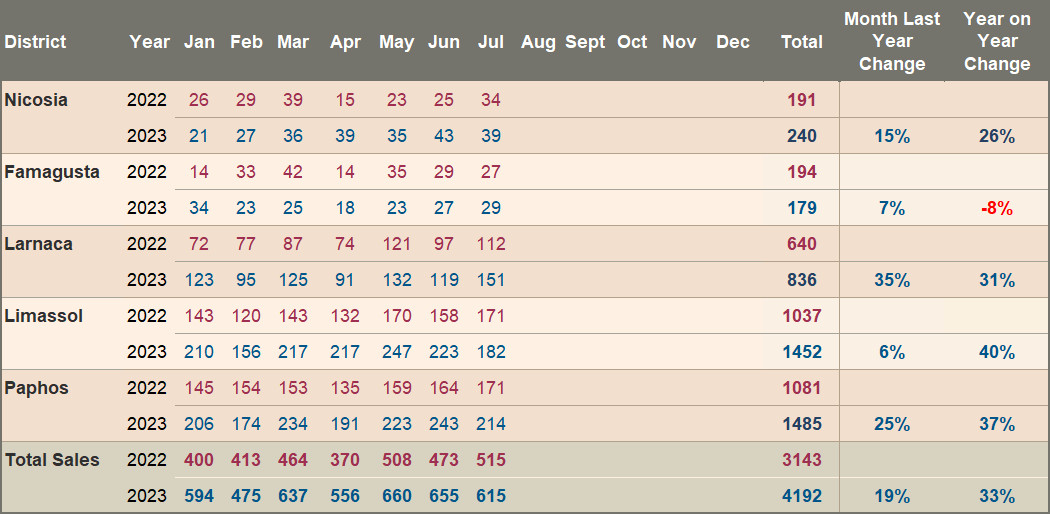
Sales to foreigners (non-Cypriots) were up 19% compared to July 2022 with sales rising in all districts.

Paphos recorded the greatest number of sales (214), followed by Limassol (182), Larnaca (151), Nicosia (39) and Famagusta (29).

Property sales to foreign citizens
Property sales to the overseas market – 2022/2023 Comparison

Foreign real estate sales during the first seven months of 2023 reached 4,192; a 33% increase on the 3,143 achieved in the same period last year.

Property sales to EU citizens

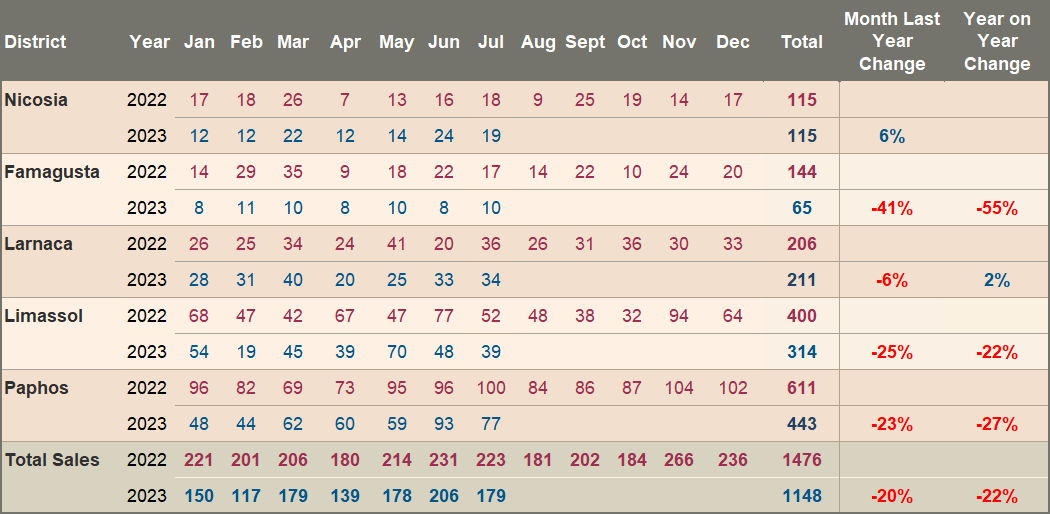
Sales to EU nationals continued to fall, dropping 20% compared to July 2022, with sales falling in all districts with the exception of Nicosia.

Paphos achieved the greatest number of sales (77), followed by Limassol (39), Larnaca (34), Nicosia (19) and Famagusta (10).

Property sales to EU citizens
Overseas (EU) Sale Transactions – 2022/2023 Comparison

Sales to EU nationals during the first seven months of 2023 reached 1,148; a fall of 23% compared to the 1,476 achieved in the first seven months of 2022.

Property sales to non-EU citizens

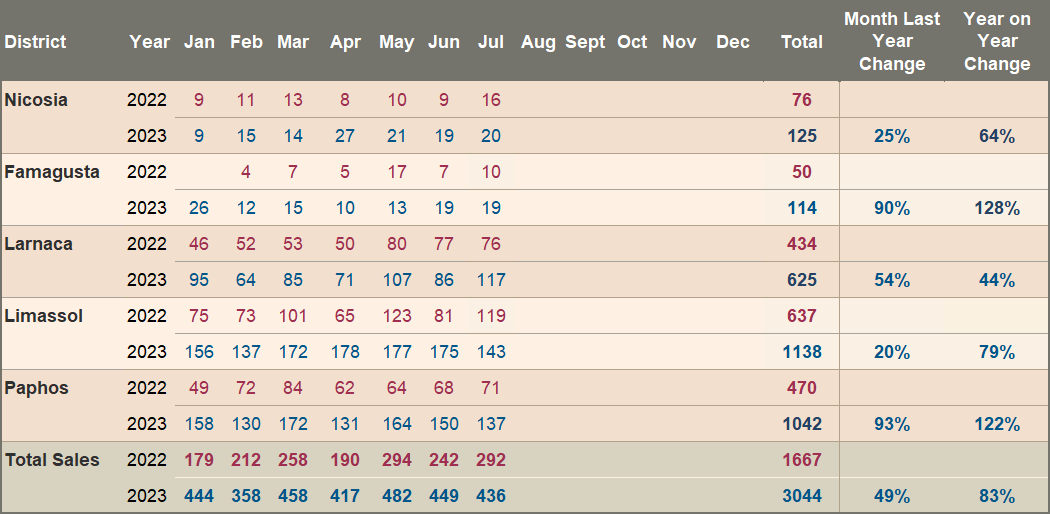
Sales to non-EU Nationals rose 49% compared to July 2022, with sales rising in all districts.

Limassol recorded the highest number of sales (143), followed by Paphos (137), Larnaca (117), Nicosia (20) and Famagusta (19).

Sales to non-EU citizens
Overseas (non-EU) Sale Transactions – 2022/2023 Comparison

Sales to non-EU nationals during the first seven months of 2023 reached 3,044, an 83% increase on the 1,1667 achieved in the same period last year.

Sales 2008 - 2023


Soaring demand for property

The Cyprus property market recorded an upswing during the first quarter of 2023, with prices continuing to rise, particularly for flats, driven by increased demand.

According to data published Tuesday by the Central Bank of Cyprus (CBC), the Residential Property Price Index (RPPI) showed a significant acceleration compared to previous quarters.

Indicators for property sales and demand in Q1 confirm the surge in housing demand.

Figures from the Department of Land and Surveys report a substantial year-on-year increase in residential property demand.

Foreign buyers accounted for the most substantial annual growth, representing approximately half of the total buyers in 2022 and for Q1.

Simultaneously, the rate of construction cost escalation seems to be stabilising compared to 2021-2022, which saw remarkably high growth rates.

The annual increase in the RPPI in Limassol and Larnaca is showing acceleration, while in the Paphos district, despite a slowing trajectory, the percentage of residential property price growth remains high.

Even with the rise in the European Central Bank’s key interest rates and the consequent decrease in demand for mortgages in Q1 2023, domestic property demand seems to have been only minimally affected as it continues to record growth.

Property prices

The RPPI for houses and apartments during Q1 recorded a quarterly rise of 2.1% from 1.6% in the previous quarter.

This increase stems from a 2.3% rise in apartment prices and a 1.7% increase in house prices compared to the preceding quarter.

Annually, there was also a surge in residential property prices by 7.7% from 6.6% in Q4 2022.

Apartment prices during the quarter registered an annual growth of 8.4%, while house prices rose by 6.6%.

Residential property prices saw quarterly growth in all districts.

Nicosia recorded a 1.3% increase, Limassol +2.9%, Larnaca +2.6%, Paphos +0.3%, and Famagusta +2.3%.

As for the annual changes in property price indices by district, there were increases in all districts for the sixth consecutive quarter.

Nicosia’s property prices rose by 4.3%, Limassol by 10.6%, Larnaca by 7.7%, Paphos by 6.8%, and Famagusta by 4%.

Quarterly, house prices increased in all districts except for Paphos.

Nicosia house prices rose by 1.3%, Limassol by 2.8%, Larnaca by 2.2%, and Famagusta by 2.9%, while Paphos experienced a decline of 1.1%.

Annually, house prices saw growth in all districts.

House prices in Nicosia, Limassol, Larnaca, Paphos, and Famagusta increased by 4.2%, 9.4%, 5.8%, 5.7%, and 5%, respectively.

As for apartment prices quarterly, an increase was recorded in all districts.

Nicosia apartment prices rose by 1.4%, Limassol by 2.4%, Larnaca by 3.5%, Paphos by 4.3%, and Famagusta by 1.2%.

Annually, apartment prices grew in all districts for the seventh consecutive quarter.

In Q1 2023, Nicosia apartment prices increased by 4.4%, Limassol by 10.4%, Larnaca by 12.3%, Paphos by 10.3%, and Famagusta by 2.4%, compared to Q1 2022.

Foreign buyers

According to the latest Department of Land and Surveys (DLS) data, property sale documents continued to rise by 18.8% annually, reaching 3,574 from 3,009 last year.

This reflects the increased demand for properties.

There was a big increase of 33.6% annually in properties sold to foreign buyers (1,706 from 1,277), primarily from countries outside the EU.

Additionally, the number of properties sold to domestic buyers rose 7.9% annually (1,868 from 1,732).

This surge in sales documents to foreign buyers is mainly attributed to the “headquartering policy,” which attracts foreign professionals from Russia, Israel, Ukraine, the United Kingdom, Lebanon, and Belarus.

After six consecutive quarters of annual decline, the construction index recorded a 5.5% increase in Q1.

Rental values rising across all property types

Ask Wire, the tech-informed real estate company, has published its Q2 2023 edition of the Ask Wire Index for property sale and rental values. The Ask Wire Index covers all districts and main property types, with values from Q4 2009.

Prices

Across Cyprus, on an annual basis, prices increased by 12.2% for apartments, 4.6% for houses, 4.4% for offices, 1.2% for retail, 8.8% for holiday apartments, 3.7% for holiday houses, and decreased by 1.5% for warehouses. Overall, on a quarterly basis values increased by 2.7% for apartments, 2.0% for houses, 1.0% for retail, 2.0% for offices, and remained stable for warehouses. As for holiday apartments and holiday houses, values increased by 3.0% and 1.2%, respectively.

Rental values

Regarding rental values, compared to Q2 2022 there has been an increase of 17.9% for apartments, 13.6% for houses, 6.8% for retail, 1.0% for warehouses, 10.8% for offices, 16.5% for holiday apartments and 13.9% for holiday houses. On a quarterly basis rental values increased by 5.6% for apartments, 6.2% for houses, 3.3% for retail, 4.8% for offices, and 0.5% for warehouses. As for holiday apartments and holiday houses rental values increased by 3.3% and 3.2%, respectively.

Pavlos Loizou, CEO of Ask Wire, commented that “The rising trend in property values and rental rates since Q2 2022 isn’t slowing down, particularly due to the increase in prices of apartments and houses in Limassol, Paphos, and Larnaca.

“However, the blend of increased interest rates and high prices/rents has established a stable, albeit high, market threshold. We expect commercial property pricing to feel increased pressure, as alternative investments provide attractive risk-adjusted returns.

“Looking forward to Q3 2023, we foresee residential property prices remaining fairly steady, despite potentially slower demand and reduced transaction volume. Investor demand for commercial properties might remain somewhat restrained.”

For a breakdown of movements in sale and rental values by district, visit https://ask-wire.com/insights/.

Property Type Sale Value Rental Value
Apartments 2.7% 5.6%
Houses 2.0% 6.2%
Commercial 1.0% 3.3%
Warehouses 0.0% 0.5%
Office spaces 2.0% 4.8%
Holiday apartments 3.0% 3.3%
Holiday houses 1.2% 3.2%
Source: Ask WiRE – Quarterly percentage change in property values (Q1 2023 with Q2 2023)


Property Type Sale Value Rental Value
Apartments 12.2% 17.9%
Houses 4.6% 13.6%
Commercial 1.2% 6.8%
Warehouses -1.5% 1.0%
Office spaces 4.4% 10.8%
Holiday apartments 8.8% 16.5%
Holiday houses 3.7% 13.9%
Source: Ask WiRE – Annual percentage change in property values (Q2 2022 with Q23 2023)

June’s most expensive property sales

The 50 most expensive property sales in June had a total value of €79 million, according to a report published on Tuesday by the real estate market intelligence company Ask WiRE.

The 10 most expensive sales totalled €39 million, where the most expensive sale was a €12 million commercial property in the Limassol district.

The district with the most properties with the highest sales value was Larnaca, with four transactions totalling €13.75 million.

Famagusta district had two sales in the top ten; a hotel and a hotel apartment complex, with a total value of €5.38 million, both of which were in Paralimni.

Paphos and Nicosia districts each had one property in the top ten most expensive list.

Top ten most expensive property sales in June 2023

  1. Commercial Property – €12 million in Limassol (Limassol Municipality)
  2. Land – €5.4 million in Larnaca (Mazotos)
  3. Plot – €3.65 million in Larnaca (Pervolia)
  4. Land – €3.3 million in Paphos (Pegeia)
  5. Hotel – €3.28 million in Famagusta (Paralimni)
  6. Land – €2.5 million in Larnaca (Livadia)
  7. Mixed-use building – €2.32 million in Nicosia (Lakatamia)
  8. Offices – €2.3 million in Limassol (Limassol Municipality)
  9. Land – €2.2 million in Larnaca (Larnaca Municipality)
  10. Tourist apartments – €2.1 million in Famagusta (Paralimni)

Nearly 60% of the 50 most expensive properties were in the top 20 sold in Limassol and Larnaca districts. The top 10 in Limassol sold for a total of €25.65 million (32%) and the top ten in Larnaca sold for €19.7 million (25%.)

The ten most expensive properties sold in Nicosia district had a significantly lower total value of €13.45 million, followed by Paphos (€11.8 million) and Famagusta (€8.5 million).

Total value of top ten sales/district

  • Limassol – €25.65 million (32%)
  • Larnaca – €19.7 million (25%)
  • Nicosia – €13.45 million (17%)
  • Paphos – €11.8 million (15%)
  • Famagusta – €8.48 million (11%)

Commenting on figures Pavlos Loizou, the CEO of Ask WiRE, said: “The analysis demonstrates the depth of the high-value property market in each province, revealing that the market is mainly driven by properties of lower value.

“Specifically, out of the 50 largest sales, 20 were below €1 million. This indicates that any investment evaluation should consider not only the value but also the geography, type, and depth of the market, enabling investors to assess the liquidity of their investments.”

Data source: Department of Lands & Surveys