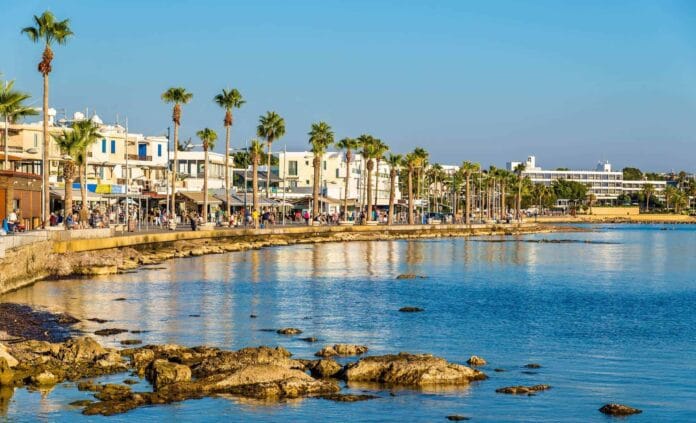
Larnaca marina to take shape in 2024

Redevelopment of Larnaca marina and port will be in full swing from the beginning of 2024, with the €1.2 billion project taking shape.

In comments to news site StockWatch, the CEO of Kition Ocean Holdings – the Cypriot-Israeli consortium awarded redevelopment project – January 2024 will mark the launch of phase 1 works.

“From the beginning of the year, the area around the marina will be a huge construction site,” said Alexandrou.

He noted they had received the green light from the Department of Town Planning and Housing for the first buildings.

Alexandrou clarified that the central building, the completion of which is estimated to take 18 months, will house the offices of the Kition company, the local port authority, the Cyprus Ports Authorities, customs and other local services.

Works on the buildings are expected to start in April 2024.

Other buildings, which are for the police, the Ministry of Agriculture and a terminal for cruise ships, are expected to be completed within a year.

According to Alexandrou, planning is also progressing for the pier, where the Yacht Club and the service building will be built, for which construction will start next April.

During the same period, infrastructure projects will be launched, including roads and pedestrian walkways to connect the development area with the city.

He said a dispute with workers at the Larnaca port over signing a collective agreement has also been settled.

Alexandrou said work on the pier is underway, scheduled to be completed before the end of this year.

The aim is for the pier to be completed for January’s Epiphany celebrations and the foundation stone ceremony.

According to Alexandrou, the contractors will need four years to complete the work from the beginning of the project, estimated to generate around €12 billion for the government.

It will create 4,000 new jobs, calculating those directly tied to the marina operations and businesses that will open outlets in the commercial areas.

The work will be carried out in four phases over 15 years.

The BOT project will see the government receiving fixed rent and a percentage of the revenue through a concession agreement with the port/marina operated on a 40-year lease and real estate acquired on a 125-year lease.

After 40 years, the port and marina can be returned to the government.

Reconstruction of the existing marina will accommodate 650 yachts and offer facilities such as boat repairs.

An upgraded Larnaca port will accommodate ships up to 450 metres in length, such as luxury cruise ships, energy exploration vessels, military, and other merchant ships.

The real estate is expected to include luxury hotels, apartment buildings, a convention centre, shopping malls, educational spaces, research auditoriums, a medical school, a tourism college and an environment and energy university.

Home repair & maintenance costs rising

Prices in home maintenance and repair are on the rise in Cyprus, in addition to the sky-rocketing cost of buying a residence in the sun-drenched island.

And this is mainly because of increased prices in construction materials but also because repair professionals such as plumbers and electricians are becoming more and more expensive.

Latest data from the Cyprus Statistical Service shows that prices concerning work on home improvements have risen substantially within a year, with June as the reference month.

Specifically, plumbing services rose by 20.8% in June on a year-over-year basis compared to a 4% increase in 2022 and no change recorded in 2021 compared to 2020.

The price index for electrician services rose by 14.2% in June on a yearly basis compared to a 21.3% increase in 2022 and no change in 2021.

The price index for a wall painter’s services recorded a 13.8% year-over-year increase in June compared to an 11.6% increase in 2022 and no change in 2021.

© 2020 In-Cyprus.com

Renting in Limassol – forget it

Renting in Limassol has become a mission impossible, as real estate agents now report that long waiting lists are being formed, a first for the coastal city.

High earners relocating to Cyprus, with tech and fintech companies, have taken over the market as they are willing to pay much higher rents than locals.

In comments to news site Stockwatch, Eleni Aristidou of FOX Real Estate Limassol office said highly paid executives are willing to pay above the island’s median wage, around €1,860, just for a studio flat.

“Highly paid employees are able and willing to pay up to €1,900 rent for a studio, pushing up prices, creating a shortage of flats.

“As a result, estate agencies have long-waiting lists on their hands,” said Aristidou.

The problem is bigger for students looking to tent in the city.

Renting a second-class studio outside the busy city centre would cost around €500-700 a month.

Rents for a one-bedroom flat start at €700, while a two-bedroom flat would cost between €1,000 to €1,200 a month.

Three-bedroom flats cost between €1,500 to €2,000.

Meanwhile, Limassol is not the only coastal town to report skyrocketing rents, powered by a shortage of flats.

According to local real estate agent, George Petrou, renting in Paphos also poses challenges.

“Foreign employees relocating to Paphos, alone or with their families, along with Israelis buying property in the city, have skyrocketed rent prices.

“At the same time, a large number of apartments are off the market, as they are being leased out to holidaymakers through platforms like Airbnb,” said Petrou.

The real estate agent argued that the shortage of flats is pushing students to have second thoughts about coming to study in Paphos.

“Out of some 400 students who have earned a spot at the Technical University of Cyprus’ Paphos campus, only 180 have enrolled as they cannot find a place to stay,” he claimed.

Renting a studio in Paphos would cost between €400-€500 a month, while prices for a one-bedroom apartment range from €550 to €700.

Renting a two-bedroom flat costs between €800 and €1,200, and a three-bedroom apartments cost between €1,300 and €1,500.

The picture in Nicosia is somewhat better, according to what FOX real estate consultant in Nicosia Eleni Masonidou told Stockwatch.

“At the moment, apartments are available a short distance from the Universities,” said Masonidou.

She noted that in Nicosia, apartments are usually snapped up by international students, who mostly prefer to live alone.

“After Brexit, due to high costs in British Universities, the number of students increased enormously”.

Regarding rent prices, he said that in Engomi – Makedonitissa, a short distance from the University of Nicosia and the European University, the rent for:

  • Studios range from €490 to €530 furnished.
  • One bedroom, depending on the age of the building, prices start from €550 up to €820
  • Rents start from €650 up to €1000 for a two-bedroom.

Rents in the Aglantzia area, near the University of Cyprus, are at the same level.

Paphos property market contracts

The Paphos real estate market experienced a slight decline of 17 per cent in the value of property transactions during the second quarter of 2023, according to George Mais, the president of the Paphos Chamber of Commerce and Industry.

In an interview with the Cyprus News Agency (CNA), Mais stated that the Paphos district witnessed a decrease in the property market during the second quarter.

While sales amounted to €297 million in the first quarter of 2023, the second quarter recorded a decline, with sales reaching €252 million.

Moreover, he mentioned that there were 1,103 transactions in the first quarter of the current year, while the second quarter of 2023 saw 1,022 transactions.

The chamber president described the decline as minor, attributing it to circumstantial factors, and emphasising that the number of sales or the volume of transactions are not enough to make serious assumptions.

In addition, Mais stated that the decrease in transaction value was approximately 17 per cent during the second quarter of the current year. In terms of the number of transactions, there was a decrease of approximately 7.5 per cent.

Regarding the property categories sold, Mais noted an increase in residential properties and a decrease in apartments.

However, he clarified that these trends should not be considered significant indicators in the broader context of the property market.

He also emphasised the need for a comprehensive analysis of the data, examining the trends and reasons behind the variation, whether in terms of percentages or actual transaction numbers, in order to draw more accurate conclusions.

Foreclosures saga gets ugly

The foreclosures row rumbles on as the latest episode in the saga played out when parliament voted against two non-government bills regarding the rights of borrowers defaulting on their mortgage.

At the same time, MPs agreed not to decide on a government bill to expedite disputes between borrowers and banking institutions, disregarding warnings from the Central Bank about potential threats to the financial sector’s stability.

MPs were split over a bill allowing defaulted borrowers to request that foreclosure procedures be put on ice with a court order while they resort to justice to resolve a dispute with a bank.

Parliamentarians decided to delay the voting on a government bill that would establish special-jurisdiction courts to address foreclosures disputes related to primary residences with a value of up to €350,000.

This marked the final plenary session before the summer recess.

The government’s package hoped to avert the approval of a bill tabled by Opposition left-wing party AKEL, co-signed by ELAM, the Greens, and MPs of government coalition parties DIPA and DIKO, giving the right of a non-performing borrower to appeal to the court requesting suspension of foreclosures over excessive charges.

Initially, the non-government bill was set to pass, as it garnered a 33 majority.

However, the vote was split on Thursday, 27-27, with one MP not voting and another absent on family matters.

The bill granted borrowers the right to obtain a court order halting ongoing foreclosure proceedings against their property.

The grounds for such an order included unfair contract clauses and overcharging by banks.

The majority of MPs also rejected the second bill, introduced by EDEK and focused on selling a property at the estimated price on the date of signing a loan agreement.

Government pleased

Responding to the outcome of the House vote, Government spokesperson Constantinos Letymbiotis welcomed the bill’s defeat.

“With today’s vote against the proposed law that would allow the massive suspension of sales, a mound of responsibility was raised against populism and bad habits of the past,” Tweeted Letymbiotis.

“Through constructive dialogue and prudence, with all responsible political forces, we hope to conclude the discussion regarding the overall treatment of the chronic ailment of foreclosures and NPLs.”

Letymbiotis emphasized that the government has put forth a comprehensive set of measures and remains open to discussing any advantageous proposals that have been submitted.

Earlier in the week, the Finance Ministry, the Central Bank of Cyprus, and the Association of Cyprus Banks expressed concerns that such a law would obstruct efforts to reduce non-performing loans and subsequently weigh on the state’s credit ratings.

A source from the island’s banking sector told the Financial Mirror that discussion at the House over the right of borrowers to resort to justice did not have banks worried.

“We were mostly concerned over messages that would have been sent out to strategic defaulters, rather than whether borrowers would have the right to freeze the foreclosure of their property,” said the source.

The source admitted that from the moment the sector had reduced its exposure to Non-Performing Loans to almost 10% of what it stood just a few years back, the banks were not concerned over the remaining non-performing assets in their portfolio.

This week, the Central Bank of Cyprus released an updated report indicating a significant reduction in non-performing loans (NPLs) by €105 million, a drop of 4.6% of the total outstanding amount.

As of the end of March 2023, the figures reflect a decrease to €2.2 billion compared to December 2022.

From December 31, 2017, to March 31, 2023, there was a significant decline of €18.4 billion, a share of 89.3%, in NPLs held by Cypriot banks.

“It’s more about the message that would have been sent out to new and existing borrowers,” said the source.

“Our data reveals that half of borrowers not paying their instalments are strategic defaulters.

“We do not wish to see their number grow.”

The source applauded the state’s intervention with lifelines for distressed borrowers, such as the ESTIA and OIKIA schemes and the latest Rent to Mortgage scheme.

Parties dissatisfied

Opposition AKEL, the main supporter of the bill to allow defaulted borrowers the right to seek a foreclosure freeze, said the other parties had gone back on their word to pass the legislation.

AKEL MP George Koukoumas said: “The co-governing parties aligned themselves with DISY and the Christodoulides administration in favour of the banks and the vulture funds (which have acquired defaulted loans).

“The proposed law would offer a minimal protection shield for borrowers against the aggressiveness of the banks.

“The law proposal restored citizens’ constitutional right to effective access to Justice”.

Koukoumas argued that the failed bid would have aligned Cypriot legislation on foreclosures with the EU’s.

A financial consultant with expertise in disputes between borrowers and banks, Anna Theologou, backed AKEL’s accusation that the political U-turn favoured banks and funds.

“A number of MPs from parties supporting the government have tabled a bill that would exclude economists from offering their feedback in cases of dispute between defaulted borrowers and banks,” said Theologou.

“It is clearly another move to tweak the rules of the game in favour of banks and funds.

“Economists, through their studies, have helped borrowers recover millions of euros stolen by banks through overcharging and avoiding restructuring loans.

“In the last 50 successful cases I managed, totalling over €19 million in loans, borrowers have received a refund of €8.5 million because we were able to prove cases of overcharging and failure to restructure loans despite the willingness of distressed borrowers,” said Theologou.


Are new homes more compelling than resales?

An analysis by the managing director of Paphos-based real estate company Property Canvas, Christos Nikolaou, suggests that investing in new homes may be more advantageous than resale homes in the current Paphos market.

In his analysis, Nikolaou highlighted the benefits of new properties and provided relevant data to help investors make informed decisions.

Nikolaou pointed out that while a 15-year-old two-bedroom apartment costs just under €200,000, a brand-new apartment is priced at approximately €250,000. Despite the higher cost, he argued that investing the extra €50,000 is worthwhile due to a number of reasons.

These include modern features and amenities, customisation options, lower maintenance costs, as well as a warranty and other guarantees.

Nikolaou explained that new properties offer the latest in design and technology, including energy-efficient appliances and smart home systems. Moreover, new storage options and built-in cabinets maximise space utilisation, while features like large windows, thermal insulation, indoor gardens, and green walls contribute to a more pleasant and environmentally friendly living environment.

In terms of customisation, he noted that buyers can choose layouts, materials, and finishes that suit their lifestyles.

“According to 2015 research by the Royal Institute of Chartered Surveyors (RICS), homebuyers are increasingly favouring customised homes that suit their preferences,” Nikolaou stated.

Regarding costs, Nikolaou pointed out that newer properties generally require less upkeep and immediate repairs compared to older homes.

“In the first years, maintenance costs for newly constructed homes typically amount to roughly 1 per cent of the purchase price, but they might range from 2 per cent to 4 per cent for resale homes,” he stated.

“Additionally, an Energy Efficiency Class A home, which is the norm for new constructions, can save about €80 per month on energy costs depending on an average home size of 150 square metres with an EPC Class C,” he added.

Rewarding warranties, the real estate executive noted that builders or developers of new homes provide warranties and guarantees that cover building flaws, significant structural problems, and specific systems and equipment.

The warranty periods in Cyprus typically range up to 10 years for the building, 2 years for plumbing and electrical systems, and 1 year for appliances.

Nikolaou acknowledged that resale homes are often located in well-established areas close to amenities but may require revitalisation due to their outdated appearance.

While they may cost less initially, it’s important to consider renovation costs and overall return on investment. Moreover, newer properties tend to command higher monthly rental fees. Additionally, there may be room for negotiation when purchasing a resale property, as owners may be more accommodating than developers of new properties.

Considering budget and finances, Nikolaou advises carefully assessing the affordability of new homes, which offer modern features, customisation options, and warranty coverage, while also factoring in potential renovation projects and expenses associated with resale homes.

“Remember to evaluate potential revival projects and repair expenditures with resale homes,” Nikolaou said.

“If affordable, new properties align with current trends for individualised living spaces, improving your quality of life and potential long-term profits through renting,” he added.

If feasible, he continued, investing an additional €50,000 in a new property over 15 years, equivalent to €3,500 per year or €280 per month, can be a wise financial decision.

“By evaluating your specific needs, preferences, and financial considerations, you can make an informed choice for a fulfilling homeownership experience within your budget,” Nikolaou concluded.