Stakes raised in 5% VAT rules fiasco

The European Commission has decided to send a reasoned opinion to Cyprus for its failure to properly apply EU VAT rules for dwellings purchased or constructed in Cyprus.

Cyprus allows a reduced rate of VAT of 5% on the first 200m2 of dwellings used as the principal and permanent residence by the beneficiary, without any other limitations.

The VAT Directive (Council Directive 2006/112/EC) does allow Member States to apply a reduced rate of VAT on housing as part of a social policy. However, the wide scope of the Cypriot legislation and the lack of limitations therein indicate that the measure goes beyond that objective.

In particular, the reduced rate is applied regardless of the income, assets and economic situation of the beneficiary, the members of the family that will reside in the dwelling, and the maximum total area of the dwellings concerned.

Consequently, the Commission considers that Cyprus has failed to fulfil its obligations under the VAT Directive. Today’s reasoned opinion follows up on the letter of formal notice sent by the Commission to Cyprus in July 2021.

Cyprus now has two months to address the shortcomings identified in this reasoned opinion. If Cyprus does not act within the next two months, the Commission may decide to refer the case to the Court of Justice of the European Union.

EU rejects proposed VAT cut

The European Commission disagreed with parliament’s compromise proposal over reduced VAT on homes, deputies at the House finance committee heard on Monday, amid an impending deadline just over a week from now.

Speaking to deputies during the House finance committee, permanent secretary at the finance minister George Panteli told MPs the EU Commission was not convinced by the latest proposal was targeting social elements.

Deputies had previously suggested not having a minimum threshold of the property area, with the commission reverting back to set a limit of 110 square metres.

With Brussels already initiating infringement proceedings against Cyprus – but has not yet issued a reasoned opinion – MPs have until June 8 to pass the bill into law.

Chairwoman of the committee and Diko MP Christiana Erotokritou told deputies they have two options: either to revert to the original bill the government submitted, or prepare a different formula based on discussions with the commission’s tax directorate.

Lawmakers will hold an extraordinary session on Thursday to discuss this further.

Last week the House finance committee agreed to a deal providing for the abolition the distinction between apartments and houses, while imposing a reduced VAT at five per cent for the first 190 square meters for properties valued up to €350,000.

They had also agreed that property worth up to €475,000 with an area up to 190 square meters, would have reduced VAT for the first €350,000, and the remaining €125,000 would be taxed with a 19 per cent VAT.

According to Panteli, the EU Commission concluded that there should be a threshold of 110 square metres – in contrast to the parliamentary suggestion of 190 square metres.

“Whether in its initial form in the way it was submitted or with any amendments, it must be put before plenum on June 8, the date will not change,” Erotokritou said.

Panteli also specified that the commission is set to send a second letter to Cyprus in June, giving it two months to respond with legal arguments, over the infringement proceedings. The next stage is to go before the EU Court by September or October.

Should lawmakers manage to get new legislation voted through, this will be evaluated by the Commission and if it believes it does not comply with the acquis Communautaire will reopen the infringement procedure.

Erotokritou said they are exerting all efforts to stop proceedings against Cyprus, which is paying for the “sins of the past” and also create a legal framework that encompasses as many citizens of the middle class as possible, as well as young couples vying to get their own home.

Property market too tight to mention

Cyprus is facing a housing crisis, as young couples are locked out of the property market by skyrocketing prices, while supply is quickly diminishing due to thousands moving to the island.

President Nikos Christodoulides recently called it “an unprecedented housing crisis, affecting mainly younger generations”.

“The particularly high cost of building a house and the difficulty in securing financing have shut out many of our compatriots from the housing market.

“I would like to point out that the cost of securing affordable housing, either by purchase or rental, has risen sharply,” Christodoulides said recently.

Despite promising he will introduce a holistic affordable strategy in the coming months, the government have come under criticism “for not doing much”.

In comments to the Financial Mirror, Green Party leader and MP Charalambos Theopemptou said that calculating the birth and death rate, combined with newcomers, existing supply cannot cover needs.

Parliament has pressured the government to inform it of the number of homes available for young couples in the next ten years, only to receive a vague response.

“Based on state data on deaths and births, and information on the number of migrants, refugees from Ukraine and employees of high-tech companies moving to Cyprus, we estimate that an additional 2,000 to 3,000 new homes will have to be built each year for the next decade,” said Theopemptou.

The MP calculates that Cyprus’ population will increase by 6,000 every year.

“Cyprus does not have a comprehensive housing strategy nor planning.

“The finest example is the government’s decision to set up the Cyprus Technological University in the heart of Limassol, where it is almost impossible for students to rent, as rents as sky high, and there is no supply,” said Theopemptou.

He explained that most available housing units were taken up by employees of offshore and high-tech companies relocating to Cyprus.

The MP said that supply is shortened further by demand from Ukrainian refugees, who fled their country after Russia’s invasion last year.

A government scheme sponsoring hotels to accommodate Ukrainian refugees ends on Wednesday.

According to government figures, some 3,000 Ukrainian refugees will seek a place to rent.

The majority of Ukrainian refugees are living in Limassol and Larnaca.

The Green MP argued that the state needs to put forward an affordable housing strategy.

“It’s been done everywhere in the EU.

“It’s called social and public housing.

“The state can build houses or apartments to rent or sell to low-income families.

“Around two-thirds of homes in Vienna, Austria, were built with the social housing model,” said Theopemptou.

High rents

Real estate agents confirm the lack of housing units has led to an unprecedented increase in rents and property prices.

In comments to the Financial Mirror, Pavlos Loizou, CEO of Ask WiRE, said: “We’ve seen prices hike in the past ten years, with supply moving in the opposite direction.”

Loizou argued that, excluding high-end properties, just a few housing projects had been built in the past 15 years.

“The sector was affected by the international real estate at the beginning of the previous decade, with almost nothing being built until 2016, when the industry started taking off again,” said Loizou.

He noted that developers in the following years concentrated on projects targeting foreign investors seeking a Cyprus passport.

“This lasted until 2020 when the scheme ended following a number of scandals.

“Unfortunately, the industry was put on ice due to the coronavirus pandemic.”

He said that in the past year or so, the industry has been striving to get its bearings, building housing units for locals on lower budgets.

“However, movement in the industry is not enough to cover heightened demand from newcomers to Cypriot society, such as Ukrainians, Israelis, and Lebanese.

“This undersupply has pushed up prices, and the only way to bring down prices is to increase supply.

“This would mean not only an increase in housing projects but affordable housing units.”

He argued that government intervention would not solve the problem, as it would only cater to hundreds of citizens whilst there is a demand for thousands of units.

“Drastic measures are needed to bring new properties onto the market, even by taxing unused land.”

Loizou said that a survey conducted by his firm has shown that during this period of heightened demand, land is being held from the market or not exploited to the maximum.

Ask WiRE has found this was the case in Limassol, which analysts said is close to saturation, and Nicosia, where demand for housing is at an all-time high.

“These properties have not been built because the land is being withheld, or project developers are not making the most of the building coefficient allowed.”

Taxation

Ask WiRE’s latest survey identified 2,369 plots with a total area of 1,689,921 square metres in Nicosia.

Surveyors recorded 9,240 residential units within these blocks with a total area of 1,131,791 sqm.

Based on the existing urban planning zones, a total of 2,149,741 sqm can be built on.

Therefore, the unutilized building factor is 1,017,950 sq.m.

“Our findings show that in Acropolis (Nicosia), which is in high demand, just 53% of the allowed building coefficient has been used.

“There is room for another 10,180 apartments”.

Ask WiRE did a similar survey close to Limassol city centre, finding comparable results.

According to surveyors, there is room for another 8,000 apartments in the uptown area.

“It is clear that authorities must address the high rents and the cost of buying a home.

“The solution is simple and stares us in the face.

“As we have mentioned, this can come through the taxation of idle properties in areas with high demand,” said Loizou.

He believes this would force landowners to either develop their land or sell it to third parties with the means to do so.

President Christodoulides has committed to delivering his campaign promises to introduce an affordable housing strategy.

He said the government has decided to design a new housing policy framework, establishing a Unified Housing Agency soon, which will be responsible for formulating the state’s housing policy to meet the needs of citizens.

“The government has decided to design a new housing policy framework.”

House U-turn on first homes VAT deal

Cypriot MPs made a U-turn over a compromise on reduced VAT for smaller first homes, backed by the European Commission.

MPs increased the total area of the home entitled to reduced VAT of 5% from 19%.

After Monday’s session of the Finance Committee behind closed doors, the initial deal of 150 square metres has gone up to 190 sqm.

The EU directive dictates that member states introduce legislation of 5% VAT on homes up to 140 square metres.

Parliament’s change of heart is not expected to be taken lightly by Brussels, which has told Cyprus that EU-approved legislation must be adopted by 8 June.

On Monday, local media reported that Brussels would greenlight a compromise on reduced VAT for first homes of 150 sqm.

According to the previous compromise, a flat or a house of up to 150 sqm with a maximum value of €350,000 will benefit from a reduced VAT rate of 5%.

Homes from 150 to 200 sqm were to get the standard 19% VAT for every square metre over the limit of up to 200 sqm for properties worth €475,000.

But a home covering anything over 200 square metres is not eligible for the lower VAT rate of 5% and instead incurs 19% for the whole project.

MPs are now proposing that 5% VAT should be imposed on homes of up to 190 sqm worth up to €350,000.

For residences with a value from €350,000 to €475,000, with a maximum area of 190 sqm, 19% VAT will be imposed for the €125,000 difference.

For houses worth more than €475,000, the VAT will be 19%

If EU-approved legislation is not adopted, Cyprus could be slapped with sanctions by Brussels, as an infringement procedure was launched against the Republic in the summer of 2021.

Many MPs had campaigned to extend the size criteria in the legislation to fit the Cypriot market specs for larger homes, while the finance ministry pushed for the EU directive’s adoption before deadlines expired.

According to 2021 data from the Finance Ministry, applications submitted for a reduced VAT rate revealed that 35% involved homes of up to 100 sqm, 17% from 100-140 sqm, while 31% involved properties from 140-200 sqm.

Another 11% of applications involved houses of 200-275 sqm.

Editor’s note

Yesterday Phileleftheros reported that the European Commission had approved a proposed bill that a first home, whether an apartment or a house, of up to 150 sqm with a maximum value of €350,000 will benefit from the 5% reduced VAT rate.

First homes from 150 sqm to 200 sqm. would pay the standard 19% VAT for every square metre over the 150 sqm. up to the 200 sqm. limit with a maximum value of €475,000.

First homes over 200 sqm. would be ineligible for the 5% VAT rate; they will pay the standard 19% VAT rate.

Cyprus facing housing crisis

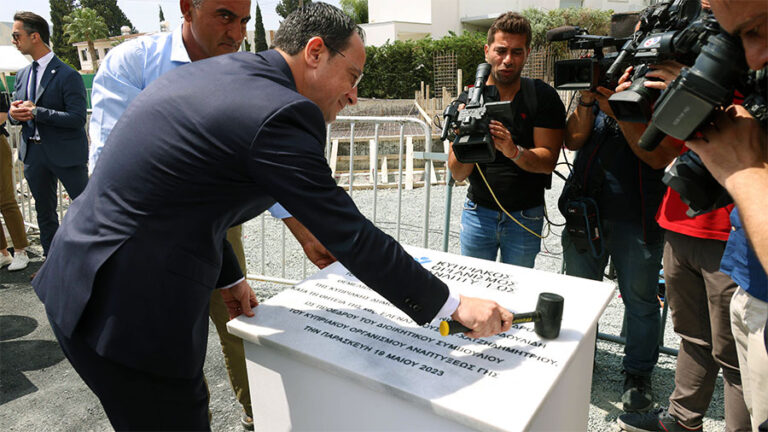
Cyprus is facing an unprecedented housing crisis, which primarily affects the younger generations, President Nikos Christodoulides said on Friday as he laid the foundation stone for the new social housing development ‘Ianthi’ created by the Cyprus Land Development Corporation (Koag) in Larnaca.

Christodoulides said the government has been called to immediately manage this crisis.

“The particularly high cost of building a house, as well as the difficulty in securing financing, have shut out a significant number of our compatriots from the housing market. I would like to point out that the cost of securing affordable housing, either by purchase or by rental, has risen sharply in recent years in our country,” he said.

He added that as a result, the risk of eroding social cohesion was now visible, since by increasing the family budget to cover housing needs, other equally important and necessary needs were adversely affected, such as education, children’s needs, and many others.

The government has decided to design a new housing policy framework, as well as establishing a Unified Housing Agency soon, which will be responsible for formulating the states housing policy to meet the needs of citizens, the president added.

“With its establishment, this new Unified Housing Agency will be the one and only point of reference through which the citizen will be guided for their housing choices, based on their needs and their financial and family data, taking into account at the same time and other priorities that we have as a government, such as the need for the revitalisation of the countryside, support for critical areas, cooperation with the local authorities, but also dealing with traffic, all these issues, which we are asked to take into account in our housing policy,” he said.

He added that the intention of the government is to implement the campaign promises to the Cypriot people through the new housing policy, which is to ensure housing for all groups of the population who face a problem, especially young people and young couples.

Commenting further, the president said that they were gathering and categorising state plots of land, so that it was possible to evaluate their development potential and to draw up specific and targeted housing policies.

“It is not lost on us that the policies up to now have focused on helping citizens’ efforts to acquire their own home, primarily,” he said.

The government will also seek to activate the private sector, which is able, with targeted incentives, to assist and help increase the available building stock, he said.

Another goal he mentioned is, “ensuring unimpeded access of moderate and low-paid social strata to financing for the acquisition of a modern and dignified first home, through the announcement of targeted sponsorships and projects.”

Limassol suburbs flourish as the city ages

0

Out of the total of 52,259 buildings in the city and suburbs of Limassol, approximately 806 are new properties up to 10 years old, but the majority are over 50.

In the category of 10-20 years, there are 1503 properties, while in the 20-30 years category, there are 11,264 properties.

Ask Wire, a company that combines expertise in the real estate sector with the utilisation of technology, has analysed the data that reveals the age of buildings in Limassol.

The analysis showcases the trajectory of residential development over time, as well as the areas that are experiencing growth.

Additionally, construction works have commenced for 163 apartment buildings from January 2022 to March 2023.

Out of these, 65 (40%) are in the Municipality of Limassol, 29 (18%) in the Municipality of Germasogeia, and 21 (13%) in the Municipality of Agios Athanasios.

Based on the findings of Ask Wire, it is evident that there has been increased residential development in the western areas of Limassol, specifically in the Erimi and Zakaki regions near the casino resort.

In the eastern areas, there is a noticeable residential development in the Agia Fyla and Papa tourist areas.

Closer to the city centre and the surrounding municipalities/communities, there is naturally a higher number of older buildings.

Specifically, there are 18,571 buildings in the 30-50 years category and 20,115 buildings in the 50+ years category.

Building Age Number of Buildings
1-10 806
10-20 1,503
20-30 11,264
30-50 18,571
50+ 20,115
Total 52,259

Considering the significant population growth in the city in 2022, which absorbed an estimated 40,000 individuals who settled in Cyprus, along with the number of properties, it explains the continued increase in prices for both buying and renting.

According to Ask Wire data for the first quarter of 2023, rental prices for apartments and houses in Limassol increased by 1.78% and 4.17%, respectively, on an annual basis, while prices for buying apartments and houses also saw an increase of 3.29% and 2% respectively.

Pavlos Loizou, CEO of Ask Wire, said: “The picture of residential development is as expected in a city where the oldest buildings are concentrated in the city centre, and as you move outward, the age of the properties decreases.

“However, there are also the traditional cores in the villages surrounding the city of Limassol, such as Agios Athanasios and Polemidia, which are now part of the wider city of Limassol while retaining some of their characteristics.

“The analysis by Ask Wire presents the areas with the highest potential and shows in real-time and detail how the city and its dynamics are changing, such as the growing/expanding areas and population density.

“These findings are particularly significant for entrepreneurs operating in sectors such as commerce and hospitality, as well as for real estate investors, construction companies, and building materials sales companies”.