Deal on reduced VAT for first homes near

MPs are seeking a compromise on the thorny issue of reduced VAT for first homes, under pressure to beat the 8 June deadline of introducing legislation to harmonise Cyprus’ laws with the EU.

Reports say that MPs are close to resolving the issue following a proposal tabled by social democrats EDEK.

The House has picked up the issue once more as the grace period given by the European Commission is close to expiring, along with a warning against Cyprus over the discount.

If EU-approved legislation is not adopted, Cyprus could be slapped with sanctions by Brussels, as an infringement procedure was launched against the Republic in the summer of 2021.

The EU directive dictates that member states introduce legislation of 5% VAT on homes up to 140 square metres.

According to the proposed bill by EDEK’s MP Marinos Sizopoulos, a home of more than 150 sqm with a maximum value of €350,000 will benefit from the reduced VAT rate.

Homes from 150 sqm to 200 sq. m. will get the standard 19% VAT for every square metre over the limit of up to 200 square metres. The proposal covers both houses and flats.

But a home covering anything over 200 square metres is not eligible for the lower VAT rate of 5% and instead incurs 19% for the whole project.

Currently, this is applicable for homes and flats over 275 square metres.

EDEK’s proposal is the latest of a series of suggestions tabled to resolve the complex issue, as the EU allows states to employ a reduced VAT rate on homes if this serves social policy, such as promoting affordable housing.

Bills have been going and coming to the House, from MPs and the Finance Ministry, for the past two years with no concession reached.

The Finance Ministry’s previous proposal had tried to tie the reduced rate with the property’s value, suggesting that it covers property transactions with a value of up to €350,000 for houses and flats with a total value of €200,000.

Conversely, MPs had been campaigning to extend the size criteria included in the legislation to fit the Cypriot market specs for larger homes.

The House Finance Committee has reportedly greenlighted EDEK’s proposal as Brussels tightens the noose.

According to 2021 data from the Finance Ministry, applications submitted for a reduced VAT rate revealed that 35% involved homes of up to 100 sqm, 17% from 100-140 sqm, while 31% involved properties from 140-200 sqm.

Another 11% of applications involved houses of 200-275 sqm.

Property price & rental index Q1 2023

The 54th quarterly publication of the RICS Cyprus Property Index with KPMG in Cyprus records the property price and rental index, tracking property and rental prices across all Cyprus districts and main property types.

Market values year-on-year

A year-on-year comparison of values shows an increase in all asset classes, with the largest evident in Apartments, followed by Offices and Houses. Retail is exhibiting the lowest increase:

  • Apartments up 10.97%
  • Houses up 8.48%
  • Retail premises up 0.95%
  • Warehouses up 4.82%
  • Offices up 9.63%

Holiday homes

On a year-on-year comparison, both categories experienced growth with Holiday Houses leading the way:

  • Holiday apartments up 8.86%
  • Holiday houses up 9.50%

Rental values year-on-year

On a year-on-year comparison, rental values showed an increase, with the largest identified in Holiday Apartments, followed closely by the residential sector properties (Apartments, Houses). Retail and Warehouse asset classes are at the lower end of the increase, with Retail showing the lowest increase:

  • Apartments up 29.07%
  • Houses up 28.32%
  • Retail premises up 4.01%
  • Warehouses up 4.52%
  • Offices up 14.13%
  • Holiday apartments up 31.35%
  • Holiday houses up 18.02%

Rental yields

In the first quarter of 2023, rental yields stood at:

  • Apartments 5.37%
  • Houses 2.86%
  • Retail 5.77%
  • Warehouse 4.30%
  • Office 5.35%
  • Holiday Apartments 5.71%
  • Holiday Houses 2.71%

Comments from KPMG and RICS

On behalf of KPMG in Cyprus, Christophoros Anayiotos, Head of Real Estate Industry Group, stated:

“During the first quarter of 2023 the increasing trend in property values continued in most asset classes, with notable increases in Larnaca. The best performing asset class is Houses with overall increases in all areas. However, the highest increases were recorded in Larnaca, in Offices and Apartments. Retail displayed minor increases in Limassol, but also the largest drop of the quarter in Larnaca. Rental values have also increased, with holiday apartments and residential sector properties (apartments, houses) exhibiting the largest increases – the same trend was also identified in property yields”.

On behalf of RICS, Simon Rubinsohn, RICS Chief Economist, commented:

“The resilient performance of the economy is reflected not just in this dataset but also in the generally positive feedback to the RICS sentiment survey of real estate in the country. That shows occupied demand in most areas continuing to grow over recent months and that rental expectations largely remain upbeat helping to support the appetite of investors”.

About the price and rental index

The RICS Cyprus Property Price Index with KPMG in Cyprus monitors hypothetical or notional buildings, each having specific characteristics. Details of these hypothetical properties are provided in the University of Reading’s report.

The provided price per sqm is based on the Gross External Area of the property (as defined in the RICS’ Code of Measurement Practice 8th Edition), which includes the living area and covered verandas but excludes common areas.

The estimation of price levels is carried out by accredited RICS property professionals who are active in the relevant markets.

Full details may be found in the RICS Cyprus Property Index with KPMG in Cyprus for Quarter 1 2023


Demand for housing loans down 40%

Demand for housing loans dropped by almost 40% in the first quarter of the year, as Cypriot households are put off by rising interest rates, according to the Central Bank of Cyprus.

Last Thursday, the European Central Bank pushed interest rates up by 0.25%, announcing its seventh increase since July 2022 in a bid to curb inflation.

The ECB has now brought the eurozone’s key interest rate to 3.75%

According to the latest data released by the CBC, new loans to households showed a decrease of 37.3% in the first three months of 2023, dropping to €308 million from €491 million in the same quarter last year.

However, when compared to 2019 the data showed an increase of 4.4%.

As the CBC pointed out in its latest economic bulletin, the decline in new home loans observed, also recorded in the second and third quarters of 2022, may reflect the end of the government’s interest rate subsidy for housing loans, as well as the gradual increase in interest rates by the ECB.

CBC’s survey notes that, according to Cypriot banks, the drop in demand for housing loans is attributable to the upward trend in interest rates, the deterioration of consumer confidence and, to a lesser extent, the less favourable housing market outlook.

Business loans

Meanwhile, business loans issued in the first three months of the year have increased by 6.8% compared to the same period last year, reaching €448 million, up from 420 million.

Compared to the same period in pre-COVID 2019, there is a decrease of 19.2%.

The total amount of loans channelled by banks to households and businesses, excluding restructurings, dropped to €756 million in the first quarter of 2023, from €911 million in 2022, and €849 million in 2019.

According to the CBC, since July 2022, the dynamics in lending have slowed down, reflecting the increased uncertainty in the geopolitical and economic environment, the even more stringent lending criteria of banks, higher interest rates and the negative impact of inflation on real disposable income of households and in the profit margin of businesses.

“At the same time, the increased uncertainty due to successive crises and the upward trend of interest rates seem to be limiting new corporate borrowing for large investment projects,” noted the CBC.

According to Central Bank data, new loans granted by banks in 2022 amounted to €3.2 billion from €2.9 billion in 2021, marking an increase of 10%.

Compared to 2019, total loans show an increase of 8.4%.

Real estate sales up 26% in first quarter

Annual real estate transactions in Cyprus continued to rise in the first quarter of the year, as sales documents submitted are 26.6% higher compared to the same period last year, according to the Real Estate Registration Board.

The Board’s latest quarterly report showed that 6,188 property transactions were recorded in Q1 this year with a total value of €1.7 billion, up from €1.3 billion in the first three months last year.

The latest boost in the island’s real estate sector has been attributed to the relocation of high-tech firms and their employees.

At a district level, only the capital did not see a significant boost in property sales.

Nicosia remained at the same levels as in Q1 2022, with the volume of transactions increasing slightly to 1,597. However, the value of transactions dropped as properties sold in Q1 this year were worth €257.5 million, compared to €313 million the same period last year.

In Limassol, the value of sales transactions in the first quarter of 2023 exceeded €908 million for 2,097 transactions, increasing significantly on an annual basis.

In the corresponding quarter of 2022, properties worth €587 million were sold in Limassol.

Paphos seems to be keeping the momentum of recent years, as both the volume and value of transactions in the first quarter of the year enjoyed a significant increase on an annual and quarterly basis.

Three consecutive quarters

The value of properties sold in the reporting period in the Paphos district remained above €250 million for the third consecutive quarter.

Accordingly, the real estate market in Larnaca also saw a significant increase in the volume and value of transactions on an annual basis. The value of properties sold in the first quarter of 2023 was just over €200 million, while in the corresponding quarter of 2022 it was €145 million.

Famagusta district also saw an increase in the value of properties sold in the first quarter of the year, reaching €57.3 million compared to €54 million in the corresponding quarter last year.

In terms of property categories, the Real Estate Registration Board noted that the house market has built up momentum, reflected in the 931 sales recorded in Q1 this year. It noted that in the whole of 2022 there were 2,175 house sales.

Board President Marinos Kineyirou emphasised that caution is needed, as “these performances should not disorient stakeholders from the bigger picture of the problems plaguing the real estate market in Cyprus”.

Kineyirou warned that inflation, rising lending rates, and increased costs of building materials are applying downward pressure and impacting demand.

Inexorable rise in property sales continues

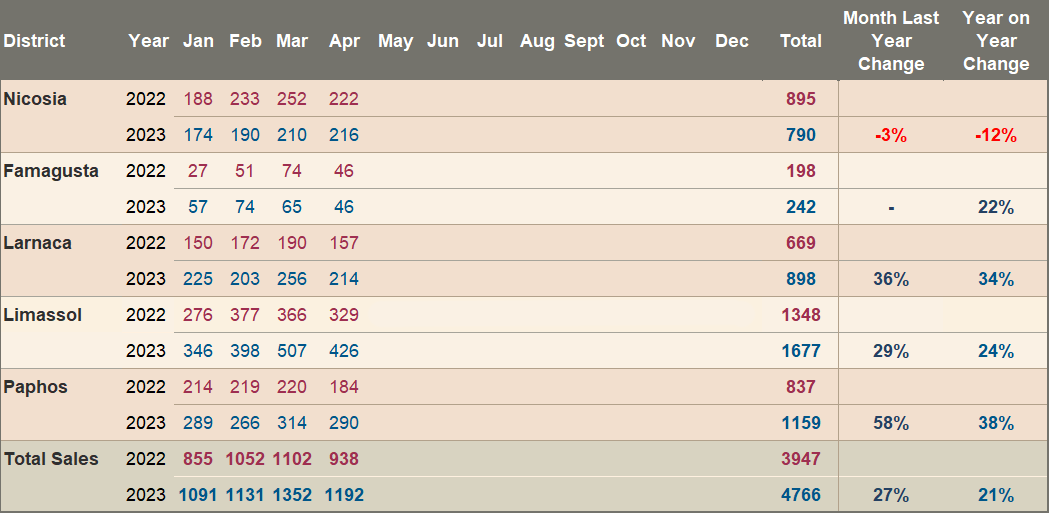
The relentless demand for Cyprus real estate continued in April, with the number of  property sales rising by 27 per cent compared to the same month last year according to official statistics from the Department of Lands and Surveys.

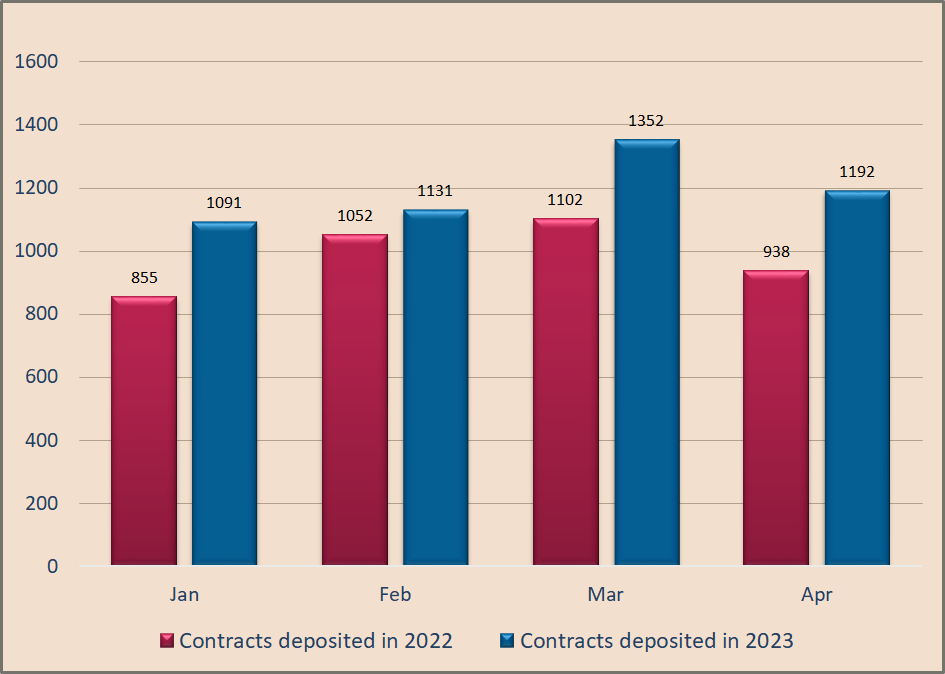
The total number of sales (as measured by the number of contracts deposited at Land Registry offices) in April 2023 reached 1,192 – an increase of 27% compared to April 2022.

Although sales in Nicosia fell by 3% and remained steady in Famagusta compared to April 2022, they rose in the remaining three districts.

In percentage terms, Paphos led the way followed by Limassol and Larnaca with the highest number of sales (426) recorded in Limassol.

Pancyprian property sales
Total Property Sale Transactions – 2022/2023 Comparison

Year to date property sales

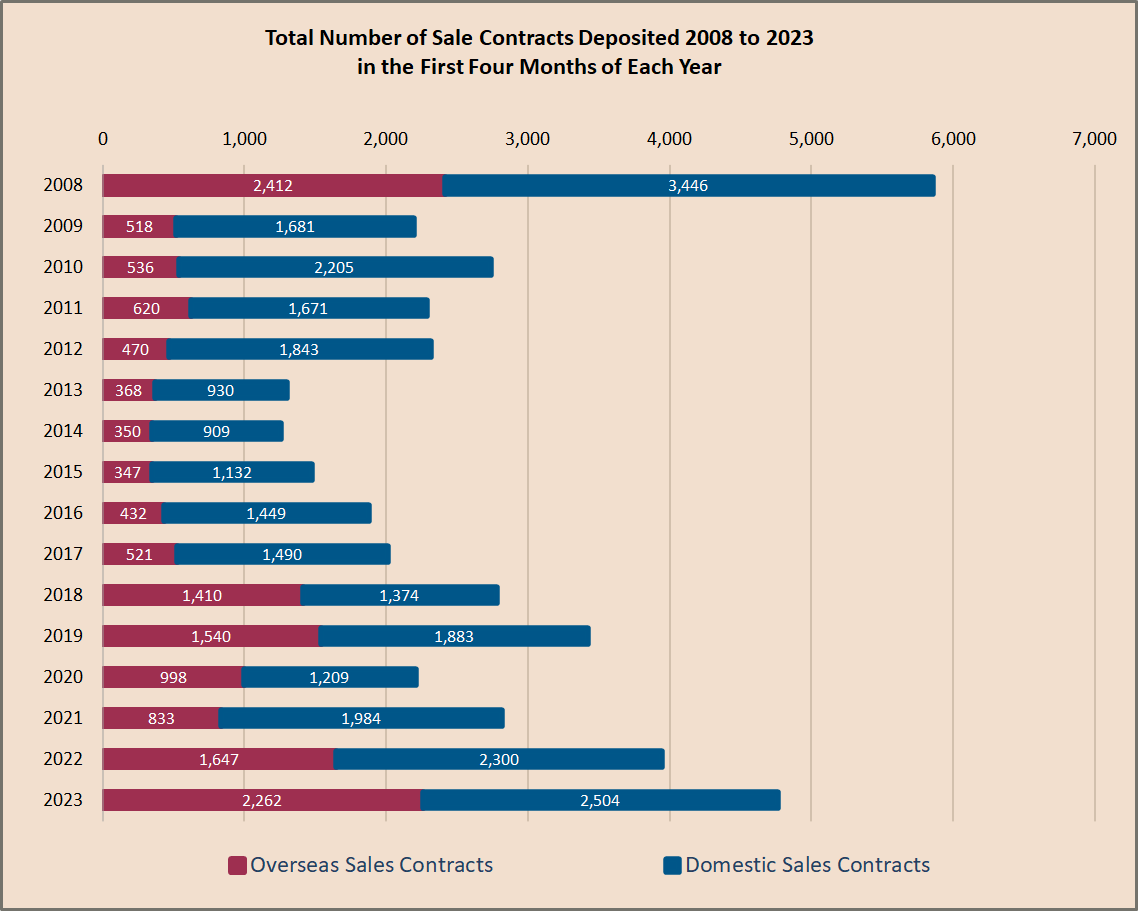
Sales during the first four months of 2023 reached 4,766; an increase of 21% compared to the same period last year. With the exception of Nicosia, sales have risen in all districts.

Total Property Sale Transactions – 2022/2023 Comparison

Market segment analysis

Property sales to the domestic market

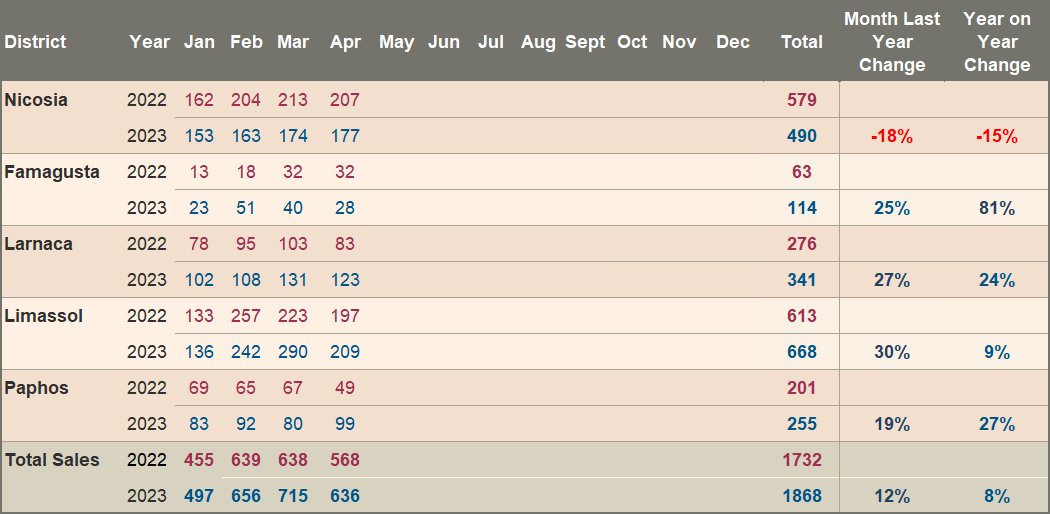
Real estate sales to the domestic market in April rose 12% compared to April 2022 but with Nicosia reporting a fall of 18%.

Limassol saw the greatest number of sales followed by Nicosia, Larnaca, Paphos and Famagusta.

Domestic sales
Domestic Sale Transactions – 2022/2023 Comparison

Sales to the domestic market during the first four months of 2023 stood at 1,868; an increase of 12% on the 1,732 achieved during the same period last year.

Property sales to the overseas market

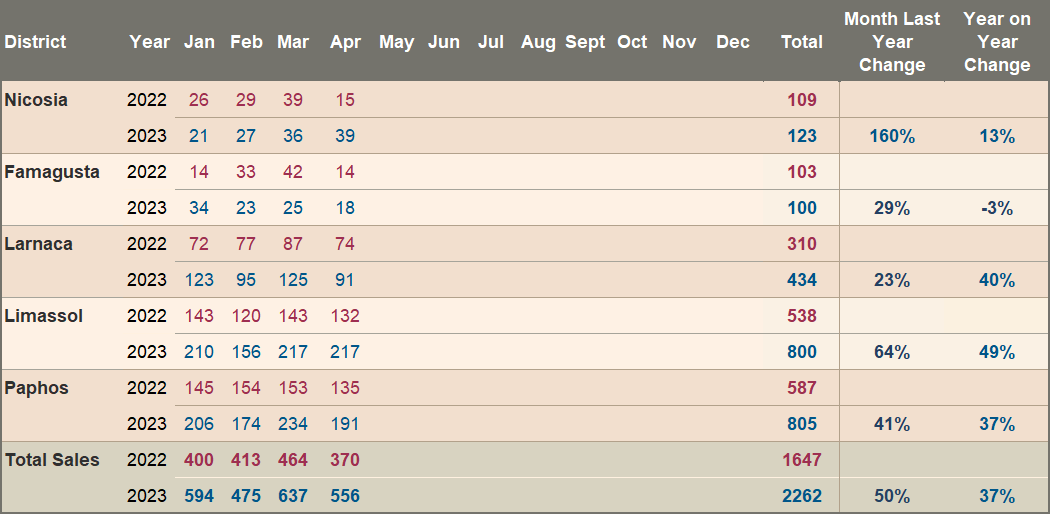
Sales to foreigners (non-Cypriots) were up 50% compared to April 2022 with sales rising in all districts.

Limassol recorded the greatest number of sales, followed by Paphos, Larnaca, Nicosia and Famagusta.

Property sales to foreign citizens
Property sales to the overseas market – 2022/2023 Comparison

Foreign real estate sales during the first four months of 2023 reached 2,622; a 37% increase on the 1,647 achieved in the same period last year.

Property sales to EU citizens

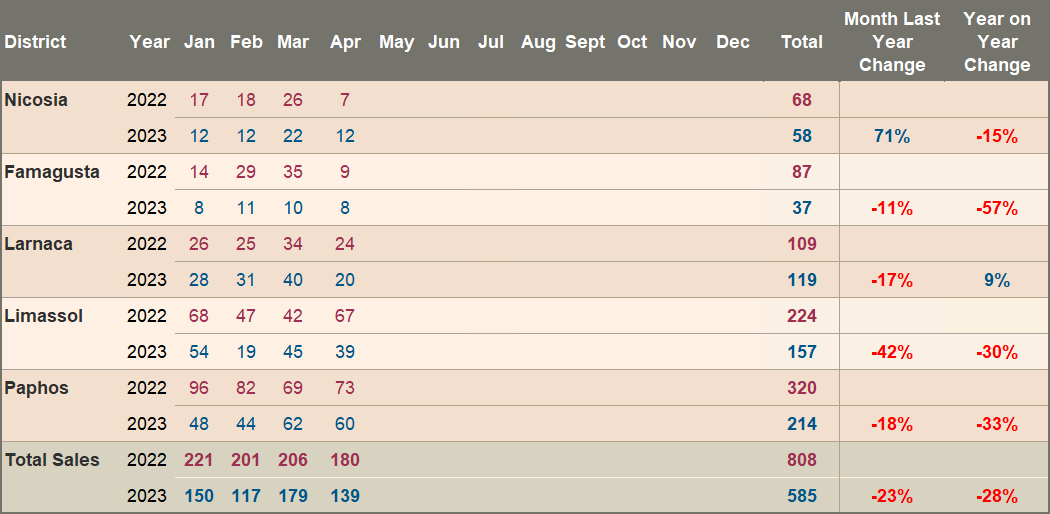
Sales to EU nationals continued their downward trend, falling by 23% compared to April 2022, with sales falling in all districts with the exception of Nicosia.

Paphos achieved the greatest number of sales, followed by Limassol, Larnaca, Nicosia and Famagusta.

Overseas (EU) Sale Transactions – 2022/2023 Comparison

Sales to EU nationals during the first four months of 2023 reached 585; a fall of 28% compared to the 808 achieved in the first four months of last year.

Property sales to non-EU citizens

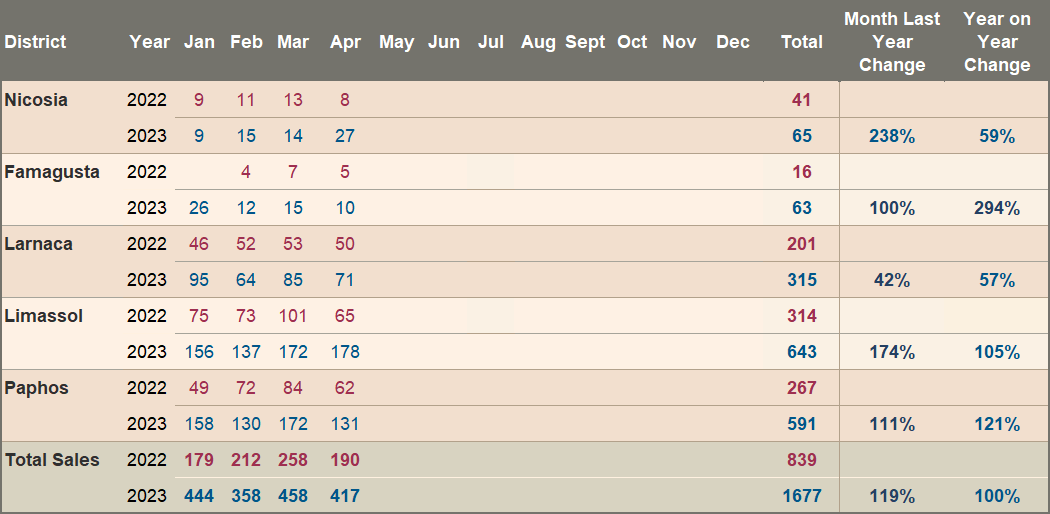
Sales to non-EU Nationals maintained their strong growth rising by a substantial 119% compared to April 2022, with sales rising in all districts.

Limassol recorded the highest number of sales, followed by Paphos, Larnaca, Nicosia and Famagusta.

Sales to non-EU citizens
Overseas (non-EU) Sale Transactions – 2022/2023 Comparison

Sales to non-EU nationals during the first four months of 2023 reached 1,677, twice the number achieved in the first four months of last year.

Highly paid Ukrainians upset property market

Almost 10,000 highly skilled and highly paid Ukrainian refugees have joined the island’s work force, paving the way for a number of socioeconomic and demographic changes to the structure of Cypriot society.

In just over a year since Russia’s invasion of Ukraine, 9,000 highly skilled Ukrainians were granted a working permit, employed by high tech companies setting up shop in Cyprus, according to Invest Cyprus, the national agency to attract foreign investment.

Invest Cyprus’ newly appointed CEO, Marios Tannousis, said that in 2022, when including family members, the total number of Ukrainians obtaining a residence permit through the Business Facilitation Unit under the Commerce Ministry reached 24,000.

In comments to news site Philenews, Tannousis noted that the number of highly skilled employees making their way to Cyprus is further inflated by Belarussians and Russians fleeing from the fallout of the war.

“A significant number of employees have also made their way to the island from Israel and from Lebanon, which is torn by a deep political and economic crisis. The majority of these people have been employed by high-tech companies already on the island,” said Tannousis.

Invest Cyprus’ head also noted that a large number of companies have also decided to relocate to the island as a result of the war in Ukraine and turbulence in the region.

Tannousis pointed out that in 2022, according to the BFU, a one-stop mechanism set up in 2020 to reduce red tape procedures for businesses, a total of 1,640 submitted a request to set up shop on the island.

He noted that the national strategy introduced in January 2022 to encourage headquartering of large firms is the main drive behind the arrival of thousands of highly qualified professionals.

In comments to the Financial Mirror, PwC Cyprus Partner Constantinos Savvides said the real estate market’s growth last year was down to an influx of foreign high-tech employees relocating to Cyprus, and Ukrainian refugees.

According to PwC’s in-depth analysis, the total value of Cyprus’ real estate transactions reached a record-high of €5.2 billion in 2022, recording an annual increase of 27%.

Fast tracking

Latest legislation has seen Cyprus offer incentives to companies to relocate to the island, including the fast tracking of residence permit for employees, and tax incentives for both companies and their employees.

For existing employees, the latest legislation introduced provides for a 50% tax break on remuneration from employment earnings of €55,000 p.a. by an individual already in Cyprus, provided that before their employment, they were abroad for 12 consecutive years.

The law also provides a grace period of six months for obtaining the benefit, while the exemption will continue to apply for 17 years from the commencement of employment.

For new employees, the bill provides a 50% tax deduction on remuneration exercised in Cyprus by an individual abroad for 12 consecutive years, while eligible persons should earn €55,000 p.a.

Companies moving to Cyprus must make a documented investment of a minimum €200,000 in the island’s economy, before being eligible for registration.

Meanwhile, economists warn that although the arrival of highly skilled and highly paid employees will be injecting serious amounts into the island’s economy, the state will need to rethink its development and housing models.

Side effects

Economist Dr Sofronis Clerides told Philenews that the state will need to address a series of side effects, including the abrupt increase of rents and the value of houses, as the newcomers make their way into the property market.

Clerides, the head of the School of Economics and Management at the University of Cyprus, stated that the arrival of qualified professionals generally has had a positive impact on the economy, as the demand for services has increased.

“This has had a positive impact on the operation of related businesses increases, such as foreign language schools, while money is also injected in the rest of the Cypriot market, such as in the catering sector,” said Clerides.

The economist said, however, that the state will need to introduce a safety net, in order to protect the scheme from “similar mistakes made in the case of the Citizenship for Investment scheme”.

Clerides noted that the arrival of thousands of highly paid employees has already pushed up rents and had a negative impact on the cost of living of locals, especially in Limassol, where the majority of foreign companies have relocated to.

He argued that the national strategy to attract business is undoubtedly a more positive economic policy than the ‘golden passports’ scheme, however it should be accompanied by a housing policy from the state.

Clerides emphasised that the intervention of the state is necessary to deal with the negative effects, as “leaving the market unchecked, will only allow it to work in the interest of those with high income”.

According to data from Ask Wire Index for property sale and rental values, the rental values in Q1 2023, compared to Q1 2022, increased 19% for apartments and 12.2% for houses across the island.