Cyprus raises bar for expat retirees

UK and other non-EU pensioners eyeing a retirement home in Cyprus need to rethink their plans as authorities have raised the bar for permanent residence permits.

The government has tweaked regulations by tightening criteria for residency permits, in a bid to comply with EU anti-money laundering directives, with expats seen as suffering collateral damage.

The changes, announced on Friday by the Interior Ministry, come amid a surge of demand from retirees from the UK, Israel and Germany, with real estate agents worried the government’s plans will endanger a mini-bubble in the sector.

Changes, include a hefty increase of 66% on the insured annual income an expat retiree must have to apply for the fast-track procedure.

An expat planning to retire to the island will now need proof of €50,000 income per year, up from €30,000 before the changes.

The annual income is increased by €15,000 for a dependant spouse and €10,000 for each dependent minor.

Authorities have also introduced the requirement for health insurance, which raises the bar even higher, as an expat retiree will need to dish out several thousand euros for medical cover.

The main requirement for the scheme sees expats investing €300,000, which could go towards the purchase of a newly constructed home.

“The underlying purpose behind these changes is to protect the integrity of the regulations, thus further safeguarding its continuity and securing the country’s reputation,” said the Interior Ministry, announcing the changes.

The changes take effect as of Tuesday, May 2, 2023 and will probably make life difficult for expats eyeing a retirement home in one of the island’s coastal towns, attracting thousands of retirees over the years.

“This could endanger the boom in demand we have seen in recent months for property in the coastal areas, especially Paphos,” said Esme Palas, Barrister at Law, Partner at Michael Kyprianou and Co LLC in Paphos.

“Word got out that the government had been preparing to change the criteria for the permanent residency permit through investment scheme earlier last week, and we have already received tens of calls from concerned expats,” said Palas.

Clients pull out

Talking to the Financial Mirror, the Paphos based barrister said that their firm has been told by clients who were ready to purchase property in the district, that they would have to pull out as they do not meet the new criteria.

“Furthermore, we were not informed of these changes, which come into effect in just a few days.

“This has resulted in stakeholders on the island having to inform their clients of the new requirements, which they may not be able to meet,” said the barrister.

“They are concerned, as many of these people rely on selling property they own back in the UK, and on their pensions.

“Many people may have money in the bank to back a property purchase, but do not have a yearly income to meet the new higher criteria,” said Palas.

Real estate agents in Limassol and Paphos are reporting the highest demand from foreign buyers and Cypriots for homes since 2020 when the government ended the disgraced citizenship for investment scheme.

According to Land Registry data, overall, during 2022, a total of 5,928 properties across Cyprus were acquired by foreigners, compared to 3,691 during 2021, representing a 61% increase.

Approximately 57% of properties acquired by foreigners during 2022 relate to non-EU buyers (2021: 50%, 2020: 61%).

All Cyprus districts recorded YoY increases during 2022, in terms of the number of properties acquired by foreigners, with Paphos and Limassol experiencing the most notable increases (79% and 78% respectively), followed by Larnaca (55%).

Impossible

Retired UK expat and property analyst Nigel Howarth told the Financial Mirror that the new criteria will make things impossible for British expats to retire on the island.

“With the new criteria I don’t see many UK expats being eligible to make the move to Cyprus, as very few retirees have a pension of €50,000,” said Howarth.

“My wife and I have been here long enough to know that a couple does not need €65,000 a year to make ends meet in Cyprus,” said Howarth.

He added that the demand for private health insurance, raises the bar even further as not many insurance companies will be willing to insure retirees who are in their golden years.

As he said, he and his wife pay several thousand euros year for a private medical insurance policy.

The requirement for private health insurance is for applicants when they first submit their application. The procedure foresees that they are initially given a temporary residence permit for a few months before their application is processed.

Once approved, investors acquiring a permanent residence permit are included automatically in the country’s General Health Scheme (GHS).

Howarth continued that he had personally contacted the authorities in Spain to inquire over the local investment for residency scheme.

“The Spanish authorities said that they are not asking British retirees to meet any additional criteria, that did not apply to them before Brexit,” said the veteran property analyst.

“This means that the island will be losing out to competitors, as it will only be attractive to the ‘caviar brigade’ of retirees,” he concluded.

Meanwhile, government sources told the Financial Mirror that expats eyeing a temporary residence permit will also be in for surprises, as authorities are eyeing to increase in income criteria for the scheme by 32%.

Currently, a couple retiring to the island will need proof of €28,800 income per year.

According to the government source, the competent authorities are mulling over increasing the criteria to €37,000.

British lawyers probe golden passport scandal

The Independent Anti-Corruption Authority has hired a team of internationally accredited legal experts to investigate claims involving high-ranking officials in the golden passport scandal.

The previous administration set up the anti-corruption watchdog under President Nicos Anastasiades to investigate “as a priority” claims that he and cabinet members were involved in the golden passport debacle.

It was alleged that Anastasiades had run a corrupt administration under the influence of Russian oligarchs, published in three books by his former aide, Makarios Drousiotis.

According to Phileleftheros daily, the Authority has tasked two British lawyers who have previously represented EU governments in international courtrooms and have no ties to the island’s now-defunct citizenship for investment scheme.

The two will be joined by three Cypriot lawyers or auditors not involved in the scheme.

British lawyers are preparing a list of people to be interviewed in the framework of the probe.

The team will prioritise allegations made against Anastasiades by opposition AKEL MP Christos Christophides, combined with findings of Auditor General Odysseas Michaelides.

The first complaint against the former President concerns the alleged conflict of interest whose law firms offered services to dodgy investors seeking to obtain a “golden passport”.

In August, the Auditor General released a report on the defunct Citizenship for Investment scheme, calling it “rotten” to its core.

Michaelides had said that certain actions of government officials could constitute criminal acts.

The almost 200-page dossier contained the findings of a probe into 3,517 cases of foreign investors who acquired citizenship through the golden passport scheme, noting that actions by officials, including the cabinet, deprived the state of sizeable revenue.

Christophides had claimed that 353 passports were issued to clients of law firms belonging or related to the former President or cabinet members.

The AKEL MP also accused Anastasiades of using his position as President to benefit family members.

According to a second complaint filed by Christophides, a passport was given to a Russian investor who owns a banking institution housed in a building in Limassol, allegedly bought from one of the former President’s son-in-laws.

Drousiotis, who served as an advisor to Anastasiades from March 2013 to October 2014, had written a trilogy of books on alleged corruption incidents at the Presidential Palace.

The trilogy’s first book, “The Gang,” exposes how, during the 2013 banking crisis, the political elite rejected a European bailout package to protect the interests of the Kremlin.

His second book, “Crime in Crans Montana,” depicts how President Anastasiades allegedly walked out of the 2017 talks on Cyprus reunification.

Anastasiades had said in a November interview that he had contemplated filing for libel.

“I never did so to avoid being accused of attempting to gag the press,” he claimed.

The citizenships programme was axed in November 2020 after an undercover Al Jazeera video showed then House speaker Demetris Syllouris and AKEL MP Christakis Giovanis offering help to a fictional Chinese businessman with a criminal record to secure citizenship.

A public inquiry found that the government broke the law countless times to grant citizenship to over 6,700 people from 2007 to 2020.

It concluded that over half (53%) of the 6,779 passports granted were done illegally, encouraged by a due diligence vacuum or insufficient background checks.

Cyprus’ passport scheme generated over €8 billion during its lifespan.

Cyprus permanent residency rules revised

The Cypriot Government, in an attempt to attract foreign investment to the island and to help economic recovery and further economic growth, introduced Regulation 6(2) of the Aliens and Immigration Regulations which gave non-EU nationals, who invested in Cyprus, the right to permanently reside on the Island, provided certain criteria were met.

In order to address some weaknesses in the system, these criteria have been amended and will take effect on May 2, 2023, the aim being to protect the integrity of the system, thereby safeguarding their continuity and securing the country’s reputation.

Permanent Residency permits shall be issued to non-EU applicants, provided they meet one of the investment criteria mentioned below:

The applicant must make an investment of at least €300,000 in one of the following categories:

  • House/apartment: Purchase of a house/apartment sold for the first time (not a resale) by land development company of a minimum value of €300,000 (plus VAT).
  • Real estate (excluding houses/apartments): Purchase of another form of real estate such as offices, shops, hotels or similar developments, or a combination of these, with a total value of €300,000. These properties may also be resale properties.
  • Share capital of a Cypriot company with activities and personnel in Cyprus: Investment worth €300,000 in the share capital of a new company or an existing company which is registered, based and operates in Cyprus with a proven physical presence and employs at least five (5) people.
  • Shares of a Cyprus Investment Organisation for Collective Investments (type AIF, AIFLNP, RAIF): Investment worth €300,000 in shares of a Cyprus Investment Organisation for Collective Investments whose investments need to be carried out in Cyprus.

In the event that the applicant ceases to hold the investment without immediately replacing it with another of the same or greater value, which should meet the conditions set in this procedure, then the Permanent Residence permit will be cancelled.

It must be proved that the money to be used for the investment must have come from abroad from the applicant’s personal bank account or that of his spouse and the value of the investment needs to be transferred to the vendor’s bank account in Cyprus.

In addition, the applicant should prove that he has at his disposal a secure annual income emanating from abroad of at least €50,000. The annual income is increased by €15,000 for a dependant spouse and €10,000 for each dependent minor child.

In cases where the applicant invests in a house or apartment, this income can be from salaries, pensions, stock dividends, fixed deposits, or rents emanating from abroad. Such income, however, can only be proven by tax declarations of the applicant from the country in which the applicant is tax resident. In calculating the total income, the income of the applicant’s spouse may also be taken into account.

In cases where the applicant chooses to invest in real estate excluding houses or apartments, then the total income or part of it may also arise from sources originating from activities within the Republic, provided these are taxed in the Republic.

Quality Criteria

The applicant and their spouse must submit a clean criminal record from their country of residence or from the Republic, if they reside in Cyprus.

They must certify that they do not intend to work in the Republic, with the exception of their acting as directors in a company in which they have chosen to invest within the framework of this policy.

If the investment does not concern a company’s share capital, they may be shareholders in companies registered in Cyprus and receive dividends. They may also hold the position of director in such companies without remuneration.

Where applicants choose to invest under the investment criteria B, C, or D, they must present information regarding their place of residence in the Republic.

When investing in residential or other properties, the application needs to contain proof that the contract of sale was filed with the Land Registry and official receipts for the payment of at least €300,000 (excluding VAT), regardless of the date of delivery of the property. Evidence must be provided that the funds invested have come from abroad and are not a product of internal borrowing. The total investment should be paid into the seller’s account at a Cypriot financial institution.

The applicant may purchase up to two (2) residential units (apartments or houses), provided that the total market value meets the above criteria. The said purchase must be dwellings sold by the developer for the first time, unless the purchase of the houses took place before May 7, 2013.

The properties do not have to be purchased from the same land development company.

Provisions relating to dependents

The Immigration Permit is issued to the applicant and the applicant’s dependents (spouse and minor children up to the age of 18).

Unmarried children between the ages of 18 and 25, who are students in higher education abroad on the date of submission of the application, and who are financially dependent on the applicant, may submit their own, separate application for an Immigration Permit. In such a case, the father or mother and/or both parents together must prove that they have an additional annual income of €10,000 for each such dependent child.

Such permit, once issued, will continue to be valid even after they reach the age of 25, even if they marry and cease to be students and/or financially dependent on their parents.

Higher value investments to include adult children

An Immigration Permit may also be granted to adult children of the applicant who are not financially dependent provided a higher value investment is made.

The market value of the €300,000 investment should be multiplied according to the number of adult children, who will rely on the same investment for the purposes of obtaining an Immigration Permit.

Each adult child will need to prove they have at their disposal a secure annual income of at least €50,000, which will be increased by €15,000 for a dependent spouse and €10,000 for each dependent child.

It is no longer possible for applicants  to include in their application their parents or parents in-law.

Mechanism ensuring criteria continue to be met

Applicants are required to prove on an annual basis that they continue to hold the investment and that they continue to receive the required annual income for themselves and their dependants and that they all continue to hold a valid health insurance cover if no longer registered with the national health scheme GHS.

They need to present on an annual basis a clean criminal record from their country of origin and residence. In case the applicants fail to provide the above, then they and their dependents’ residence permits shall be cancelled.

The right of the applicants and their adult dependent children to reside in Cyprus is indefinite. The residency permit issued for the minor children of the applicant will end on reaching the age of 18. They can reapply if they fulfil the relevant criteria mentioned above.

The underlying objective of these provisions is to maintain the integrity of the system, safeguard the process and eliminate the loopholes that were observed.

While one can understand and respect the need for stricter controls, the increase in the amount of annual income that is required will exclude many potential investors, especially those of retirement age who wish to have Cyprus as their retirement haven and who do not have such high annual income.

It remains to be seen how these changes will be perceived by potential investors.

The content of this post is intended to provide a general guide to the subject matter and does not constitute legal advice.

By Esme Palas, Barrister at Law, Partner of the Law Firm Michael Kyprianou Advocates and Legal Consultants

Editor’s comments

Please note the above article refers to the revised criteria regarding the expedited process of granting immigration permits to third country nationals applying to invest in Cyprus. I.e. Investor Investor Immigration Permits

It’s anticipated that revised criteria for ‘Category F’ persons will be published in May (Category F persons are those who possess and have fully and freely at their disposal from abroad a secured annual income of an appropriate amount to allow them a decent living in Cyprus, without having to engage in any business, trade or profession in the Republic.)

Price and rental increases tapering off

Ask Wire, combining real estate know-how with technology, has published its Q1 2023 edition of the Ask Wire Index for property sale and rental values. The Ask Wire Index covers all districts and main property types, with values from Q4 2009.

Prices

Across Cyprus, on an annual basis, prices increased by 12.3% for apartments, 3.1% for houses, 2.4% for offices, 8.0% for holiday apartments and 3.1% for holiday houses, and decreased by 0.1% for retail and 1.8% for warehouses.

Overall, on a quarterly basis, sale values increased by 3.2% for apartments, 1.3% for houses, 0.4% for retail, 1.4% for offices, and remained stable for warehouses. As for holiday apartments and holiday houses, sale values increased by 1.8% and 1.5%, respectively.

Rental values

Regarding rental values, compared to Q1 2022 there has been an increase of 19.0% for apartments, 12.2% for houses, 3.3% for retail, 1.0% for warehouses, 7.5% for offices, 19.1% for holiday apartments and 14.5% for holiday houses.

On a quarterly basis rental values increased by 2.6% for apartments, 1.5% for houses, 0.7% for retail, 0.8% for offices, and remained stable for warehouses. As for holiday apartments and holiday houses rental values increased by 2.3% and 1.3%, respectively.

Pavlos Loizou, CEO of Ask Wire, commented that “the increase in property prices and rents is showing signs of slowing down, following significant increases since Q1 2022 and being led by apartment and house prices in Limassol, Paphos, and Larnaca.

“The combination of higher interest rates and high prices/rents has created a ceiling, with the market being generally stable, but at high levels. We expect pricing of commercial properties to come under pressure, as alternative investment classes offer appealing returns on a risk adjusted basis.

“Looking ahead to the second half 2023, we expect residential property prices to remain broadly stable, albeit with slowing demand and less transaction volume, whilst commercial real estate will face various challenges, with investor demand remaining relatively thin.”

For a breakdown of movements in sale and rental values by district, visit https://ask-wire.com/insights/.

Property Type Sale Value Rental Value
Apartments 3.2% 2.6%
Houses 1.3% 1.5%
Commercial 0.4% 0.7%
Warehouses 0.0% 0.0%
Office spaces 1.4% 0.8%
Holiday apartments 1.8% 2.3%
Holiday houses 1.5% 1.3%
Source: Ask WiRE – Quarterly percentage change in property values (Q4 2022 with Q1 2023)


Property Type Sale Value Rental Value
Apartments 12.3% 19.0%
Houses 3.1% 12.2%
Commercial -0.1% 3.3%
Warehouses -1.8% 1.0%
Office spaces 2.4% 7.5%
Holiday apartments 8.0% 19.1%
Holiday houses 3.1% 14.5%
Source: Ask WiRE – Annual percentage change in property values (Q1 2022 with Q1 2023)

Why prices are not coming down anytime soon

Cyprus has been attracting foreigners for tourism, real estate, and business purposes for the past 30 years. This has brought in significant amounts of money into the economy, transferred expertise to locals, and boosted businesses with more affluent clients.

However, since the Russia-Ukraine war broke out in early 2022, over 20,000 Ukrainians, Belarussians, and Russians have relocated to Cyprus, with many settling in Limassol to take advantage of the favourable tax regime. Fintech companies from the warring countries and neighbouring Belarus have also moved to Cyprus, bringing in new wealth and talent. Russian-language communications company Vestnik Kipra reported having 3,000 new IT professionals on its roster in May 2022 with some of their employees earning more than €5,000/month. The Limassol mayor estimated over 10,000 Ukrainians moving to the city since the war.

The “headquartering initiative” by the Cypriot government has also attracted overseas companies to set up operations on the island, resulting in 4,524 families applying for relocation up to August 2022.

Additionally, Israel’s recent political changes have prompted a surge of inquiries for emigration from its citizens, with Ocean Relocation receiving over 100 per day since January 2022. Cyprus has also been a popular destination for Israelis, with around 10,000 applying for Cypriot residency since 2020.

Information International has reported that around 12,000 Lebanese have also come to Cyprus, with a majority being between 25 and 40 years old.

These developments have brought new challenges and opportunities to Cyprus and its residents.

The influx of migrants to Cyprus has led to a surge in demand for rental accommodation, particularly in popular destinations such as Limassol and Paphos. Many of these migrants, have a much higher salary than the average local worker, some times more than 5 times the average salary of a local blue-collar worker. As a result, paying €1,500 for rent is not a problem for these high-earning migrants.

The surge in demand for housing, combined with the high salaries of these migrants, has led to a significant increase in rent prices in Limassol and Paphos. In 2016, it was possible to rent a two-bedroom apartment in Paphos for around €300 and in Limassol for around €400 per month. Now, the minimum rent for a two-bedroom apartment in Paphos is €1,000 and in Limassol can exceed €1,400 per month. This means that many locals are finding themselves priced out of the market, especially in the more desirable areas of the island.

The surge in rental prices has had a direct effect on the sales market, as foreign investors seek to purchase properties that yield a return of approximately 6%. The rental income generated by a property is a key factor in determining its value, as investors are willing to pay more for apartments that can be rented out for higher amounts. For instance, if an apartment can be rented for €1,000 per month, investors are willing to pay up to €200,000 to purchase it. However, if the same apartment can only be rented for €500 per month, the investor is only willing to pay up to €100,000 for it. This highlights the close correlation between rental prices and sale prices in the real estate market.

The individuals who have recently relocated to Cyprus and are currently working online or in fintech companies, have not only invested their time and effort in establishing themselves in the country but have also made substantial investments in the local real estate market.

This means that they are likely to stay in Cyprus for the long term, and will not be quick to leave. As a result, if there is no intervention from the government, it is unlikely that property prices will decrease significantly in the near future. The government may need to implement certain measures to regulate the real estate market and prevent it from becoming overheated, such as imposing more limits on foreign investment or introducing incentives to encourage investment in other sectors of the economy. However, until such measures are put in place, it is expected that the real estate market in Cyprus will remain stable, with prices continuing to reflect the demand from both domestic and international buyers.

About the author

Christos Nikolaou
Licensed Real Estate Agent
Property Canvas (Registered & Licensed Estate Agency A.A.826 & A.M. 432/E)

EU regs could make or break real estate sector

The European Parliament has recently passed a new bill that aims to tackle climate change by reducing carbon emissions.

This new legislation has significant implications for the real estate markets of Cyprus and Greece, where there is a large stock of buildings that are over 30 years old and require energy upgrades.

If and when these are enacted in local law, these new regulations will require that all new buildings should be zero-emission from 2028, with the deadline for new buildings occupied, operated or owned by public authorities in 2026.

All new buildings should be equipped with solar technologies by 2028, where technically suitable and economically feasible, while residential buildings undergoing major renovation have until 2032.

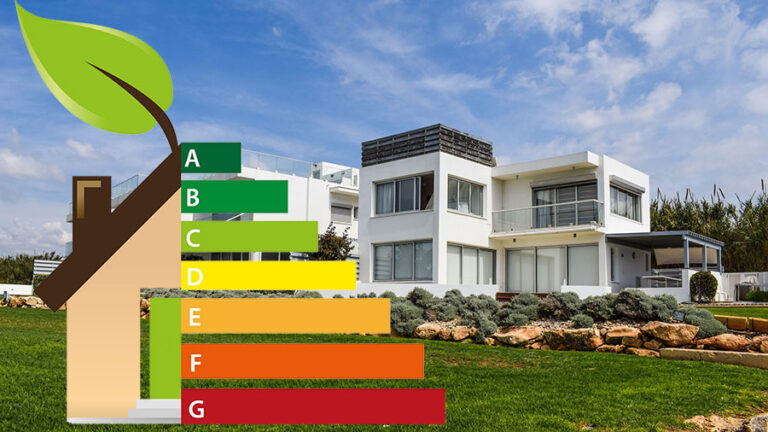
Importantly, residential buildings would have to achieve, at a minimum, energy performance class E by 2030, and D by 2033 – on a scale going from A to G, the latter corresponding to the 15% worst-performing buildings in the national stock of a member state. If a building does not meet these energy performance criteria, then it will not be possible to mortgage it or transfer its ownership.

Cyprus and Greece have a large stock of old buildings that do not meet the new energy efficiency standards set by the European Union. In Cyprus, for example, around 70% of the buildings were constructed before the 1980s, while in Greece the figure is around 55%.

According to a recent survey, there are around 154,000 buildings in Greece that were constructed before 1919 and 324,700 buildings that were constructed between 1919 and 1945. In addition, around 573,250 buildings were constructed between 1946 and 1960, and 639,475 buildings were constructed between 1961 and 1970.

These old buildings require significant upgrades to meet the new energy efficiency standards, and it is expected to have a momentous impact on the local real estate markets. It could result in higher costs for homeowners and landlords, as well as for buyers and renters who are looking for more energy-efficient properties.

The cost of renovating a building to meet the new energy efficiency standards can be significant, ranging from several thousand euros to tens of thousands of euros, depending on the size of the property and the extent of the renovation required.

For example, in Cyprus, the cost of renovating a building to meet the new energy efficiency standards could range from €7,500 to €30,000, depending on the size of the property and the extent of the renovation required. In addition, the new regulations could result in a decline in property values for buildings that do not meet the new energy efficiency standards.

Furthermore, the new regulations could affect the demand for older buildings that do not meet the new energy efficiency standards. This could have a compelling impact on the local real estate markets, as many of these older buildings are located in popular tourist destinations and form a significant part of the local economy.

The new regulations could also have repercussions on the construction industry in Cyprus and Greece. With the new regulations in place, construction companies will need to focus on building more energy-efficient buildings, which could result in higher costs. This could lead to a decline for the sector if the constructors are reluctant to invest in more expensive construction projects.

On the other hand, the new regulations create opportunities for various stakeholders in the real estate market to take action towards compliance and sustainability. Property owners and landlords can take advantage of financial incentives to invest in energy-efficient upgrades and renovations for their properties.

Banks and financial institutions can create financing options and products that support these investments (Sustainable Finance), such as green mortgages or loans that offer reduced interest rates for energy-efficient properties.

Real estate developers and construction companies can incorporate sustainable building practices into their projects, which will give them a comparative advantage since the demand for such buildings is on the rise.

Moreover, real estate agents can inform their clients about the benefits of energy-efficient properties and guide them towards making sustainable choices.

By embracing these opportunities, stakeholders will not only comply with the new regulations but also enhance their reputation and brand value, increase the value of their properties, and contribute to a more sustainable future.

Ask Wire can assist the sector’s stakeholders in three ways.

First, by mapping where these properties are located at according to their age. This will facilitate targeted financing and marketing initiatives by financial institutions, energy providers, and those offering energy efficiency related services.

Second, working with the Technological University of Cyprus (TPAK), the company has developed an innovative model that assesses the energy performance of residential buildings using a small number of intuitive inputs. The model can be used to assess properties en-masse, allowing banks to score the energy performance of their collaterals and use it to generate leads for new, green loans.

Third, by the end of the year Ask Wire will launch its own ESG assessment framework that will allow real estate owners to manage their buildings according to international standards, improving their efficiency, helping the environment, and adding value to their tenants and their portfolio.

About the Author

Pavlos Loizou, CEO, Ask WiRE