Construction material prices up 8.15%

Construction materials prices rose by 8.15% on an annual basis this March but recorded a slight drop compared to the previous month, according to official figures released by the Cyprus Statistical Service.

The Price Index of Construction Materials for March 2023 reached 135.89 units (base year 2015=100), recording an increase of 8.15%, compared to March 2022.

According to the Cyprus Statistical Service, by main commodity category, a 24.45% increase was recorded in minerals, 15.53% in mineral products, 7.98% in products of wood, insulation materials, chemicals and plastics and 7.08% in electromechanical products. A slight decrease of 0.82% was recorded in metallic products.

Compared to February 2023, a marginal decrease of 0.15% was recorded.

Conflicting market forces affect sales

As we reported last week, March saw the second highest number of property sales in the month since records began in 2000. But these figures face conflicting market forces.

On the one hand Cyprus, which has always ‘benefitted’ from trouble in the region, has strong interest from abroad due to Vladimir Putin’s war in Ukraine and also government incentives to attract foreign companies set up their corporate base in Cyprus (Headquartering).

On the other hand, increased interest rates and higher construction costs deter Cypriots from buying property, but some are looking to buy before changes to the reduced VAT on homes are agreed and implemented.

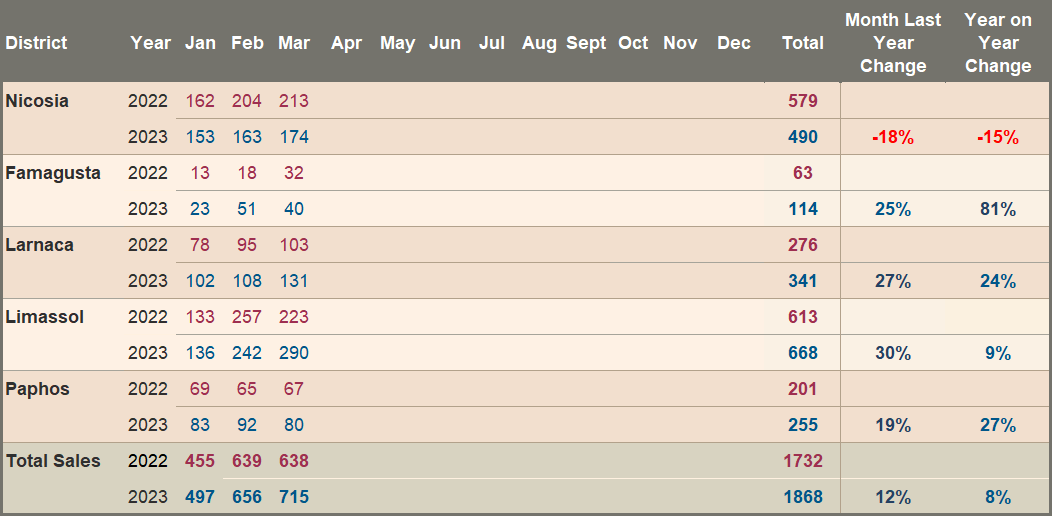
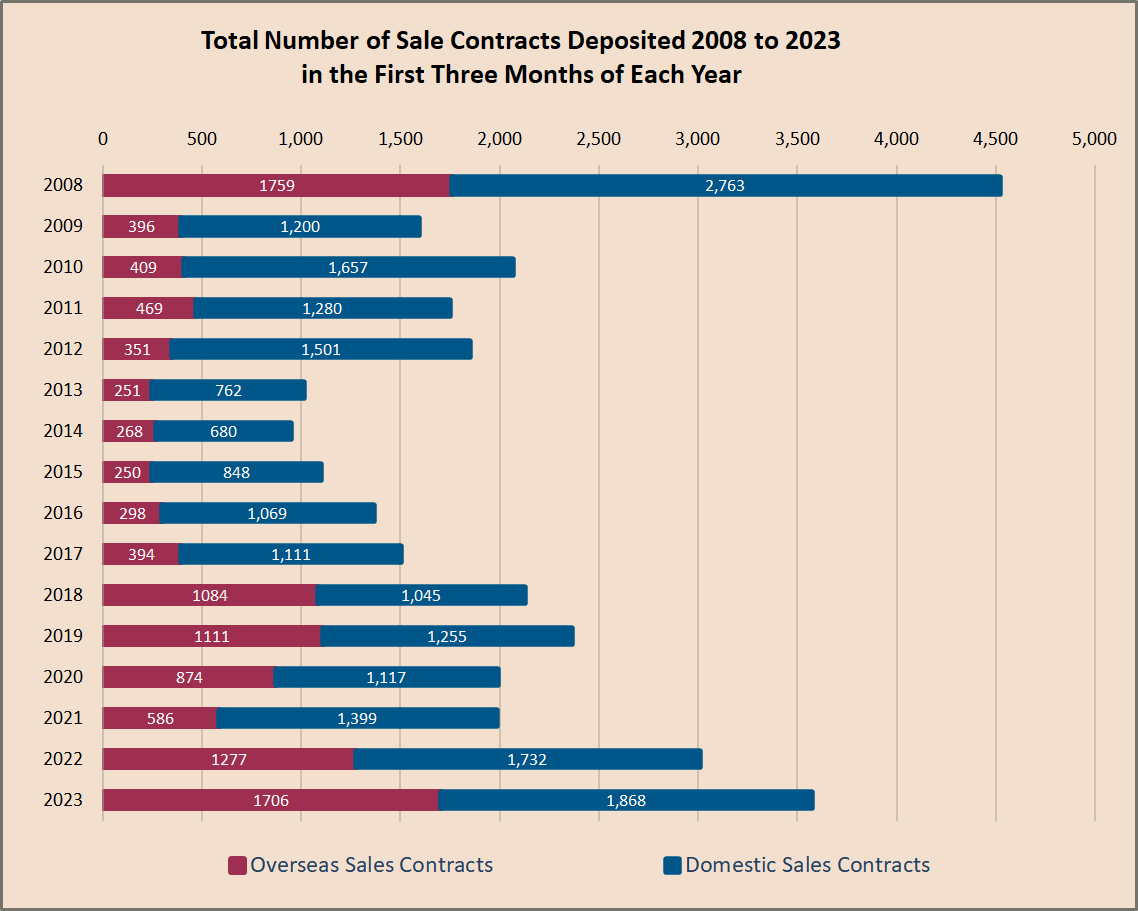
According to official statistics published by the Department of Lands & Surveys, sales to Cypriots in the first quarter this year rose 12% to reach 1,868, up from 1,732 in 2022 and 1,255 in 2019.

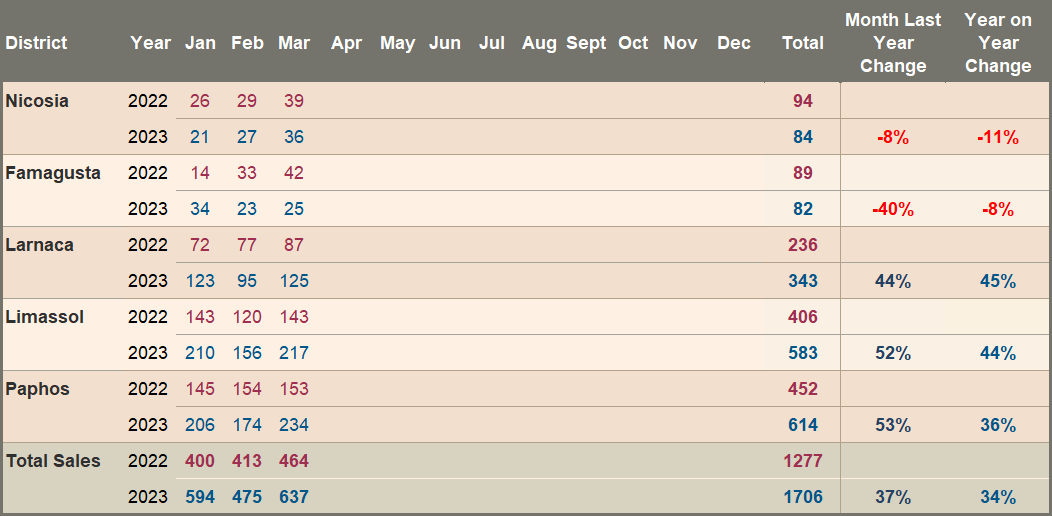
Sales to foreigners rose by 34% in the first quarter to reach 1,706, up from 1,277 in 2022 and 1,111 in 2019.

Real estate market segment analysis

Property sales to the domestic market

Sales to the domestic market in March rose 12% compared to March 2022 but with Nicosia recording a fall of 18%.

Limassol reported the greatest number of sales followed by Nicosia, Larnaca, Paphos and Famagusta.

Domestic Sale Transactions – 2022/2023 Comparison

Sales to the domestic market during the first quarter of 2023 stood at 1,868; a rise of 12% on the 1,732 achieved during the same period last year.

Property sales to overseas citizens

Sales to foreigners (non-Cypriots) rose 37% compared to March 2022 with sales rising in all districts with the exception of Famagusta and Nicosia, where they fell by 40% and 8% respectively.

Paphos achieved the greatest number of sales, followed by Limassol, Larnaca, Nicosia and Famagusta.

Property sales to the overseas market – 2022/2023 Comparison

Foreign sales during the first quarter of 2023 reached 1,706; a 34% increase on the 1,277 achieved in the same period last year.

Property sales to EU citizens

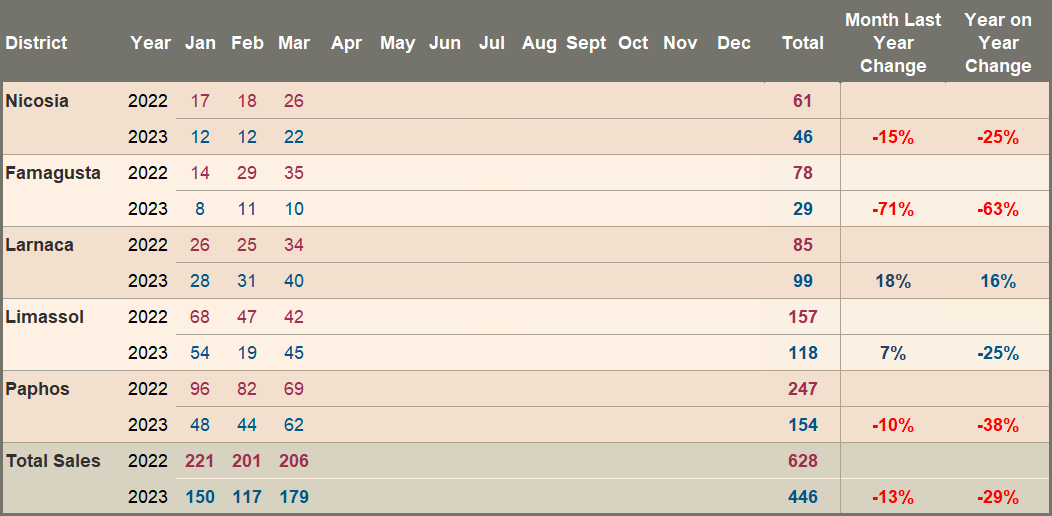
Sales to EU nationals fell for the fourth consecutive month in March and fell 17% compared to March 2022, with sales falling in all districts with the exception of Larnaca and Limassol.

Paphos achieved the greatest number of sales, followed by Limassol, Larnaca, Nicosia and Famagusta.

Overseas (EU) Sale Transactions – 2022/2023 Comparison

Sales to EU nationals during the first quarter of 2023 reached 446; a fall of 29% compared to the 628 achieved in the first quarter of last year.

Property sales to non-EU citizens

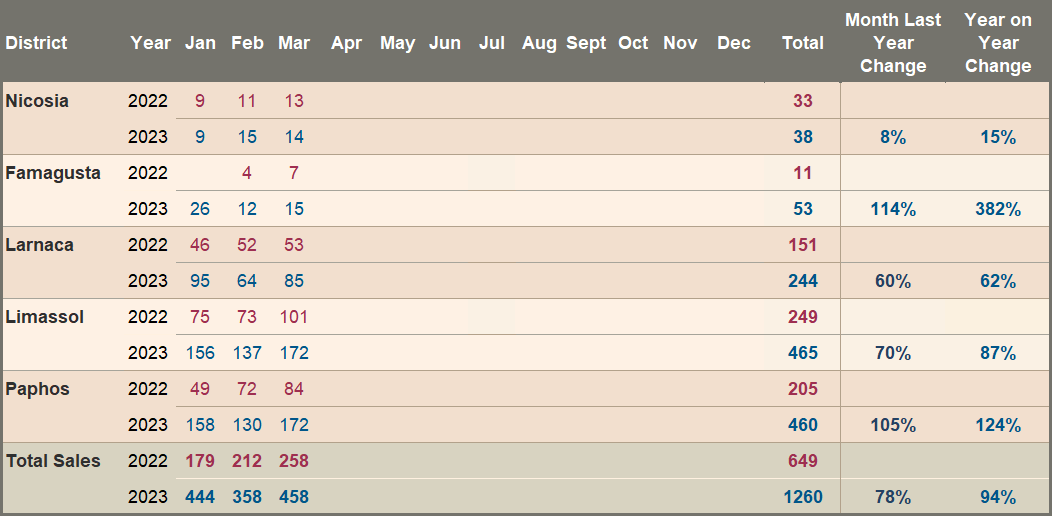
Sales to non-EU Nationals rose by 78% compared to March 2022, with sales rising in all districts.

Limassol and Paphos recorded the highest number of sales, followed by Larnaca, Famagusta and Nicosia.

Overseas (non-EU) Sale Transactions – 2022/2023 Comparison

Sales to non-EU nationals during the first quarter of 2023 reached 1,260; an increase of 94% compared to the 649 achieved in the first three months of last year.


Numerous foreclosure sales expected

Approximately 6,000 foreclosure sales per year are anticipated to take place in 2023 and 2024 due to the large number of properties that have accumulated that need to be disposed.

The COVID-19 pandemic and the subsequent suspension of divestments since 2020 have led to the creation of a considerable volume of properties for disposal that banks and credit purchase companies have on their balance sheets.

The credit purchase companies, in particular, are now managing the largest volume of non-performing loans, most of which are linked to real estate.

The borrowers have two options: either find a compromise solution and resume servicing their problem loans or let the banks and credit purchasing companies proceed with the liquidation-auction sales of the real estate linked to these problem loans.

Insiders predict that around 6,000 divestment procedures per year will take place in 2023 and 2024.

While the two major banks have a low percentage of problem loans on their balance sheets (around 3-4%), which is acceptable to European supervisors, smaller Cypriot banks have higher percentages. However, the absolute numbers of problem loans are not too concerning due to their small balance sheets.

As documented by the Central Bank of Cyprus, while addressing NPLs through instruments such as the sale of loans to Credit Acquisition Companies (CACs) has helped to correct the balance sheets of some credit institutions, these loans remain part of the private debt of the non-financial sector and continue to pose a challenge to the real economy.

Most of the properties that are now being auctioned off are those of the companies that bought loans from the banks over the last five years and set up companies on the island.

Regarding divestments, data recorded through electronic auctions shows that in 2020, there were 1,450 auctions.

The number increased to 3,000 sales in 2021 and reached 4,000 in 2022. Of these sales, 60% were for fields, 20% for apartments, 10% for land, and 5-8% for residential properties. In single-digit percentages, residential properties with shops, fields with buildings, shops, with empty residential properties, and land with buildings were also sold. However, only 10-15% of these sales were completed.

Over 80,000 loans

According to data from the Central Bank of Cyprus, the end of 2021 saw over 80,000 loans being managed by ECAs, with a maximum contractual balance of €19.2 billion. This figure does not include the €700 million worth of loans sold by Hellenic Bank to Pimco and Themis. If these are included, the total amount rises to €20 billion of loans held by credit purchasing companies.

However, the sector is highly concentrated, with the three largest Credit Acquisition Companies holding 80% of the total loans by value.

The loan portfolio breakdown shows that 50% of the total contractual balance of loans was in loans to individuals, 47% was in loans to non-financial corporations, and 3% was in other loans.

The value of collateral as a percentage of the loan portfolio was 52%, with primary residences accounting for 32% of total collateral and other real estate for 65%. Approximately 3% of the collateral was other.

The CBC notes that ECAs own a significant number of properties, acquired through the purchase of credit institutions’ portfolios or debt-to-property swaps between ECAs and borrowers.

5,679 properties in 2021

At the end of 2021, Credit Acquisition Companies (CACs) managed 5,679 properties worth a total of €978 million, with this number expected to grow in 2023 with the purchase of more loans.

According to data from the Central Bank of Cyprus, most of the properties held by CACs were residential plots, making up 29% of total properties as of December 31, 2021. Residential units accounted for 22%, followed by farmland at 21%, other properties at 19%, commercial properties at 7%, and commercial land at 2%.

CACs acquired 3,626 properties worth €584 million and sold 1,946 properties worth €320 million in 2021, either as part of the purchase of credit institutions’ portfolios or through debt-for-property swaps.

However, the rate of disposal is slower than the rate of acquisition, leading to a further accumulation of real estate on the balance sheets of the CACs.

In 2021, 1,503 properties with a total value of €248 million were acquired through the property divestment process, while 2,123 properties with a total value of €336 million were acquired through debt-for-property swaps.

Link to real estate

According to the Financial Stability Report, banks in Cyprus have a considerable amount of exposure to loans secured by real estate, which made up 59.7% of their total loan portfolio at the end of 2021, an increase from 58.8% in 2020.

At the same time, loans to households secured by residential real estate amounted to €8.1 billion, accounting for 29.8% of the total loan portfolio, a decrease from €8.8 billion and 30.3% at the end of 2020.

On the other hand, loans to non-financial corporations secured by commercial real estate amounted to €8.1 billion or 29.8% of the total loan portfolio, slightly down from €8.3 billion and 28.5% at the end of 2020.

Notably, as of the end of 2021, the loans to households were primarily related to the purchase of real estate, with 76.8% of them secured by residential real estate. Meanwhile, loans to non-financial corporations secured by commercial real estate represented 55.8% of all loans to non-financial corporations.

(This article first appeared in the printed edition of ‘Oikonomiki‘
and was translated from its Greek original)

Cyprus’ swimming pool saga continues

Cyprus’ long running swimming pool saga made headlines in the Cyprus Mail yesterday in an article “Swimming pool law damaging Cyprus property and tourism” by Beejay Browne.

Beejay reported that the Cyprus tourism and property market are being damaged by outdated and unworkable laws governing swimming pools, which have seen many complexes closing theirs over the last few years.

But the problem has worsened as it seems that privately-owned villas offered to holiday makers on Airbnb other online platforms are next to be targeted.

The problem is that under the provisions of present law, swimming pools that are shared by more than one family are considered as public swimming pools and must therefore comply with strict regulations including the provision of a lifeguard, separate male and female toilets, showers and footbaths.

As a consequence, those who have bought an apartment or a property in any other development with a shared swimming pool have to pay a significantly more in communal charges than those in complexes without pools. This makes buying a property in a complex with a shared swimming pool a much less attractive proposition.

This is how the Cyprus law relating to swimming pools currently stands:

Cyprus Law N.55(I)/92 paragraph 2 states that the term ‘public swimming pool’ also includes the swimming pools of buildings which are used by the owners of the units or their tenants.

Regulation Number 368/96 paragraph 47 (1) states that all the employees relating to the swimming pool have to obtain a health certificate, to be clean and to behave properly.

Regulation Number 368/96 paragraph 47(2) states that all the trained supervisors will be on duty during the operation and the use of the swimming pool. Their number is determined in accordance with the size of the swimming pool and the number of the persons usually using the swimming pool.

Regulation Number 368/96 paragraph 47 (2)(a)(i) states that for small swimming pools at least one trained supervisor is necessary to be appointed.

Regulation Number 368/96 Part VII paragraph 53 states that a license is needed for the operation of a swimming pool by applying to the relevant authority. The last decision is made by the Minister.

The swimming pool saga to date

In November 2005 Lakis Tofarides, the then Chairman of the Land and Building Developers Association, suggested the following measures should be taken to alleviate the situation.

“The swimming pools in apartment buildings and complexes to be considered private (not public) because the residents and their guests use them. At the same time, residents, in proportion to the number of persons living on the building/complex, could be trained as lifeguards. This means that if there are large families on the building, the number of persons to be trained would be decided accordingly”.

“As far as public pools are concerned, the number of supervisory staff needed (lifeguards, etc.) should be reduced”.

In June 2007, Denis O’Hare, Linda LeBlanc and I met with the Permanent Secretary of the Interior Ministry, Dr Lazaros Savvides, and discussed the problems of the swimming pool laws with him.

In August 2008 it was reported that the Cyprus Government was looking to change the swimming pool laws. However, this was yet another vacuous announcement.

In September 2008 the European Committee for Standardization approved two standards relating to swimming pools:

Under these European Standards, which Cyprus should have adopted by March 2009, complexes that share a pool for the use of the property owners, their families and guests are classed as a Type 3 swimming pool, making it subject to different standards than a public swimming pool and would therefore not require lifeguards, etc.

The standard defines ‘public’ pools as “open to everyone or to a defined group of users, not designated solely for the owner’s/proprietor’s/operator’s family and guests independently from paying an entrance fee.”

In 2011 Arlene McCarthy MEP questioned Cyprus swimming pool legal rulings in the European Commission after Paphos municipality took legal action against one of her constituents and others for not having a swimming pool licence for the pool in their holiday complex.

In 2012 a group of residents living at a complex in Kato Paphos had their passports confiscated temporarily for failing to comply with swimming pool regulations.

In January 2015 Phileleftheros reported that Interior Ministry is proposing a new law that would classify swimming pools into five different categories. A main concern is to ensure proper regulation to prevent accidental drownings.

The law will make a distinction between public and private swimming pools, and each category will have its own criteria for construction, operation and inspection.

In December 2016 Phileleftheros reported that an announcement from the Interior Ministry advised that a bill to amend the existing legal framework and regulation of swimming pools has been drafted and forwarded to the Attorney General for legal vetting.

However, during the vetting process it was identified that some of the provisions in the draft bill already existed the Streets and Buildings Law and Regulations; as a consequence, the draft bill was returned to the Interior Ministry for further work.

According to the ministry’s announcement, two pieces of legislation will cover:

  • Issues concerning the design and construction of public and private swimming pools will be included in the relevant legislation under the Streets and Buildings law. (A working document will shortly be issued for public consultation.)
  • Matters relating to the licensing of swimming pools will be included in separate legislation.

In 2018 a petition was launched calling on the Minister of Interior to change the law. However, the petition has yet to garner the 8,000 signatures required to get it before parliament.

Perhaps the government’s reluctance to make common-sense changes to the law is due to politically powerful individuals and/or organisations with vested interests putting pressure on government to maintain the status quo?

Apartments are an endangered species

Apartments in the Cyprus coastal town of Limassol are now an endangered species as demand has outstripped supply with prices rocketing compared to previous years, pricing Cypriots out of the market.

The demand comes mainly from Ukrainians seeking sanctuary from Vladimir Putin’s war in their country and also Russians who are leaving their country.

(Eurostat reports that in February 2023, Cyprus had the highest ratio of Ukrainian citizens granted temporary protection per thousand people at 1.1, followed by Czechia at 0.9.)

Speaking to the Greek language Phileleftheros the president of the Cyprus Property Valuers Association, Polis Kourousides, said available apartments are now an endangered species as their prices have tripled compared to previous years.

As Cypriots are paid considerably less than Ukrainians and Russians, they cannot afford to pay the exorbitant rents demanded leaving foreigners to grab what’s available.

Mr Kourousides doesn’t envisage a fall in apartment prices in Limassol for at least a year as new buildings and construction projects have yet to be completed. He said that “If the high demand in Limassol is not met with new buildings and newly built apartments to meet housing needs, apartment prices will increase even more.”

In addition to the rapid increases in apartment prices, there is also a large demand for property in Limassol, Larnaca and Paphos, which is mainly being driven by foreigners. There has been a great deal of interest by Israelis, who prefer to buy in Larnaca and Limassol, while Paphos is also showing strong interest from Britons.

Mr Kourousides noted that Britons tend to invest in smaller resale house in Paphos, while Ukrainians and Russians tend to buy or rent more expensive luxury houses and apartments. Israelis, on the other hand, tend to invest in land and build property. But a portion of them choose to buy homes in less densely populated areas of Limassol such as Germasogeia and Agios Tychonas.

Second highest March sales on record

March saw the second highest number of property sales in the month since records began in 2000 according to official statistics from the Department of Lands and Surveys.

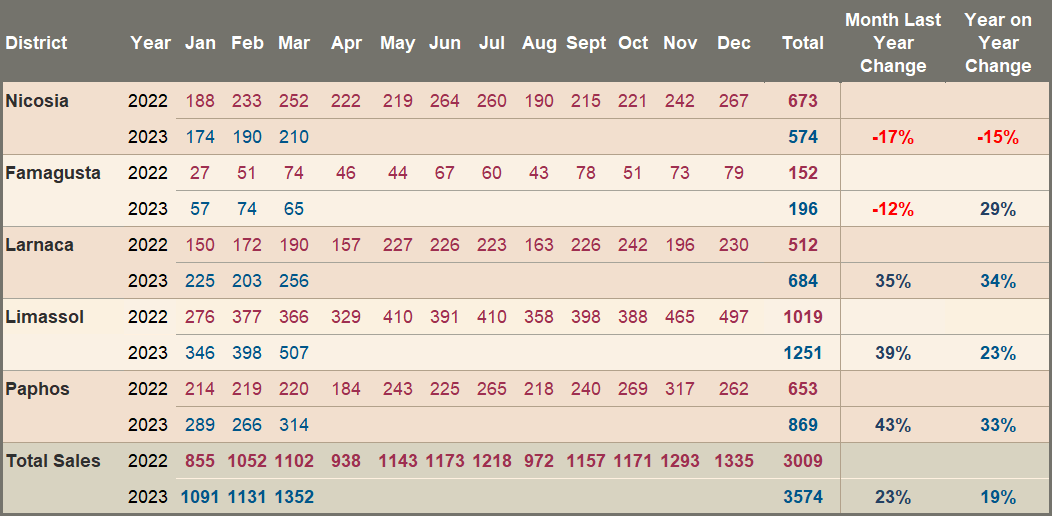
The total number of property sales (as measured by the number of contracts deposited at Land Registry offices) in March 2023 reached 1,352 – an increase of 23% compared to March 2022.

This is the second highest March figure since records began; only surpassed at the height of the boom in March 2007 when 1,903 sales contracts were deposited.

Although sales in Nicosia and Larnaca fell by 17% and 12% respectively compared to March 2022, they rose in the remaining three districts.

In percentage terms, Paphos led the way followed by Limassol and Larnaca with the highest number (507) recorded in Limassol.

Pancyprian property sales
Total Property Sale Transactions – 2022/2023 Comparison

Year to date property sales

Sales during the first quarter of 2023 reached 3,574; an increase of 19% compared to the first quarter of 2022. With the exception of Nicosia, sales have risen in all districts.