Lawmakers again discuss reduced VAT on homes

Lawmakers on Monday discussed for the umpteenth time the matter of reduced VAT on homes, with reports suggesting the government will go back to the drawing board and present yet another bill to parliament right after the Easter holiday.

The discussion at the House finance committee was held behind closed doors.

Media reports said the government’s new proposal will involve raising the value of residences eligible for the discounted 5 per cent VAT. The normal rate is 19 per cent.

For houses, the values making them eligible for the lower VAT would be increased to just under €400,000; and for apartments to just under €230,000.

MPs later told media that the government would bring the re-revised text of the bill to parliament after the Easter holiday. If it doesn’t satisfy the parties, they reserve the right to insert their own amendments before tabling the legislation to the plenum for a vote.

This is happening against the backdrop of threatened sanctions from the European Commission. Brussels has initiated infringement proceedings against Cyprus, but it has yet to issue a reasoned opinion.

A reasoned opinion is the second stage – a formal request to a national government to comply with EU law. If a country still doesn’t comply within a specified timeframe – usually two months – the Commission may decide to refer the matter to the European Court of Justice. In practice, most cases are settled before being referred to the court.

In the worst-case scenario, Brussels can impose a fine on a country for non-compliance.

It’s understood the infringement proceedings were first launched in the summer of 2021.

Brussels contends that Cyprus does not properly apply VAT rules for homes purchased or built here.

VAT directive 2017/541 allows member states to apply a lower rate for first homes as part of social policy. But the broad interpretation of the Cyprus provision apparently exceeds the social policy aim stated in the directive, for such an exemption.

The policy was also flagged when it emerged that recipients of the ‘golden passports’ scheme – who invested in property in exchange for citizenship – had likewise benefited from the lower VAT rate.

Earlier, the government had come up with a ‘sweet spot’ – a bill amending the levying of the reduced 5 per cent VAT rate for homes.

Under that government proposal, the reduced VAT rate would apply to the first 170 square metres of a home of a total surface area of 220 square metres and with a property value up to €350,000. For apartments, the lower rate would apply to the first 90 square metres of a total surface area of 110 square metres and with a property value up to €200,000. In addition, a special clause stipulates that the total surface area criterion does not apply to persons with a disability.

However, the idea met with stiff resistance from several organisations – the Employers and Industrialists Federation, the Chamber of Commerce, the Cyprus Land & Property Owners Organisation and the Property Valuers Association.

They instead suggested raising the value of eligible properties – both homes and apartments. And they pointed out that with the current inflation and increasing cost of building materials, no one would find a home or apartment with the square metres and value cited in the bill – making the legislation a damp squib.

As it currently stands, the law provides for the application of a lower VAT rate of 5 per cent for the first 200 square metres of primary residences, without any qualifications. This lower rate is applied irrespective of the income, property or economic conditions of the person or his family residing in the house. Moreover, the total surface area of the home bears no relevance.

Properties worth millions registered ‘zero value’

Expensive properties are sold for millions of euros but are recorded as having zero value with the Land Registry, meaning the state is missing out on sizeable tax revenues, according to opposition party AKEL.

Citing a 400-page document, AKEL MP Andreas Pasiourtides told the House’s Interior Committee that hundreds of properties appear to have a total value of just €22,000.

Pasiourtides claimed the list includes hotels, shops, and apartment buildings presented in the general evaluation of the DLS as having zero value.

He made special reference to a Larnaca hotel which sold for €8.5 million, but according to the Land Registry, it had no value.

He claimed that many real estate in commercial cores of cities were also recently sold for millions while appearing to be worthless.

Pasiourtides argued that such sales – officially listed as “zero value” – might lead to a significant loss of state revenue through missed taxes.

He said neither local authorities nor sewerage boards have the right property values to be able to tax property owners.

Also, the Inland Revenue Department does not have the market values at the time of the transaction, so that it can compare and impose the Capital Gains Tax.

The AKEL MP asked the Land Registry and the authorities involved to identify these properties, appraise them, and assign their true value so the state does not lose more revenue.

Responding to the MP’s claims, Land Registry official Varnavas Pashoulis told the House that although there may be isolated cases of real estate being valued at zero, their numbers are small and “definitely not in the thousands”.

He explained that the legislation stipulates that estimating properties is carried out every three years for equality regarding new developments.

Pashoulis argued they had been idle properties since 1980, meaning that no transfer, sale, or other activity has been carried out.

“That means their value is not updated.”

He said the process is completely transparent, and the value of properties is available to the public online.

Chair of the House Interior Committee Aristos Damianou, also an AKEL MP, asked for “zero value” cases to be submitted to parliament for review.

Land Registry portal offline until mid-April

The Land Registry’s online platform is still knocked out, following the cyber-attack some ten days ago, with officials saying it may take several weeks before technicians can get the vital service back online.

In comments to the Financial Mirror, the head of the island’s Land Registry, Elikkos Elia, said they hoped to see the online platform up and running in the first ten days of April.

“At best, we expect to see the platform coming back online by the end of the first working week of April. But even that could be farfetched, as the damage to the platform will need weeks to repair,” said Elia.

The Land Registry’s web portal was knocked offline on March 9, while it was forced to shut its offices the following day, after an unprecedented hack attack on its webpage and systems.

A week from the attack, technicians were able to bring the internal systems online, allowing for transactions such as property transfers, mortgages and the submission of encumbrances to take place physically at the Registry’s district offices.

Map browsing

The online platform offers prospect buyers and developers access to map browsing and navigation services, electronic applications for property demarcation and issuance of copies of title deeds and studies.

According to Elia, evidence points to a hack attack with some sort of ransomware.

“The assailants have targeted the lung of the Cypriot economy with their attack on the Land Registry,” commented Elia marking the seriousness of the matter.

“Essentially, the operation of this vital sector of the economy, worth billions of euros, was suspended,” he said.

Asked if any data regarding properties, or transactions have been lost, Elia said that technicians say that findings so far support that nothing has been lost.

“We cannot be 100% sure that no permanent damage has been inflicted, but the fact that we have not encountered anything missing, and we are able to carry out daily tasks is encouraging,” he said.

Elia added that the Registry’s employees have been putting in extra efforts to cater to a large number of transactions and appointments which were postponed following the hack attack.

Structural Integrity Certificates are essential

0

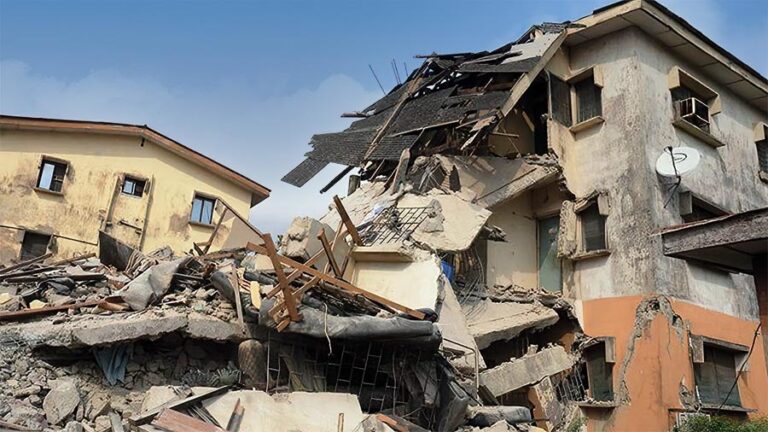
The recent earthquakes in neighbouring countries, as well as the aftershocks, felt in Cyprus, have brought to the forefront what we have been saying for years: the need to check the suitability of all our buildings on a regular basis.

It is encouraging that legislation is being promoted that will require periodic building inspections and the issuance of Certificates of Structural Integrity that will be valid for a fixed period of time. As I understand it, the period of time will be determined by a number of factors, including the type of construction, the standards to which it was designed, the date of construction, and possibly other important parameters that we will not discuss.

The following steps will be determined by the primary structural integrity check. If it passes the inspection, the certificate is issued and the next inspection date is set. If it fails the inspection, the next steps are determined to make the building structurally sound.

In other words, a secondary – possibly tertiary – structural integrity check will be performed, and appropriate repairs will be made based on the findings. Once the repairs have been completed and certified, the procedure is repeated by scheduling a new primary inspection for a later date, and so on.

Many describe the process as similar to that of the car MOT. We strongly agree. Those who find it difficult to comprehend may also consider colonoscopy procedures in humans, but for buildings. And that pretty well describes the process!

I personally haven’t seen what the bill includes, but I would like it to first include all kinds of buildings – public and private where people live, work and visit. So from single-family homes to high-rise buildings, shopping malls, hotels, etc. However, some exemptions in the first stage may be made such as agricultural and livestock buildings.

Beyond that, the law should specify exactly what is controlled at each level, who controls it, and how to ensure that it is done correctly. As a result, a record of surveyors with dates and times of building inspections, as well as inspection sheets with all findings, including observations, should be kept. The more stringent things are at this point, the more pressure there is on the end recipients for compliance, who are none other than the owners.

I will then restate a few points I have previously made in public statements that will assist in maintaining the building stock, such as:

  • That the status of management committees be raised. And the way to do so is to improve and modernize commonhold building legislation.
  • The establishment of a permanent maintenance fund should be formalized. Based on this, each owner will be required to pay an amount to be saved for maintenance purposes in addition to the annual common charges.
  • To hear cases of minor disputes between management committees and owners, a special court or a body with quasi-judicial powers should be established. This body’s decisions should be binding and enforceable and should be issued within a few weeks. A short period of compliance, for example, would be granted, or a special note (MEMO) would be added to the title deed. In addition, if the property is rented and the owner fails to pay the fees, the body should order the tenant to pay the fee to the management committee until the amount owed is paid.
  • When a unit is sold or transferred to the complex, the Land Registry must obtain permission from the complex’s management committee before the transfer can be completed. This will prevent owners from going into debt, selling and disappearing, and the new owner refusing to pay what the previous owner owed.
  • Complex maintenance for structural and energy upgrades should be subject to a 5% VAT reduction because it is an investment with a direct impact on society’s safety as well as the aesthetic and environmental upgrading of the built environment.

With the adoption of the Building Certificate of Structural Integrity, I am confident that the market will self-regulate, and it will only be a matter of time before clauses requiring the production of such a certificate are incorporated into both tenancy agreements and sales documents for used buildings, putting indirect and direct pressure on building maintenance.

[This article was translated from its Greek original and was first published in
Kathimerini‘s printed Sunday edition]

Construction material prices hit new high

0

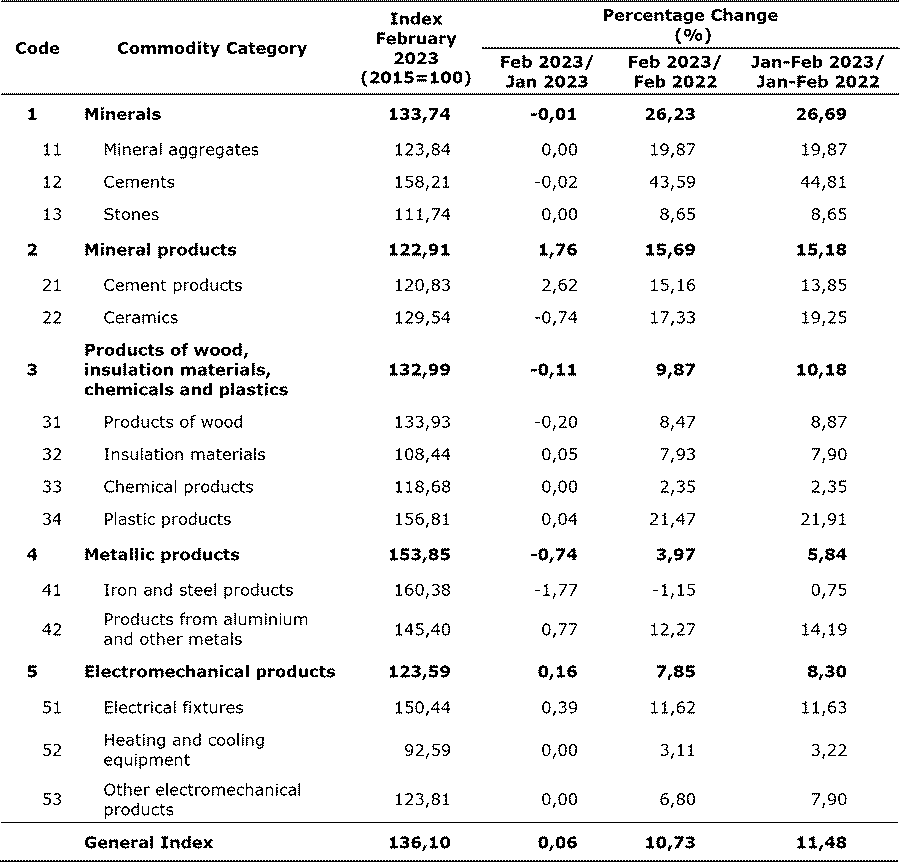
The price index of construction materials rose 10.73 per cent in February on an annual basis and increased by 0.06 per cent compared with January according to the Cyprus Statistical Service.

Compared to February 2022, the Cyprus Statistical Service reports price rises in metallic products of 3.97%, minerals 15.69%, products of wood, insulation materials, chemicals and plastics 9.87%, mineral products 15.69% and electromechanical products 7.85%.

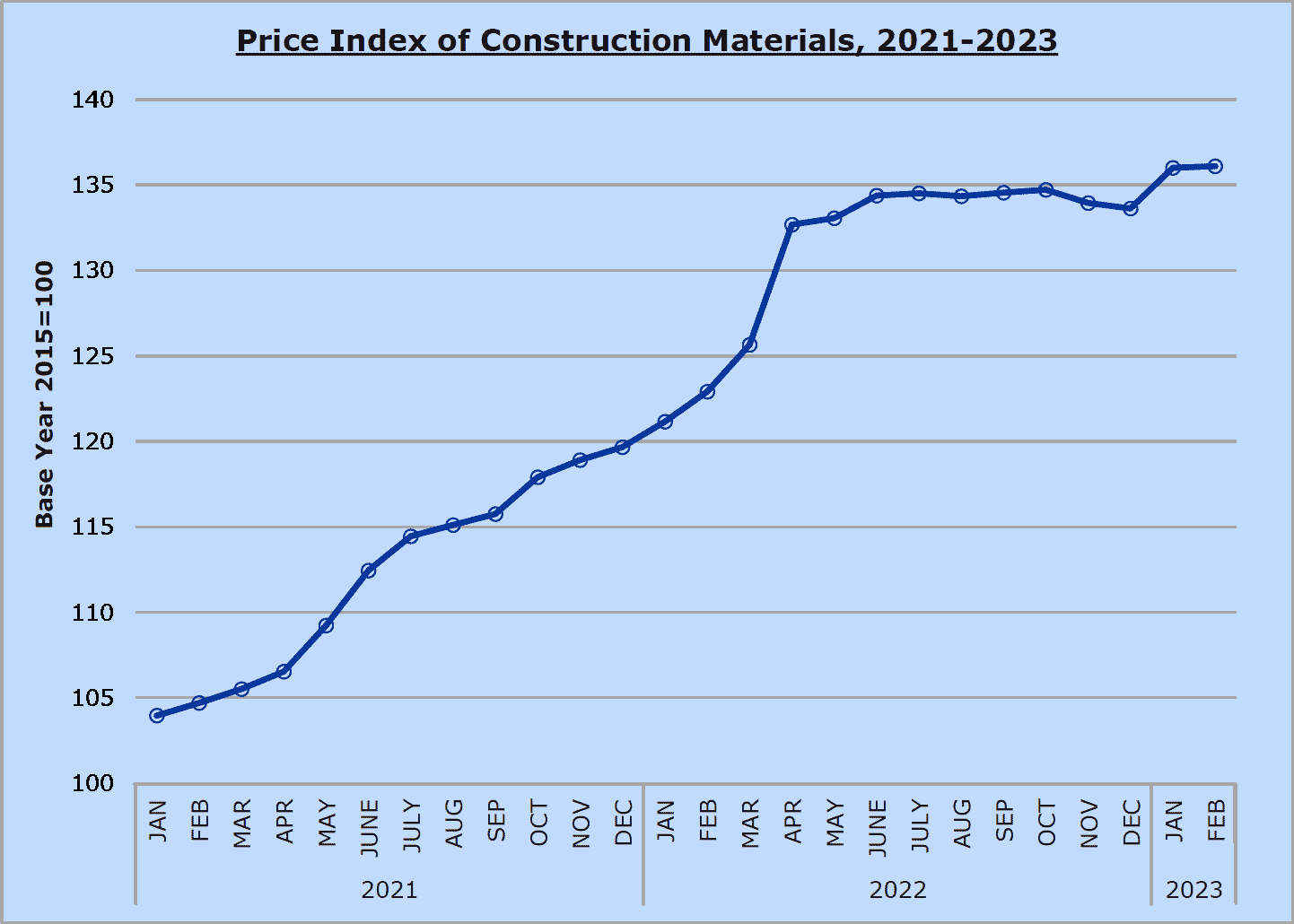
The index, which rose to 136.10 in February, is the highest on record since 2006 when the Statistical Service started to record the data.

The construction material price index has risen significantly over the past three years due to the high demand following the Covid pandemic, Russia’s war in Ukraine, China’s strict Covid lockdown policy that ended earlier this year and rampant inflation.

Cyprus construction material price index

price chart

Sales to non-EU citizens doubles

Property sales to non-EU citizens more than doubled in the first two months of 2023 compared to the same period in 2022 according to official figures from the Department of Lands and Surveys.

Speaking at the opening of the 5th Property Show, last Friday evening in Nicosia, head of the Department Elikkos Elia noted that non-EU citizens from Russia and the UK were the two largest groups of foreign nationals buying property on the island.

However, the sales figures for EU citizens went in the opposite directing with numbers falling in the first two months.

As we reported earlier, the total number of property sales in February (as measured by the number of contracts deposited at Land Registry offices) reached 1,131; an 8% increase in the number deposited in February 2022 and the highest number on record since 2008.

Market segment analysis

Property sales to the domestic market

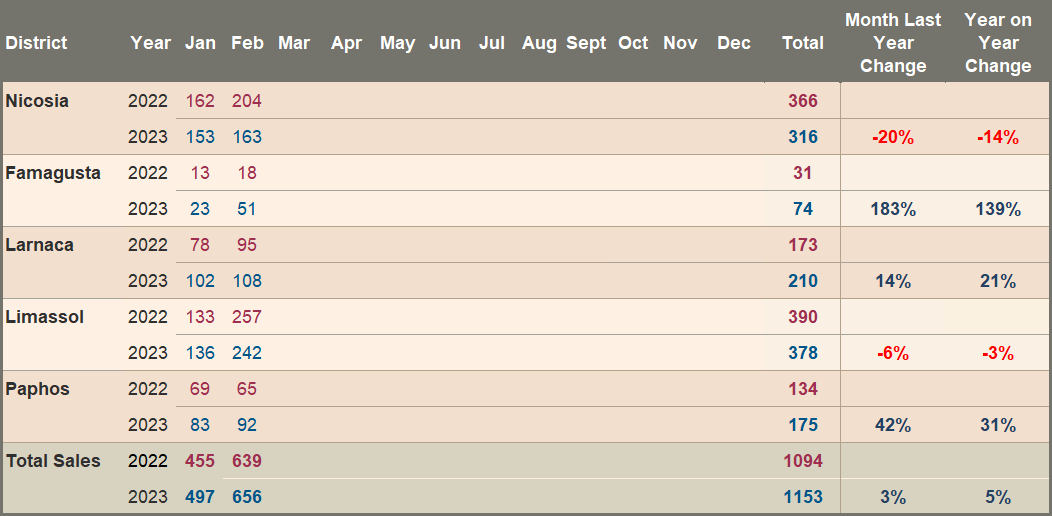
Real estate sales to the domestic market in February rose 3% compared to February 2022 but with Nicosia and Limassol reporting falls of 20% and 6% respectively.

Limassol saw the greatest number of sales followed by Nicosia, Larnaca, Paphos and Famagusta.

Domestic sales
Domestic Sale Transactions – 2022/2023 Comparison

Sales to the domestic market during the first two months of 2023 stood at 1,153; a rise of 5% on the 1,094 achieved during the same period last year.

Property sales to overseas citizens

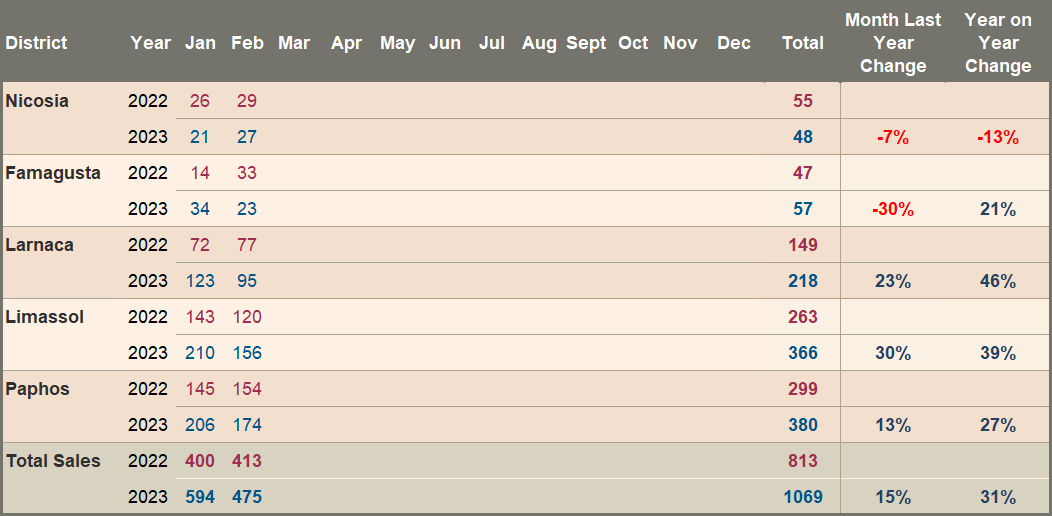
Sales to foreigners (non-Cypriots) were up 69% compared to February 2022 with sales rising in all districts with the exception of Famagusta and Nicosia, where they fell by 30% and 7% respectively

Paphos achieved the greatest number of sales, followed by Limassol, Larnaca, Nicosia and Famagusta.

Property sales to the foreign citizens
Property sales to the overseas market – 2022/2023 Comparison

Foreign real estate sales during the first two months of 2023 reached 1,069; a 31% increase on the 813 achieved in the same period last year.

Property sales to EU citizens

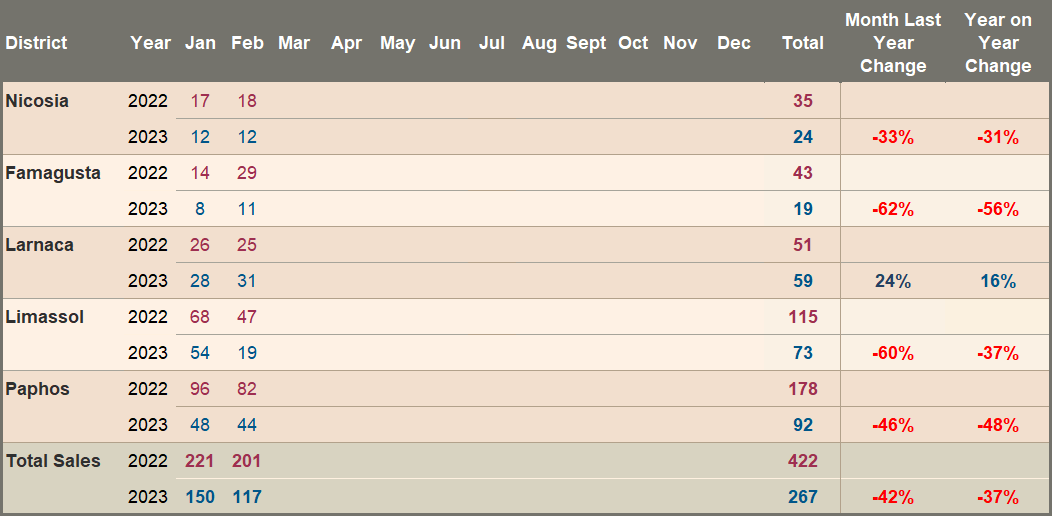
Sales to EU nationals fell 42% compared to February 2022, with sales falling in all districts with the exception of Larnaca.

Paphos achieved the greatest number of sales, followed by Larnaca, Limassol, Nicosia and Famagusta.

Overseas (EU) Sale Transactions – 2022/2023 Comparison

Sales to EU nationals during the first two months of 2023 reached 267; a fall of 37% compared to the 422 achieved in the first two months of last year.

Property sales to non-EU citizens

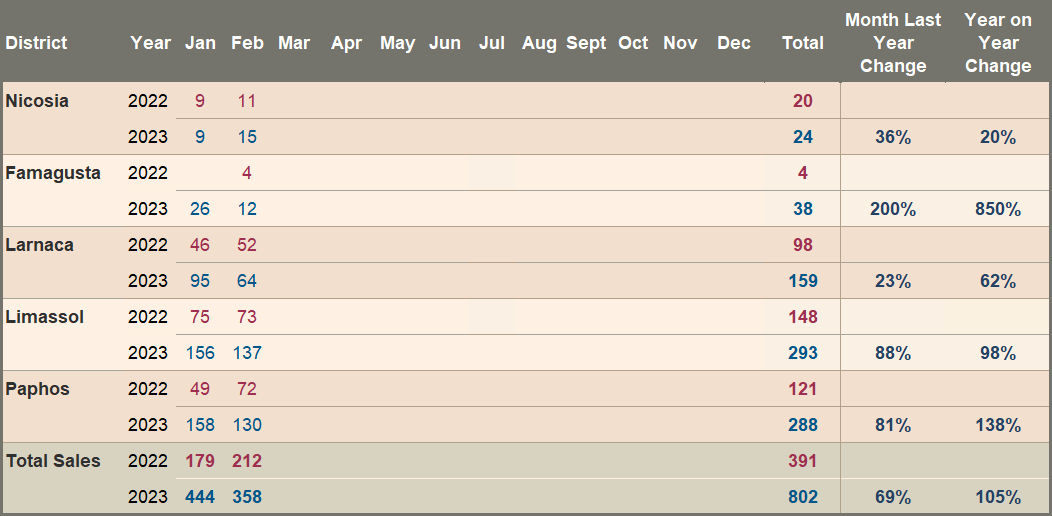
Sales to non-EU Nationals rose by 69% compared to February 2022, with sales rising in all districts.

Limassol recorded the highest number of sales, followed by Paphos, Larnaca, Nicosia and Famagusta.

Sales to non-EU citizens
Overseas (non-EU) Sale Transactions – 2022/2023 Comparison

Sales to non-EU nationals during the first two months of 2023 reached 802, more than double the number (391) achieved in the first two months of last year.